Hematite is one of the most important iron ore minerals. It is the main raw material for steelmaking around the world. But hematite is not easy to process. Unlike magnetite, hematite is weakly magnetic. This means you cannot simply use a simple magnetic separator to get a high-grade concentrate. You need to choose the right equipment based on your ore characteristics. This article explains how to select the best hematite iron ore processing equipment for your project.
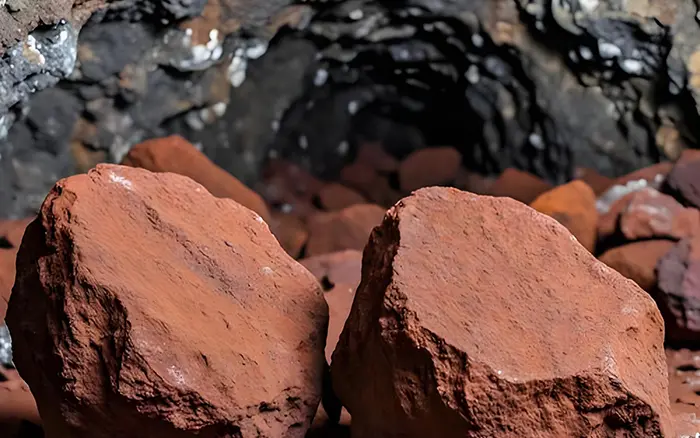
Hematite Ore Characteristics That Affect Equipment Choice
Before you pick any equipment, you need to understand your ore. Hematite has several key properties that affect processing.
Hardness. Hematite has a Mohs hardness of about 6. It is hard enough to require robust crushing equipment.
Weak magnetism. Hematite is weakly magnetic. Ordinary magnetic separators cannot capture it effectively. You need high-intensity magnetic separators or a combination of methods.
Fine liberation size. Hematite often needs to be ground very fine to liberate iron particles from gangue minerals like quartz.
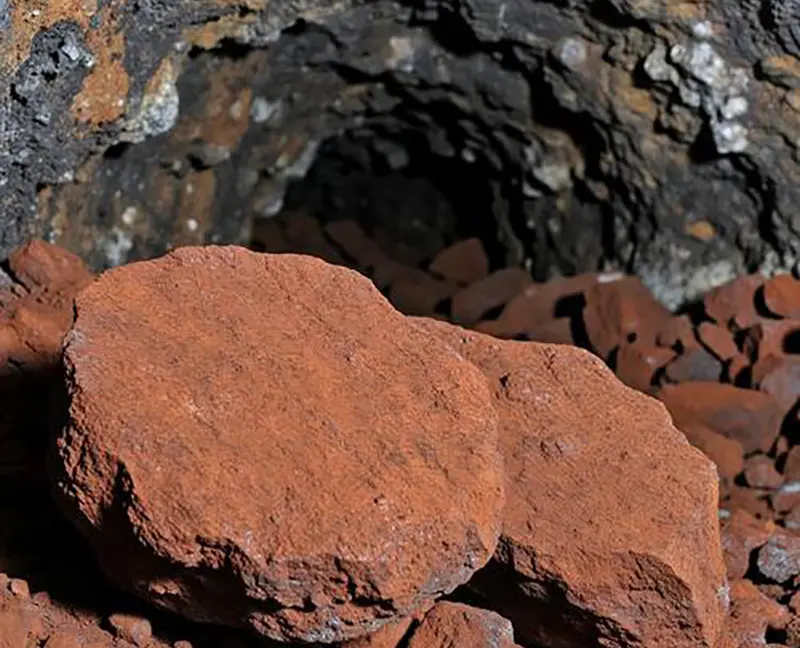
Variety of forms. Hematite appears in many forms: specular, earthy, oolitic, and more. Each type behaves differently in processing.
Because of these characteristics, you should always do a laboratory test before selecting equipment. Different ores require different processing flowsheets. Skip this step, and you risk buying the wrong machines.
Step 1: Crushing and Screening Equipment
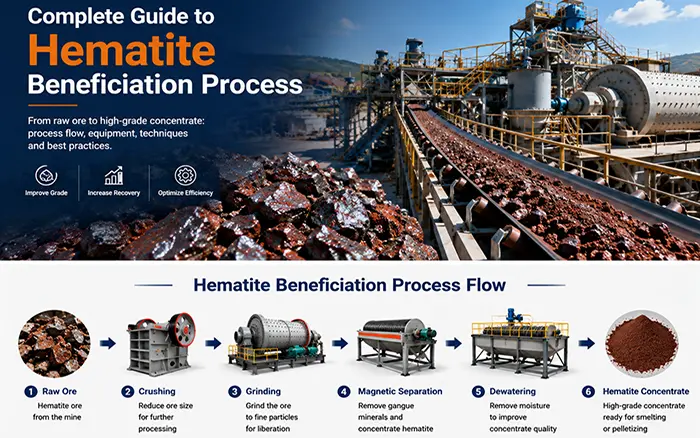
The first step in hematite processing is reducing the ore size. Hematite ore is mined in large blocks. These blocks must be crushed to a manageable size before grinding.
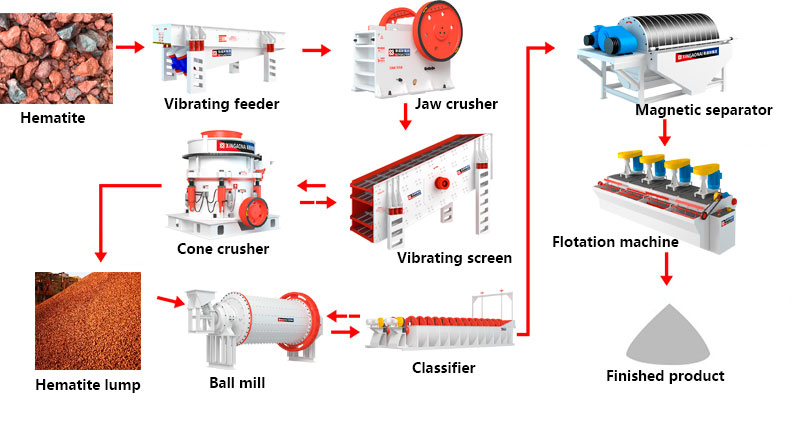
Most hematite processing plants use a three-stage crushing circuit: coarse crushing, secondary crushing, and fine crushing. A typical hematite crushing flowsheet uses jaw crushers for coarse crushing, cone crushers for secondary and fine crushing, and vibrating screens to control product size.
Here is the typical crushing and screening equipment list:
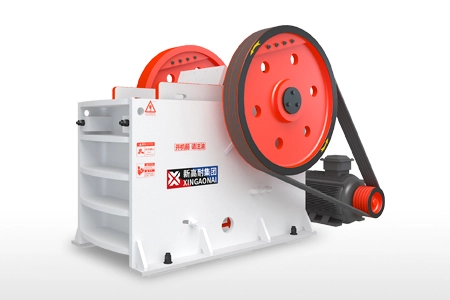
Jaw crusher: Used for coarse crushing. It takes run-of-mine ore from the pit and reduces it to a size suitable for secondary crushing.
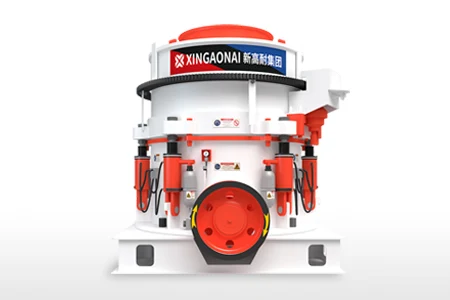
Cone crusher: Used for secondary and fine crushing. It produces a smaller, more uniform product.
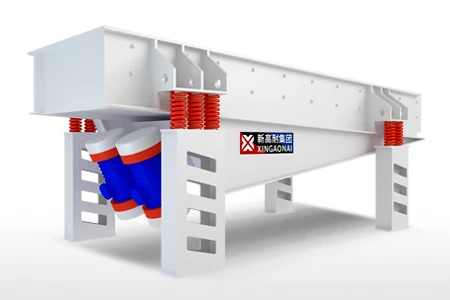
Vibrating screen: Placed after each crushing stage to separate material by size. Oversized material is returned to the crusher for another pass. Undersized material moves on to the next stage.
Feeder (vibrating or belt feeder): Delivers ore evenly to the crusher to prevent blockages and optimize crusher performance.
For some plants, three-stage crushing with a closed circuit is common. The primary jaw crusher reduces ore to about 150–200 mm. Secondary and tertiary cone crushers further reduce the size to 8–25 mm before grinding.
If your hematite ore contains a lot of fines, you can install a grizzly screen or vibrating screen before the crusher. Removing fines early protects the crusher from unnecessary wear and improves overall efficiency.
Step 2: Grinding and Classification Equipment
After crushing, the ore must be ground to a fine powder. This step liberates the hematite particles from the surrounding gangue minerals.
Hematite often requires fine grinding. Some ores must be ground to -200 mesh (74 microns) or finer to achieve good liberation. You need to match the grinding equipment to your liberation size.
The most common hematite grinding equipment includes:
Ball mill (grid type or overflow type): The standard choice for hematite grinding. Grid-type ball mills are used for coarse grinding in the first stage. Overflow ball mills are used for fine grinding in the second stage. Energy-saving ball mills use peripheral roller drive to reduce power consumption.
Rod mill: Sometimes used in the first grinding stage. Rod mills produce a more uniform product with fewer fines.
Hydrocyclone: Used in closed circuit with the ball mill. It classifies the ground material, sending fine particles to the next stage and returning coarse particles to the mill for regrinding.
Spiral classifier: An alternative to hydrocyclones. It is simpler but less efficient for fine classification.
Autogenous mill (AG mill) or semi-autogenous mill (SAG mill): Used in very large plants. These mills use the ore itself as grinding media, reducing steel consumption.
For most hematite beneficiation plants, a two-stage grinding circuit works best. The first stage uses a grid-type ball mill in open circuit. The second stage uses an overflow ball mill in closed circuit with a hydrocyclone.
Step 3: Separation Equipment
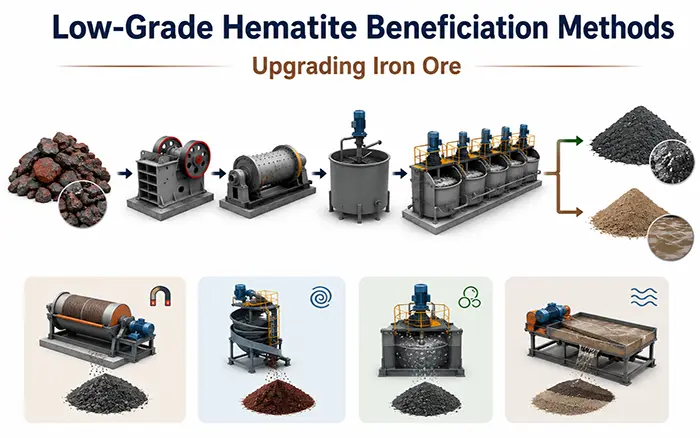
This is the heart of your processing plant. Separation equipment actually removes the gangue and upgrades the iron content. Because hematite is weakly magnetic and often fine-grained, you rarely use a single separation method. Most plants use a combination of magnetic separation, gravity separation, and flotation.
Magnetic Separation Equipment
Hematite is weakly magnetic. You cannot use standard low-intensity magnetic separators (LIMS), which are designed for magnetite. Instead, you need high-intensity magnetic separators.
The most common magnetic separation equipment for hematite includes:
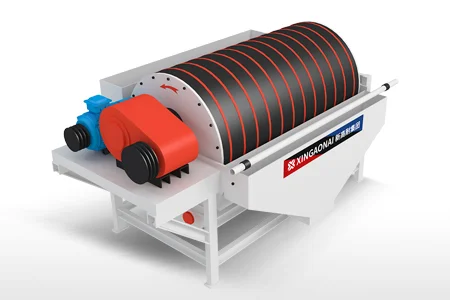
Wet High-Intensity Magnetic Separator (WHIMS): This is the key machine for hematite. WHIMS uses a high-gradient magnetic field to capture weakly magnetic hematite particles. It handles fine particles down to 0.1 mm and works in a wet slurry. WHIMS is widely used in hematite, limonite, and siderite processing. It can recover fine hematite that gravity separation cannot capture.
Vertical ring high-gradient magnetic separator (LHGC): A type of WHIMS with a vertical ring design. It is known for high capacity, no clogging, and good performance on even weakly magnetic materials.
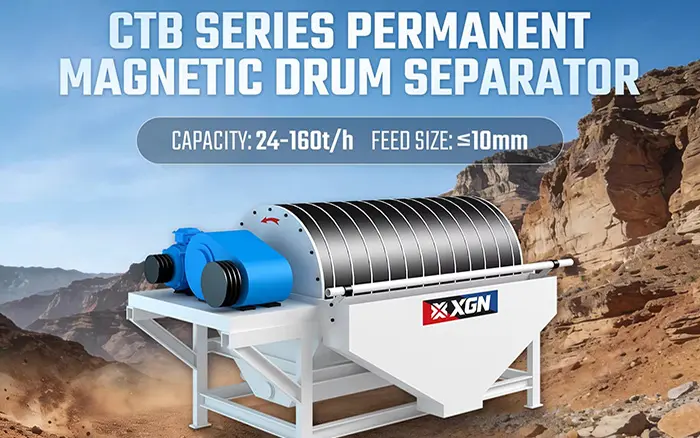
Permanent magnetic drum separator (low-intensity): Used to remove magnetite or magnetic contaminants before high-intensity separation.
Many hematite plants use a weak magnetic separation + strong magnetic separation process. Weak magnetic separation removes any magnetite or magnetic iron. Then strong magnetic separation (WHIMS) captures the hematite.
Gravity Separation Equipment
Gravity separation uses the difference in specific gravity between hematite (density about 5.3) and gangue minerals (density about 2.6–2.8). Hematite is much heavier, so it settles faster in water.
Gravity separation works best for coarse hematite particles. For fine particles, gravity efficiency drops.
Common gravity separation equipment for hematite includes:
Jig machine: Used for coarse hematite with particle size between 30 mm and 0.5 mm. Jigs are simple to operate and have high capacity. They are often used in the roughing stage.
Spiral chute: Used for medium to fine hematite (3 mm to 0.074 mm). Spiral chutes are low-cost and require no power. They are widely used in hematite gravity circuits.
Shaking table: Used for fine hematite (2 mm to 0.037 mm). Shaking tables give a very clean separation but have lower capacity. They are often used for cleaning concentrates.
Centrifugal concentrator: Used for very fine hematite (below 0.1 mm). It uses centrifugal force to enhance gravity separation.
A typical gravity separation flowsheet for hematite uses spirals for roughing and cleaning, with jigs for coarse particles and shaking tables for final cleaning.
Flotation Equipment
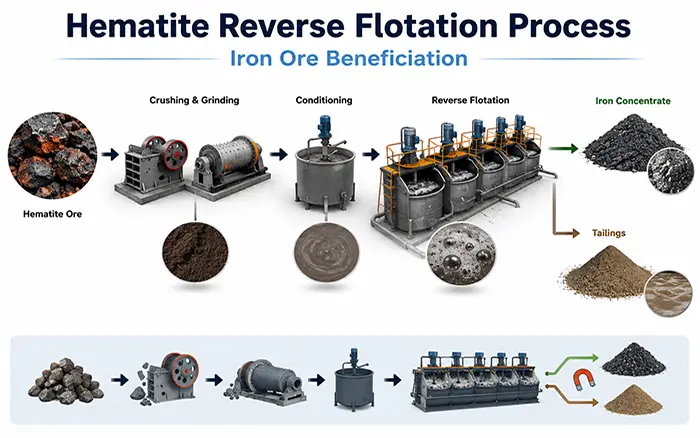
Flotation is the most effective method for fine-grained hematite. It can produce high-grade concentrates even from low-grade ores. Hematite flotation works by adding reagents that make hematite particles hydrophobic (water-repellent) or make gangue particles hydrophobic, depending on the process.
There are two types of hematite flotation:
Positive flotation: Floats the hematite and leaves gangue in the tailings. Uses anionic collectors.
Reverse flotation: Floats the gangue (usually quartz) and leaves hematite in the sink product. This is more common because it produces higher-grade concentrates.
Common hematite flotation equipment includes:
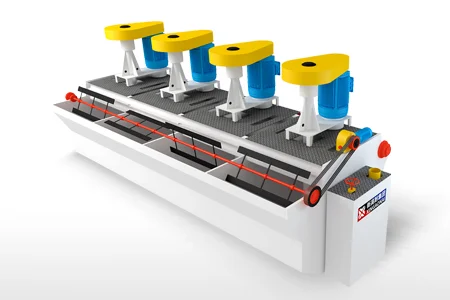
Mechanical agitation flotation cells: SF, JJF, and BF flotation cells. These are self-priming and suitable for small to medium plants.
Air-inflation mechanical flotation cells: KYF and XCF flotation cells. These use external air injection and are better for large plants. They are often used in roughing and scavenging stages.
Flotation is often combined with magnetic separation. A common process is strong magnetic separation followed by reverse flotation. The magnetic separator removes coarse hematite, and flotation cleans the fine material.
Step 4: Dewatering Equipment
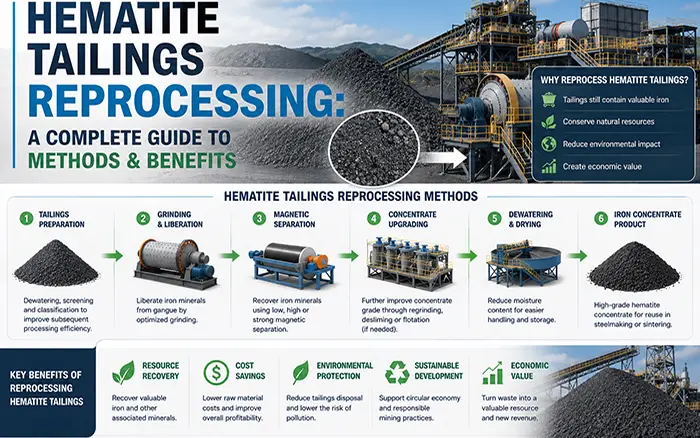
After separation, you have a wet concentrate (slurry) and wet tailings. You need to remove water from both.
Common dewatering equipment for hematite includes:
Thickener (concentrator): Used to settle solids and produce a thickened slurry. Peripheral transmission and center transmission thickeners are both used.
Filter: Used to remove remaining water and produce a dry filter cake. Common filters include ceramic filters and disk vacuum filters. Ceramic filters are more efficient but have higher initial cost.
Dewatering screen: Used for coarser concentrates. It uses vibration to shake water out of the solids.
The thickener overflow water is usually recycled back to the plant to reduce fresh water consumption.
How to Choose Between Different Processing Methods
You have three main separation methods for hematite: magnetic separation, gravity separation, and flotation. Each has advantages and disadvantages.
| Method | Best For | Advantages | Disadvantages |
|---|---|---|---|
| Gravity separation (jigs, spirals, shaking tables) | Coarse hematite (above 0.5 mm) | Low cost, no reagents, simple operation | Poor performance on fine particles |
| High-intensity magnetic separation (WHIMS) | Fine hematite (0.1–1 mm) | Good recovery, no reagents, environmentally friendly | Medium cost, requires water |
| Flotation | Fine to ultrafine hematite (below 0.1 mm) | High-grade concentrate, good recovery on fines | Higher cost, requires reagents |
Most hematite plants use a combination of methods. The most common combined processes are:
Weak magnetic separation + strong magnetic separation: Removes magnetite first, then captures hematite with WHIMS.
Gravity separation + magnetic separation + flotation: Uses gravity for coarse particles, magnetic for medium particles, and flotation for fine particles.
Magnetic separation + flotation: Magnetic separation removes coarse and medium hematite; flotation cleans the fines.
Gravity separation + flotation: Uses gravity to remove coarse gangue and flotation to upgrade the fines.
Before selecting equipment, you should test your ore with different methods. A laboratory test will tell you the best combination of processes and the required grind size.
Equipment Selection Checklist
Use this checklist when selecting hematite processing equipment.
Know your ore. Conduct a mineralogical study. Determine liberation size, hematite form, and gangue minerals.
Run lab tests. Test gravity, magnetic, and flotation methods on your ore. Find the best recovery and grade.
Size your equipment. Calculate the required tons per hour (TPH). Add a 20–30% safety margin for surges.
Match equipment to particle size. Use jigs for coarse (30–0.5 mm), spirals for medium (3–0.074 mm), WHIMS for fine (0.1–1 mm), and flotation for ultrafine (below 0.1 mm).
Plan a combined process. Single methods rarely work for hematite. Design a flowsheet that uses two or three methods in series.
Choose quality brands. Look for manufacturers with proven experience in hematite processing.
Plan for wear and maintenance. Hematite is abrasive. Select crushers and mills with wear-resistant liners. Keep spare parts in stock.
Conclusion
Selecting the best hematite iron ore processing equipment requires a thorough understanding of your ore. You need to test liberation size, run lab-scale separation tests, and design a combined process that uses gravity, magnetic, and flotation methods appropriately. Crushing and grinding equipment prepare the ore for separation. Separation equipment—jigs, spirals, WHIMS, and flotation cells—upgrades the iron content. Dewatering equipment produces a dry concentrate ready for shipment. Work with an experienced equipment supplier who can help you design the right flowsheet for your ore.