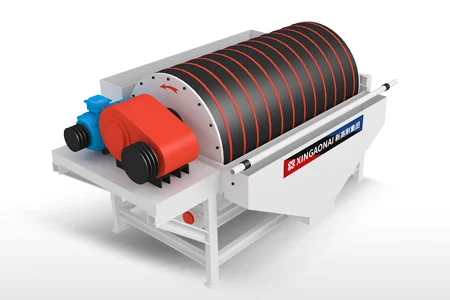
A magnetic separator works by exposing a mixture of materials to a controlled magnetic field. Particles with sufficient magnetic susceptibility are attracted or redirected by the magnetic force, while particles with little or no magnetic response follow a different path.
The process produces at least two material streams:
A magnetic product containing captured or deflected magnetic particles.
A non-magnetic product containing particles that were not captured.
Although the basic principle sounds simple, separation performance does not depend on magnetic-field strength alone. Mineral magnetism, magnetic-field gradient, particle size, liberation, feed rate, moisture and equipment design all influence the result.
This guide explains the magnetic separation process, the forces acting on particles and how common magnetic separators work in practical industrial applications.

What Is Magnetic Separation?
Magnetic separation is a physical process that uses differences in magnetic susceptibility to separate materials.
Magnetic susceptibility describes how strongly a material responds when placed in a magnetic field. Some particles are strongly attracted, some respond only weakly, and others show almost no useful response under normal industrial conditions.
Magnetic separation is commonly used to:
Recover valuable magnetic minerals.
Remove unwanted iron contamination.
Protect crushers, mills and conveyors from tramp iron.
Purify non-metallic minerals.
Recover steel and iron from waste.
Recover magnetite or ferrosilicon used in dense-media circuits.
Produce separate magnetic and non-magnetic products.
The process may be performed on dry particles or wet slurry, depending on the material and flowsheet.
How Does Magnetic Force Separate Particles?
For a particle to be captured, magnetic force must be strong enough to overcome the competing forces acting on it.
These competing forces may include:
Gravity.
Water resistance or hydraulic drag.
Centrifugal force.
Friction.
Particle collision.
Conveyor movement.
Mechanical vibration.
The magnetic force acting on a particle is influenced by:
Magnetic susceptibility of the particle.
Particle volume and mass.
Magnetic-field intensity.
Magnetic-field gradient.
Distance from the magnetic surface.
Orientation and geometry of the magnetic system.
A strong field without an adequate field gradient may not provide the required separation force. This is why equipment should not be selected solely by comparing gauss or tesla values.
The complete magnetic circuit, pole arrangement, working distance and material conditions must also be considered.
Magnetic Behaviour of Different Materials
For practical equipment selection, materials can be divided into three broad groups.
Strongly Magnetic Materials
Strongly magnetic materials respond readily to a magnetic field.
Examples include:
Iron.
Carbon steel.
Magnetite.
Ferromagnetic metal particles.
Certain nickel- and cobalt-bearing materials.
These materials can often be recovered with low- or medium-intensity equipment, depending on particle size and working distance.
Weakly Magnetic Materials
Weakly magnetic minerals produce a much smaller response.
Examples may include:
Hematite.
Ilmenite.
Chromite.
Manganese minerals.
Some rare-earth-bearing minerals.
These materials usually require high-intensity or high-gradient equipment. Their actual response varies with mineral composition, oxidation, particle size and liberation.
A conventional low-intensity drum separator should not automatically be selected for these minerals.
Materials With Little Useful Magnetic Response
Materials such as quartz, most plastics, glass and many non-ferrous minerals have little useful response to conventional magnetic separation.
These materials normally pass through the separator as the non-magnetic product while magnetic particles are captured or redirected.
However, a non-magnetic particle may still report to the magnetic product if it is physically locked with magnetic mineral or mechanically trapped in the captured material.
The Magnetic Separation Process
Most magnetic separators follow five basic stages.
1. Material Preparation
The feed must first be prepared for separation.
Preparation may include:
Crushing.
Grinding.
Screening.
Classification.
Drying.
Slurry dilution.
Removal of oversized material.
Stabilization of the feed rate.
Preparation is particularly important in mineral processing. If magnetic minerals remain locked inside gangue particles, even a strong separator may not produce a clean concentrate.
Excessive grinding can also be harmful because ultrafine particles may be more difficult to recover and can increase mechanical entrainment.
2. Uniform Feeding
The material is distributed across the effective working width of the separator.
Uniform feeding helps every particle experience similar magnetic conditions. Uneven feeding can cause:
Overloading on one side.
Magnetic particles bypassing the active field.
Reduced recovery.
Contamination of the magnetic product.
Uneven equipment wear.
Unstable operating results.
Dry equipment may use vibrating feeders, conveyors or chutes. Wet equipment normally receives slurry through pipes, distributors or tanks.
3. Exposure to the Magnetic Field
The feed passes through or near the magnetic field.
When a magnetic particle enters the effective separation zone, magnetic force changes its natural path. Depending on the machine, the particle may:
Attach to a rotating drum.
Remain on a conveyor belt.
Be lifted from a material bed.
Be held inside a magnetic matrix.
Be redirected into a different discharge channel.
Particles with insufficient magnetic response continue along their normal path under gravity, water flow or conveyor movement.
4. Transport of Captured Material
After capture, the magnetic product must be moved away from the main feed stream.
This may be achieved by:
Drum rotation.
A self-cleaning discharge belt.
A rotating roll.
A moving matrix.
A scraper.
Water flushing.
Movement beyond the magnetic pole.
Reliable transport is important because accumulated magnetic material can shield the magnetic field and reduce capacity.
5. Separate Discharge
The magnetic and non-magnetic products leave through separate discharge points.
Leaving the active magnetic zone reduces the retaining force. Gravity, scrapers, belts or rinse water then remove the magnetic product from the collecting surface.
The products are not automatically pure. Each stream may contain misplaced particles due to insufficient liberation, overfeeding, entrainment or unsuitable operating parameters.
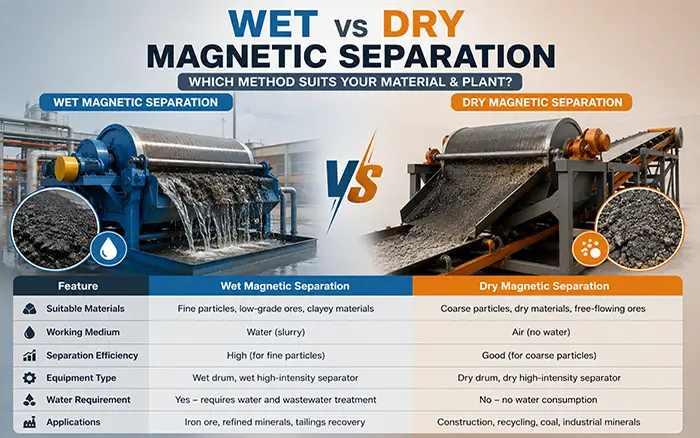
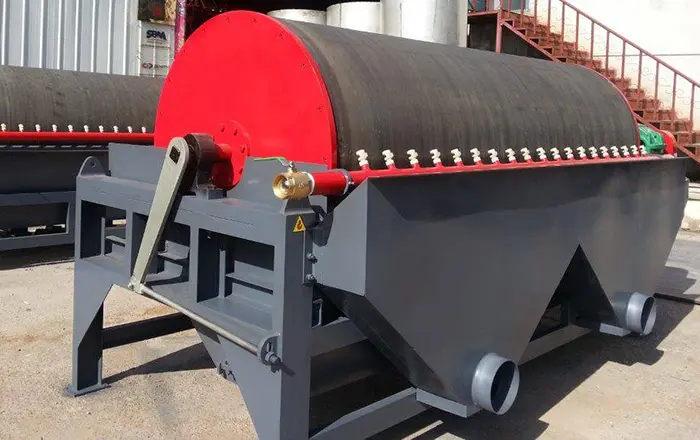
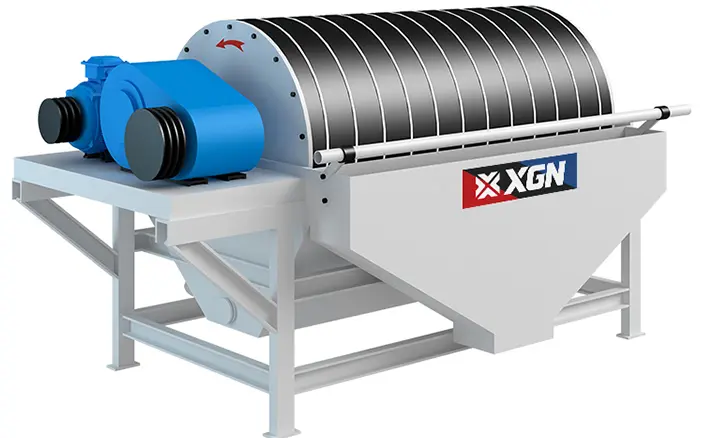
How a Wet Drum Magnetic Separator Works
A wet drum separator processes material suspended in water.
Its main components include:
A rotating non-magnetic drum.
A fixed internal magnetic system.
A slurry tank.
A feed distributor.
Magnetic and non-magnetic discharge outlets.
A drum drive.
Optional rinse-water pipes.
As slurry enters the tank, strongly magnetic particles are attracted toward the drum surface. The rotating shell carries them away from the slurry flow.
When the captured particles move beyond the effective magnetic zone, they are discharged as magnetic concentrate. Non-magnetic particles remain in the slurry and leave through a separate outlet.
Wet drum separators are commonly used for magnetite beneficiation and magnetic-media recovery. They are not automatically suitable for weakly magnetic minerals such as hematite or limonite.
For detailed operating and selection guidance, read Wet Drum Magnetic Separator: Working Principle, Applications and Selection.
How a Dry Drum Magnetic Separator Works
A dry drum separator treats free-flowing material without adding water.
Dry material is fed onto or near a rotating non-magnetic drum containing a stationary magnetic system.
The process works as follows:
Feed is distributed across the drum.
Magnetic particles are attracted toward the drum surface.
Non-magnetic particles leave the drum earlier under gravity.
Magnetic particles remain attached for a longer part of the rotation.
After leaving the magnetic zone, they fall into a separate outlet.
The splitter position controls the division between the magnetic and non-magnetic streams.
Dry drum separators may be used for:
Dry pre-concentration.
Recovery of ferromagnetic material.
Removal of iron contamination.
Treatment of certain coarse mineral feeds.
Recycling applications.
Feed moisture is important. Sticky or damp material may form agglomerates and prevent individual particles from reaching the magnetic field.
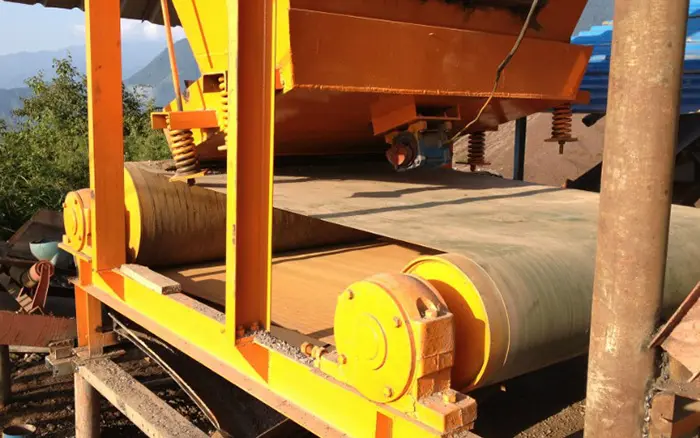
How an Overband Magnetic Separator Works
An overband magnetic separator is suspended above a conveyor carrying bulk material.
Its purpose is usually to remove tramp iron rather than beneficiate finely ground ore.
The process is:
Bulk material travels along the main conveyor.
Ferrous objects enter the magnetic field below the separator.
The objects are lifted from the material bed.
A self-cleaning belt carries them away from the main conveyor.
The metal is discharged into a separate collection area.
Performance depends on:
Suspension height.
Depth of material on the conveyor.
Conveyor speed.
Size and shape of the iron.
Magnetic strength at the actual working distance.
Position of the separator.
An overband separator should not be confused with a magnetic head pulley. The overband unit is installed above the main conveyor, whereas a magnetic pulley replaces the conveyor’s head pulley.
Learn more in Overband Magnetic Separator: Working Principle, Types and Selection.
How a Magnetic Head Pulley Works
A magnetic head pulley replaces the standard head pulley at the discharge end of a conveyor.
As material passes around the pulley:
Non-magnetic material follows its normal trajectory and falls forward.
Ferrous material remains attached to the belt around the magnetic pulley.
The captured metal is carried farther beneath the conveyor.
It drops after moving beyond the magnetic field.
A splitter separates the two product trajectories.
Magnetic pulleys are useful because particles are more dispersed while leaving the conveyor, allowing the magnetic field better access to buried ferrous material.
How a High-Intensity Magnetic Separator Works
High-intensity equipment is designed for particles with weaker magnetic susceptibility.
Instead of relying only on a strong field, many high-intensity separators use specially shaped poles, grooved plates, rolls or matrix elements to create steep magnetic-field gradients.
When weakly magnetic particles pass near these concentrated field regions, they are attracted toward the collecting surface or matrix. Non-magnetic particles pass through or follow a different trajectory.
High-intensity equipment may be used for:
Hematite.
Ilmenite.
Chromite.
Manganese minerals.
Purification of silica sand.
Removal of weakly magnetic iron contamination.
The exact machine must be selected through material testing. Increasing field intensity alone does not guarantee higher concentrate quality.
Permanent Magnets vs Electromagnets
Magnetic separators can generate their field using permanent magnets or energized coils.
Permanent Magnetic System
Permanent magnets generate a field without continuous electrical power for magnetization.
Advantages include:
No electrical consumption for field generation.
Relatively simple structure.
Stable continuous operation.
Lower cooling requirements.
Lower routine maintenance in many applications.
Limitations include:
Field strength is generally not adjustable during operation.
Magnet arrangement is fixed.
Excessive heat, impact, corrosion or physical damage can reduce performance.
The drive motor, feeder, pumps or cleaning system may still require electricity.
Electromagnetic System
Electromagnets generate a field when electrical current passes through coils.
Advantages include:
Field intensity can often be adjusted.
High magnetic forces can be produced.
Suitable for certain heavy-duty or high-intensity applications.
The field can be switched off for cleaning or maintenance.
Limitations may include:
Higher electrical consumption.
Cooling requirements.
More electrical components.
Increased maintenance complexity.
Risk of coil overheating if poorly operated.
The choice depends on the required working distance, magnetic susceptibility, capacity and operating environment.
Factors That Affect Magnetic Separation Efficiency
Magnetic Susceptibility
The greater the difference in magnetic response between the target mineral and gangue, the easier the separation.
Mixed ores and altered minerals should be tested because nominal mineral names do not fully describe their magnetic behaviour.
Mineral Liberation
If valuable magnetic mineral remains locked with gangue, the separator may recover the entire composite particle. This improves recovery but can lower concentrate grade.
Grinding finer may improve liberation, but excessive fines may be harder to recover.
Particle Size
Large particles require enough magnetic force to overcome their greater weight. Very fine particles may be dominated by water resistance, surface effects or entrainment.
A controlled particle-size distribution usually produces more stable results.
Feed Rate and Layer Depth
Excessive feed creates a thick material layer and prevents some particles from reaching the effective field.
For suspended separators, ferrous objects buried deep in the material bed are harder to lift. For drum separators, overfeeding may contaminate the magnetic product and reduce recovery.
Working Distance
Magnetic force decreases rapidly as the distance from the magnetic source increases.
Suspension height, drum-shell thickness, belt thickness, tank geometry and material-bed depth must all be considered.
Feed Distribution
Material should cover the working width evenly. Concentrating feed in one area reduces the usable magnetic surface and causes unstable results.
Moisture and Slurry Conditions
In dry separation, excessive moisture can create agglomerates and blockages.
In wet separation, slurry concentration and flow velocity affect the competition between magnetic force and hydraulic drag.
Equipment Speed
Drum, roll or belt speed controls the time particles remain in the separation zone.
Excessive speed may reduce capture time. Very low speed can reduce capacity or allow an overly thick magnetic layer to form.
Splitter and Discharge Position
The splitter determines where the product streams are divided.
An incorrect position may send magnetic particles into the non-magnetic product or increase gangue contamination in the magnetic product.
Recovery and Grade: Why Both Must Be Measured
Two common indicators are magnetic recovery and concentrate grade.
Recovery describes how much of the target magnetic mineral reports to the magnetic product.
Grade describes the proportion of the desired mineral in that product.
A setting that increases recovery may also capture more composite particles or gangue, reducing grade. Conversely, producing a very clean concentrate may result in more valuable mineral being lost to tailings.
The correct operating point depends on the economic goal of the process, not simply the highest possible magnetic-field value.
Common Problems and Causes
| Problem | Possible causes |
|---|---|
| Low recovery | Insufficient magnetic force, excessive working distance, overfeeding, poor liberation or excessive equipment speed |
| Low concentrate grade | Composite particles, mechanical entrainment, excessive feed layer, incorrect splitter or insufficient washing |
| Unstable results | Fluctuating feed rate, uneven distribution, changing particle size or slurry density |
| Magnetic material in tailings | Overloading, unsuitable separator type, worn components or incorrect settings |
| Excessive material buildup | Poor discharge, sticky feed, damaged scraper or insufficient cleaning |
| Abnormal vibration or noise | Misalignment, bearing damage, loose components or trapped foreign material |
| Reduced magnetic performance | Excessive heat, physical damage, corrosion, altered working distance or magnetic-system failure |
Operators should change one parameter at a time and verify the result by sampling both products.
How to Select the Correct Magnetic Separator
Start by defining the objective:
Recover a valuable magnetic mineral.
Remove tramp iron.
Purify a non-metallic material.
Recover dense-medium magnetite.
Produce a magnetic concentrate.
Protect downstream equipment.
Then evaluate:
Mineralogical composition.
Magnetic susceptibility.
Liberation size.
Feed particle-size distribution.
Dry or wet feed condition.
Throughput.
Material-bed depth or slurry flow.
Required recovery and grade.
Working environment.
Available installation space.
Downstream processing requirements.
For a comparison of available equipment designs, see Types of Magnetic Separators: How to Choose the Right One.
If both dry and wet processing are technically possible, compare the entire flowsheet rather than the separator alone. See Wet vs Dry Magnetic Separation.
Conclusion
A magnetic separator works by creating a magnetic field that changes the movement of particles according to their magnetic susceptibility. Magnetic particles are captured, lifted or redirected, while particles with insufficient magnetic response follow another path.
Effective separation requires more than a powerful magnet. Magnetic-field gradient, mineral liberation, particle size, working distance, feed distribution, equipment speed and discharge control all influence recovery and concentrate grade.
The most suitable separator should therefore be selected according to the material, process objective and complete production circuit—not by magnetic-field strength alone.