Beneficiation Equipment

High-Efficiency Agitation Tank

CAPACITY

0.58-45m³

FEED SIZE

---
Application areas:The Agitation Tank is not only suitable for slurry mixing, reagent conditioning, and leaching operations in gold processing plants, copper hydrometallurgy circuits, and mineral beneficiation facilities, but also widely used in chemical plants, fertilizer
Applicable materials:Gold ore slurry, copper ore slurry, silver ore slurry, zinc ore slurry, cyanide solution, acid leach solution, flotation reagent slurry, lime milk, activated carbon slurry, ceramic raw material slurry, chemical process liquids, and other liquid-solid or l

Product Overview

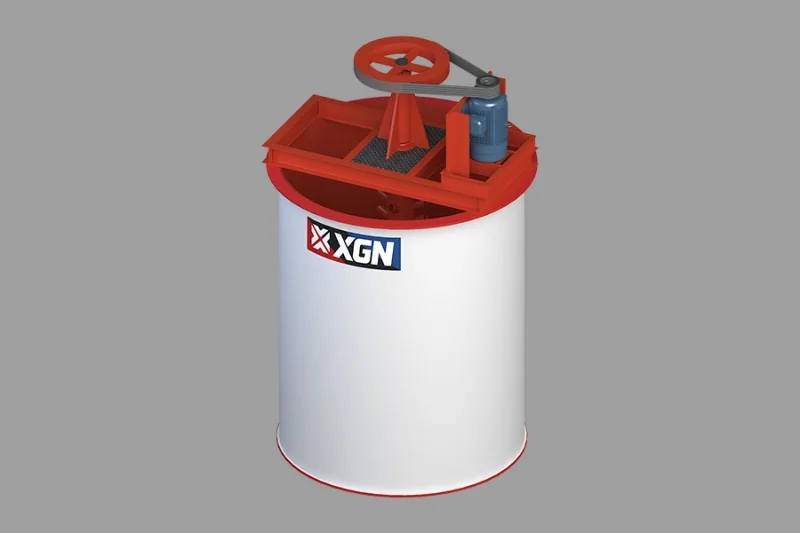
The Agitation Tank is a continuous-duty, motorized mixing vessel designed to maintain uniform suspension of solid particles in liquid, promote chemical reactions between reagents and ore slurry, and prevent sedimentation of high-density slurry in hydrometallurgical leaching and mineral beneficiation circuits. It is the standard mixing and conditioning equipment in cyanide leaching circuits for gold and silver recovery, acid leaching circuits for copper and zinc extraction, flotation feed conditioning tanks, and chemical reagent preparation systems worldwide.


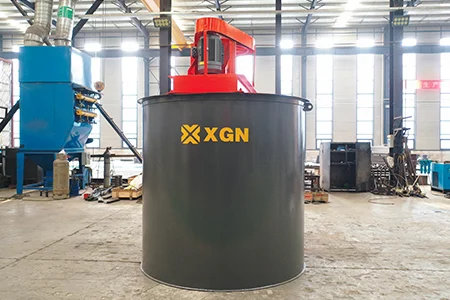
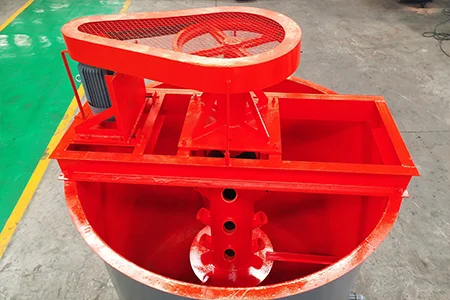
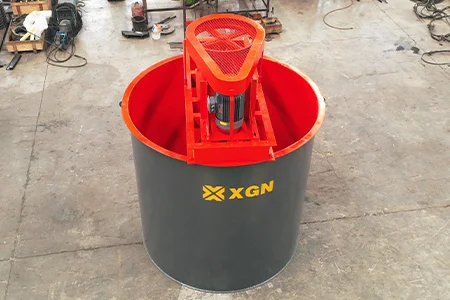
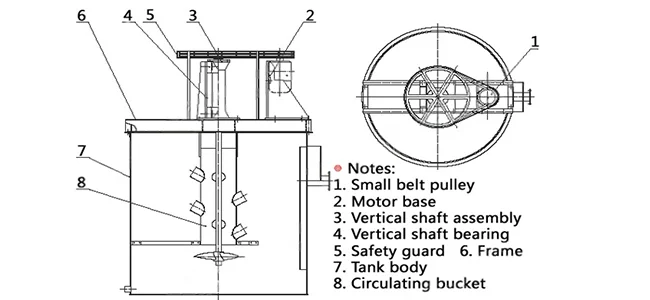
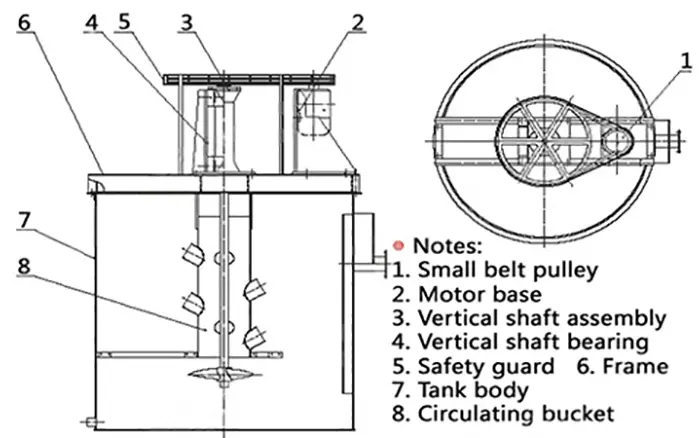
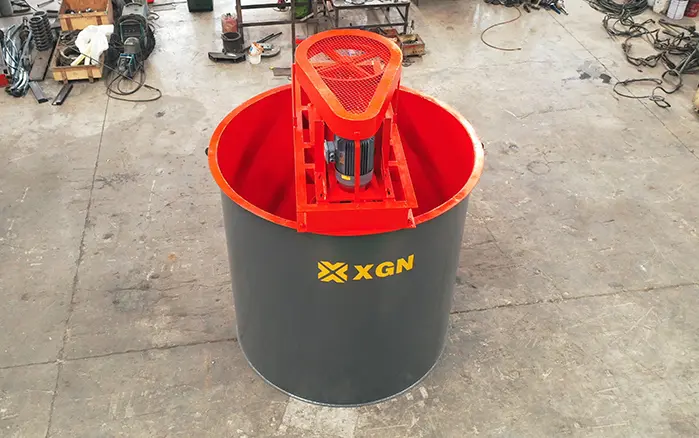
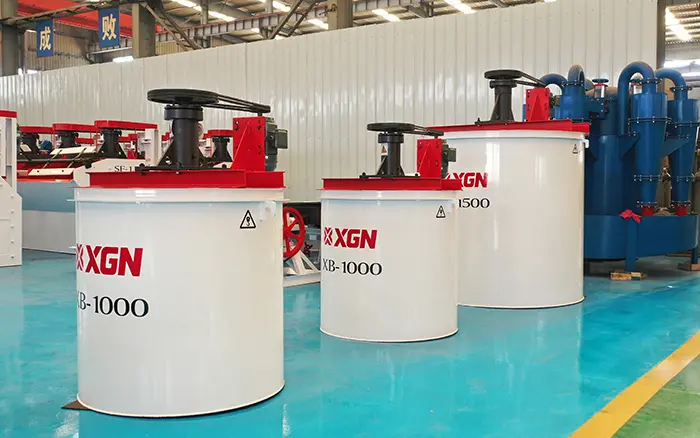
XINGAONAI Agitation Tanks are fabricated from heavy-gauge carbon steel with epoxy or rubber lining (for corrosive applications) or stainless steel (for food-grade and pharmaceutical applications), available in working volumes from 1 m³ to 320 m³ to accommodate the full range of plant throughput requirements. The tank is fitted with a centrally mounted, motor-driven impeller shaft supported on a robust upper bearing assembly with sealed grease-lubricated bearings, driving one or multiple impeller stages depending on tank depth and mixing intensity requirements.


The impeller system is available in double-blade flat paddle, four-blade 45° pitched turbine, and high-efficiency axial flow designs, each optimized for specific slurry density, particle size, and required mixing uniformity. Baffles are installed on the tank wall to break rotational flow and convert it into axial and radial circulation, ensuring thorough top-to-bottom mixing without dead zones. The drive system uses a motor-reducer arrangement with V-belt or direct gear coupling, designed for continuous 24-hour operation under varying slurry density conditions.

Key Advantages

Uniform Mixing, Zero Sedimentation

The impeller and baffle system is engineered to generate strong axial and radial circulation currents throughout the full tank volume, keeping all solid particles in uniform suspension regardless of slurry density fluctuations at the inlet. This eliminates dead zones at the tank bottom where dense particles would otherwise settle, ensuring consistent slurry concentration and reagent contact time for every particle passing through the leaching or conditioning circuit.

High Mass Transfer Efficiency for Leaching Applications

In cyanide leaching and acid leaching applications, the turbulent mixing environment created by the impeller system maximizes the contact frequency between ore particles and leaching reagent molecules, accelerating the dissolution reaction rate and improving metal recovery compared to low-agitation or static leaching systems. The impeller speed and geometry are optimized for each ore type and reagent system to achieve maximum leaching efficiency at minimum energy consumption.

Corrosion-Resistant Construction for Aggressive Chemical Environments

Tank internals in contact with cyanide solution, acidic leach liquor, or other corrosive process fluids are protected by thick rubber lining, epoxy coating, or fabrication from 304/316L stainless steel depending on the chemical aggressiveness of the application. The impeller blades and shaft are available in rubber-coated steel, stainless steel, or polyurethane-coated configurations to match the corrosion and abrasion requirements of each specific process.

Flexible Volume & Impeller Configuration

Working volumes from 1 m³ to 320 m³ and a choice of single-stage or multi-stage impeller arrangements allow XINGAONAI Agitation Tanks to be sized precisely for any plant throughput from small-scale pilot operations to large commercial processing plants. Multiple tanks are commonly connected in series to form a leaching train, with retention time in each tank controlled by slurry feed rate and tank volume to optimize leaching kinetics and overall metal recovery.

Energy-Efficient Drive System

The impeller geometry and rotational speed are optimized to achieve the required mixing intensity at minimum shaft power input, reducing energy consumption per tonne of slurry processed compared to oversized or poorly matched impeller designs. Variable-frequency drive (VFD) control is available as an option, allowing impeller speed to be adjusted in real time to match varying slurry density and viscosity conditions without mechanical drive changes, further reducing energy consumption during periods of reduced throughput.

Low Maintenance, Long Service Life

The upper bearing assembly uses sealed, grease-lubricated heavy-duty bearings with extended re-greasing intervals, accessible from outside the tank without draining. The impeller blades are bolted to the hub in replaceable segments, allowing individual worn blades to be swapped during scheduled maintenance without removing the entire shaft assembly. Rubber-lined tanks and rubber-coated impellers in cyanide leaching service typically achieve 5–8 years between major relining overhauls under normal operating conditions.

Working Principle

Working Principle of High-Efficiency Agitation Tank
Slurry or process liquid enters the Agitation Tank continuously through the inlet pipe at the tank wall or bottom, while the motor-driven impeller — rotating at 15–120 RPM depending on tank size and impeller type — generates strong radial and axial flow currents that circulate the entire tank contents in a continuous top-to-bottom and bottom-to-top pattern; the baffles mounted on the tank wall interrupt the rotational flow and redirect it into vigorous axial circulation, preventing solid particles from settling at the bottom and ensuring uniform distribution of reagents, solids, and liquid throughout the full tank volume; conditioned or leached slurry overflows continuously from the outlet pipe at the upper tank wall by gravity and advances to the next tank in the leaching train or to the downstream solid-liquid separation circuit, while the impeller and baffle system maintains a stable, fully suspended slurry condition at all times to maximize reagent contact efficiency and metal recovery throughout continuous 24-hour operation.

Technical Parameters

Model

Effective Volume

(m³)

Rotating Speed of Impeller

(r/min)

Diameter of Impeller

(mm)

Motor Model

Motor power

(kw)

Weight

(kg)

GBJ-1000X10000.58530240Y112M-62.2548
GBJ-1250X12501.15350240Y100L2-43820
GBJ-1500X15002.2320420Y132M2-65.51350
GBJ-2000X20005.46240560Y160M-67.53173
GBJ-2500X250011.2232560Y180L-6153939
GBJ-3000X300019.1220700Y225S-818.56676
GBJ-3500X350031248700Y225M-8227581
GBJ-4000X400045
1531000Y250M-8379560


We are here waiting for you
Our professional team can tailor the solution to suit your needs and answer your questions
Contact Engineer

Frequently Asked Questions

An agitation tank is a cylindrical vessel equipped with a motor-driven impeller that continuously stirs and suspends slurry or reagent mixtures in mineral processing operations. It is primarily used for reagent conditioning before flotation — ensuring uniform distribution of collectors, frothers, and activators throughout the ore pulp — as well as for leaching agitation in gold cyanidation and acid leaching circuits, slurry homogenization between processing stages, and pH or chemical environment adjustment prior to beneficiation. It is an essential piece of equipment in gold, copper, iron, and polymetallic ore processing plants.

The three main types are the mechanical agitation tank, which uses a rotating impeller driven by a motor and gearbox and is the most widely used option for flotation conditioning, leaching, and general slurry mixing; the air agitation tank (Pachuca tank), which uses compressed air injection to circulate slurry with no moving parts in contact with the liquid, making it ideal for highly corrosive leaching environments; and the high-efficiency agitation tank, which features an optimized impeller geometry and draft tube for stronger circulation and lower power consumption, recommended for large-scale plants. For most mining applications, the mechanical agitation tank is the standard choice, and Xingaonai's engineers can recommend the optimal type based on your slurry density, volume requirements, and process conditions.

Agitation tanks are designed to handle slurry with a pulp density of 20–75% solids by weight, with flotation conditioning circuits typically operating at 25–45% solids and leaching circuits at 30–50% solids. In terms of particle size, they are designed for material already ground by a ball mill or rod mill — generally below 0.5mm, with most flotation and leaching feeds in the 0.074–0.15mm range. For coarser or denser feed materials with higher settling velocities, a higher impeller tip speed and motor power are required to maintain full particle suspension and prevent sedimentation at the tank bottom.

Agitation tanks have a simple mechanical structure and relatively low maintenance requirements. Key tasks include inspecting the impeller and shaft every 3–6 months for wear or corrosion and replacing impeller blades when wear exceeds 20–30% of original thickness; checking gearbox oil level weekly and changing lubricating oil every 2,000 operating hours; inspecting rubber tank linings every 6 months for bubbling, peeling, or punctures; re-greasing impeller shaft bearings every 200–300 operating hours; and checking the mechanical seal or packing gland monthly for leakage. With proper maintenance, the tank shell and structural components have a service life of 10–20 years, and Xingaonai provides a full range of replacement impellers, shaft assemblies, rubber linings, and gearbox components for all agitation tank models.

Explore Our Projects

Related Blog

Send message

Please enter your name
Please enter your email
Please enter your message