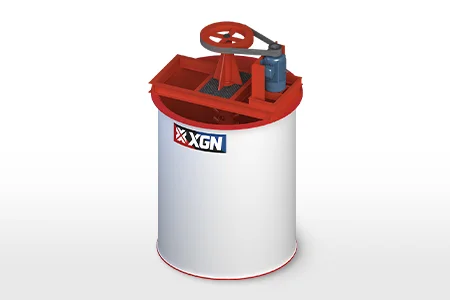
An industrial tank agitator is a heavy-duty mixing system designed to circulate liquids, suspend solids and distribute process chemicals inside a tank or vessel.
Unlike a light-duty mixer used for simple liquid blending, an industrial agitator may need to operate continuously with dense slurry, abrasive particles, corrosive reagents and changing feed conditions. Its motor, gearbox, shaft, impeller, bearings and support structure must therefore be selected as one complete system.
In mineral processing, industrial tank agitators are commonly used for slurry conditioning, reagent preparation, leaching, pH adjustment, feed homogenization and sedimentation prevention.
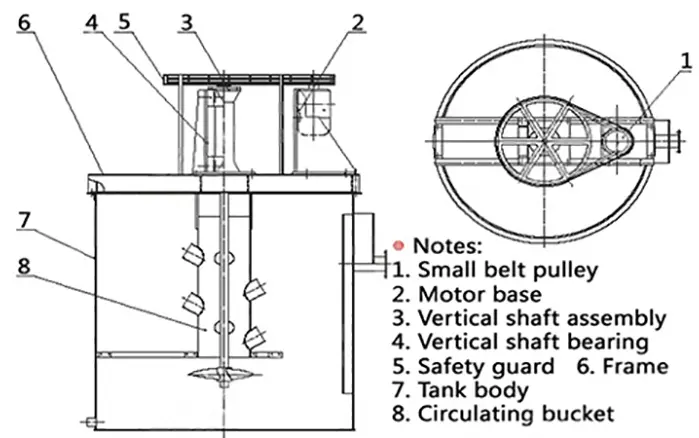
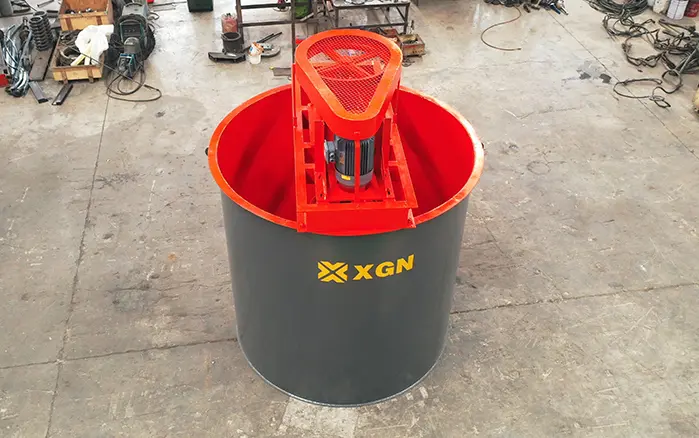
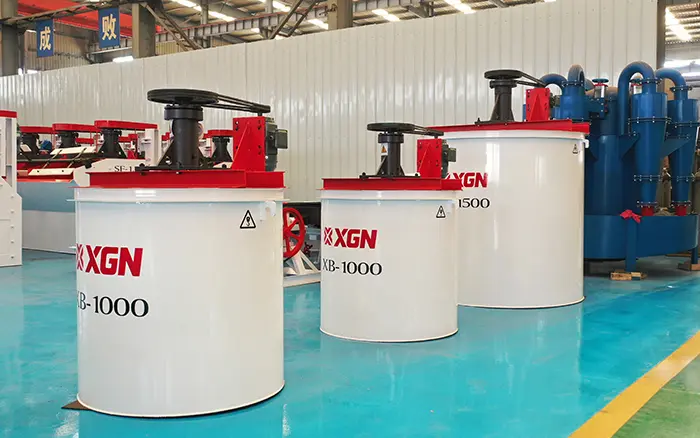
XINGAONAI’s high-efficiency agitation tank for mineral processing is designed for continuous slurry mixing, reagent conditioning and leaching duties.
Quick answer: An industrial tank agitator uses a motor-driven shaft and impeller to create controlled circulation inside a process tank. The equipment must be matched to the working volume, slurry density, particle size, viscosity, chemistry and required operating time.
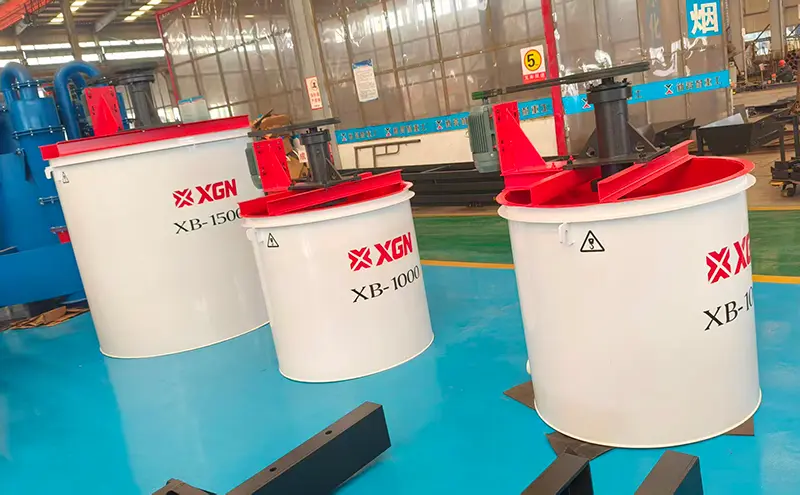
What Makes an Agitator Industrial Grade?
The term “industrial” should describe the operating duty, not simply the physical size of the mixer.
An industrial tank agitator normally requires:
Continuous or high-duty-cycle operation
A gearbox selected for the required torque
A shaft checked for bending, fatigue and vibration
Bearings suitable for sustained radial and axial loads
An impeller matched to the process duty
A rigid mounting and support structure
Wear- or corrosion-resistant wetted components
Safe guards and electrical protection
Maintenance access around the drive and shaft
A defined performance requirement
The difference between a general mixer and an industrial tank agitator can be summarized as follows:
| Requirement | General-purpose mixer | Industrial tank agitator |
|---|---|---|
| Operating period | Intermittent or light duty | Extended or continuous duty |
| Material | Clean or low-density liquid | Liquid, slurry or chemical mixture |
| Torque requirement | Relatively low | Calculated for process load |
| Solids handling | Limited | Designed for suspension where required |
| Wear protection | Often minimal | Selected for abrasion and corrosion |
| Drive system | Direct drive may be sufficient | Gear reducer commonly required |
| Controls | Basic on/off | May include VFD, current and level monitoring |
| Mechanical verification | Limited | Shaft, bearing and structure checks required |
Main Industrial Mixing Duties
An industrial agitator should be selected according to its primary process duty.
Solids Suspension
The impeller must create enough circulation to lift particles from the tank bottom and maintain a reasonably uniform slurry.
This duty is common in:
Ore slurry conditioning
Mineral storage tanks
Leaching tanks
Tailings treatment
Reagent slurries
Lime milk preparation
Particle size, solids concentration and mineral density are critical because they determine how quickly the material settles.
Liquid Blending
Liquid blending distributes one liquid or dissolved component throughout another. Compared with solids suspension, this duty may require less bottom velocity but still needs complete tank circulation.
Reagent Dispersion
Collectors, frothers, activators, depressants, acids, alkalis or other chemicals must be distributed through the process liquid or slurry.
The reagent feed point should be positioned inside an active circulation region rather than close to the outlet.
Reaction and Leaching
Agitation increases contact between mineral particles and the process solution. In leaching service, the system may need to maintain suspension and consistent chemistry during a defined residence time.
Homogenization
An agitation tank can reduce fluctuations in feed density, solids concentration or reagent concentration before the material enters the next processing stage.
Sedimentation Prevention
Storage or buffer tanks may use continuous or intermittent agitation to prevent particles from forming a compact settled bed.
Industrial Tank Agitator Configurations
Top-Entry Agitator
A top-entry agitator is mounted above the tank, with a vertical shaft extending into the slurry.
It is the most common configuration for industrial mineral-processing tanks because it can provide:
Full-volume circulation
Strong solids-suspension capability
Stable mounting
Single- or multiple-impeller arrangements
Access to the motor and gearbox from above
Top-entry systems are commonly used for flotation conditioning, reagent mixing, leaching and slurry homogenization.
Side-Entry Agitator
A side-entry agitator is mounted through the tank wall, normally near the lower section of a large storage tank.
Its main advantages include:
Shorter shaft length
Easier access on some large tanks
Efficient horizontal circulation
Suitability for maintaining movement in storage tanks
Side-entry agitators may require careful seal selection and may not provide the same top-to-bottom suspension as a properly designed top-entry system.
Bottom-Entry Agitator
A bottom-entry agitator is installed beneath the tank. It can reduce shaft length and generate mixing close to the tank bottom.
However, it presents additional sealing and maintenance requirements. In abrasive mineral slurry, bottom-mounted seals and drive components must be evaluated carefully.
Multi-Impeller Agitator
Deep industrial tanks may require two or more impellers on one shaft.
A multi-impeller arrangement is considered when:
Liquid depth is high relative to tank diameter
One impeller cannot circulate the full volume
Density gradients form at different tank levels
The process requires both lower suspension and upper blending
The impeller spacing and shaft strength must be engineered together.
How an Industrial Tank Agitator Operates
The motor transfers power through a gearbox and coupling to the shaft. The rotating impeller accelerates the surrounding slurry and creates axial, radial or combined flow.
Tank baffles reduce uncontrolled swirling and help redirect the slurry through the upper and lower parts of the tank. When circulation is sufficient, solids remain in motion and reagents are distributed through the working volume.
For a detailed explanation of slurry circulation, baffles and suspension, read How Does an Agitation Tank Work?.
Industrial Tank Agitator Applications
Mineral Processing
Mineral-processing plants use industrial agitators to mix ground ore with water and process reagents.
Typical positions include:
Before flotation
Between grinding and separation
In reagent-conditioning circuits
Before magnetic or gravity separation
In intermediate slurry storage tanks
Stable agitation helps maintain consistent feed conditions for downstream equipment.
Flotation Conditioning
Collectors, frothers, activators and depressants require sufficient contact with mineral surfaces before flotation.
A conditioning tank provides:
Reagent distribution
Defined contact time
Slurry homogenization
pH adjustment
Consistent feed to the flotation cells
The agitator should provide effective bulk circulation without excessive air entrainment before the slurry enters the flotation machine.
Gold and Silver Leaching
In cyanide leaching circuits, agitation maintains ore particles in suspension and distributes the leaching solution.
Several tanks may be installed in series to provide the required overall residence time. The material of construction must be compatible with the selected process chemistry and plant safety requirements.
Copper and Zinc Leaching
Acidic slurry can create combined corrosion and abrasion. Tanks, shafts, impellers and fasteners must therefore be selected according to actual acid concentration, chloride content, temperature and solids characteristics.
Reagent Preparation
Industrial agitators are used to prepare lime milk, flocculant solutions and other process reagents.
The system must be selected according to:
Dissolution requirements
Solids concentration
Required preparation time
Risk of sedimentation
Reagent compatibility
Dosing consistency
Wastewater and Process-Water Treatment
Agitation may be used to distribute neutralizing chemicals, maintain suspended solids or condition water before clarification and filtration.
The required mixing intensity depends on whether the purpose is rapid chemical dispersion, slow flocculation or solids suspension. These duties should not use the same agitator configuration automatically.
Chemical and Fertilizer Processing
Industrial tank agitators may handle chemical solutions, suspensions and fertilizer mixtures. Corrosion resistance, temperature and reaction conditions become important selection factors.
Food, pharmaceutical and hygienic processing require specialized sanitary designs and certifications; a standard mining slurry agitator should not be presented as suitable for those applications without a separate validated configuration.
Industrial Agitator Materials
The correct material depends on both abrasion and corrosion.
| Process condition | Possible equipment configuration |
|---|---|
| Mild, non-corrosive slurry | Carbon-steel tank and standard industrial coating |
| Abrasive ore slurry | Rubber, polyurethane or wear-resistant lining |
| Acidic slurry | Compatible rubber lining, coating or corrosion-resistant alloy |
| High-wear impeller duty | Replaceable coated or wear-resistant blades |
| Corrosive process liquid | Stainless steel or selected alloy after compatibility review |
| Outdoor installation | Weather protection for motor, gearbox and controls |
Final material selection must use actual pH, reagent concentration, temperature and slurry abrasiveness.
Drive and Control Options
Gear Reducer
A gear reducer lowers motor speed and increases output torque. Industrial slurry agitators usually need a gearbox selected for continuous service and startup load.
Variable-Frequency Drive
A variable-frequency drive allows operators to adjust rotational speed as process conditions change.
It may help when:
Slurry density varies
Throughput changes
Different operating recipes are required
Lower speed is acceptable during reduced production
A VFD cannot correct an undersized gearbox, weak shaft or unsuitable impeller.
Motor-Current Monitoring
Motor current can provide an indication of agitator load. A sudden increase may indicate:
Higher slurry density
Solids accumulation
Impeller blockage
Bearing problems
Mechanical misalignment
Current monitoring should be combined with vibration, temperature and process observations.
Level and Density Monitoring
Stable tank level and feed density improve agitation consistency. Instrumentation may include:
Level transmitters
Density meters
Flow meters
pH sensors
Temperature sensors
Motor-current monitoring
Vibration monitoring
How to Select an Industrial Tank Agitator
1. Define the Process Duty
Identify whether the primary purpose is:
Solids suspension
Liquid blending
Reagent conditioning
Leaching
Homogenization
Sedimentation prevention
2. Determine the Effective Working Volume
Use the normal liquid volume rather than only the tank’s total geometric capacity. For continuous operation, the volume must support the required residence time at the planned feed rate.
3. Provide Slurry Properties
At minimum, provide:
Slurry density
Solids concentration
Maximum particle size
Particle specific gravity
Viscosity
pH and temperature
4. Define the Operating Range
The supplier needs minimum, normal and maximum operating conditions—not only one nominal value.
These include:
Flow rate
Tank level
Slurry concentration
Operating hours
Process temperature
Required mixing intensity
5. Confirm Abrasion and Corrosion Conditions
A material suitable for corrosion may not necessarily resist abrasion. The two conditions must be evaluated separately.
6. Check Installation Conditions
Important site information includes:
Available headroom
Platform dimensions
Tank support structure
Electrical supply
Indoor or outdoor installation
Altitude
Ambient temperature
Maintenance access
7. Define the Required Performance
The quotation should state the expected result, such as:
No persistent solids bed
Defined blending uniformity
Required reagent-contact time
Maximum allowable power
Continuous-duty operating period
Required material or lining
Acceptable vibration level
For detailed impeller sizing, power and tank-dimension considerations, refer to the tank agitator design guide.
Specification Checklist for a Supplier
When requesting an industrial tank agitator quotation, provide:
| Category | Information |
|---|---|
| Material | Ore, slurry or chemical name |
| Process | Conditioning, suspension, leaching or storage |
| Capacity | Feed rate and required working volume |
| Tank | Diameter, height and bottom shape |
| Slurry | Density and solids percentage |
| Particles | Maximum size and specific gravity |
| Liquid | Viscosity, pH and temperature |
| Chemistry | Reagent type and concentration |
| Operation | Batch or continuous; hours per day |
| Installation | Top, side or other mounting requirement |
| Electrical | Voltage, frequency and phase |
| Controls | Fixed speed or VFD |
| Site | Country, altitude and ambient conditions |
This information allows the manufacturer to evaluate the impeller, motor, gearbox, shaft, materials and mounting structure as one system.
Industrial Tank Agitator Cost Factors
The cost is influenced by more than tank volume.
Important cost factors include:
Motor power and efficiency class
Gearbox torque and service factor
Shaft length and diameter
Number and type of impellers
Tank size and plate thickness
Rubber or corrosion-resistant lining
Stainless-steel or alloy components
Mechanical seals
Variable-speed controls
Instrumentation
Platforms and support structures
Shipping dimensions
Installation and commissioning scope
A low initial price may lead to higher operating cost if the agitator is inefficient, wears rapidly or cannot maintain suspension.
Installation and Commissioning Checks
Before commissioning:
Verify tank and mounting dimensions.
Confirm that the support structure is level and rigid.
Check shaft and coupling alignment.
Confirm impeller clearance from the tank bottom and internals.
Inspect all fasteners and guards.
Verify lubrication.
Check motor rotation direction.
Test electrical protection and emergency stops.
Run the unit initially under controlled conditions.
Record baseline motor current, vibration and temperature.
Performance should be checked using the actual process slurry where practical. A water test can verify mechanical operation but may not prove solids-suspension performance.
Maintenance Requirements
A practical maintenance program should cover:
Gearbox oil level and condition
Bearing lubrication
Coupling alignment
Fastener tightness
Shaft runout
Impeller wear
Tank lining condition
Seal leakage
Motor current
Vibration and noise
In abrasive slurry service, uneven impeller wear can create imbalance and increase shaft vibration. Replace or repair worn blades before the imbalance damages bearings or the gearbox.
Common Industrial Agitator Problems
Solids Settling at the Tank Bottom
Possible causes include an unsuitable impeller, insufficient circulation, excessive solids concentration, coarse particles or incorrect impeller height.
Excessive Power Consumption
Check slurry density, speed, impeller condition, mechanical alignment and whether solids have accumulated around the blades.
Strong Vortex Formation
The tank may lack suitable baffles, or the agitator may be operating at excessive speed.
Shaft Vibration
Possible causes include misalignment, worn bearings, impeller imbalance, insufficient shaft stiffness or operation near a critical speed.
Rapid Impeller Wear
Review material selection, tip speed, particle abrasiveness and whether the impeller is operating in a concentrated solids region.
Conclusion
An industrial tank agitator must be designed for the actual operating duty rather than selected only by tank capacity or motor power.
Reliable industrial operation depends on matching the impeller, shaft, gearbox, materials and tank geometry to the slurry properties, process objective and operating range. In mining applications, solids suspension, abrasion resistance and continuous-duty reliability are particularly important.
For a detailed explanation of equipment components, read the tank agitator mixer selection guide. To understand slurry circulation and suspension, see How Does an Agitation Tank Work?.
For equipment specifications, review XINGAONAI’s high-efficiency industrial agitation tank.