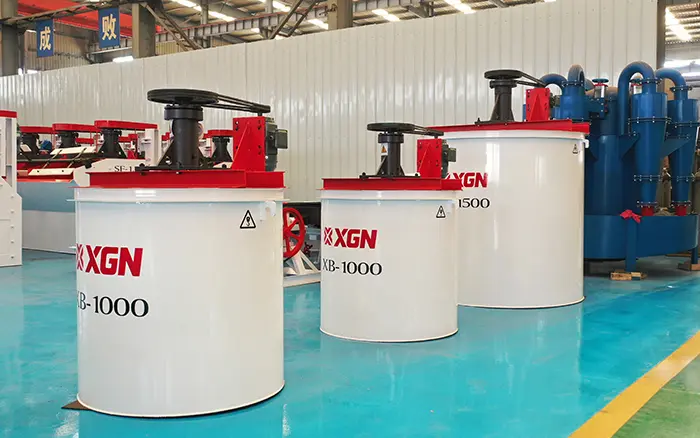
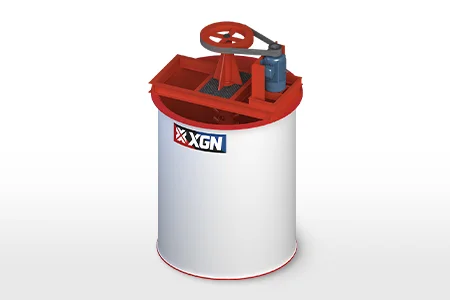
A tank agitator mixer is a motor-driven mixing system installed in a tank or vessel to circulate liquids, keep solid particles suspended, disperse reagents and maintain a uniform mixture.
In mineral processing, tank agitator mixers are commonly used for slurry conditioning before flotation, reagent preparation, leaching, pH adjustment and intermediate slurry storage. Selecting the correct mixer requires more than matching the equipment to tank volume. Slurry density, particle size, viscosity, required retention time and corrosion conditions must also be considered.
For mineral-processing applications, XINGAONAI offers a high-efficiency agitation tank designed for continuous slurry mixing, reagent conditioning and leaching duties.
Quick answer: A tank agitator mixer uses a motor, shaft and impeller to create controlled liquid circulation inside a vessel. The resulting flow keeps particles suspended and distributes reagents throughout the slurry.
What Is a Tank Agitator Mixer?
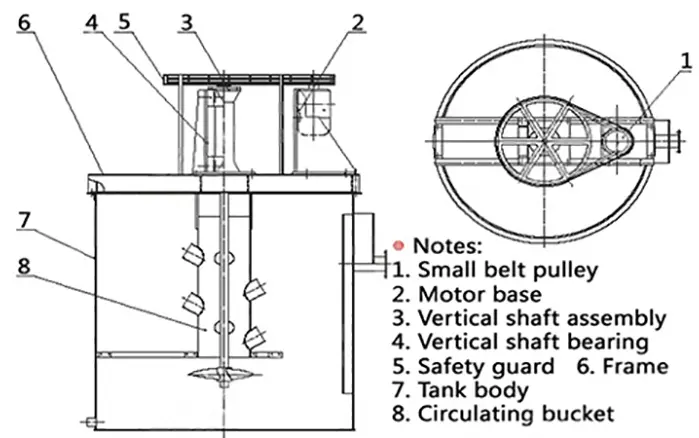
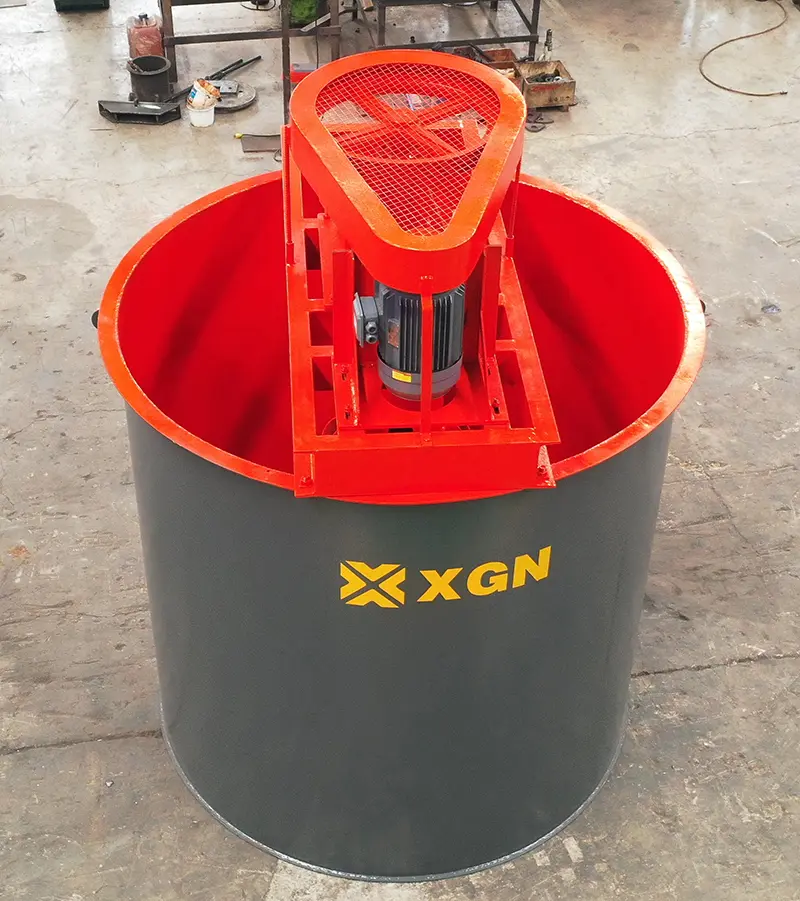
A tank agitator mixer normally consists of a drive unit, gearbox, shaft, impeller, support structure and mixing tank. When the impeller rotates, it transfers mechanical energy to the slurry and generates axial, radial or combined flow.
The mixer may perform one or several process duties:
Blending two or more liquids
Suspending solid particles in a liquid
Distributing flotation or leaching reagents
Preventing solids from settling
Maintaining uniform slurry concentration
Increasing contact between ore particles and process chemicals
Equalizing material before the next processing stage
A mixer designed for water-like liquid may not perform effectively with dense mineral slurry. Mining applications usually require greater torque, abrasion-resistant components and an impeller selected specifically for solids suspension.
Main Components of a Tank Agitator Mixer
1. Motor and Drive System
The motor supplies the power required to rotate the impeller. A gearbox reduces motor speed and increases torque so that the mixer can operate efficiently under the required slurry load.
A variable-frequency drive may be used to adjust impeller speed when feed density, throughput or process conditions change.
2. Agitator Shaft
The shaft transfers torque from the drive system to the impeller. Its diameter and length must be sufficient to resist bending, vibration and fatigue during continuous operation.
Long shafts or deep tanks may require additional support or more than one impeller stage.
3. Impeller
The impeller creates the fluid flow required for mixing. Its diameter, blade angle, position and rotational speed directly affect solids suspension, power consumption and mixing uniformity.
Common impeller categories include:
| Impeller type | Main flow pattern | Typical use |
|---|---|---|
| Pitched-blade turbine | Axial and radial flow | General slurry mixing and solids suspension |
| Hydrofoil impeller | Strong axial flow | Large-volume circulation with relatively low power consumption |
| Radial turbine | Radial flow and higher shear | Reagent dispersion and intensive mixing |
| Paddle impeller | Moderate circulation | Simple blending and conditioning duties |
| Anchor agitator | Wall-sweeping flow | High-viscosity liquids; less common for ordinary mineral slurry |
The best impeller is determined by the process duty rather than by tank size alone.
4. Mixing Tank
The tank contains the slurry and provides the space in which circulation occurs. Tank diameter, liquid depth, bottom shape, inlet position and outlet position all influence mixer performance.
Poor tank geometry can create dead zones even when the motor has sufficient power.
5. Baffles
Baffles are vertical plates installed along the inner wall of the tank. They reduce uncontrolled swirling and help convert rotational motion into useful top-to-bottom circulation.
Without suitable baffles, the entire liquid mass may rotate around the shaft while vertical mixing remains inadequate.
6. Bearings, Couplings and Support Structure
Bearings support the rotating shaft, while couplings transfer power and accommodate minor alignment differences. The support frame must withstand equipment weight, operational torque and vibration.
7. Wear and Corrosion Protection
Mining slurry may be abrasive, corrosive or both. Depending on the application, wetted components may require:
Rubber lining
Epoxy coating
Wear-resistant alloy
Stainless steel
Polyurethane coating
Replaceable impeller blades
Material selection should be based on slurry chemistry, pH, solids concentration and particle abrasiveness.
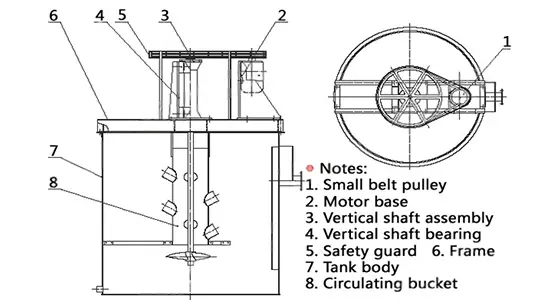
Common Tank Agitator Mixer Configurations
Top-Entry Agitator
A top-entry agitator is installed above the tank, with the shaft extending vertically into the slurry. It is the most common arrangement for mineral processing because it provides stable circulation and is suitable for medium and large tanks.
Typical applications include:
Flotation feed conditioning
Reagent mixing
Gold cyanide leaching
Copper acid leaching
Slurry homogenization
Side-Entry Agitator
A side-entry agitator is mounted through the tank wall. It is often used in large storage tanks where the main requirement is to maintain circulation or prevent sediment accumulation.
It may not provide the same full-volume suspension performance as a properly designed top-entry system.
Bottom-Entry Agitator
A bottom-entry mixer is installed beneath the tank. This configuration can reduce shaft length and provide circulation near the tank bottom, but sealing and maintenance requirements are generally more demanding.
Single-Impeller and Multi-Impeller Systems
A single impeller may be sufficient for a shallow tank. Deep tanks often require two or more impellers on the same shaft to avoid poorly mixed regions at different liquid levels.
Impeller spacing and elevation should be determined during the design stage.
How Does a Tank Agitator Mixer Work?
The motor and gearbox rotate the shaft and impeller. The impeller accelerates the surrounding slurry, producing axial and radial circulation inside the tank. Baffles interrupt simple rotational flow and direct the slurry through the upper and lower parts of the vessel.
This circulation distributes reagents and keeps solid particles in motion. In continuous operation, incoming slurry is mixed before leaving through the outlet or overflow connection.
Mixing performance depends on whether the circulation velocity is sufficient to overcome the settling tendency of the particles. Excessive speed, however, can increase power consumption, wear and air entrainment without improving the process result.
For a detailed process explanation, see How Does an Agitation Tank Work?.
Tank Agitator Mixer Applications in Mineral Processing
Slurry Conditioning Before Flotation
Before slurry enters a flotation machine, collectors, frothers, activators or depressants must be distributed evenly through the pulp.
A conditioning tank provides the contact time and circulation required for these reagents to interact with mineral surfaces.
Leaching
In gold, silver, copper and zinc processing, agitation improves contact between ore particles and the leaching solution. Uniform suspension helps reduce dead zones and supports more consistent reaction conditions.
The mixer must be selected according to slurry density, chemical environment and required retention time.
Reagent Preparation
Dry or concentrated reagents may need to be diluted and mixed before dosing. A reagent preparation tank helps produce a consistent solution and reduces local concentration variations.
Slurry Homogenization
The discharge from a ball mill or upstream process may vary in density and composition. An agitation tank can equalize these fluctuations before classification, flotation, leaching or separation.
Storage and Sedimentation Prevention
When slurry must remain in a tank temporarily, continuous or intermittent agitation can prevent dense particles from forming a compact settled bed.
How to Select a Tank Agitator Mixer
The following information should be collected before selecting a mixer.
1. Working Volume
Use the normal operating volume rather than the total geometric capacity of the tank. Allow sufficient freeboard for flow fluctuations and surface movement.
2. Slurry Density and Solids Concentration
Higher solids concentration and specific gravity generally increase the torque and power required to maintain suspension.
Provide both:
Slurry density
Percentage of solids by weight
3. Particle Size
Coarse and dense particles settle faster than fine particles. The maximum particle size and particle-size distribution are therefore more useful than a general material name.
4. Viscosity
Viscosity affects the flow regime and impeller selection. Low-viscosity mineral slurry generally relies on turbulent circulation, while high-viscosity mixtures may require different impellers and lower operating speeds.
5. Process Duty
Clearly identify the main objective:
Simple liquid blending
Solids suspension
Reagent conditioning
Leaching
Gas dispersion
Heat transfer
Slurry storage
One mixer cannot be optimized for every duty at the same time.
6. Retention Time and Flow Rate
For continuous operation, the working volume should provide adequate residence time at the planned feed rate.
A simplified preliminary relationship is:
Required working volume = slurry flow rate × required retention time
This calculation provides only an initial volume estimate. Tank geometry, usable volume and process fluctuations must also be considered.
7. Chemical and Abrasion Conditions
Provide the pH, temperature, chemical composition and abrasiveness of the slurry so that suitable tank lining, shaft and impeller materials can be selected.
8. Site and Installation Conditions
The supplier should also know:
Available installation height
Power supply
Indoor or outdoor installation
Ambient temperature
Continuous or batch operation
Maintenance access
Required control method
For more detailed engineering factors, read the tank agitator design guide.
Common Selection Mistakes
Selecting by Tank Volume Alone
Two tanks with the same volume may require very different mixers if their slurry density, particle size or process duty differs.
Using Excessive Speed to Solve Sedimentation
Higher speed does not automatically provide better suspension. It can increase wear, vibration, power consumption and air entrainment.
Ignoring Tank Geometry
A suitable impeller may still perform poorly when the tank is too deep, lacks baffles or has incorrectly positioned inlet and outlet connections.
Treating All Slurries as Water-Like Liquids
Mineral slurry places greater torque, wear and suspension demands on the mixer. Equipment intended for clean liquids may be unsuitable.
Overlooking Maintenance Access
The design should provide sufficient space to inspect or remove the motor, gearbox, shaft and impeller without major structural dismantling.
Operation and Maintenance Recommendations
Before starting the mixer:
Check gearbox oil and bearing lubrication.
Confirm that the shaft and impeller rotate freely.
Inspect fasteners, couplings and protective guards.
Verify that the tank contains enough liquid to cover the impeller.
Make sure no settled solids are locking the impeller.
During operation:
Monitor motor current, vibration, noise and temperature.
Watch for unstable slurry levels or excessive vortex formation.
Check the tank and shaft seals for leakage.
Investigate any sudden increase in power consumption.
During scheduled shutdowns:
Inspect impeller blades for abrasion or corrosion.
Check shaft alignment and coupling condition.
Examine the tank lining and baffles.
Remove accumulated solids from dead zones.
Replace worn components before imbalance becomes severe.
Information to Provide When Requesting a Quotation
To select a suitable tank agitator mixer, provide:
Material or ore type
Slurry density
Solids concentration
Maximum particle size
Required processing rate
Tank working volume
Tank diameter and liquid depth
Mixing or conditioning purpose
Required retention time
Slurry pH and temperature
Local power supply
Project location
These details allow the manufacturer to determine the tank size, motor power, shaft configuration, impeller type and construction material more accurately.
Conclusion
A tank agitator mixer is a critical part of slurry conditioning, reagent preparation, leaching and mineral-processing circuits. Reliable mixing depends on the combined selection of the tank, impeller, shaft, drive system and construction materials.
The correct system should maintain the required solids suspension and reagent distribution without unnecessary power consumption, wear or vibration. Tank volume alone is not enough for equipment selection; slurry properties, particle size, process duty and retention time must all be evaluated.
For equipment selection, submit your slurry data and operating requirements to XINGAONAI or review the available high-efficiency agitation tank for mineral processing.