Fluorite and quartz are commonly associated in fluorite deposits. Although their physical appearance and chemical composition are different, separating them efficiently in a mineral processing plant is not simply a matter of identifying the two minerals.
The real challenge is to liberate fluorite from quartz and create sufficient differences in their surface behavior for selective separation.
For coarse and sufficiently liberated particles, gravity-based pre-concentration may sometimes be considered. However, when fluorite is finely disseminated in quartz or a higher-grade concentrate is required, grinding followed by flotation is generally the more important processing route.
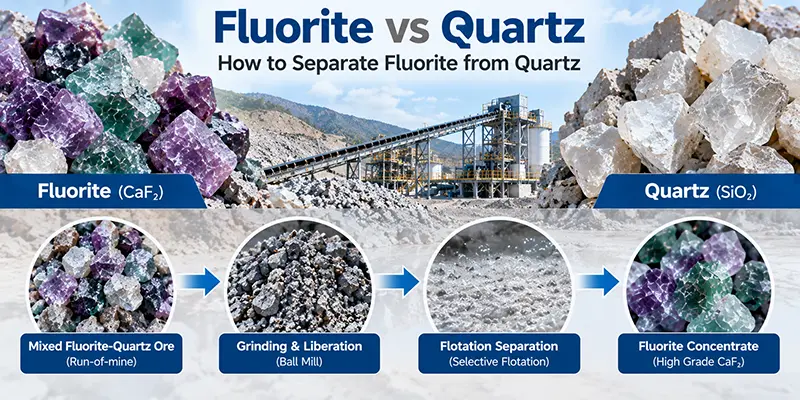
A typical fluorite-quartz separation circuit is:
Crushing → Grinding → Classification → Conditioning → Rougher Flotation → Cleaner Flotation → Fluorite Concentrate
The effectiveness of this process depends heavily on mineral liberation, grinding fineness, reagent selection, pulp chemistry and flotation-circuit design.
Why Is Fluorite and Quartz Separation Difficult?
Fluorite is calcium fluoride, CaF₂, while quartz is primarily silicon dioxide, SiO₂. Their chemical compositions are very different, but this does not mean they can always be separated easily.
Several characteristics of the ore can make separation difficult.
Fine Mineral Intergrowth
Fluorite may occur as fine particles intergrown with quartz.
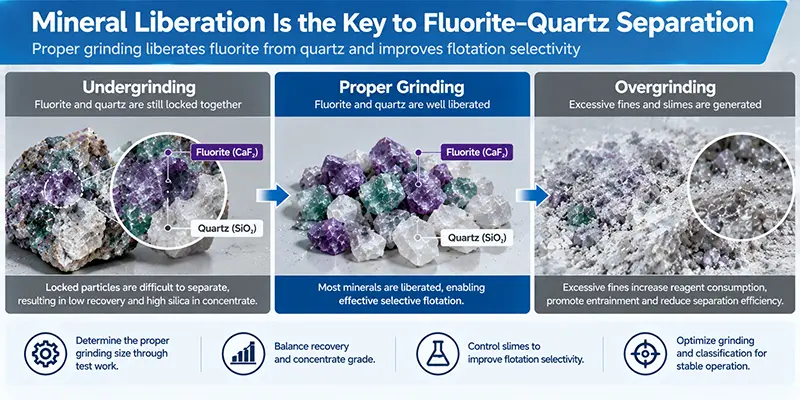
If the ore is not ground sufficiently, individual particles can still contain both fluorite and quartz. These locked particles are difficult to separate because the flotation system is effectively treating a mixed mineral surface.
This can result in:
Fluorite losses to tailings
Excessive silica in the concentrate
Lower CaF₂ concentrate grade
A difficult trade-off between recovery and grade
Mineral liberation should therefore be evaluated before attempting to solve the problem only by changing flotation reagents.
Fine Particles and Slimes
The opposite problem occurs when the ore is ground too finely.
Excessive grinding can generate fine particles and slimes. These particles have a high specific surface area and may interfere with selective reagent adsorption, increase reagent consumption and promote the entrainment of unwanted gangue into the flotation concentrate.
Therefore:
Finer grinding does not automatically produce better fluorite flotation.
The objective is sufficient liberation, not the smallest possible particle size.
Variable Gangue Composition
Quartz-rich fluorite ore rarely contains quartz alone.
Calcite, barite, clay minerals and sulfides may also be present. When the gangue composition changes, the flotation response may also change.
A reagent scheme developed for a relatively simple fluorite-quartz ore should not automatically be applied to a more complex deposit.
Step 1: Crush the Fluorite Ore
Before grinding, run-of-mine fluorite ore must be reduced to a suitable feed size.
A conventional crushing circuit may use:
Vibrating Feeder → Jaw Crusher → Cone Crusher → Vibrating Screen
The jaw crusher performs primary crushing, while the cone crusher further reduces the ore where secondary or fine crushing is required.
Screening controls the final crushed product and returns oversized particles for further crushing.
The objective at this stage is not to separate fluorite from quartz. Crushing prepares stable feed for the grinding circuit, where mineral liberation becomes the primary concern.
For harder ores or larger plants, closed-circuit crushing and screening can help control the product size and stabilize downstream grinding.
Step 2: Grind Fluorite and Quartz to Achieve Liberation
Grinding is one of the most important stages in fluorite-quartz separation.
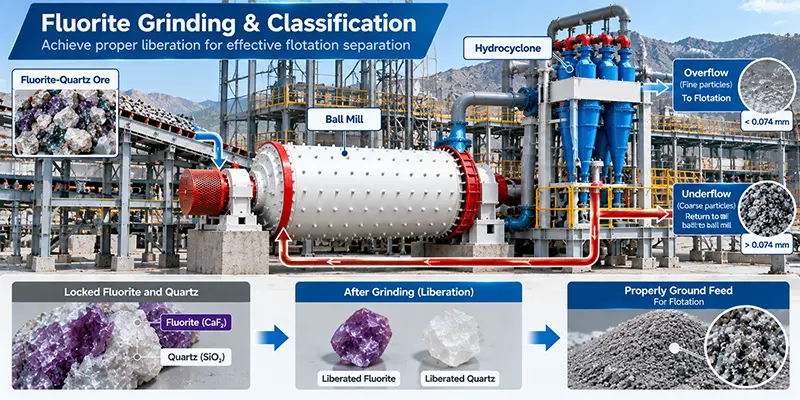
A typical closed-circuit configuration is:
Crushed Ore → Ball Mill → Hydrocyclone or Classifier
Fine material that reaches the required particle size proceeds to flotation, while coarse material returns to the mill.
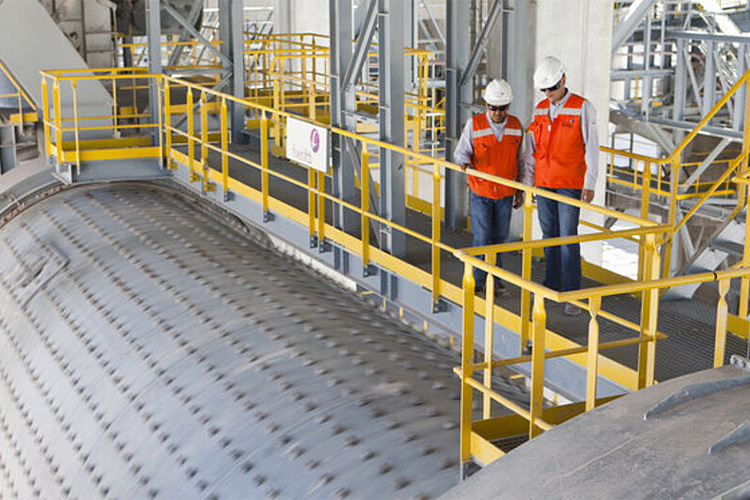
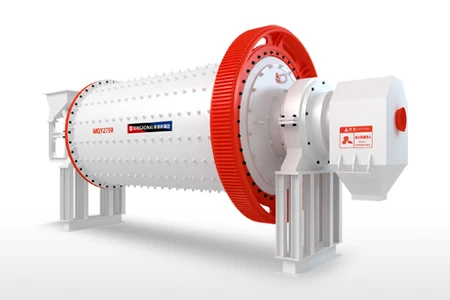
A Ball Mill can be used to liberate fluorite from quartz and other gangue minerals before flotation.
What Is the Best Grinding Size for Fluorite Flotation?
There is no universal grinding size that works for every fluorite ore.
The appropriate target depends on:
Fluorite crystal size
Association with quartz
Degree of mineral liberation
Ore texture
Ore hardness
Other gangue minerals
Flotation response at different sizes
If fluorite becomes sufficiently liberated at a relatively coarse size, further grinding may provide little benefit.
If significant fluorite remains locked with quartz, additional grinding or staged regrinding may be required.
The target size should therefore be determined through mineralogical analysis and beneficiation testing rather than copied from another plant.
Step 3: Classify the Ground Ore
Classification is closely connected to grinding performance.
After the ball mill, a hydrocyclone or classifier divides the particles according to the requirements of the grinding circuit.
The general principle is:
Fine Fraction → Flotation
Coarse Fraction → Return to Grinding
Without effective classification, coarse locked particles may enter flotation while already-fine particles continue to be unnecessarily ground.
Both conditions can reduce separation efficiency.
A stable grinding-classification circuit provides a more consistent flotation feed in terms of particle size and liberation.
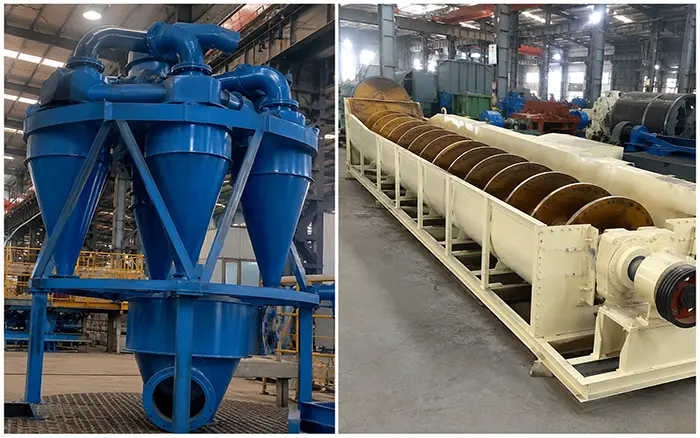
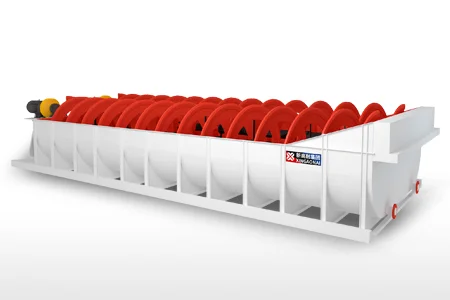
The differences between the main classification systems are explained in Hydrocyclone vs Spiral Classifier.
Step 4: Condition the Fluorite Slurry
Before flotation, the classified slurry is normally conditioned with the required reagents.
An agitation tank provides mixing among:
Mineral particles
Process water
Collectors
Depressants
pH modifiers
Other required reagents
Conditioning time and mixing intensity should allow sufficient reagent-mineral interaction without unnecessarily extending the process.
This stage is particularly important because selective flotation depends on creating different surface properties between fluorite and quartz.
Step 5: Separate Fluorite from Quartz by Flotation
Flotation is commonly used when finely disseminated fluorite must be separated from quartz.
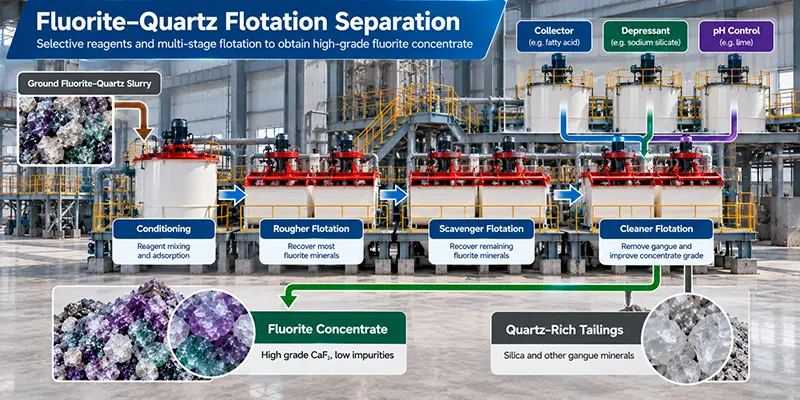
A simplified circuit is:
Conditioning → Rougher Flotation → Scavenger Flotation → Cleaner Flotation → Fluorite Concentrate
Each stage has a different objective.
Rougher Flotation
Rougher flotation aims to recover a large proportion of the liberated fluorite.
At this stage, recovery is generally more important than immediately producing the final concentrate grade.
The rougher concentrate may therefore contain some floated or entrained gangue.
Scavenger Flotation
Rougher tailings may still contain recoverable fluorite.
Scavenger flotation provides another opportunity to recover this material before the final tailings leave the circuit.
Depending on the flowsheet, the scavenger concentrate can be returned to an earlier stage for additional treatment.
Cleaner Flotation
Cleaner flotation focuses more strongly on concentrate quality.
The objective is to remove remaining quartz and other gangue from the rough concentrate and increase the CaF₂ grade.
Some quartz-rich ores may require several cleaning stages. When fluorite and quartz remain partially locked, rough-concentrate regrinding may be considered before further cleaning.
The circuit may then become:
Rougher Concentrate → Regrinding → Cleaner I → Cleaner II → Cleaner III → Final Concentrate
The number of cleaning stages should be based on test results rather than treated as a fixed design.
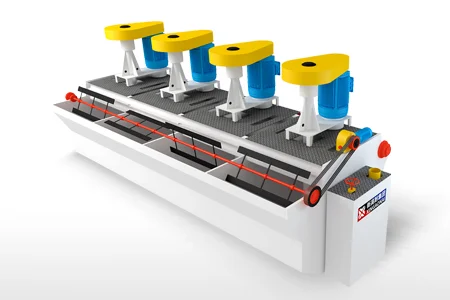
A Flotation Machine can be configured for roughing, scavenging and cleaning according to the required capacity and residence time.
What Reagents Are Used to Separate Fluorite from Quartz?
A typical reagent system may include:
| Reagent type | Main function |
|---|---|
| Collector | Promotes fluorite flotation |
| Depressant | Suppresses quartz and other unwanted gangue |
| pH modifier | Controls pulp chemistry and selectivity |
| Frother | Controls froth formation and stability |
Fatty-Acid Collectors
Fatty-acid-type collectors, including oleic-acid-related reagents, are commonly associated with fluorite flotation.
Their purpose is to make fluorite surfaces sufficiently hydrophobic so that the particles attach to air bubbles and report to the froth.
Increasing collector dosage indefinitely does not necessarily improve the process.
Excessive collector may:
Reduce selectivity
Increase reagent consumption
Increase gangue recovery
Make froth control more difficult
Sodium Silicate as a Quartz Depressant
Sodium silicate, also known as water glass, is widely used as a depressant or dispersant in fluorite systems containing silicate gangue.
Its purpose is to suppress quartz and other silicate minerals while fluorite is recovered.
Dosage is important.
Too little may produce poor quartz rejection. Too much may negatively affect fluorite recovery or make the flotation system more difficult to control.
Dosage should therefore be established through testing rather than presented as one fixed recipe.
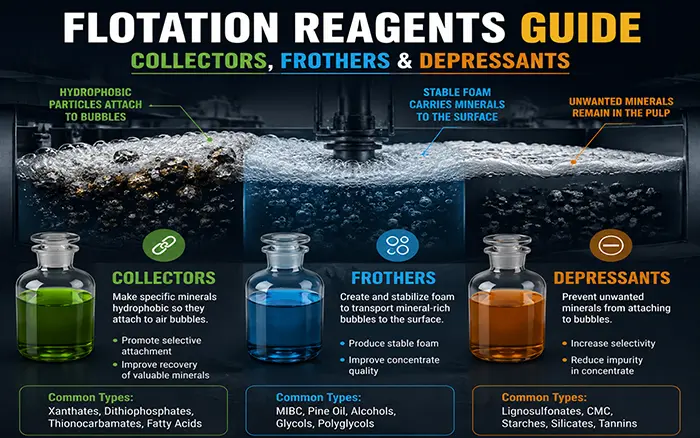
More information about reagent functions and selection is available in the Flotation Reagents Guide.
How Does pH Affect Fluorite-Quartz Flotation?
Pulp pH influences mineral surface chemistry and reagent behavior.
Changing pH can alter:
Collector adsorption
Depressant performance
Mineral surface charge
Froth behavior
Fluorite-quartz selectivity
There is no single pH value that is universally optimal for every deposit.
The correct range depends on mineralogy, water chemistry, collector type, depressant system and the presence of other minerals.
pH should therefore be optimized together with the complete reagent scheme rather than treated as an isolated parameter.
How to Reduce Silica in Fluorite Concentrate
High silica in the final concentrate is a common indication that fluorite-quartz separation needs improvement.
Adding more depressant is not always the correct solution.
1. Check Mineral Liberation
If fluorite and quartz remain physically locked, flotation reagents alone cannot completely separate them.
Determine whether additional grinding or rough-concentrate regrinding is required.
2. Check for Overgrinding
If the flotation feed contains excessive fines, quartz may enter the concentrate through entrainment or slime-related effects.
Reducing unnecessary overgrinding and improving classification can help.
3. Optimize Depressant Dosage
Insufficient depressant may allow too much quartz to float.
Excessive dosage may also interfere with fluorite recovery.
Testing several dosage levels is more useful than assuming that more reagent always means better separation.
4. Review Cleaner Flotation
A rougher concentrate with acceptable recovery may still require additional cleaning to reach the required CaF₂ grade.
The cleaner circuit should be reviewed before sacrificing large amounts of fluorite recovery in the rougher stage.
5. Evaluate Water Quality
Dissolved ions and recycled water can influence reagent behavior and mineral surfaces.
When performance changes without an obvious change in ore grade, water chemistry should be investigated.
Why Is Fluorite Recovery Low?
| Possible cause | Effect | Processing direction |
|---|---|---|
| Insufficient grinding | Fluorite remains locked with quartz | Improve liberation |
| Excessive grinding | Fine particles and slimes increase | Optimize grinding and classification |
| Poor classification | Flotation feed becomes unstable | Improve closed-circuit control |
| Insufficient collector | Valuable fluorite remains in tailings | Optimize dosage |
| Excessive depressant | Fluorite flotation may be suppressed | Rebalance the reagent scheme |
| Poor conditioning | Reagent distribution becomes inconsistent | Optimize mixing |
| Insufficient scavenging | Recoverable fluorite is lost | Review the scavenger circuit |
| Unstable froth | Recovery or selectivity declines | Adjust flotation conditions |
Low recovery is not automatically a flotation-machine problem. The cause may begin upstream in grinding or classification.
Fluorite Recovery vs Concentrate Grade
One of the most important considerations is the relationship between recovery and concentrate grade.
Trying to maximize recovery alone can bring more quartz into the concentrate.
Trying to maximize grade too aggressively can cause valuable fluorite to be rejected with the tailings.
A practical plant must balance:
Fluorite Recovery ↔ CaF₂ Grade
This is why rougher and cleaner stages have different objectives.
The rougher circuit prioritizes recovery, while the cleaner circuit progressively improves concentrate quality. A properly designed circuit distributes these objectives across different stages.
Typical Fluorite-Quartz Separation Flowsheet
Raw Fluorite Ore
↓
Crushing and Screening
↓
Ball Mill Grinding
↓
Classification
↓
Conditioning
↓
Rougher Flotation
↓
Scavenger Flotation
↓
Rough Concentrate
↓
Regrinding if Required
↓
Multiple Cleaner Flotation Stages
↓
Thickening and Filtration
↓
Fluorite Concentrate
This is a conceptual flowsheet.
The actual plant may require fewer or more stages depending on fluorite liberation, quartz content, other gangue minerals and concentrate specifications.
For the complete process, see the Fluorite Beneficiation Process and Plant Solution.
Equipment for Fluorite-Quartz Separation
| Process | Equipment |
|---|---|
| Feeding | Vibrating feeder |
| Primary crushing | Jaw crusher |
| Secondary crushing | Cone crusher |
| Screening | Vibrating screen |
| Grinding | Ball mill |
| Classification | Hydrocyclone or spiral classifier |
| Conditioning | Agitation tank |
| Roughing | Flotation machine |
| Scavenging | Flotation machine |
| Cleaning | Flotation machine |
| Concentrate thickening | Thickener |
| Concentrate dewatering | Filter press |
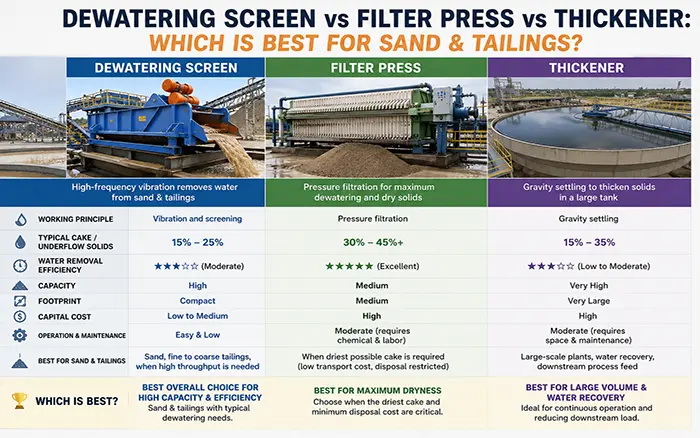
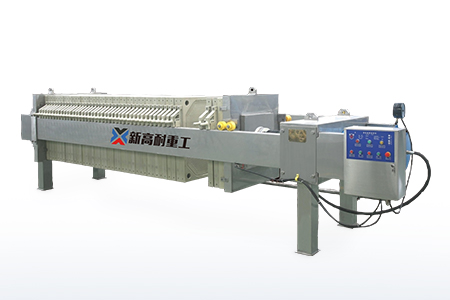
Where filtration is required, a Plate and Frame Filter Press can reduce the moisture content of fluorite concentrate after thickening.
The final equipment configuration depends on plant capacity, feed size, ore hardness, grinding requirements, flotation test results and product specifications.
Equipment should be selected after the beneficiation route has been established, not the other way around.
When Should You Consider a Different Process?
A different or combined approach may be considered when:
Fluorite is liberated at a relatively coarse size
Coarse waste can be rejected before grinding
The ore contains significant barite or calcite
Sulfide minerals require prior removal
Ore characteristics vary between mining zones
Excessive fines make conventional flotation difficult
Gravity pre-concentration, staged grinding, sulfide flotation, regrinding or other modifications may improve the complete flowsheet.
The decision should be based on ore characterization and beneficiation testing.
Build the Process Around the Ore, Not a Fixed Recipe
Successful fluorite-quartz separation begins with understanding how fluorite occurs in the ore.
If fluorite remains locked with quartz, improve liberation. If excessive fines enter flotation, review grinding and classification. If the minerals are sufficiently liberated but quartz still enters the concentrate, investigate conditioning, reagent dosage, pulp chemistry and cleaner flotation.
The correct sequence is:
Mineralogy → Liberation → Grinding → Classification → Reagent Conditioning → Flotation → Concentrate Quality
Rather than relying on a fixed reagent recipe or simply adding more flotation stages, XINGAONAI can configure the grinding, classification and flotation equipment around the actual ore and concentrate requirements