Fluorite, also known as fluorspar, is a calcium fluoride mineral with the chemical formula CaF₂. It is an important source of fluorine for the chemical, metallurgical and other industries.
Natural fluorite ores, however, are rarely composed of fluorite alone. They are commonly associated with quartz, calcite, barite, sulfide minerals and other gangue. Beneficiation is therefore normally required to produce a marketable concentrate.
There is no single fluorite beneficiation process suitable for every deposit. The appropriate flowsheet depends on:
Ore mineralogy
Fluorite grade
Gangue composition
Mineral liberation size
Particle-size distribution
Required concentrate quality
Plant capacity
Water and site conditions
For coarse and sufficiently liberated fluorite, gravity separation may be considered for pre-concentration or the production of certain metallurgical-grade products.
For finely disseminated or complex fluorite ores, flotation is generally the more important separation method.
The fluorite processing route and equipment configuration should therefore be selected according to the characteristics of the actual ore rather than by applying one fixed flowsheet to every project.
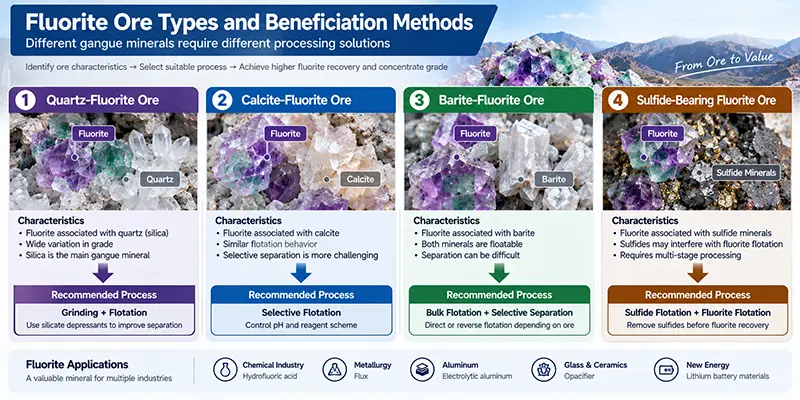
Fluorite Ore Types and Beneficiation Methods
The gangue minerals associated with fluorite have a major influence on process selection.
Quartz-, calcite-, barite- and sulfide-bearing fluorite ores require different separation conditions because their surface properties and processing challenges are different.
| Fluorite ore type | Main separation challenge | Typical processing direction |
|---|---|---|
| Quartz-fluorite ore | Reducing silica in the concentrate | Grinding and flotation |
| Calcite-fluorite ore | Similar flotation behavior of calcium minerals | Selective flotation |
| Barite-fluorite ore | Separating two floatable minerals | Bulk flotation and separation or selective flotation |
| Sulfide-bearing fluorite | Removing sulfide minerals before fluorite recovery | Sulfide flotation followed by fluorite flotation |
| Coarse liberated fluorite | Recovering fluorite before excessive grinding | Gravity separation may be considered |
The main gangue minerals should be identified before flotation reagents or the final equipment configuration are selected.
Complete Fluorite Beneficiation Process
A flotation-based fluorite processing plant can generally be represented as:
Raw Fluorite Ore → Crushing → Screening → Grinding → Classification → Conditioning → Rougher Flotation → Scavenging and Cleaning → Concentrate Thickening → Filtration → Fluorite Concentrate
The actual circuit may be simpler or more complex depending on the ore.
A relatively simple quartz-fluorite ore may require conventional grinding followed by roughing and several cleaning stages.
More complex ores may require:
Staged grinding
Regrinding of rough concentrate
Sulfide removal
Gravity pre-concentration
Additional flotation stages
Separate treatment of intermediate products
The objective is not to maximize the number of processing stages. It is to achieve sufficient mineral liberation and selective separation using a practical flowsheet.
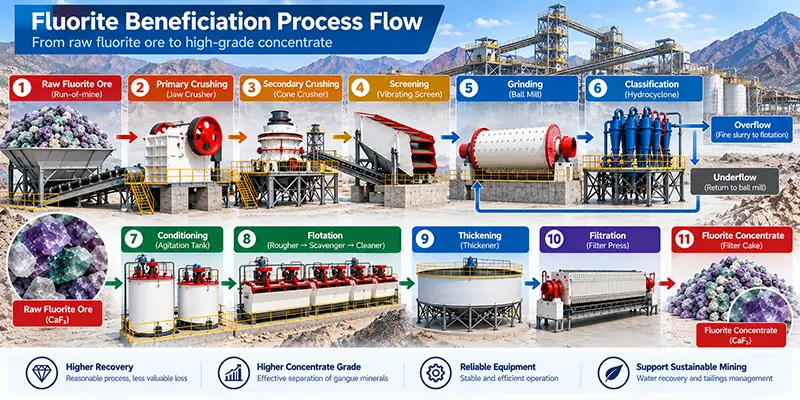
Stage 1: Fluorite Ore Crushing and Screening
Run-of-mine fluorite ore is first reduced to a particle size suitable for grinding.
A typical crushing section may include:
Vibrating Feeder → Jaw Crusher → Cone Crusher → Vibrating Screen
The jaw crusher performs primary size reduction. A cone crusher can be used for secondary or fine crushing where required. The vibrating screen controls the final crushed product size and returns oversize material for further crushing.
The crushing circuit should provide stable and reasonably uniform feed to the grinding stage. It should not attempt to achieve the final mineral liberation size through crushing alone.
For harder ores or larger plant capacities, closed-circuit crushing and screening can help control product size and stabilize downstream grinding.
Stage 2: Grinding and Classification
Grinding is one of the most important stages in fluorite beneficiation because flotation performance depends strongly on mineral liberation.
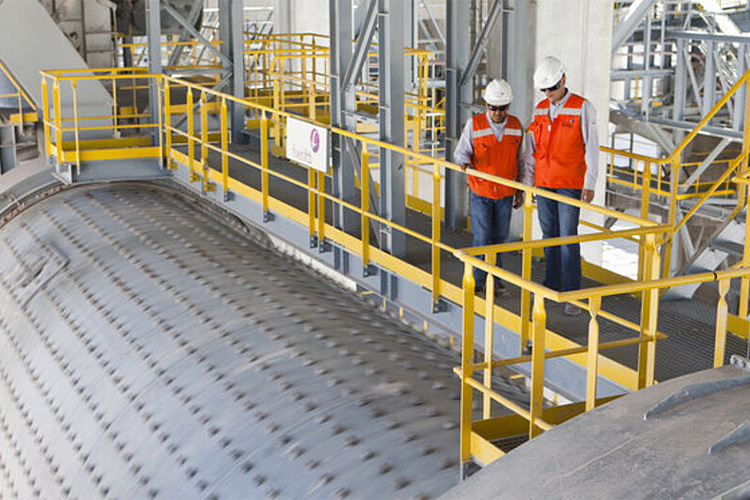
After crushing, the ore normally enters a Ball Mill or another suitable grinding mill.
The objective is to liberate fluorite particles from quartz, calcite, barite and other associated minerals without generating unnecessary fine particles.
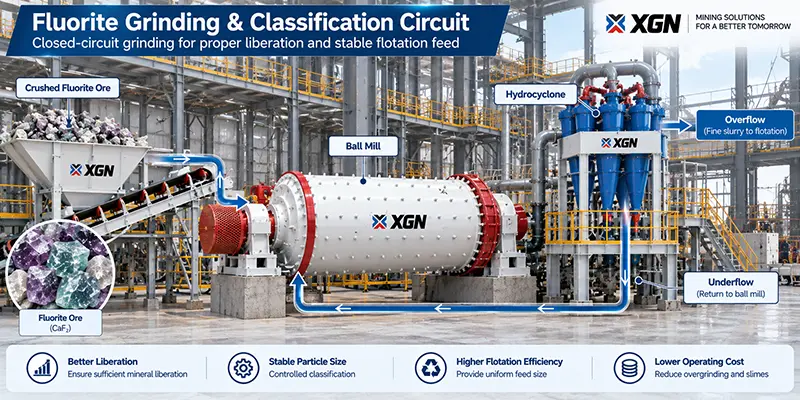
A typical closed grinding circuit is:
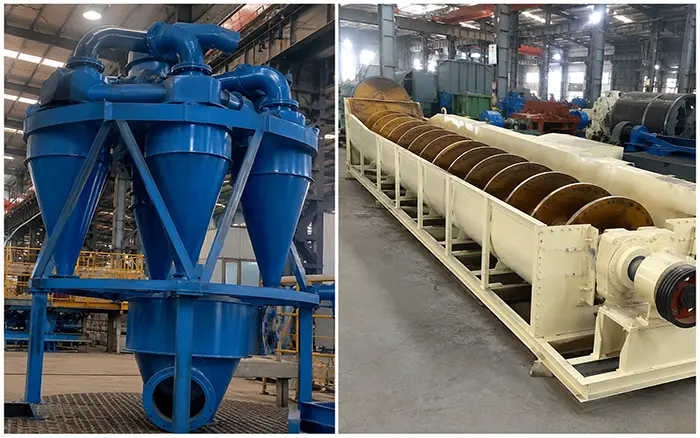
Crushed Ore → Ball Mill → Hydrocyclone or Spiral Classifier
The classifier separates the ground slurry into two streams:
Fine particles that meet the required size proceed to flotation.
Coarse particles return to the mill for additional grinding.
Closed-circuit classification helps maintain a more controlled flotation feed.
The choice between the two main classification systems is discussed in Hydrocyclone vs Spiral Classifier.
Why Grinding Fineness Matters
Grinding fluorite ore as fine as possible is not necessarily beneficial.
Undergrinding can leave fluorite locked with gangue minerals, reducing separation efficiency.
Overgrinding can generate excessive fines or slimes. These particles may make selective flotation more difficult and increase reagent consumption.
The target grinding size should be determined according to the liberation characteristics of the actual ore and confirmed through beneficiation tests.
Stage 3: Fluorite Flotation Process
For finely disseminated and complex fluorite ores, flotation is usually the core beneficiation stage.
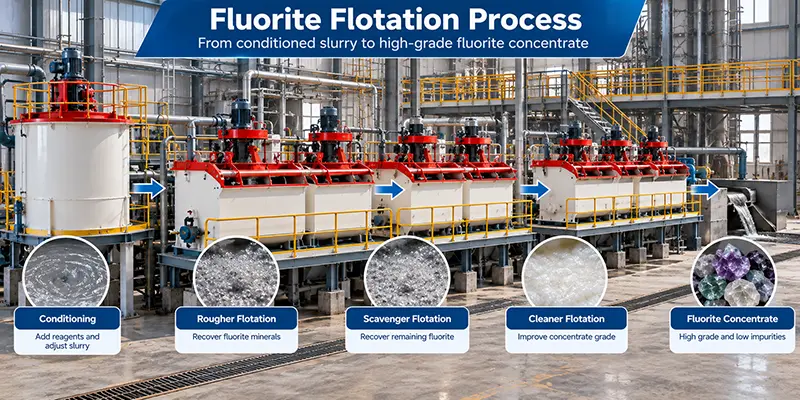
Before flotation, the ground slurry enters an agitation tank where it is conditioned and the flotation reagents are mixed with the mineral particles.
A typical circuit may include:
Conditioning → Rougher Flotation → Scavenger Flotation → Cleaner Flotation → Fluorite Concentrate
Rougher Flotation
The rougher stage aims to recover as much liberated fluorite as practical from the flotation feed.
The rough concentrate may proceed directly to cleaning or be reground first when fluorite remains locked with gangue minerals.
Scavenger Flotation
Scavenger flotation treats rougher tailings to recover additional valuable fluorite that would otherwise be lost.
The recovered material can be returned to an appropriate point in the circuit according to the plant design.
Cleaner Flotation
Cleaner stages focus on removing remaining gangue and increasing the CaF₂ grade of the fluorite concentrate.
Complex ores may require several cleaning stages. Quartz-type fluorite flowsheets, for example, may include roughing, rough-concentrate regrinding and multiple cleaning stages when a higher-quality concentrate is required.
The number of stages should therefore be determined from flotation tests rather than fixed in advance.
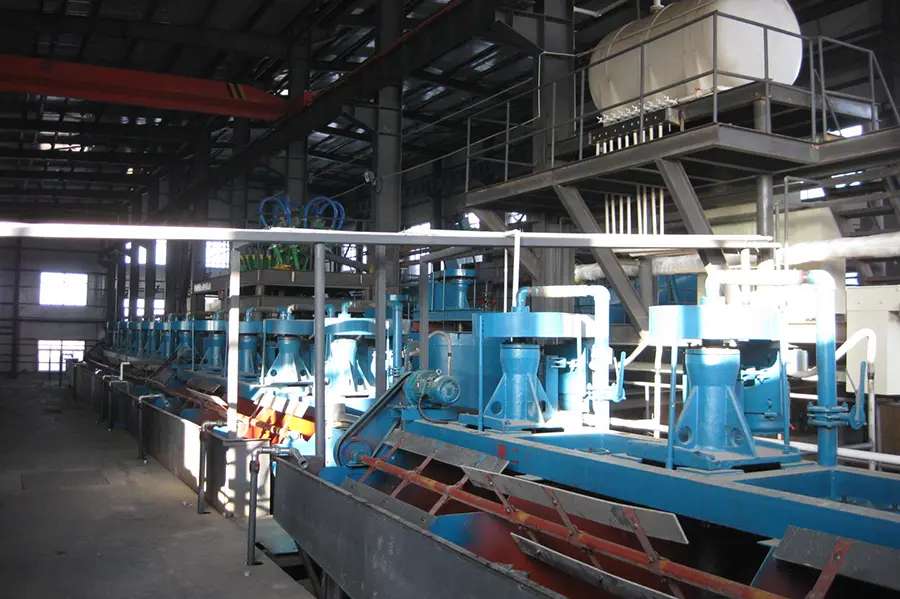
A Flotation Machine can be configured for roughing, scavenging and cleaning according to the required capacity and flotation residence time.
How to Separate Fluorite from Different Gangue Minerals
Gangue mineralogy is one of the main reasons fluorite flotation flowsheets vary between deposits.
Fluorite and Quartz Separation
For quartz-rich fluorite ore, sufficient liberation is the first requirement.
Fatty-acid-type collectors are commonly associated with fluorite flotation. Sodium silicate, also called water glass, may be used to depress silicate gangue such as quartz.
Reagent dosage must be controlled because excessive depressant can also reduce fluorite flotation performance.
Grinding is equally important. Insufficient liberation leaves fluorite and quartz locked together, while excessive grinding creates fine particles that may be difficult to treat.
Fluorite-quartz separation therefore depends on the combined control of:
Grinding fineness
Collector dosage
Depressant dosage
Pulp pH
Cleaner flotation
Water chemistry
Fluorite and Calcite Separation
Calcite-fluorite ore can be more difficult to process selectively because fluorite and calcite are both calcium-bearing minerals and may respond to similar collectors.
The process must create sufficient differences in their flotation behavior through appropriate control of:
Grinding fineness
Pulp chemistry
Depressant selection
Collector selection
Reagent addition sequence
Flotation conditions
The reagent scheme should be established through tests using the actual ore rather than copied from another plant.
Fluorite and Barite Separation
Barite and fluorite may both respond to flotation collectors, making selective separation challenging.
One possible route is:
Bulk Flotation → Fluorite-Barite Mixed Concentrate → Selective Separation
Depending on the minerals and their flotation response, direct or reverse flotation may then be used to separate the two minerals.
Another possibility is a more selective flotation route without producing the same bulk concentrate.
The appropriate method depends on mineral association, liberation and flotation test results.
Fluorite and Sulfide Mineral Separation
When fluorite ore contains significant sulfide minerals, the sulfides may be removed before fluorite flotation.
A simplified route is:
Grinding → Sulfide Flotation → Fluorite Conditioning → Fluorite Flotation
This reduces the risk of sulfide minerals contaminating the final fluorite concentrate.
The flotation sequence and reagent scheme should be selected according to the sulfide minerals present and their association with fluorite.
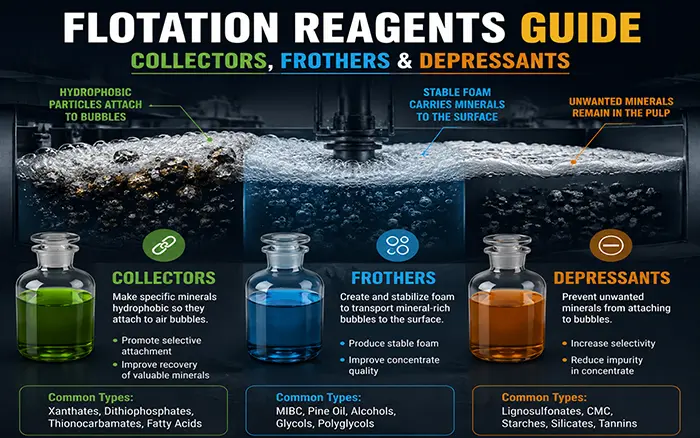
Fluorite Flotation Reagents
Reagent selection affects both fluorite recovery and concentrate grade.
| Reagent type | Main function |
|---|---|
| Collector | Promotes fluorite attachment to air bubbles |
| Depressant | Suppresses unwanted gangue minerals |
| pH modifier | Adjusts pulp chemistry for selective flotation |
| Frother | Helps generate and control flotation froth |
Fatty-acid-type collectors are widely associated with fluorite flotation. Sodium silicate is frequently used when silicate gangue needs to be depressed.
However, a reagent scheme suitable for quartz-rich ore may not be suitable for calcite- or barite-rich ore.
Grinding fineness, pulp pH, reagent type and dosage, water chemistry and flotation operating conditions can all affect performance.
There should therefore be no universal reagent recipe for every fluorite deposit. The functions and selection considerations of the main reagent categories are explained in the Flotation Reagents Guide.
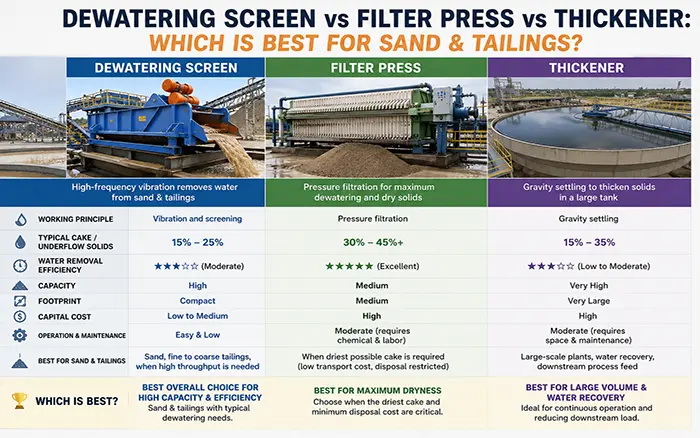
Stage 4: Fluorite Concentrate Thickening and Dewatering
After flotation, the fluorite concentrate still contains a substantial amount of process water.
A typical dewatering section is:
Flotation Concentrate → Thickener → Filter Press → Fluorite Concentrate Cake
The thickener increases the solids concentration and allows part of the process water to be recovered.
The thickened concentrate is then sent to a Plate and Frame Filter Press to remove additional water and produce a concentrate that is easier to handle, store and transport.
Where required by the product specification or downstream process, additional drying may be considered after filtration.
Water recovered from thickening and filtration may be reused after appropriate treatment and water-quality assessment.
Gravity Separation vs Flotation for Fluorite
Not every fluorite ore requires the same beneficiation method.
| Factor | Gravity separation | Flotation |
|---|---|---|
| Suitable feed | Coarse, sufficiently liberated ore | Fine or complex ore |
| Main principle | Density difference | Surface-property difference |
| Process complexity | Relatively simple | More complex |
| Reagent requirement | Low or none during separation | Flotation reagents required |
| Typical objective | Pre-concentration or certain coarse products | Higher-grade concentrate and selective separation |
| Main challenge | Requires sufficient density and liberation differences | Sensitive to grinding and pulp chemistry |
Gravity separation can be attractive when fluorite occurs as relatively coarse liberated particles.
Flotation becomes more important when fluorite is finely disseminated or closely associated with quartz, calcite, barite or sulfide minerals.
Some deposits may benefit from a combined process rather than selecting only one method.
Factors Affecting Fluorite Recovery and Concentrate Grade
A successful plant depends on more than the flotation machine itself.
1. Mineral Liberation
Fluorite must be sufficiently liberated from gangue before effective separation can occur.
2. Grinding Fineness
A coarse product may contain locked particles, while excessive grinding increases slime generation.
3. Classification Efficiency
Stable classification provides a more consistent particle-size distribution to flotation.
4. Gangue Composition
Quartz, calcite, barite and sulfide minerals require different separation strategies.
5. Reagent Scheme
Collector, depressant, modifier and frother selection must match the mineralogical characteristics.
6. Pulp Conditions
pH, slurry concentration, temperature and water chemistry affect selectivity and froth behavior.
7. Flotation Circuit Configuration
The balance among roughing, scavenging, cleaning and possible regrinding affects both recovery and concentrate grade.
Low fluorite recovery should not automatically be addressed by adding more collector or more flotation cells. The complete grinding-classification-flotation circuit should be evaluated.
Fluorite Beneficiation Equipment
| Processing stage | Main equipment | Function |
|---|---|---|
| Feeding | Vibrating feeder | Provides stable ore feeding |
| Primary crushing | Jaw crusher | Reduces run-of-mine ore |
| Secondary crushing | Cone crusher | Further reduces particle size |
| Screening | Vibrating screen | Controls crushed product size |
| Grinding | Ball mill | Liberates fluorite from gangue |
| Classification | Hydrocyclone or spiral classifier | Controls flotation feed size |
| Conditioning | Agitation tank | Mixes slurry and reagents |
| Separation | Flotation machine | Recovers fluorite from gangue |
| Thickening | Thickener | Increases concentrate solids |
| Filtration | Filter press | Dewaters fluorite concentrate |
The equipment list should not be treated as a fixed package.
Equipment type, model, quantity and size depend on throughput, ore hardness, feed size, grinding requirements and the selected beneficiation process.
Fluorite Processing Plant Configuration
A possible conventional flotation configuration is:
Feeding and Crushing
Vibrating Feeder
↓
Jaw Crusher
↓
Cone Crusher
↓
Vibrating Screen
Grinding and Classification
Ball Mill
↓
Hydrocyclone or Spiral Classifier
↺ Coarse particles return to grinding
Conditioning and Flotation
Agitation Tank
↓
Rougher Flotation
↓
Scavenging and Cleaning
↓
Fluorite Concentrate
Concentrate Dewatering
Thickener
↓
Filter Press
↓
Final Fluorite Concentrate
Complex ores may require pre-concentration, staged grinding, concentrate regrinding, sulfide flotation or additional cleaner stages.
Process selection should therefore come before equipment selection.
How XINGAONAI Designs a Fluorite Beneficiation Solution
Before determining the equipment configuration, the following parameters should be evaluated:
Feed CaF₂ grade
Main gangue minerals and proportions
Mineral associations and liberation characteristics
Run-of-mine feed size
Ore hardness and grinding characteristics
Required processing capacity
Target concentrate grade
Expected recovery
Process-water availability and quality
Site and layout requirements
Tailings and water-management requirements
Based on these parameters and beneficiation test results, XINGAONAI can configure the crushing, grinding, classification, flotation and dewatering sections.
For existing plants, the same approach can identify whether performance limitations originate from insufficient liberation, poor classification, unsuitable reagent conditions, flotation configuration or concentrate handling.
A practical example of recovering additional fluorite from previously discarded material is the 100 TPD Fluorite Tailings Re-flotation Recovery Project.
From Ore Characteristics to the Right Fluorite Process
A fluorite beneficiation project should not begin by selecting a flotation machine or copying a flowsheet from another mine. It should begin with understanding the ore.
Coarse liberated fluorite may allow gravity pre-concentration. Finely disseminated fluorite generally requires grinding and flotation. Quartz-, calcite-, barite- and sulfide-bearing ores introduce different separation challenges.
The most practical design combines appropriate mineral liberation, controlled classification, selective flotation and effective concentrate dewatering in one integrated system.
XINGAONAI can configure the equipment according to ore characteristics, plant capacity, concentrate requirements and test results, helping develop a processing line suited to the actual deposit.
Frequently Asked Questions
What is the most common beneficiation method for fluorite ore?
Flotation is widely used for finely disseminated or complex fluorite ores because it can selectively separate fluorite from quartz, calcite and barite. Coarse and sufficiently liberated fluorite may also be suitable for gravity separation or pre-concentration.
What is the difference between fluorite and fluorspar?
Fluorite is the mineral name for calcium fluoride, CaF₂, while “fluorspar” is commonly used in industrial and commercial contexts. Both terms are frequently used for fluorite ore and concentrate.
Why is calcite difficult to separate from fluorite?
Fluorite and calcite are both calcium-bearing minerals and can respond similarly to some collectors. Selective separation therefore depends on liberation, pulp chemistry, depressants, collectors and controlled flotation conditions.
Can gravity separation and flotation be used together?
Yes. Gravity separation may recover or reject sufficiently liberated coarse material before the finer or more complex fraction enters flotation. The value of a combined flowsheet should be confirmed through testing.
How do you choose equipment for a fluorite processing plant?
Equipment selection should consider feed size, ore hardness, throughput, liberation size, beneficiation method and final concentrate requirements. The process route should be established before individual equipment models are selected.