Selecting a ball mill based on throughput alone can lead to an undersized mill that cannot achieve the required product fineness or an oversized mill that increases capital and energy costs. A 100 TPH grinding circuit, for example, does not automatically require a specific mill diameter and length.
Proper ball mill sizing considers how much material must be processed, how coarse the feed is, how fine the product must be, and how much energy the ore requires for size reduction. Ore grindability, circuit configuration, slurry conditions, and classification efficiency can also influence the final selection.
For preliminary engineering, the sizing process can be summarized as:
Ore characteristics → F80 and P80 → grinding energy → required power → mill dimensions
This guide explains each step and shows how these parameters work together when selecting a Ball Mill for a mineral processing circuit.
What Does Ball Mill Sizing Mean?
Ball mill sizing is the process of determining the mill dimensions, power requirement, and operating configuration needed to achieve a target throughput and grind size.
A mill size is commonly expressed by its diameter and length, such as:
Ø3.2 × 4.5 m
However, choosing a diameter and length is the result of the sizing process—not the starting point.
Before a preliminary mill size can be selected, engineers normally need to understand:
Required throughput
Feed particle size
Target product size
Ore grindability
Ore density
Wet or dry grinding
Open or closed circuit
Classification requirements
Expected operating conditions
This is why two plants processing the same tonnage can require different grinding power and different mill sizes.
Key Parameters Required for Ball Mill Sizing
Several parameters have a particularly strong influence on preliminary sizing.
| Parameter | Meaning | Why It Matters |
|---|---|---|
| Throughput | Required plant capacity, usually t/h | Determines total grinding duty |
| F80 | Size through which 80% of feed passes | Represents the starting particle size |
| P80 | Size through which 80% of product passes | Defines the target grind |
| Bond Work Index (Wi) | Ore grindability indicator, kWh/t | Helps estimate grinding energy |
| Ore density | Density of the material being processed | Influences mill and slurry loading |
| Grinding method | Wet or dry | Changes operating conditions |
| Circuit type | Open or closed circuit | Influences classification and circulating load |
| Solids concentration | Percentage of solids in slurry | Affects wet grinding behavior |
These parameters should be evaluated together rather than independently.
Throughput
Throughput defines how much ore the grinding circuit must process over a given period.
For example:
Required capacity = 150 t/h
A higher throughput generally increases total power demand because more material must be ground per hour.
However, throughput alone is not enough to select a mill. A 150 TPH circuit producing a relatively coarse product can have very different requirements from a 150 TPH circuit producing a fine flotation feed.
If you primarily want to estimate how operating variables affect production rate rather than determine mill dimensions, see our Ball Mill Capacity Calculation guide.
F80 Feed Size
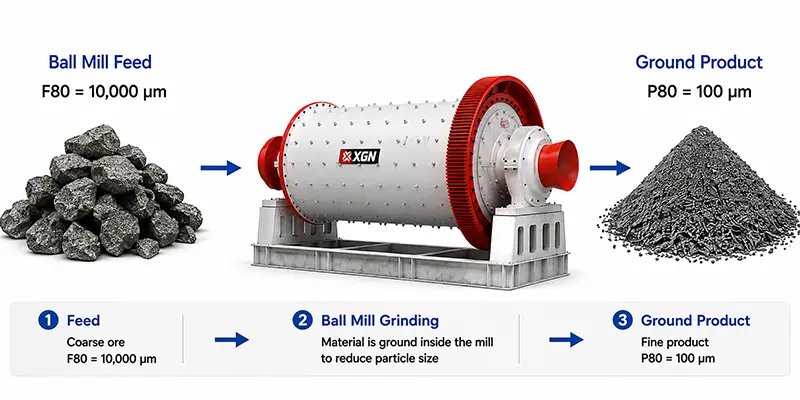
F80 is the particle size at which 80% of the mill feed passes.
For example:
F80 = 10,000 μm = 10 mm
F80 provides a much more useful engineering description of the feed than simply stating the maximum lump size.
Coarser feed generally increases the amount of size reduction that must occur inside the mill. Proper upstream crushing equipment can therefore have a major influence on the grinding duty.
P80 Product Size
P80 is the particle size at which 80% of the mill product passes.
For example:
P80 = 100 μm
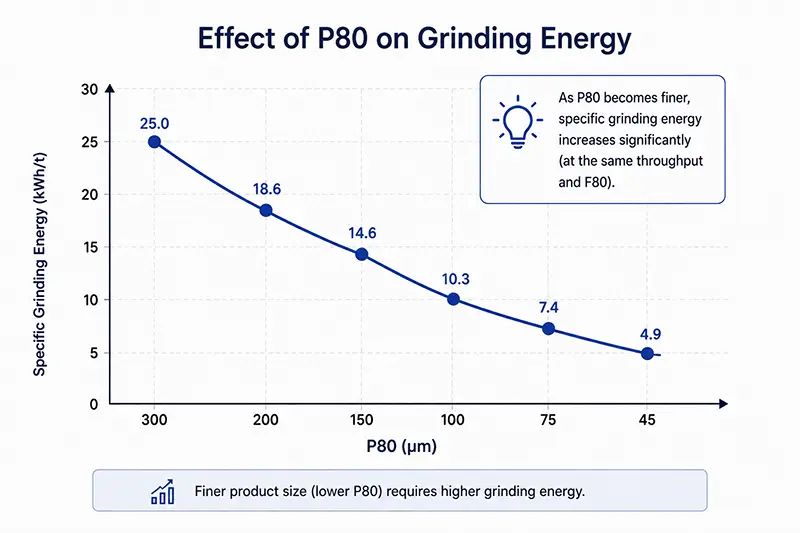
The smaller the target P80, the more size reduction is required.
Grinding from:
10 mm → 150 μm
is a different duty from:
10 mm → 75 μm
even when the ore type and throughput are identical.
This is particularly important in mineral beneficiation because downstream flotation, magnetic separation, or gravity separation often requires sufficient mineral liberation within a specified particle-size range.
Bond Work Index
The Bond Ball Mill Work Index (BWi) is commonly used as an indicator of the energy required to grind an ore under standardized test conditions.
It is normally obtained through laboratory grindability testing.
In general:
Higher Wi → greater grinding resistance → higher energy requirement
However, the Work Index should be determined from representative ore testwork whenever possible. Assigning one fixed value to all copper ore, iron ore, graphite, or lithium ore can result in misleading calculations because grindability can vary substantially within the same broad ore category.
Step-by-Step Ball Mill Sizing Calculation
A preliminary ball mill sizing exercise can be organized into six steps.
Step 1: Define the Required Throughput
Start with the expected plant production rate.
Assume a mineral processing plant requires:
Q = 150 t/h
Where possible, distinguish between:
Average operating throughput
Nominal design throughput
Maximum expected throughput
Designing exactly around an average value without considering normal feed variation can leave insufficient operating flexibility.
Step 2: Determine F80 and P80
Next, obtain representative feed and target product size distributions.
For this example:
F80 = 10,000 μm
P80 = 100 μm
The difference between F80 and P80 represents the size reduction duty that the grinding circuit must accomplish.
If the upstream crusher produces a finer and more consistent feed, the grinding duty may decrease. Conversely, demanding a substantially finer P80 can increase the required specific energy.
Step 3: Obtain the Bond Work Index
Assume laboratory testing gives:
Wi = 15 kWh/t
The Work Index provides a basis for estimating the specific energy required for the target size reduction.
For a real project, testwork is preferable to choosing a generic value from an online table.
Ore mineralogy, texture, alteration, weathering, and the representativeness of the sample can all affect grinding behavior.
Step 4: Estimate Specific Grinding Energy
A commonly used Bond relationship for preliminary energy estimation is:
W = 10 × Wi × (1/√P80 − 1/√F80)
Where:
W = specific grinding energy, kWh/t
Wi = Bond Work Index, kWh/t
P80 = 80% passing product size, μm
F80 = 80% passing feed size, μm
Using the example values:
Wi = 15 kWh/t
F80 = 10,000 μm
P80 = 100 μm
The calculation becomes:
W = 10 × 15 × (1/√100 − 1/√10,000)
W ≈ 13.5 kWh/t
This represents a preliminary specific energy estimate before applying the appropriate correction and design considerations for the actual circuit.
Step 5: Estimate Required Grinding Power
Once the specific energy and throughput are known, the theoretical grinding power can be estimated:
P = W × Q
Using:
W = 13.5 kWh/t
and:
Q = 150 t/h
gives:
P ≈ 2,025 kW
This number should not automatically be treated as the final motor rating.
Actual drive selection may need to consider:
Mechanical efficiency
Drive losses
Design margin
Mill type
Mill diameter
Circuit configuration
Feed characteristics
Operating variability
Applicable Bond correction factors
The purpose of this calculation is to establish the approximate grinding duty before matching that duty to an actual mill.
Step 6: Select Mill Diameter and Length
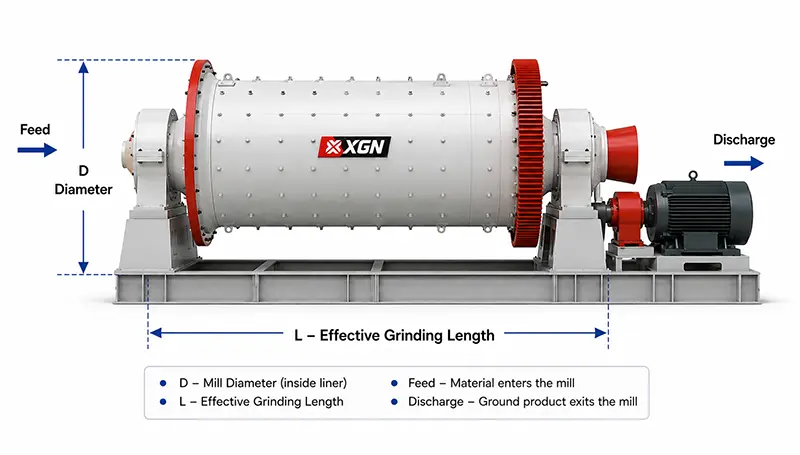
Once the required grinding power is established, engineers can begin matching the duty to available mill dimensions and drive configurations.
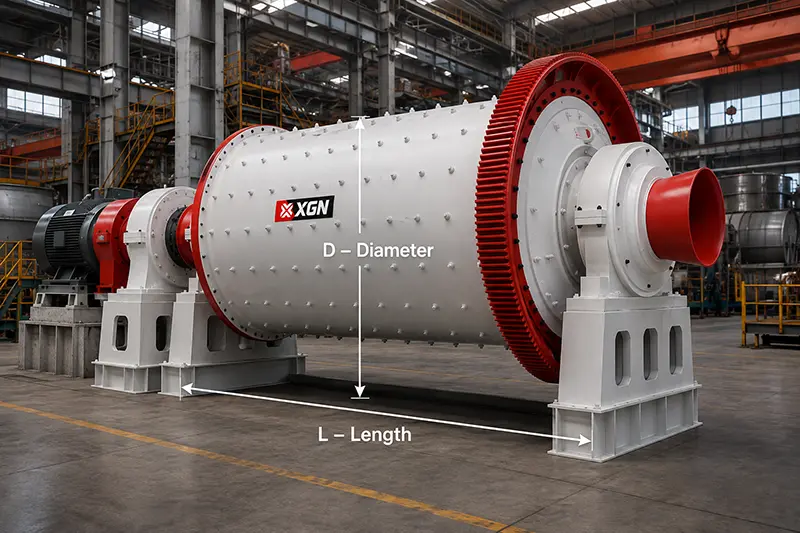
Ball mill dimensions are generally expressed as:
Diameter × Length (D × L)
Diameter strongly affects available mill power and grinding action, while length influences internal volume and material residence behavior.
Final selection should also consider:
Mill speed
L/D ratio
Ball charge
Liner design
Discharge system
Bearing configuration
Drive arrangement
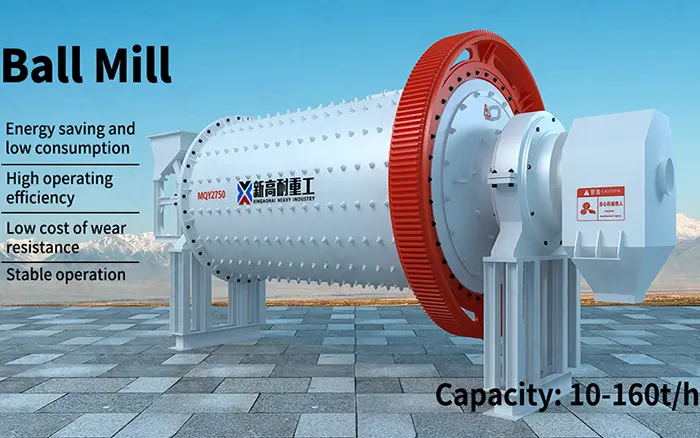
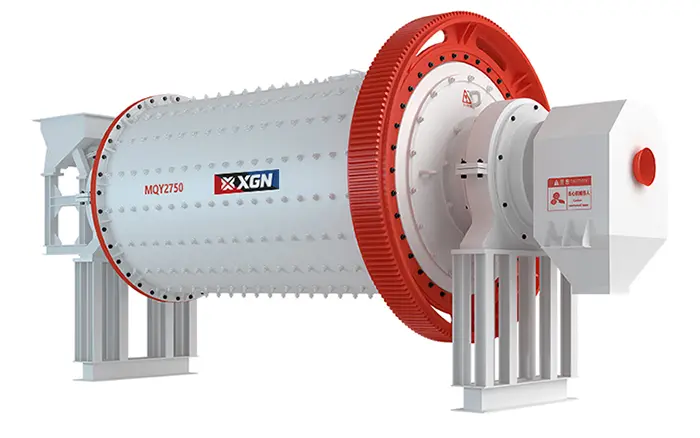
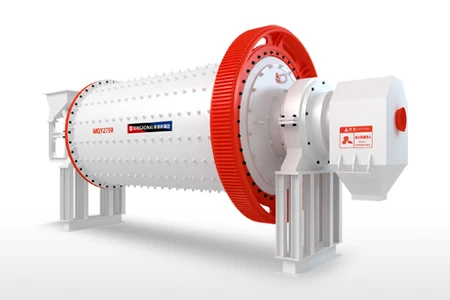
XINGAONAI Ball Mills are available in different diameters and lengths as well as overflow and grate-discharge configurations, allowing the equipment to be matched to different grinding duties and downstream processing requirements.
Ball Mill Sizing Example
Consider a preliminary copper ore grinding project with the following data:
| Parameter | Example Value |
|---|---|
| Throughput | 150 t/h |
| F80 | 10,000 μm |
| P80 | 100 μm |
| Bond Work Index | 15 kWh/t |
| Grinding | Wet |
| Circuit | Closed circuit |
1. Calculate Specific Energy
Using the simplified Bond relationship:
W ≈ 13.5 kWh/t
2. Calculate Theoretical Grinding Power
P = 13.5 × 150
P ≈ 2,025 kW
3. Evaluate the Actual Circuit
The theoretical value must then be reviewed against:
Correction factors
Classification efficiency
Circulating load
Ore variability
Slurry conditions
Mill mechanical efficiency
Required operating margin
4. Select a Preliminary Mill
The manufacturer can then compare the required duty with its available mill diameter, length, drive power, discharge type, and operating data.
This is an important distinction:
A sizing calculation establishes the grinding requirement; it does not automatically determine the final machine model.
Final equipment selection should be verified against representative testwork and manufacturer performance data.
How Ore Properties Affect Ball Mill Sizing
Ore type alone does not determine the required mill size.
Two copper deposits, for example, may have very different grindability because their mineralogy, texture, hardness, and degree of alteration are different.
Important ore characteristics include:
Grindability
A higher Bond Work Index generally means more energy is required to reach the same P80.
Mineral Liberation
Grinding is performed to achieve useful mineral liberation—not simply to produce the finest possible material.
For example, a graphite beneficiation process may require careful control of grinding to avoid unnecessary damage to valuable large flakes, while other ores may require substantially finer grinding to expose valuable minerals.
Abrasiveness
Highly abrasive ore can increase liner and grinding-media consumption. Although this does not directly define the mill diameter, it can influence mill design, liner selection, operating cost, and maintenance planning.
Ore Density
Ore density affects mill loading and slurry behavior and should therefore be included when reviewing the mechanical and operating design.
For these reasons, representative testwork should be used whenever the project moves beyond preliminary sizing.
How F80 and P80 Affect Mill Power
Suppose two grinding circuits process the same ore at the same throughput.
Circuit A requires:
F80 = 10 mm → P80 = 150 μm
Circuit B requires:
F80 = 10 mm → P80 = 75 μm
Circuit B generally requires more grinding energy because it must produce a finer product.
This creates an important relationship:
Finer target P80 → higher grinding duty → potentially higher power requirement
It also explains why upstream crushing and downstream mineral liberation requirements should be evaluated together.
Making the crusher product finer may reduce part of the ball mill grinding duty, but excessive crushing can create its own energy, wear, and process-control issues.
The objective is therefore not to minimize F80 or P80 independently. The objective is to optimize the complete comminution circuit.
Open-Circuit vs Closed-Circuit Ball Mill Sizing
Circuit configuration also affects how a ball mill performs.
Open-Circuit Grinding
A simple open circuit can be represented as:
Feed → Ball Mill → Product
Material passes through the mill without an external classifier returning coarse particles.
Open circuits may be suitable where a relatively coarse product is acceptable or where tight control of product size is not essential.
Closed-Circuit Grinding
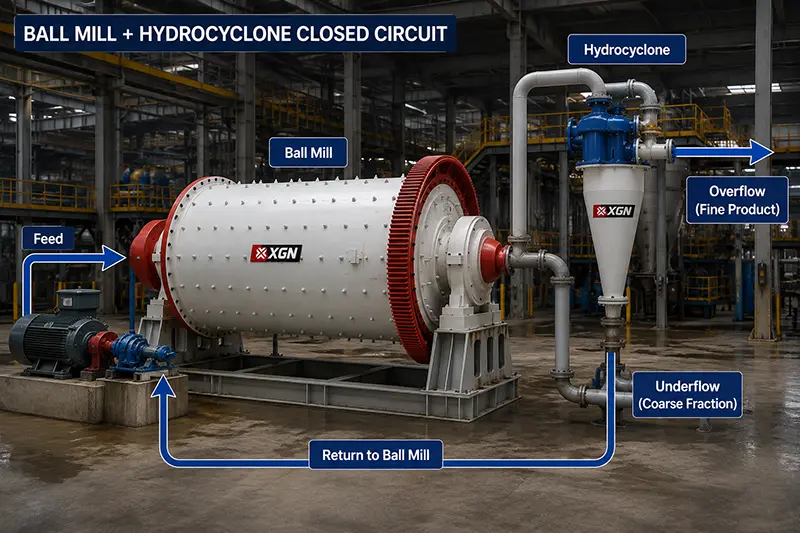
A closed circuit can be represented as:
Feed → Ball Mill → Classifier → Product
with coarse material returning to the mill:
Classifier Coarse Fraction → Ball Mill
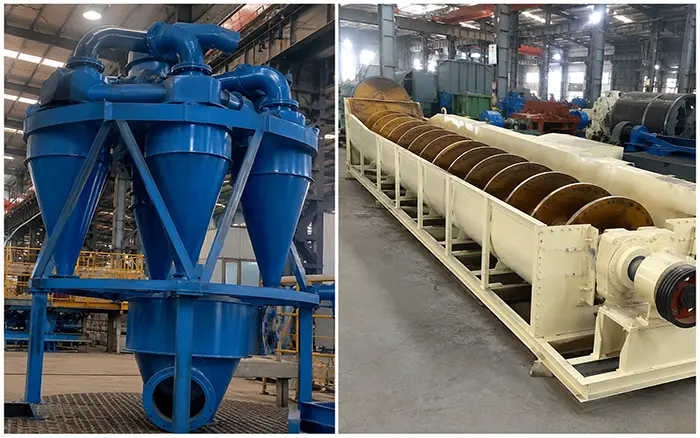
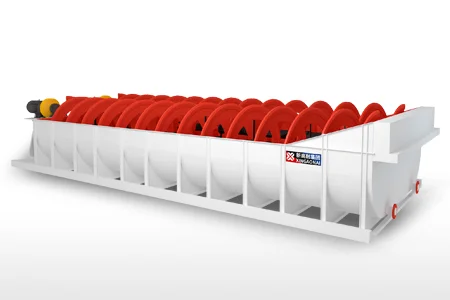
Classification can be performed with a Spiral Classifier or hydrocyclone depending on the required cut size, plant capacity, space, slurry conditions, and process-control requirements.
XINGAONAI ball mills are commonly integrated into both open and closed grinding circuits, and the company's spiral classifiers can be paired with ball mills for continuous separation and return of coarse particles.
Closed circuits introduce additional sizing considerations, including:
Circulating load
Classification efficiency
Classifier cut size
Slurry density
Cyclone operating pressure
Return load to the mill
A poorly performing classifier can return excessive fines to the mill or allow excessive coarse material into the final product.
For more information on improving an existing circuit rather than selecting a new mill, see How to Improve Ball Mill Efficiency.
Ball Mill Diameter vs Length: What Is the Difference?
Mill diameter and mill length do not perform exactly the same function.
Diameter
Diameter has a strong influence on:
Grinding-media trajectory
Available mill power
Critical speed
Grinding intensity
Increasing diameter can substantially change the energy that can be applied inside the mill.
Length
Length influences:
Internal mill volume
Material residence behavior
Grinding-media inventory
Total grinding zone
This is why two mills with similar internal volume but different D/L ratios may not perform identically.
When comparing equipment from different manufacturers, also confirm how diameter and length are defined. Specifications may refer to shell dimensions, effective grinding length, or dimensions measured relative to the liner system.
Wet vs Dry Grinding in Ball Mill Selection
The sizing process should also identify whether the application requires wet or dry grinding.
Wet Grinding
Wet ball mills are widely used in mineral beneficiation because the slurry can be transferred directly to classification, flotation, magnetic separation, or other downstream stages.
Important variables include:
Slurry density
Water addition
Pulp viscosity
Classification conditions
Dry Grinding
Dry grinding may be preferred where adding water is undesirable or where the downstream process requires dry material.
It introduces different requirements for:
Material transport
Dust collection
Ventilation
Heat management
Fine-particle removal
Therefore, a mill should not be selected only by nominal dimensions without confirming the intended grinding method.
Common Ball Mill Sizing Mistakes
1. Selecting the Mill Only by TPH
Two projects with identical throughput can require very different grinding power.
Always consider F80, P80 and ore grindability.
2. Using Maximum Feed Size Instead of F80
Maximum particle size and F80 describe different characteristics of the feed distribution.
For energy-based sizing, representative F80 data are more useful.
3. Guessing the Bond Work Index
Published values can help during very early conceptual studies, but representative grindability testwork provides a stronger basis for equipment selection.
4. Confusing P80 with Maximum Product Size
P80 means 80% of the product passes the specified size. It is not the largest particle in the discharge.
5. Ignoring Classification
In a closed circuit, mill and classifier performance are interconnected.
The mill cannot be sized and evaluated completely independently from the classification stage.
6. Treating Theoretical Power as Final Motor Power
Theoretical grinding energy is only one part of drive selection.
Mechanical losses, correction factors, design margins, mill geometry and actual operating conditions also need to be considered.
7. Designing for One Ore Sample Only
Ore properties can vary across a deposit.
If the ore body has substantial variability, sizing should consider representative samples and expected operating ranges rather than relying on one convenient test result.
What Information Should You Provide to a Ball Mill Manufacturer?
Providing better project data usually leads to a more reliable preliminary equipment recommendation.
Before requesting a mill selection, prepare as much of the following information as possible:
Ore or material type
Required throughput, t/h
Feed size distribution and F80
Target product size and P80
Bond Work Index, if available
Ore density
Moisture content
Wet or dry grinding
Open or closed circuit
Existing crushing equipment
Classification equipment
Downstream beneficiation process
Available power supply
Site altitude, if relevant
Required operating hours per day
If the Bond Work Index is not yet available, XINGAONAI can still make an initial assessment from the available project information, but representative grindability testing is recommended before finalizing equipment for a large mineral processing project.
For detailed machine configurations and available grinding options, see the XINGAONAI Ball Mill product page.