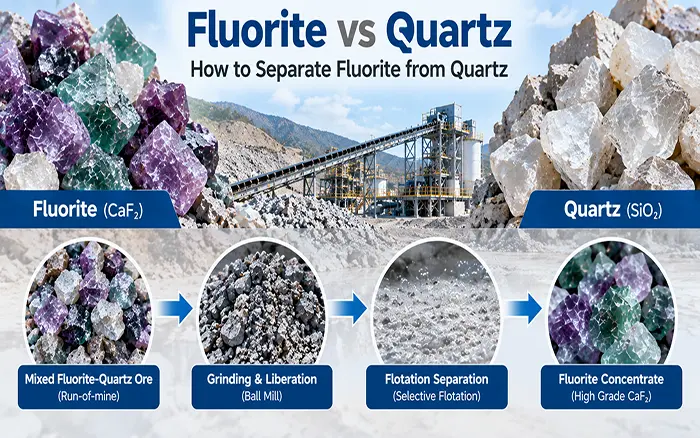
Building a stable fluorite processing plant involves more than combining crushers, ball mills and flotation machines. The run-of-mine feed size, fluorite mineral texture, gangue composition, processing capacity and final concentrate requirements all affect the process structure and equipment configuration.
A typical fluorite processing plant generally includes crushing, grinding and classification, slurry conditioning, flotation and concentrate dewatering:
Run-of-Mine Fluorite Ore → Crushing → Grinding and Classification → Conditioning → Flotation → Concentrate Dewatering → Fluorite Concentrate
Although most fluorite plants include these basic stages, the same production line cannot simply be copied for every ore. The real design objective is to connect all processing stages into a continuous and stable system based on the ore characteristics and final product requirements.

What Processing Stages Does a Fluorite Plant Include?
From the arrival of run-of-mine ore to the production of final fluorite concentrate, a complete plant can normally be divided into several main processing areas.
The crushing section reduces large ore pieces and prepares a suitable feed for grinding. The grinding and classification section controls mineral liberation and flotation feed size. Conditioning and flotation selectively separate fluorite from gangue minerals. Finally, thickening and filtration reduce the moisture content of the concentrate.
Therefore, fluorite processing plant design should not focus only on the capacity of an individual machine. It must also consider whether the upstream and downstream stages are properly matched.
For example, an excessively coarse crushing product may increase the downstream grinding load. If grinding and classification are unstable, the feed conditions for flotation may also fluctuate.
The purpose of plant design is to create a stable material flow through every stage rather than simply maximize the capacity of one machine.
Typical Fluorite Processing Plant Flowsheet
A typical fluorite processing line may use the following basic configuration:
ROM Fluorite Ore
↓
Jaw Crusher
↓
Cone Crusher
↓
Vibrating Screen
↓
Ball Mill
↓
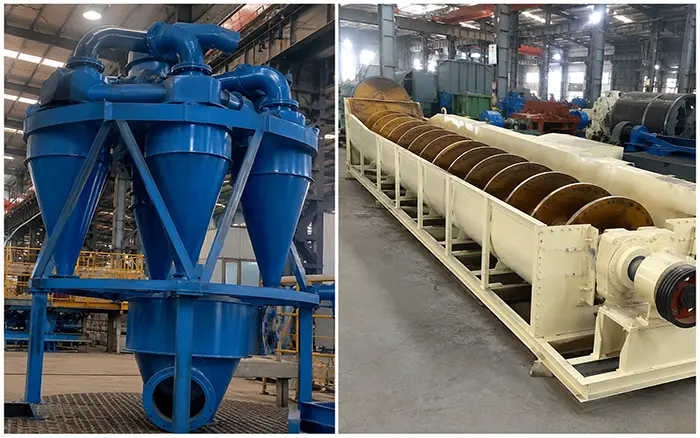
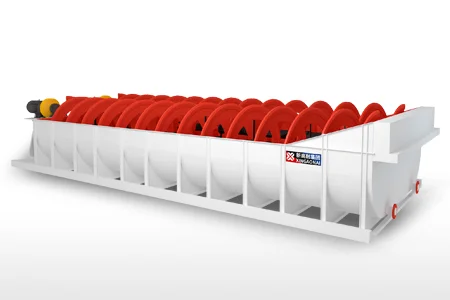
Hydrocyclone or Spiral Classifier
↓
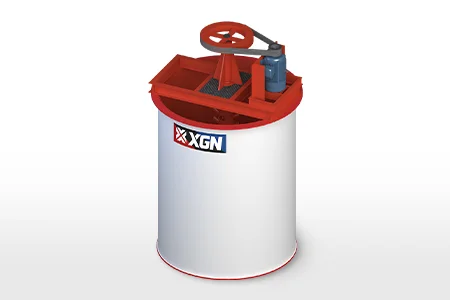
Conditioning Tank
↓
Rougher Flotation
↓
Scavenger and Cleaner Flotation
↓
Concentrate Dewatering
↓
Fluorite Concentrate
This is a typical structure used to explain the components of a plant. It is not a fixed flowsheet suitable for every fluorite ore.
An actual project may add or remove crushing stages, adjust the grinding and classification system or change the flotation configuration according to the ore properties. The ore characteristics and concentrate requirements should therefore be defined before specific equipment models are selected.
How Should the Crushing Section Be Configured?
The first stage of a fluorite processing plant is normally run-of-mine ore crushing.
Large pieces of ore entering the plant can first be treated by a jaw crusher for primary crushing, reducing them to a size suitable for the next stage.
When a smaller grinding feed size is required, a cone crusher can be added for secondary or fine crushing. It can operate with a vibrating screen to form a screening or closed crushing circuit.
A typical crushing section can be represented as:
ROM Ore → Jaw Crusher → Cone Crusher → Vibrating Screen → Grinding Section
The objective of this stage is not to add as many crushing stages as possible. It is to produce a stable product suitable for downstream grinding.
The maximum feed size, ore hardness, clay content, target capacity and mill feed requirements all affect crusher selection and configuration.
Consequently, different fluorite processing plants may use different crushing arrangements. A relatively simple circuit may be sufficient for a small plant processing finer feed. A high-capacity project usually requires greater attention to continuous feeding, screening control and capacity matching between the crushing and grinding sections.

How Should the Grinding and Classification System Be Designed?
After crushing, the fluorite ore enters the grinding and classification system to prepare suitable material for flotation.
A typical configuration is:
Crushed Ore → Ball Mill → Classification → Flotation Feed
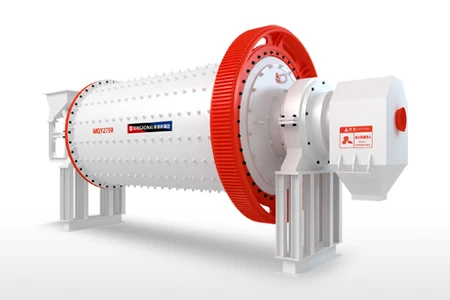
The ball mill further reduces the ore size so that fluorite can gradually become liberated from the associated gangue minerals.
Classification equipment separates the ground material according to particle-size conditions. Fine particles that meet the requirement proceed to the next stage, while coarse particles can return to the mill:
Coarse Fraction → Return to Ball Mill
The ball mill and classification equipment should therefore be configured as one integrated grinding circuit rather than treated as two independent machines.
A particularly important misconception should be avoided: finer grinding is not always better.
A fluorite plant needs the degree of mineral liberation required for downstream separation. A product that is too coarse may leave fluorite locked with gangue, while unnecessary overgrinding can generate more fine particles and make flotation control more difficult.
The required grinding fineness should be determined from mineral texture and test results rather than designing the entire plant around one fixed particle size.
For additional information about classification equipment, see Hydrocyclone vs Spiral Classifier.

How Should Conditioning and Flotation Be Configured?
For a production line that uses flotation to produce fluorite concentrate, the ground product normally requires conditioning before entering the flotation system.
The main function of conditioning equipment is to establish relatively stable slurry conditions and provide suitable mixing and reaction time for the pulp and flotation reagents.
The conditioned slurry then enters the flotation section.
An industrial fluorite processing plant usually does not rely on a single flotation operation to achieve final separation. Several stages with different functions are normally configured according to the ore characteristics:
Conditioning → Rougher → Scavenger → Cleaner
Rougher flotation first recovers the majority of the target mineral. Scavenger flotation recovers additional valuable material from the rougher tailings. Cleaner flotation focuses on improving concentrate quality.
The actual plant may use one or several cleaning stages. Intermediate products may also be returned to earlier stages depending on the circuit arrangement.
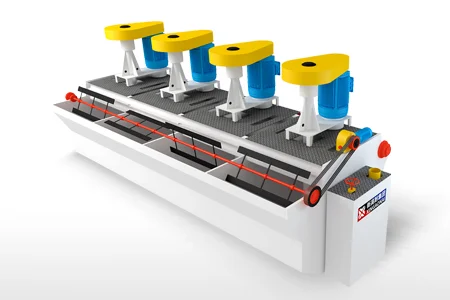
The number of flotation machines cannot therefore be determined only from the hourly plant capacity. Slurry flow, required flotation time, ore characteristics and the detailed circuit structure must also be considered.
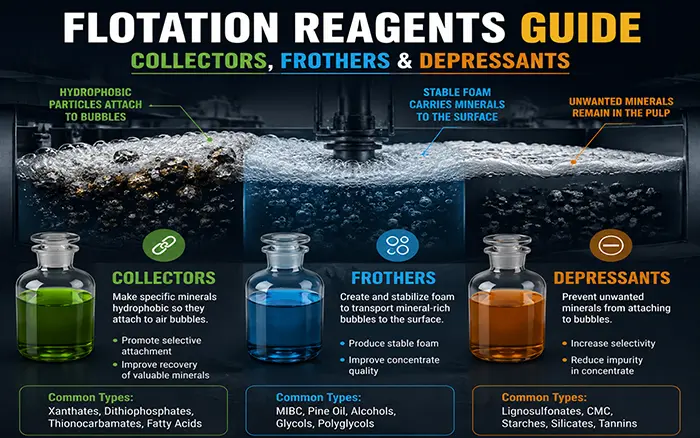
The reagent regime also affects flotation performance, but it is a separate and more specific design issue. Different gangue minerals may require substantially different collection, depression and pulp conditions. During fluorite processing plant design, the priority is to establish the flotation-system structure and equipment configuration rather than apply a fixed reagent recipe.
The functions of collectors, depressants, frothers and modifiers are discussed separately in the Flotation Reagents Guide.

How Is Fluorite Concentrate Dewatered?
Fluorite concentrate produced by flotation usually still contains a large amount of water. A concentrate-dewatering system is therefore required at the end of the production line.
A typical configuration is:
Flotation Concentrate → Thickening → Filtration → Final Fluorite Concentrate
A thickener first removes part of the water and increases the solids concentration. Filtration equipment then further reduces the moisture content of the concentrate.
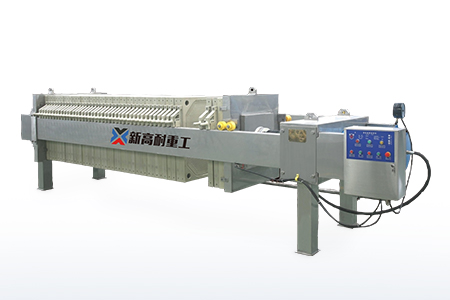
For projects using filtration, a filter press can be selected according to the plant capacity and material properties.
The objective of this stage is not to change the fluorite grade. It is to produce a final concentrate in a physical condition suitable for storage, transportation or further processing.
When conditions permit, water recovered during dewatering can be returned to the production system, reducing the demand for fresh water.
How Do Different Fluorite Ores Affect Plant Configuration?
Two fluorite processing plants with the same nominal capacity may require different flowsheets because their ores have different compositions.
One of the most important plant-design factors is which gangue minerals occur with fluorite and how those minerals are intergrown.
| Run-of-mine ore characteristic | Main plant-design consideration |
|---|---|
| Fluorite + quartz | Mineral liberation and flotation selectivity |
| Fluorite + calcite | Selective separation of fluorite and calcite |
| Fluorite + barite | Mineralogical and beneficiation testing before flowsheet selection |
| Fine or complex ore | Slime control and flotation stability |
| Coarse intergrowth | Determination of appropriate grinding and liberation conditions |
For example, the design of a quartz-bearing fluorite plant must focus on fluorite-quartz liberation and subsequent selective flotation. More details are available in fluorite-quartz separation.
If the ore contains a substantial amount of calcite, the processing problem changes. Because fluorite and calcite may respond similarly during flotation, greater attention must be given to conditioning and cleaner-circuit configuration. See fluorite-calcite separation for a detailed explanation.
Adding more flotation equipment should not automatically be regarded as the solution. The mineralogical characteristics of the ore provide the foundation for determining the process structure.
What Equipment Does a Fluorite Processing Plant Need?
A complete fluorite processing plant may include the following principal equipment:
| Processing stage | Typical equipment | Main function |
|---|---|---|
| Feeding | Vibrating feeder | Provides stable run-of-mine ore feeding |
| Primary crushing | Jaw crusher | Reduces large pieces of ore |
| Secondary crushing | Cone crusher | Further reduces the ore size |
| Screening | Vibrating screen | Controls the crushed product size |
| Grinding | Ball mill | Promotes mineral liberation |
| Classification | Hydrocyclone or spiral classifier | Controls the ground product size |
| Conditioning | Agitation tank | Conditions the slurry before flotation |
| Flotation | Flotation machine | Separates fluorite from gangue |
| Thickening | Thickener | Increases concentrate solids concentration |
| Filtration | Filter press | Reduces final concentrate moisture |
This table represents the functional relationship among the equipment. It is not a fixed purchasing list.
For example, one fluorite plant may require one ball mill, while another requires several mills. Different quantities and specifications of flotation machines may also be needed. Final equipment quantities and models should be determined from the plant capacity, ore characteristics and process-test results.
How Do Fluorite Plants of Different Capacities Differ?
Processing capacity significantly affects equipment size and plant layout, but the complete process cannot be determined from tonnes per hour alone.
Small Fluorite Processing Plant
For a small processing capacity, a relatively simple production line with fewer machines may be considered.
Provided that mineral liberation and flotation requirements can be achieved, unnecessary intermediate stages can be reduced to make the plant more compact.
Medium-Sized Fluorite Processing Plant
As capacity increases, greater attention must be given to the balance among the different processing stages.
A more complete crushing and screening circuit, closed grinding and classification circuit, and multi-stage flotation system may be used to maintain continuous production.
Large Fluorite Processing Plant
A large fluorite processing plant places greater emphasis on capacity matching, parallel equipment, production stability and maintenance space.
Several machines may operate in parallel in certain sections to prevent a single unit from becoming a capacity bottleneck. Plant layout, material transport, slurry transport, automation and water-recycling systems also become increasingly important.
Therefore:
Capacity determines equipment scale, but mineralogy and liberation requirements determine the flowsheet.
Two projects designed for 100 TPH should not automatically use identical fluorite processing plant configurations.
How Do You Determine the Right Fluorite Plant Configuration?
Before the production line is finalized, sufficient ore and project data must be obtained.
1. Run-of-Mine Ore Information
The following information is required:
Fluorite grade of the run-of-mine ore
Principal gangue minerals
Mineral intergrowth and liberation characteristics
Maximum feed size
Ore hardness and other physical characteristics
Mineral composition is particularly important.
Knowing only that the material is “fluorite ore” is generally insufficient to determine the complete process.
2. Production Requirements
The following requirements should be defined:
Design processing capacity
Target concentrate grade
Recovery requirements
Required final concentrate condition
Expected daily operating hours
These parameters establish the processing targets that the production line must achieve.
3. Project-Site Conditions
The following site conditions should also be considered:
Available plant area
Terrain
Water resources
Electrical power
Equipment transportation conditions
Building and foundation requirements
For a large plant, the equipment itself is only one part of the project. Equipment arrangement, transport distances, maintenance space and water circulation all affect actual operation.
Why Should Beneficiation Testing Come Before Final Equipment Selection?
For projects involving complex ores, it is not advisable to select every equipment model first and then test whether the process is suitable.
A more logical sequence is:
Ore Analysis → Beneficiation Test → Flowsheet → Equipment Selection → Plant Layout
Mineralogical analysis should first identify the fluorite and gangue composition. Beneficiation testing can then establish suitable directions for grinding, separation and concentrate treatment.
After the basic flowsheet has been determined, specific equipment can be selected according to processing capacity and material balance.
This sequence helps prevent a common problem:
The equipment has sufficient capacity, but the process itself is unsuitable for the actual ore.
In a fluorite processing plant, equipment selection should serve the process rather than forcing the process to accommodate equipment that has already been selected.
From Individual Machines to a Complete Fluorite Processing Plant
Designing a fluorite plant means connecting crushing, grinding, classification, conditioning, flotation and dewatering into one stable production system.
Instead of asking only “What size ball mill is required?” or “How many flotation machines are needed?”, plant planning should first answer the following questions:
What is the run-of-mine ore? What product must be produced? How must the minerals be liberated and separated? What capacity is required at each processing stage?
Only after these basic conditions have been established can the following sequence be finalized:
Process Flowsheet → Equipment Configuration → Plant Layout
XINGAONAI Group can configure a fluorite processing plant according to the run-of-mine ore characteristics, processing capacity, concentrate requirements and project-site conditions, integrating crushing, grinding, flotation and dewatering equipment into a complete production line.