Fluorite ores often contain calcite as a gangue mineral. Although the two minerals differ in composition and physical properties, separating them by flotation can be challenging. Both are calcium-bearing minerals, and under certain conditions they can respond similarly to fatty-acid collectors.
This means the challenge is not simply to make fluorite float. The real objective is to recover fluorite while preventing as much calcite as possible from entering the concentrate.
Successful fluorite-calcite separation therefore depends on three closely related factors: adequate mineral liberation, controlled pulp chemistry and selective reagent action. If any of these is poorly controlled, fluorite recovery may remain acceptable while concentrate grade deteriorates because too much calcite reports to the froth.
Fluorite vs Calcite: What Makes Them Different?
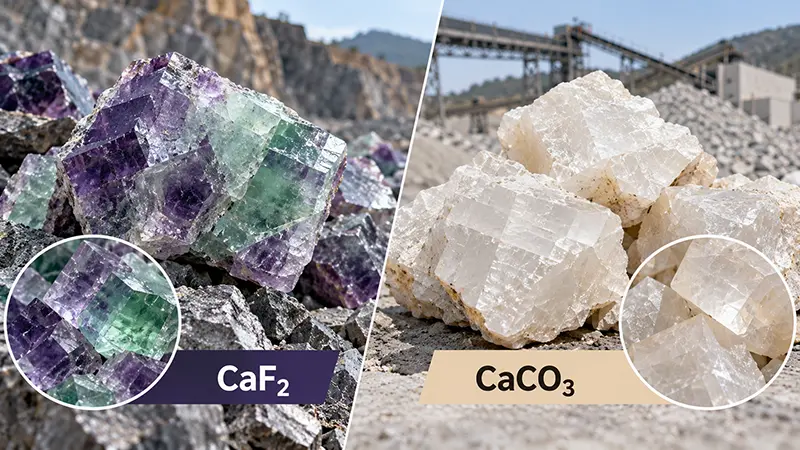
Fluorite and calcite can occur together in the same orebody, but they are different minerals.
| Property | Fluorite | Calcite |
|---|---|---|
| Chemical formula | CaF₂ | CaCO₃ |
| Main anion | Fluoride | Carbonate |
| Mohs hardness | 4 | 3 |
| Typical role in fluorite ore | Valuable mineral | Common gangue mineral |
| Flotation behavior | Can respond to fatty-acid collectors | May show a similar collector response |
Fluorite is calcium fluoride, whereas calcite is calcium carbonate. Their differences in hardness and chemical composition can help with mineral identification, but these physical differences do not automatically make flotation separation easy.
For beneficiation, the more important issue is their surface behavior in the flotation pulp.
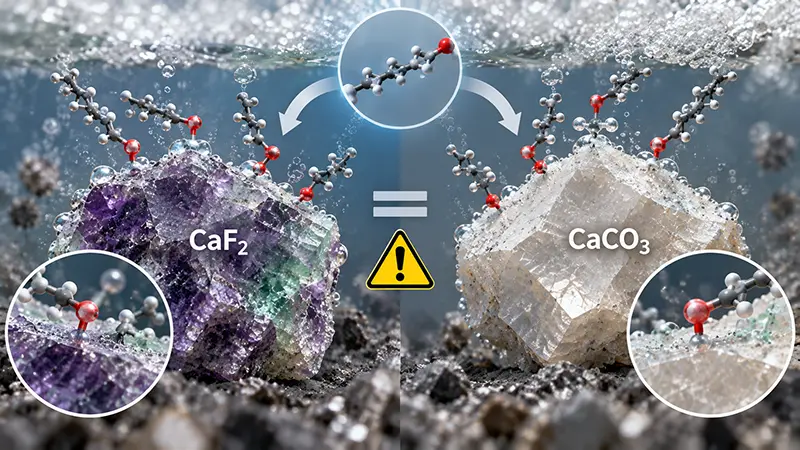
Because both minerals contain calcium sites on their surfaces, certain collectors may interact with both minerals. As a result, a flotation condition that produces strong fluorite recovery does not necessarily produce a high-grade fluorite concentrate.
Why Is Fluorite-Calcite Separation Difficult?
Compared with separating fluorite from some silicate gangue minerals, fluorite-calcite separation places greater emphasis on flotation selectivity.
Several factors contribute to this difficulty.
Similar Surface Chemistry
Fluorite and calcite have different crystal structures, but both expose calcium-related surface sites that can interact with flotation reagents.
This similarity becomes important when collectors adsorb onto the mineral surfaces. If the collector has insufficient selectivity, both fluorite and calcite can become hydrophobic and report to the froth.
The result may appear positive at first because a large amount of material is floating. However, the fluorite concentrate can contain excessive CaCO₃, reducing its quality.
The objective is therefore not maximum flotation activity. It is selective flotation.
Similar Response to Fatty-Acid Collectors
Fatty-acid collectors and their derivatives are commonly associated with fluorite flotation. Depending on pulp chemistry and mineral surface conditions, however, calcite can also respond to these collectors.
This creates a common operating problem:
Increasing collector dosage may improve fluorite recovery, but it can also increase calcite recovery.
For this reason, collector dosage cannot be optimized based only on the amount of froth or total mineral recovery. Concentrate grade and gangue recovery must also be considered.
Collectors such as oleic acid or sodium oleate may be encountered in fluorite flotation systems, but their actual performance depends on the ore and the complete reagent environment. There is no single reagent dosage that should be applied universally to every fluorite-calcite ore.
Fine Intergrowth Makes Liberation Important
Before selective flotation can work effectively, fluorite must be sufficiently liberated from calcite.
If grinding is too coarse, locked particles containing both minerals can enter the concentrate. Even a highly selective flotation environment cannot completely separate two minerals that remain physically attached within the same particle.
However, simply grinding finer is not always the solution.
Excessive grinding can generate fine particles and slimes, increasing surface area and changing reagent consumption and flotation behavior. Fine particles can also make selective separation more difficult.
The target should therefore be:
Sufficient liberation without unnecessary overgrinding.
This balance should be determined from mineralogical analysis and flotation testing rather than from a fixed grinding size.
How to Separate Fluorite from Calcite
Effective fluorite-calcite separation usually requires coordinated control of grinding, conditioning and flotation rather than reliance on one reagent or operating parameter.
The following factors are particularly important.
1. Achieve Adequate Mineral Liberation
Grinding should first expose the fluorite and calcite surfaces sufficiently for selective flotation.
When the ore is under-ground, fluorite-calcite composite particles remain in the flotation feed. If the fluorite portion of such a particle floats, the attached calcite can be carried mechanically into the concentrate.
Grinding should therefore be based on the ore’s liberation characteristics.
A useful approach is to evaluate:
Fluorite liberation at different particle sizes
Calcite distribution by size fraction
The amount of fluorite-calcite intergrowth
Slime generation as grinding becomes finer
This helps identify a practical grinding condition rather than assuming that the finest product will provide the best separation.
For ores containing multiple gangue minerals, grinding requirements should also be evaluated as part of the overall fluorite beneficiation process because quartz, barite and sulfide minerals may behave differently from calcite.
2. Control Pulp pH
Pulp pH is one of the important variables affecting fluorite-calcite selectivity.
Changing the pH can influence mineral surface properties, reagent ionization, collector adsorption and depressant performance. Therefore, the same collector dosage can produce different flotation results under different pulp conditions.
The important point is that there is no universal pH value that guarantees fluorite-calcite separation.
Optimum conditions depend on factors such as:
Mineral composition
Fluorite-to-calcite ratio
Water chemistry
Collector system
Depressant system
Dissolved ions in the pulp
Laboratory flotation tests are normally required to establish an appropriate operating window for a specific ore.
3. Selectively Depress Calcite
Because fluorite and calcite may both respond to the collector, selective depression becomes a key part of the separation strategy.
The desired flotation behavior is straightforward:
Fluorite → remains sufficiently floatable
Calcite → becomes less floatable
A suitable depressant system should reduce the flotation response of calcite while preserving enough fluorite floatability to maintain acceptable recovery.
This is more difficult than simply adding a strong depressant. Poor reagent selectivity can suppress fluorite together with calcite, improving neither grade nor recovery.
Reagent selection should therefore consider the interaction between the collector, depressant, pH regulator and mineral surfaces rather than evaluating each chemical independently.
The detailed choice of fluorite flotation reagents deserves separate evaluation because reagent performance can vary considerably among ore types.
4. Optimize Collector Dosage
A common mistake in flotation optimization is to treat stronger flotation as better flotation.
In fluorite-calcite separation, excessive collector addition may increase the hydrophobicity of unwanted calcite and reduce the difference in flotation behavior between the two minerals.
The relationship can be summarized as follows:
Too little collector → insufficient fluorite recovery
Appropriate collector conditions → fluorite recovery with better selectivity
Excess collector → increased gangue flotation and lower concentrate grade
Collector optimization should therefore evaluate both recovery and concentrate quality.
Higher fluorite recovery is not necessarily an improvement if the additional recovered material contains a disproportionately high amount of calcite.
5. Use Cleaning Stages When Necessary
A rougher flotation stage is primarily intended to recover valuable fluorite, so the rougher concentrate may still contain calcite and other gangue minerals.
Cleaning stages can further improve concentrate quality by rejecting part of this remaining gangue.
A simplified selective flotation circuit can be represented as:
Conditioning → Rougher Flotation → Cleaner Flotation → Fluorite Concentrate
Meanwhile, rejected gangue and intermediate products can be treated according to the characteristics of the actual flotation circuit.
The number of cleaning stages should not be determined by a fixed rule. It depends on the required concentrate quality, mineral liberation and separation performance observed during testing.
What Causes High Calcite Content in Fluorite Concentrate?
When CaCO₃ content remains high in the fluorite concentrate, simply increasing reagent dosage may not solve the problem. The cause should first be identified.
Several mechanisms can produce similar symptoms.
| Possible problem | Effect on separation |
|---|---|
| Poor mineral liberation | Calcite remains locked with fluorite |
| Excessive collector dosage | More calcite may report to the froth |
| Insufficient calcite depression | Fluorite and calcite float together |
| Unstable pulp pH | Reagent selectivity becomes inconsistent |
| Excessive fine particles | Surface interactions and reagent consumption become harder to control |
| Inappropriate cleaning conditions | Remaining calcite is not sufficiently rejected |
Poor Liberation
If microscopic examination or size-by-size analysis shows that fluorite remains intergrown with calcite, the problem begins before flotation.
Changing flotation reagents alone may have a limited effect because the two minerals are still physically connected.
Insufficient Selective Depression
If liberated calcite is still reporting strongly to the concentrate, the reagent environment may not provide enough differentiation between the fluorite and calcite surfaces.
In this situation, collector-depressant interaction and pulp chemistry deserve closer attention.
Excessive Collector Addition
If calcite recovery increases sharply as collector dosage rises, the flotation system may be losing selectivity.
Reducing or redistributing collector addition can sometimes be more effective than attempting to counteract excessive collection with additional depressant.
Unstable Pulp Conditions
Variations in feed mineralogy, process water or pH can cause flotation performance to change even when nominal reagent dosages remain the same.
This is why a reagent scheme developed from one ore sample should not automatically be assumed to work unchanged as the ore characteristics vary.
Excessive Slimes
Fine particles can consume reagents, coat mineral surfaces and behave differently from coarser liberated particles.
If overgrinding is producing significant slimes, the solution may involve improving grinding and classification control rather than modifying only the flotation stage.
Fluorite-Calcite Separation Requires Selectivity, Not Maximum Flotation
The main challenge in fluorite-calcite beneficiation is not simply recovering as much floating material as possible. It is creating enough difference in flotation behavior to recover fluorite while limiting calcite recovery.
That requires balancing several variables:
Mineral liberation → Pulp chemistry → Collector action → Calcite depression → Cleaning
These factors interact. Finer grinding cannot compensate for poor reagent selectivity, while an optimized reagent scheme cannot completely separate locked fluorite-calcite particles.
For this reason, a practical separation strategy should begin with mineralogical characterization and laboratory flotation testing. The results can then be used to determine suitable grinding conditions, reagent combinations and cleaning requirements for the specific ore.
For deposits containing calcite together with quartz, barite or other gangue minerals, fluorite-calcite separation should be considered part of the broader fluorite beneficiation process rather than an isolated flotation problem.