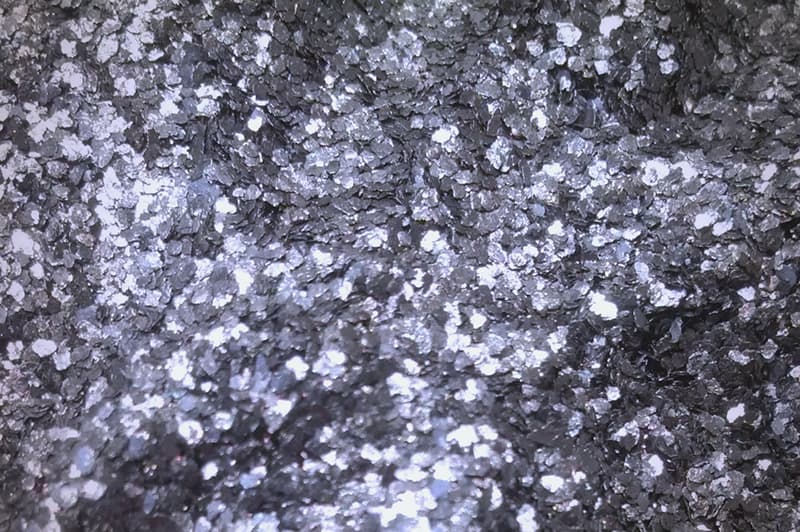
Flake graphite is a valuable industrial mineral with applications in refractories, lubricants, conductive materials, battery components, and advanced carbon products. Its excellent electrical conductivity, thermal stability, and chemical resistance make it indispensable across multiple industries.
However, the commercial value of flake graphite is not determined by carbon content alone. Flake size and flake integrity are equally critical factors. Large flakes typically command higher prices in markets where physical characteristics such as expandability, crystallinity, and particle morphology are important.
This creates a unique challenge in the flake graphite beneficiation process. The process must achieve two objectives simultaneously:
Liberate graphite from gangue minerals effectively
Preserve as many large flakes as possible
This guide explains the complete flake graphite beneficiation process and provides practical strategies for protecting valuable large flakes throughout the processing circuit.
What Is Flake Graphite Beneficiation?
Flake graphite beneficiation is the process of upgrading natural graphite ore by separating graphite flakes from unwanted gangue minerals such as quartz, feldspar, mica, and other silicates.
The objective is to produce a marketable concentrate with:
High fixed carbon content
High graphite recovery
A desirable flake-size distribution
Minimal damage to large flakes
Consistent product quality
Unlike many other minerals where fine grinding is standard practice, graphite processing demands a more careful approach. Graphite has a naturally layered, soft structure, making it susceptible to breakage during crushing and grinding. Once a large flake is fractured into smaller particles, the size reduction is permanent—there is no way to restore the original flake size.
For this reason, the graphite beneficiation process should be designed around the principle of selective liberation rather than maximizing grinding intensity.
Why Is Flake Size Important in Graphite Beneficiation?
Natural flake graphite occurs as individual flakes embedded in surrounding rock. During beneficiation, these flakes must be separated from gangue.
Large flakes are particularly valuable because they offer distinct physical properties compared to fine graphite:
| Property | Large Flake Graphite | Fine Flake Graphite |
|---|---|---|
| Expandability | Higher | Lower |
| Thermal conductivity | Superior in some applications | Moderate |
| Lubricity | Better for certain coatings | Limited |
| Market value | Often premium | Established but lower per unit |
| Applications | Refractories, expandable graphite, high-end lubricants | Batteries, brake linings, foundry facings |
However, larger flakes do not always command a higher price in every market. The ideal flake size depends on the specific application, customer requirements, and product specifications. Some applications perform better with fine or medium-flake graphite.
Therefore, the goal of the flake graphite beneficiation process should be to produce the right mix of flake sizes for the target market, rather than maximizing large flakes at the expense of overall recovery.
Typical Flake Graphite Beneficiation Process Flow
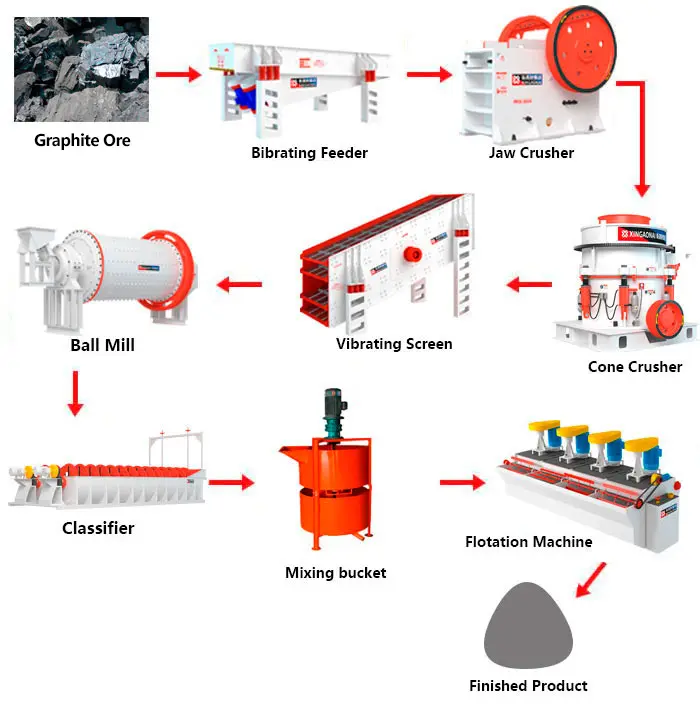
A conventional graphite processing plant follows a general flowsheet that can be adapted to suit different ore types:
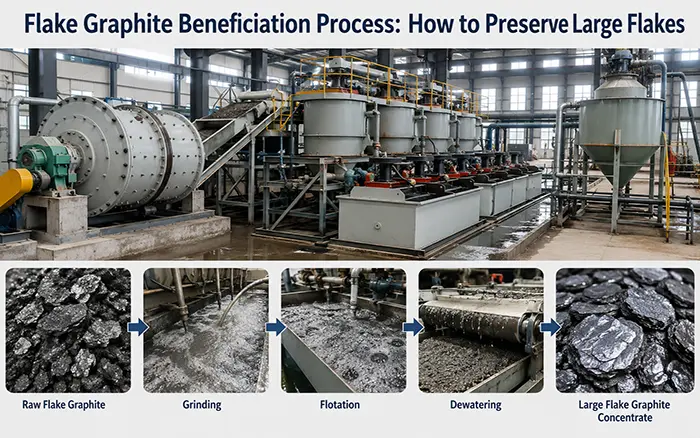
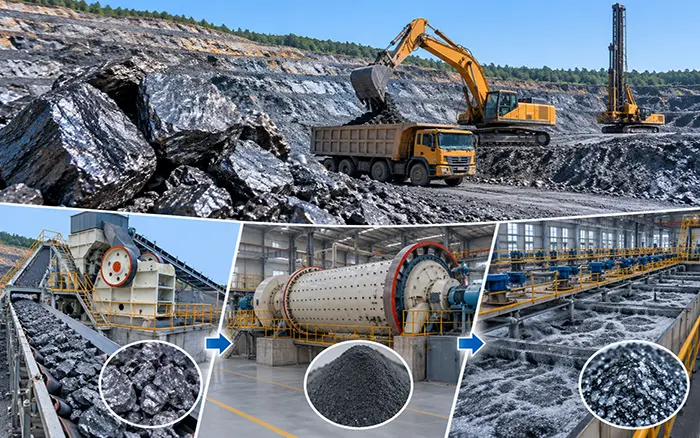
Crushing → Grinding → Classification → Rougher Flotation → Regrinding → Cleaner Flotation → Dewatering → Drying
The exact configuration varies significantly depending on:
Ore mineralogy
Graphite grade and liberation characteristics
Natural flake-size distribution
Concentrate specifications and market requirements
What sets graphite ore processing apart from other mineral beneficiation is the careful control required at every stage to prevent unnecessary flake breakage.
Stage 1: Controlled Crushing
The purpose of crushing is to reduce run-of-mine ore to a suitable size for grinding and subsequent beneficiation.
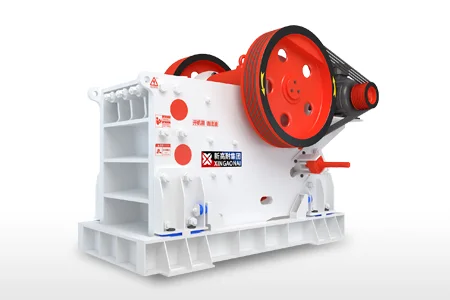
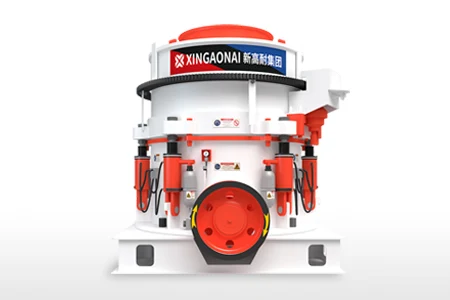
Primary crushing equipment such as jaw crushers may be used, followed by secondary crushers like cone crushers, depending on ore hardness and throughput requirements.
However, crushing should not be more aggressive than necessary. If graphite is already well liberated from the host rock at a relatively coarse size, excessive crushing can damage valuable flakes before they even reach the flotation circuit.
How to Reduce Flake Damage During Crushing
Several practical measures help minimize flake breakage:
Avoid unnecessary crushing stages—use the minimum reduction ratio required
Use appropriate crusher settings—adjust closed-side settings carefully
Control the maximum feed size—remove oversize material before it enters the crusher
Screen between stages—remove fines that do not require further crushing
Monitor particle-size distribution—track flake sizes after each stage
The goal at this stage is to prepare the ore for controlled liberation, not to produce the finest possible crushed product.
Stage 2: Grinding and Classification
Grinding is often the most critical stage when the objective is to preserve large graphite flakes.
Graphite may be closely associated with gangue minerals, so some grinding is necessary to expose graphite surfaces for flotation. However, excessive grinding can fracture the flakes and increase the amount of fine graphite.
Staged Grinding: A Better Approach
Rather than grinding the entire ore to a very fine size before flotation, a common strategy is staged grinding and flotation:
Primary Grinding → Rougher Flotation → Regrinding of Concentrate → Cleaner Flotation
This staged approach allows liberated graphite to be recovered earlier, avoiding unnecessary additional grinding.
The Role of Classification
Hydrocyclones are commonly used in closed grinding circuits to separate finer particles from coarser material. Effective classification helps:
Prevent already-liberated graphite from returning to the mill
Reduce the circulating load
Protect coarse flakes from repeated grinding
Improve overall circuit efficiency
The optimum grinding size should be established through laboratory testing rather than assumed from other deposits. Grind only as much as necessary, and recover liberated graphite as early as possible.
Stage 3: Rougher Flotation
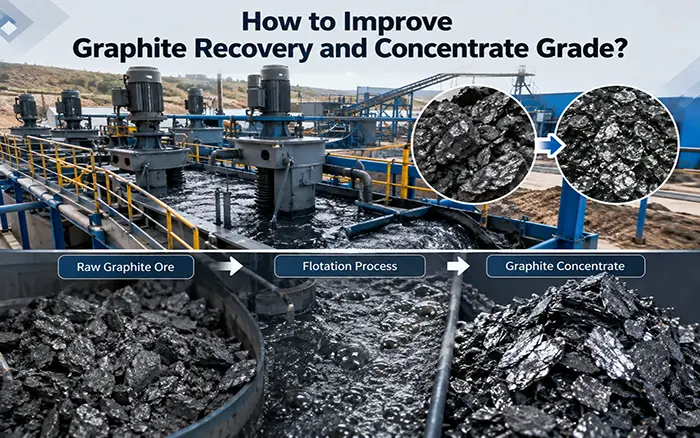
Graphite's naturally hydrophobic surface makes graphite flotation an efficient separation method for most flake graphite ores.
After grinding, the slurry enters the rougher flotation stage, where air bubbles are introduced. Graphite particles attach to the bubbles and rise into the froth, while hydrophilic gangue remains in the pulp.
The rougher concentrate typically contains:
A high proportion of graphite
Some residual gangue minerals
A range of flake sizes
The purpose of rougher flotation is to recover graphite efficiently while preparing a concentrate for subsequent upgrading in the cleaner stages.
Flotation Conditions That Matter
Important operating variables in the graphite processing flotation circuit include:
Pulp density
Reagent dosage and type
Frother selection and concentration
Air flow rate
Impeller speed
Flotation time
Pulp pH
Number of cleaning stages
Because graphite is naturally floatable, excessive reagent addition is not necessarily beneficial. Overly aggressive flotation can increase gangue entrainment and make cleaning more difficult.
Stage 4: Regrinding of Graphite Concentrate
Regrinding is often used to improve the liberation between graphite and remaining gangue minerals. However, this stage requires particularly careful control.
Regrinding is also one of the biggest risks to large-flake preservation.
If the entire graphite concentrate is reground repeatedly, liberated flakes can be unnecessarily converted into fines.
Selective Regrinding Strategy
A more selective approach involves:
Classifying the intermediate concentrate first
Regrinding only the fraction that requires additional liberation
Returning liberated material directly to cleaning stages
This targeted approach minimizes unnecessary breakage of already-liberated graphite flakes while still improving the overall concentrate grade.
The regrinding target should be based on mineralogical testing—if the graphite is already sufficiently liberated, additional grinding provides little benefit while increasing the production of fine particles.
Stage 5: Cleaner Flotation
After rougher flotation and, where necessary, regrinding, the graphite concentrate passes through one or more cleaner flotation stages.
Cleaner flotation removes residual gangue and increases the fixed carbon content of the final concentrate.
A simplified cleaner circuit may look like:
Rougher Concentrate → Regrinding (when needed) → Cleaner 1 → Cleaner 2 → Final Concentrate
The number of cleaner stages depends on:
Required concentrate grade
Ore mineralogy
Market specifications
The objective is to achieve the required purity without creating unnecessary losses or damaging the valuable flake structure.
How to Preserve Large Graphite Flakes: Key Principles
Preserving large flakes requires attention to the entire processing circuit, not just one piece of equipment.
1. Minimize Over-Crushing and Over-Grinding
The most fundamental principle is simple: do not reduce graphite particles more than necessary. A smaller particle size does not automatically mean better recovery. If graphite is already liberated, further size reduction destroys value without providing a corresponding benefit.
2. Use Staged Grinding Instead of Aggressive Fine Grinding
When graphite is only partially liberated, staged grinding is generally preferable to immediately grinding the entire feed to a very fine size. After each grinding stage, classification removes sufficiently liberated particles from the grinding circuit, reducing unnecessary residence time.
3. Separate Coarse Flakes Where Appropriate
If the ore contains a significant proportion of naturally large graphite flakes, size classification can be incorporated into the flowsheet. Coarse graphite-bearing fractions can be treated separately, allowing different operating conditions to be applied to each fraction.
4. Control Slurry Agitation and Handling
Strong mechanical agitation can damage fragile graphite particles, especially after liberation. Pump selection, slurry transportation, and agitation intensity should all be designed with flake integrity in mind.
5. Avoid Unnecessary Regrinding of Concentrate
Once a graphite flake has been liberated and recovered, it should not automatically be returned to a grinding circuit. Circuit design should provide opportunities to remove valuable coarse flakes before additional size-reduction stages.
6. Monitor Flake-Size Distribution Continuously
Product analysis should include not only carbon grade and recovery, but also the distribution of graphite across different flake-size fractions. Regular monitoring helps identify issues before they affect product quality.
Equipment Used in Flake Graphite Beneficiation
A typical graphite processing plant may include the following equipment:
| Processing Stage | Typical Equipment |
|---|---|
| Primary crushing | Jaw crusher |
| Secondary crushing | Cone crusher |
| Screening | Vibrating screen |
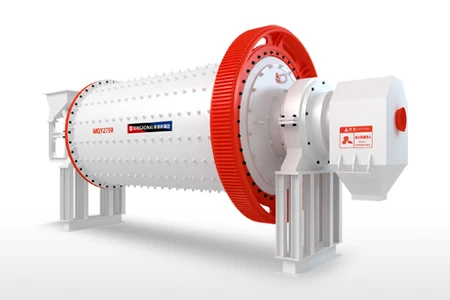
| Grinding | Ball mill |
| Classification | Hydrocyclone |
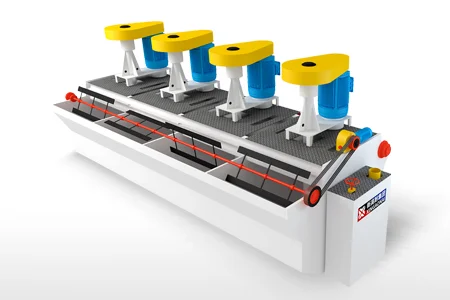
| Rougher flotation | Flotation machine |
| Regrinding | Fine grinding equipment |
| Cleaner flotation | Flotation cells |
| Concentrate thickening | Thickener |
| Filtration | Filter press or vacuum filter |
| Drying | Rotary dryer |
Equipment selection should always be based on laboratory test work and the actual characteristics of the specific graphite ore, rather than generic assumptions.
Factors That Affect Large-Flake Recovery
Several factors influence the final flake-size distribution and the success of flake graphite beneficiation:
Ore Texture
The way graphite occurs within the host rock determines how much grinding is required for liberation. Coarse, well-developed flakes that are weakly bonded to gangue are easier to preserve.
Graphite Grain Size
Naturally coarse graphite may require a different grinding strategy from fine disseminated graphite.
Grinding Intensity
Higher intensity can increase liberation but also increases graphite breakage. A balance must be found.
Residence Time
Longer residence times in grinding equipment increase the degree of size reduction—and the risk of flake damage.
Circulating Load
Excessive circulating material exposes graphite particles to repeated grinding, increasing fines generation.
Equipment Selection
Different grinding and crushing technologies impose different mechanical stresses on the material. Selection matters.
Optimizing the Flowsheet for Large-Flake Recovery
A practical optimization strategy follows these steps:
Step 1: Characterize the graphite ore and determine the natural flake-size distribution.
Step 2: Identify the size at which graphite becomes adequately liberated.
Step 3: Test different crushing and grinding conditions to find the optimum balance.
Step 4: Introduce flotation as early as practical once sufficient liberation is achieved.
Step 5: Regrind only the fraction that requires additional liberation.
Step 6: Use cleaner flotation to improve concentrate quality.
Step 7: Analyze the final concentrate according to both carbon grade and flake-size distribution.
Step 8: Compare recovery, product value, energy consumption, and operating costs.
This approach helps balance metallurgical performance with the commercial value of different graphite products.
Common Mistakes in Flake Graphite Processing
Avoid these common pitfalls in graphite ore processing:
Grinding Too Fine at the Beginning
Grinding the entire ore aggressively before flotation creates unnecessary fine graphite and destroys large flakes.
Focusing Only on Carbon Recovery
A high overall recovery does not necessarily mean the plant is producing the most commercially valuable product.
Ignoring Flake-Size Distribution
If flake size matters to the final product, it must be monitored throughout the process.
Using Too Many Regrinding Stages
Additional grinding should have a clear metallurgical purpose. If it doesn't improve liberation, it's harming flake integrity.
Designing Without Ore Testing
Graphite deposits vary significantly in mineralogy and liberation characteristics. A flowsheet developed without representative test work is unlikely to perform as expected.
Laboratory Testing Before Plant Design
Laboratory testing is particularly important for graphite projects. Useful test work includes:
Mineralogical analysis
Particle-size analysis
Liberation analysis
Crushing tests
Grinding tests
Flotation tests
Regrinding tests
Cleaner flotation tests
Flake-size analysis
Concentrate quality testing
The results determine whether staged grinding and flotation provide a measurable advantage over more intensive grinding. Pilot testing then confirms the flowsheet under conditions closer to commercial operation.
Graphite Concentrate Quality Evaluation
Graphite concentrate quality is evaluated using multiple criteria:
| Parameter | Why It Matters |
|---|---|
| Fixed carbon grade | Determines concentrate purity and market value |
| Graphite recovery | Measures how much valuable graphite is recovered |
| Flake-size distribution | Influences product value and application suitability |
| Flake integrity | Indicates whether valuable flakes remain intact |
| Moisture content | Affects handling, transportation, and downstream use |
| Impurity levels | Impacts suitability for different applications |
A successful graphite beneficiation process optimizes all these parameters together, not just one in isolation.
Conclusion
The key to a successful flake graphite beneficiation process is selective liberation. Graphite must be separated from gangue effectively while avoiding unnecessary mechanical treatment that can break valuable large flakes.
Controlled crushing, staged grinding, efficient classification, carefully optimized flotation, and selective regrinding all contribute to better large-flake preservation.
The most important principle is simple: do not grind graphite more than necessary.
However, the optimum flowsheet depends on the specific deposit. Graphite grain size, host-rock composition, liberation characteristics, natural flake distribution, concentrate specifications, and downstream applications should all be considered.
For deposits where coarse graphite flakes have significant commercial value, preserving flake size should be treated as a primary design objective alongside graphite grade and recovery.