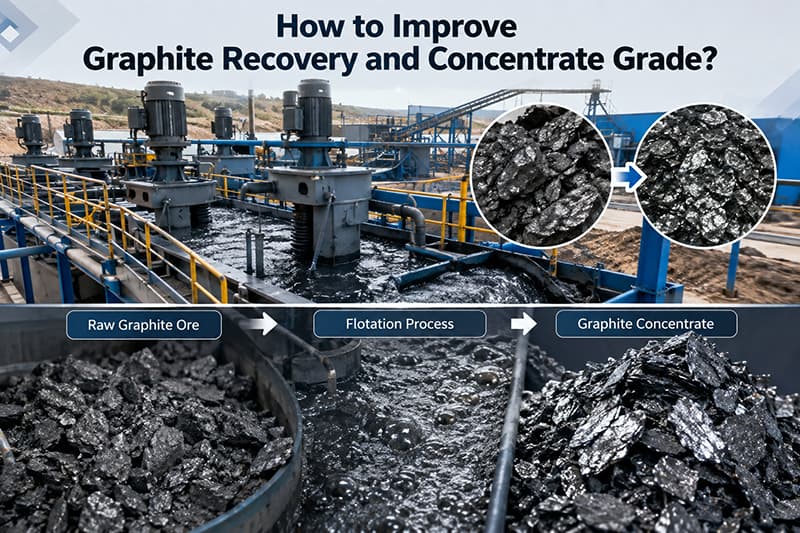
Achieving both high graphite recovery and a high concentrate grade is one of the main objectives of a graphite beneficiation plant. However, these two targets do not always improve at the same time.
Aggressive flotation conditions may recover more graphite but also carry additional gangue minerals into the concentrate. On the other hand, excessive cleaning or grinding may improve concentrate grade while increasing graphite losses.
The key is therefore not simply to maximize one indicator. A well-designed graphite beneficiation process should achieve an economical balance between recovery, concentrate quality, flake preservation, operating cost, and downstream product requirements.
This article explains the main factors affecting graphite recovery and concentrate grade and discusses practical ways to improve flotation performance.
1. Understand the Relationship Between Recovery and Concentrate Grade
Recovery measures how much of the graphite contained in the feed is recovered into the concentrate.
Concentrate grade indicates the quality of the recovered graphite product, commonly evaluated using fixed carbon or other product specifications.
In practice, there is often a trade-off between the two.
For example, increasing collector dosage or extending flotation time may recover additional graphite particles. However, these operating changes can also increase entrainment or flotation of unwanted gangue.
Similarly, adding more cleaner stages may produce a higher-grade concentrate but can also reject some graphite with the cleaner tailings.
A successful process must therefore consider:
Graphite recovery
Concentrate grade
Flake-size distribution
Impurity levels
Product yield
Operating cost
Final product value
The highest recovery does not necessarily produce the most profitable graphite concentrate.
2. Start with Detailed Ore Characterization
Before adjusting flotation equipment or reagent dosage, it is important to understand the graphite ore itself.
Different deposits can have very different beneficiation characteristics.
Important properties include:
Graphite content
Graphite flake size
Liberation characteristics
Gangue mineral composition
Mineral associations
Degree of oxidation
Feed particle-size distribution
Mineralogical testing can reveal whether graphite occurs as coarse liberated flakes, fine disseminated particles, or graphite closely associated with gangue minerals.
This information determines how aggressively the ore should be ground and how the flotation circuit should be configured.
Without proper characterization, process optimization can become a trial-and-error exercise.
3. Optimize Crushing Before Grinding
Although flotation receives much of the attention in graphite processing, upstream crushing also affects beneficiation performance.
The purpose of crushing is to reduce the ore to a suitable size for grinding without creating unnecessary fines.
Excessive crushing can increase the amount of fine material entering the grinding circuit, while insufficient crushing may reduce grinding efficiency.
A typical preparation circuit may include:
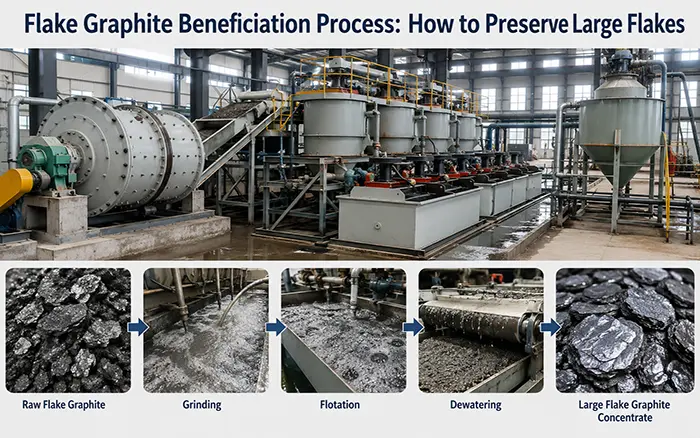
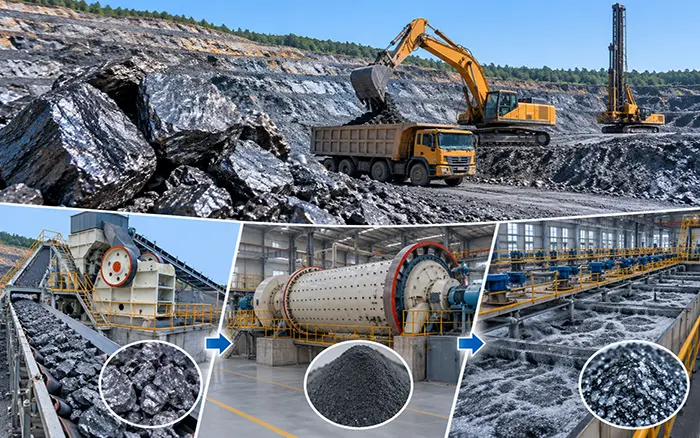
Raw Ore → Primary Crushing → Secondary Crushing → Screening → Grinding
The crushing circuit should provide a stable and reasonably uniform feed to the grinding stage.
Stable feed conditions make it easier to control downstream particle size and graphite liberation.
4. Control Grinding to Achieve Proper Liberation
Grinding is one of the most important stages for improving graphite recovery and concentrate grade.
The objective is to liberate graphite from gangue minerals so that flotation can separate them effectively.
If the ore is under-ground, graphite remains locked with gangue. These composite particles can reduce concentrate grade or report to the tailings.
If the ore is over-ground, graphite flakes may become excessively fine.
This can create several problems:
Increased fine graphite production
More difficult flotation control
Increased gangue entrainment
Changes in final product size distribution
The optimum grinding size should therefore be determined through mineralogical analysis and beneficiation testing rather than applying the same grinding target to every graphite ore.
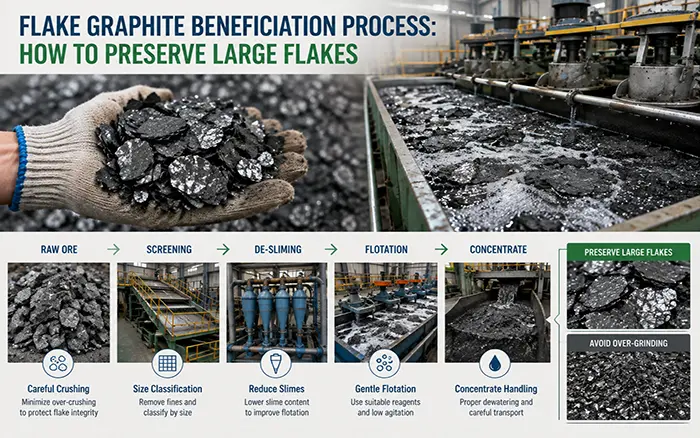
5. Avoid Overgrinding Large-Flake Graphite
Large-flake graphite can have different commercial characteristics from fine graphite, making flake preservation an important consideration for many deposits.
Because graphite is relatively soft, excessive grinding can damage flakes before they are fully recovered.
A common strategy is to recover liberated graphite as early as practical and grind only the material that still requires additional liberation.
Instead of:
Grinding → Complete Fine Grinding → Flotation
a staged circuit can use:
Grinding → Flotation → Regrinding of Selected Streams → Flotation
This reduces unnecessary exposure of already liberated graphite to repeated grinding.
The objective is not simply to achieve a fine particle size. It is to achieve sufficient liberation while preserving valuable graphite characteristics.
6. Use Stage Grinding and Stage Flotation
Stage grinding and stage flotation can be particularly useful for flake graphite beneficiation.
After an initial grinding stage, liberated graphite is recovered by flotation.
The remaining material can then be reground to release additional graphite before another flotation stage.
A simplified circuit may be:
Primary Grinding
↓
Rougher Flotation
↓
Graphite Concentrate + Middlings
↓
Selective Regrinding
↓
Cleaner Flotation
This approach can provide several advantages.
First, liberated graphite can be recovered before excessive grinding occurs.
Second, energy is focused on particles that actually require additional liberation.
Third, the plant has greater control over concentrate quality at different stages.
The exact number of grinding and flotation stages should be determined through test work.
7. Optimize the Rougher Flotation Stage
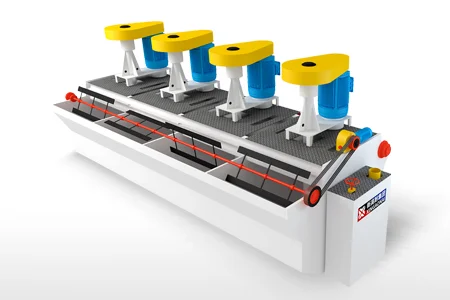
The rougher flotation stage is primarily responsible for recovering graphite from the feed.
If rougher recovery is too low, valuable graphite may be lost early in the process and become difficult to recover later.
Important operating variables include:
Feed particle size
Pulp density
Reagent dosage
Conditioning time
Air flow
Froth depth
Flotation time
Pulp level
The rougher stage should provide strong graphite recovery without allowing excessive gangue to enter the concentrate.
A poorly controlled rougher stage can create additional work for downstream cleaner flotation.
8. Optimize Collector Dosage
Natural graphite has relatively good hydrophobicity, but collectors may still be used to improve flotation performance depending on the ore and process conditions.
Collector dosage should be carefully controlled.
Too little collector can result in incomplete graphite recovery.
Too much collector may increase reagent consumption and reduce flotation selectivity under some conditions.
Instead of simply increasing dosage when recovery falls, operators should first investigate whether the actual problem is related to:
Poor liberation
Unstable feed size
Incorrect pulp conditions
Insufficient conditioning
Froth instability
Equipment performance
Reagent optimization should be based on flotation testing and plant data.
9. Control Frother Addition
Frothers help create and stabilize bubbles during flotation.
Bubble characteristics influence the transport of graphite particles from the pulp to the froth.
Insufficient frother can produce an unstable froth and reduce graphite recovery.
Excessive frother may create overly persistent froth or increase the mechanical entrainment of fine gangue particles.
The appropriate dosage depends on the ore, water chemistry, equipment, and other reagents used in the circuit.
Operators should evaluate froth behavior together with recovery and concentrate grade rather than relying only on a fixed reagent dosage.
10. Reduce Gangue Entrainment
One reason concentrate grade may remain low even when graphite flotation is effective is gangue entrainment.
Fine gangue particles can be mechanically carried into the froth with water rather than being recovered through true flotation.
This becomes particularly important when the feed contains large amounts of very fine material.
Possible strategies include:
Avoiding unnecessary overgrinding
Maintaining suitable pulp density
Optimizing froth depth
Controlling air flow
Improving cleaner flotation
Managing water recovery to the concentrate
Using appropriate reagent conditions
Reducing entrainment can improve concentrate grade without necessarily sacrificing large amounts of graphite.
11. Improve Cleaner Flotation
The rougher concentrate normally contains graphite together with some remaining gangue.
Cleaner flotation is used to upgrade this concentrate.
Depending on the ore and target product, multiple cleaning stages may be required.
A simplified circuit can be:
Rougher Concentrate → Cleaner 1 → Cleaner 2 → Cleaner 3 → Final Concentrate
However, simply adding more cleaner stages does not guarantee better overall performance.
Every additional cleaning stage creates another opportunity for graphite losses.
Cleaner circuits should therefore be optimized to achieve the required product quality while minimizing the amount of graphite reporting to cleaner tailings.
12. Use Selective Regrinding
Regrinding can improve concentrate grade by liberating gangue that remains attached to graphite particles.
However, grinding the entire concentrate repeatedly may damage already liberated graphite flakes.
Selective regrinding is often a better strategy.
Instead of treating every particle equally, selected middlings or lower-grade streams can be reground before returning to flotation.
This approach can help:
Improve liberation
Reduce unnecessary flake breakage
Increase concentrate grade
Limit excessive fines generation
Reduce grinding energy
The appropriate regrinding strategy depends strongly on mineral associations and flake-size requirements.
13. Recover Graphite from Middlings
Middlings are intermediate products containing both graphite and gangue.
Discarding them too early can reduce overall graphite recovery.
However, returning all middlings directly to the beginning of the flotation circuit can increase circulating load and reduce process stability.
A better approach may involve:
Middlings → Classification → Selective Regrinding → Reflotation
This gives partially liberated particles another opportunity for separation.
The treatment method should depend on how much recoverable graphite remains in the stream and how it is associated with gangue minerals.
14. Minimize Graphite Losses in Tailings
When recovery is lower than expected, tailings analysis should be one of the first diagnostic steps.
Graphite may be lost to tailings because of:
Insufficient liberation
Particles that are too coarse
Excessive fine graphite
Inadequate flotation time
Unstable froth
Incorrect reagent conditions
Poor equipment operation
A particle-size-by-particle-size analysis of the tailings can be particularly useful.
If graphite losses are concentrated in coarse particles, additional liberation may be required.
If losses mainly occur in very fine fractions, the solution may involve flotation hydrodynamics, fines management, or changes to upstream grinding.
15. Control Feed Size Consistency
Flotation circuits perform more predictably when the feed is stable.
Large fluctuations in particle size can change:
Liberation
Flotation kinetics
Reagent demand
Froth characteristics
Concentrate grade
Recovery
Classification equipment should therefore work together with the grinding circuit to maintain the desired flotation feed.
Hydrocyclones or other classifiers may be used depending on the process requirements.
Stable classification is often an overlooked part of improving graphite flotation performance.
16. Pay Attention to Process Water Quality
Water quality can influence flotation chemistry and froth behavior.
Recycled process water may contain dissolved ions, residual reagents, fine solids, or other components that affect flotation performance.
As water recycling increases, these substances can accumulate within the circuit.
If flotation performance changes without an obvious change in ore characteristics, process water should be considered as one possible cause.
Water quality monitoring can include parameters relevant to the specific plant and reagent system.
17. Maintain Stable Pulp Density
Pulp density affects particle suspension, reagent contact, flotation kinetics, and froth loading.
If the pulp is too dilute, plant capacity and reagent efficiency may be affected.
If it is too dense, mixing and air-particle interaction may become less effective.
The optimum pulp density depends on:
Ore characteristics
Particle size
Flotation cell design
Reagent system
Required residence time
Stable density is generally more important than constantly changing operating conditions in an attempt to maximize short-term recovery.
18. Optimize Flotation Equipment Performance
Even a well-designed flowsheet can perform poorly if the flotation equipment is not operating correctly.
Regularly check:
Air distribution
Agitation
Froth depth
Pulp level
Feed distribution
Launder performance
Wear condition
Instrument calibration
Uneven feed distribution between flotation cells can create inconsistent residence times and reduce circuit performance.
Equipment condition should therefore be included in any investigation into declining recovery or concentrate grade.
19. Monitor the Process by Size Fraction
Plant performance should not be evaluated only by a single overall recovery number.
Graphite behavior can vary significantly between coarse and fine size fractions.
Monitoring concentrate and tailings by particle size can reveal where losses are occurring.
For example:
| Observation | Possible Issue |
|---|---|
| Coarse graphite in tailings | Insufficient liberation or flotation |
| Fine graphite in tailings | Fine-particle flotation difficulty |
| High gangue in concentrate | Entrainment or poor liberation |
| Declining concentrate grade | Feed change or cleaner inefficiency |
| Increasing fine graphite | Excessive grinding |
| High graphite in middlings | Incomplete liberation |
This type of diagnosis makes process optimization more targeted.
20. Balance Recovery, Grade, and Flake Size
A graphite plant should not optimize recovery and grade while ignoring flake size.
Consider two hypothetical operating strategies.
Process A produces very high recovery but breaks much of the coarse graphite into fine particles.
Process B has slightly lower overall recovery but preserves a larger proportion of commercially desirable flake fractions.
Depending on the product market, Process B could potentially generate greater economic value.
For this reason, graphite beneficiation should often be evaluated using three major indicators:
Recovery + Concentrate Grade + Flake-Size Distribution
The optimum operating point depends on the characteristics and value of the final products.
21. How to Troubleshoot Low Graphite Recovery
When recovery suddenly declines, changing reagent dosage should not automatically be the first response.
A systematic investigation can follow this sequence:
Step 1: Check the Feed
Determine whether ore grade, mineralogy, or particle size has changed.
Step 2: Check Grinding and Classification
Confirm whether flotation feed size remains within the expected range.
Step 3: Analyze Tailings
Determine which particle-size fractions contain the lost graphite.
Step 4: Check Reagents
Verify dosage, concentration, preparation, and dosing equipment.
Step 5: Inspect Flotation Conditions
Check air flow, froth depth, pulp level, density, and residence time.
Step 6: Review Cleaner and Middlings Circuits
Determine whether graphite is being lost during upgrading rather than during rougher flotation.
This approach helps identify the actual cause instead of masking the problem through excessive reagent addition.
22. How to Troubleshoot Low Graphite Concentrate Grade
If recovery is acceptable but concentrate grade is low, the problem is often related to gangue contamination.
Possible causes include:
Insufficient liberation
Excessive fine gangue
Gangue entrainment
Poor cleaner performance
Excessive water recovery to the froth
Unstable feed characteristics
Ineffective middlings treatment
Mineralogical analysis of the concentrate can help determine whether the impurities are liberated gangue particles or minerals still locked with graphite.
The solution differs significantly between these two situations.
Liberated gangue may require better flotation selectivity, while locked gangue may require additional liberation.
23. Build a Stable Graphite Beneficiation Circuit
Long-term improvement usually comes from process stability rather than continuously changing individual operating parameters.
A well-controlled graphite beneficiation plant should monitor:
Feed grade
Feed particle size
Grinding performance
Classification efficiency
Reagent dosage
Flotation air rate
Pulp density
Concentrate grade
Tailings grade
Recovery
Flake-size distribution
Historical operating data can then be used to identify relationships between process conditions and plant performance.
This makes it easier to distinguish genuine process improvements from short-term fluctuations.
Conclusion
Improving graphite recovery and concentrate grade requires optimization of the entire beneficiation process rather than focusing on flotation reagents alone.
Ore mineralogy, graphite liberation, grinding, classification, rougher flotation, cleaner flotation, selective regrinding, middlings treatment, process water, and equipment condition can all influence the final result.
One of the most important principles is to avoid unnecessary overgrinding. Recovering liberated graphite early and selectively regrinding material that requires further liberation can help improve concentrate quality while preserving valuable graphite flakes.
At the same time, plants should analyze where graphite is being lost and where gangue enters the concentrate. Particle-size analysis, mineralogical testing, and systematic plant monitoring provide a much stronger basis for optimization than simply increasing reagent dosage or flotation time.
Ultimately, the best operating point is the one that achieves an economical balance between graphite recovery, concentrate grade, flake-size distribution, product specifications, and processing cost