Basalt is one of the hardest and most durable rocks used in construction. You find it in roads, railways, bridges, and concrete buildings. But crushing basalt is not easy. Its high hardness and abrasiveness wear down crusher parts quickly. If you do not plan carefully, your operating costs will be high, and your plant will have frequent downtime.
This guide will show you how to design a basalt crushing plant using a three-stage process. You will learn the right equipment for each stage, how to arrange your plant layout, and what equipment list you need for different capacity targets.
Why Basalt Is Difficult to Crush
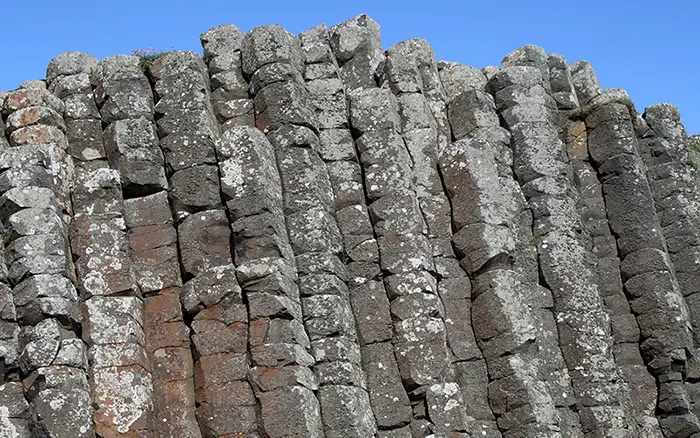
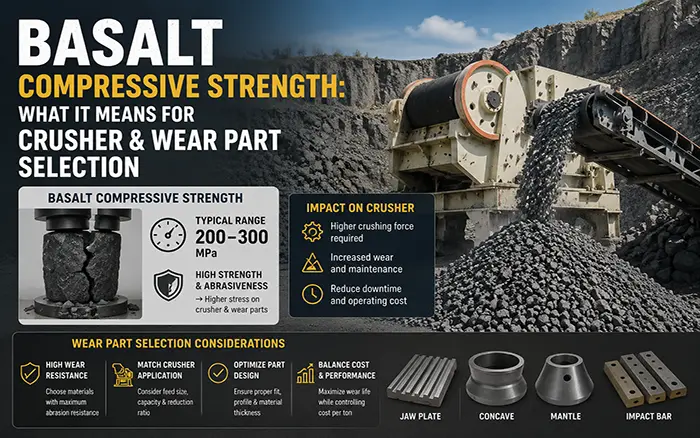
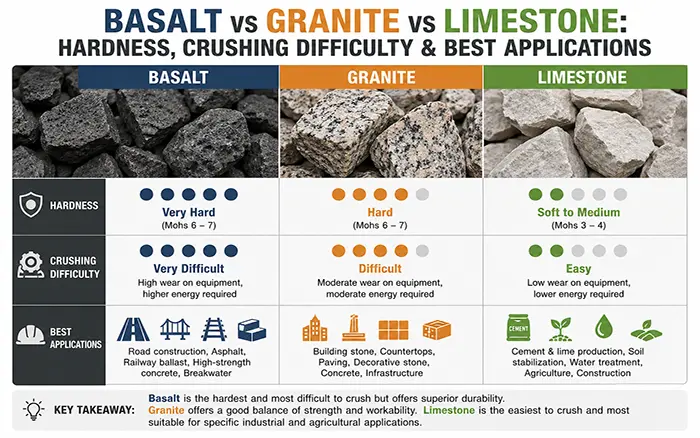
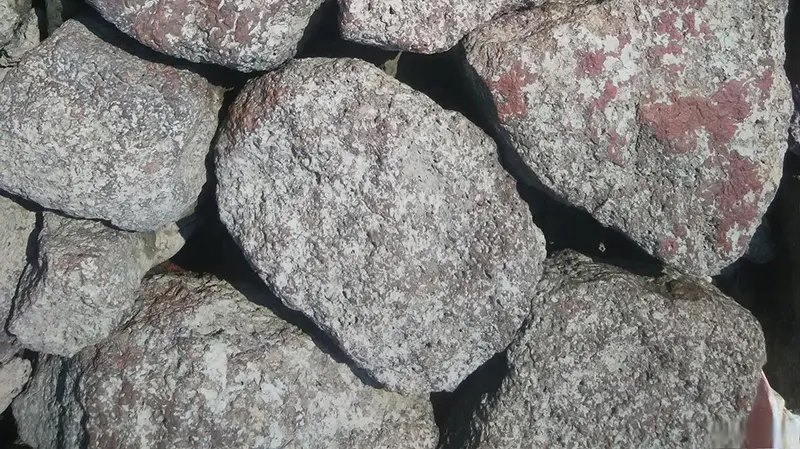
Basalt is a volcanic rock with a Mohs hardness of 5 to 7 and compressive strength up to 300 MPa. This makes it much harder than limestone or other sedimentary rocks. The rock contains hard minerals like pyroxene and olivine. When crushed, these minerals act like sandpaper on the metal parts of your crushers, causing high wear.
Because of this, you cannot use just any crusher for basalt. Many operators have learned the hard way that using the wrong equipment leads to frequent part replacements and lost production.
The Three-Stage Crushing Process
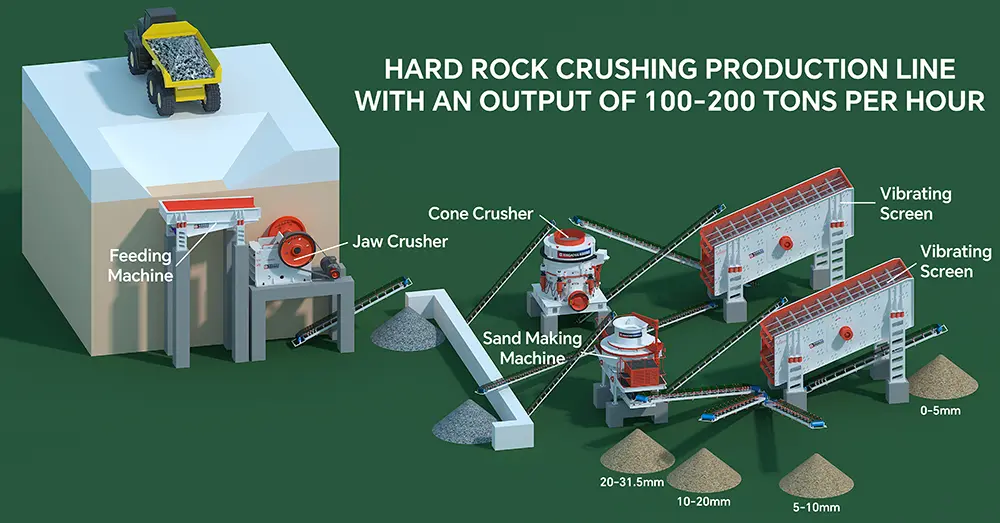
A properly designed basalt crushing plant uses three stages: primary crushing (coarse), secondary crushing (medium), and tertiary crushing (fine/sand making). Each stage has a specific job, and the equipment for each stage is different.
Stage 1: Primary Crushing (Jaw Crusher)
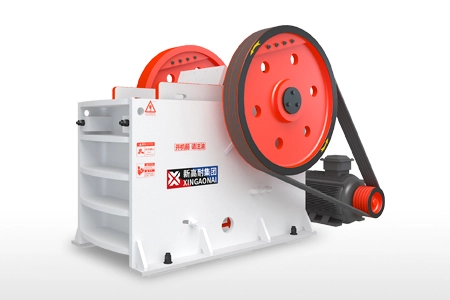
The first stage handles the largest basalt boulders. Raw basalt from the quarry can be as big as 1,200 mm. A jaw crusher is the standard choice here.
How it works: A fixed jaw and a moving jaw squeeze the rock until it breaks. The output size is usually 150–200 mm.
Why a jaw crusher works for basalt: Jaw crushers are built to handle hard and abrasive materials. They have a deep crushing chamber and use compression, which is more suitable for hard rock than impact force. The jaw plates are made of high manganese steel to resist wear. On a 200 tph plant, the primary crusher is often a PE-750×1060 jaw crusher.
If your capacity is very high (over 1,000 tph), you may need a gyratory crusher instead of a jaw crusher. But for most medium to large basalt plants, a jaw crusher works well.
Stage 2: Secondary Crushing (Cone Crusher)
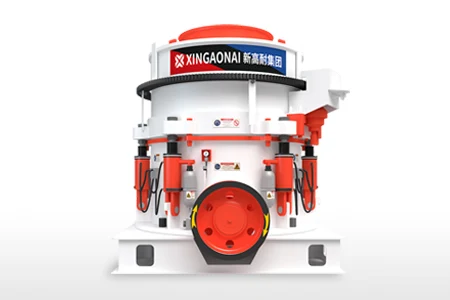
The second stage takes the 150–200 mm material from the jaw crusher and reduces it to 40–80 mm. A cone crusher is the best choice here.
How it works: A rotating mantle presses the rock against a stationary concave (bowl liner). This compressive action breaks the rock along its natural grain boundaries.
Why a cone crusher works for basalt: Cone crushers use the lamination crushing principle. The rock breaks against other rock, not just against metal. This reduces wear on the crusher parts compared to impact crushers. For higher capacity, many plants use a combination of a single-cylinder cone crusher followed by a multi-cylinder cone crusher. This setup shares the workload and gives better particle shape. On a 200 tph plant, the secondary crusher is often a CH440 or CS250 cone crusher.
Stage 3: Tertiary Crushing (VSI Sand Maker)
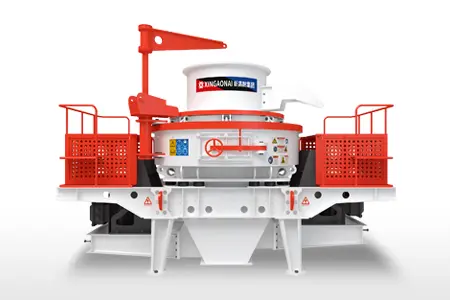
The third stage produces the final product. It takes the 40–80 mm material from the cone crusher and shapes it into uniform, cubical particles. A VSI (Vertical Shaft Impact) sand maker is the standard choice.
How it works: A high-speed rotor throws the rock against a steel chamber or against other rock particles. This action breaks and shapes the material into clean, cubical particles with very few flat or elongated pieces.
Why a VSI works for basalt: The "rock-on-rock" design uses the material to break itself. This keeps wear costs low compared to traditional impact crushers with blow bars. Some plants can produce manufactured sand as fine as 0–5 mm in this stage, which is a good replacement for natural sand in concrete and asphalt.
The VSI also improves the particle shape of larger aggregate sizes (5–20 mm). Cubical aggregates pack better in concrete and asphalt, which means stronger roads and buildings.
Optional Equipment
Beyond the three main crushers, a complete basalt crushing plant needs additional equipment.
Vibrating feeder: Placed before the jaw crusher. It feeds the rock evenly into the crusher and prevents blockages. A grizzly bar section can remove small rocks and dirt before they enter the crusher, which reduces wear on the jaw plates.
Vibrating screen: Placed after each crushing stage to separate material by size. A multi-deck screen can produce several product sizes at once (e.g., 0–5 mm, 5–10 mm, 10–20 mm, 20–30 mm). Oversized material is sent back to the crusher for another pass. This is called a closed circuit and it ensures consistent product quality.
Belt conveyors: Connect all the machines. The number and length of conveyors depends on your site layout. A typical plant uses 8–10 conveyors.
Sand washer (optional): If you need clean sand for concrete or mortar, add a spiral or wheel sand washer after the VSI. It removes excess fines and improves product quality.
Dust suppression system: Basalt crushing generates a lot of dust. A water spray system or baghouse filter is necessary for environmental compliance and worker safety.
Plant Layout Design
How you arrange your equipment matters as much as the equipment you choose. A good layout reduces material handling costs, saves space, and makes maintenance easier.
Choosing a Fixed or Mobile Plant
First, decide whether you need a fixed or mobile plant.
Fixed plant: Best for long-term operations (more than 5–10 years) where the quarry face does not move far. Fixed plants have lower operating costs and higher capacity.
Mobile plant (wheeled or tracked): Best for short-term projects or quarries where the rock source moves. Mobile plants can be relocated between sites and set up in hours without concrete foundations.
For most commercial basalt quarries, a fixed plant is the better choice because of the high initial investment and the long life of the deposit.
Common Layout Configurations by Capacity
| Capacity | Typical Configuration |
|---|---|
| 50–100 tph | Jaw crusher + Cone crusher + Vibrating screen |
| 100–300 tph | Jaw crusher + Hydraulic cone crusher + Screening system |
| 300–800 tph | Jaw crusher + Multi-cylinder cone crusher + VSI sand maker |
| 800+ tph | Large stationary or modular plant (gyratory primary) |
Layout Principles
Keep these principles in mind when designing your layout.
Centralized layout: Place all three crushers in the same building. This reduces conveyor length and land use. It also makes it easier for operators to move between machines. This layout works best for flat terrain.
Tiered layout: Place equipment on different levels. For example, the jaw crusher on the top level, the cone crusher on the middle level, and the VSI on the bottom level. Material flows down by gravity between stages, reducing the need for long conveyors. This saves energy and reduces equipment cost.
Open pit layout (decentralized): Place the primary crusher near the quarry face and the secondary/tertiary crushers closer to the product stockpile. This reduces truck haulage distance but requires more conveyors.
Complete Equipment List
Here is a sample equipment list for a 200 tph basalt crushing plant.
| Stage | Equipment | Model | Key Specs |
|---|---|---|---|
| Feeding | Vibrating feeder | GZD-1100×4200 | 15 kW, grizzly bars |
| Primary crushing | Jaw crusher | PE-750×1060 | 110 kW, 150–200 mm output |
| Secondary crushing | Cone crusher (single-cylinder) | CS250 or CH440 | 132 kW, 40–80 mm output |
| Tertiary crushing | VSI sand maker | VSI-1140 | 200 kW, 0–30 mm output |
| Screening | Vibrating screen (4-deck) | 4YK-2460 | 30 kW, 4 product sizes |
| Conveyors | Belt conveyors | B1000 | 8–10 units |
| Sand washer (optional) | Spiral sand washer | LX-1500 | 15 kW |
For smaller capacity (100 tph), you can downsize the models. For larger capacity (500+ tph), you will need larger models or multiple units in parallel.
Special Considerations for Basalt
Because basalt is so abrasive, you need to pay extra attention to wear parts.
Use high manganese steel for jaw plates and cone liners. Grades like Mn18Cr2 or Mn22 offer 2–3 times longer life than standard Mn13.
Use the lamination crushing principle. Cone crushers that use "rock-on-rock" crushing cause less wear than impact crushers.
Avoid impact crushers for secondary crushing of basalt. Some plants use an impact crusher because it has a lower purchase price. But the blow bars wear out very quickly on basalt. Over time, the replacement costs are much higher than the savings from the lower purchase price. A cone crusher costs more upfront but is much cheaper to run.
Plan for spare parts. Keep spare jaw plates, cone liners, and VSI wear parts on site. A single worn part can shut down your whole plant.
Common Design Mistakes
Using an impact crusher for secondary crushing. This is the most common mistake. The blow bars wear out in days or weeks, not months.
No pre-screening before the jaw crusher. Fines and dirt should be removed before they enter the crusher. They cause unnecessary wear on the jaw plates and reduce capacity.
Not enough stockpile space. Product stockpiles need space. If you do not plan for this, you will have to move finished material away frequently, which adds cost.
Poor conveyor angles. Conveyors that are too steep cause material to slide back. Conveyors that are too flat cause material to accumulate. Use the manufacturer’s recommended angle for basalt.
Conclusion
Designing a basalt crushing plant requires careful planning. You need a three-stage process: a jaw crusher for primary, a cone crusher for secondary, and a VSI for tertiary shaping. You must also choose the right layout and plan for high wear. With the right equipment and layout, your basalt crushing plant can produce high-quality aggregate for many years. Always prioritize cone crushers over impact crushers for hard basalt. And keep spare wear parts on hand to avoid unplanned downtime.