Copper beneficiation is not based on one fixed flowsheet. The appropriate process depends on the copper minerals present in the ore, oxidation degree, head grade, mineral liberation size, gangue composition, processing capacity and required concentrate quality.
For many sulfide copper ores, the main route consists of crushing, grinding and classification, flotation, and concentrate dewatering. Oxide and mixed copper ores may require different flotation conditions, sulfidization, leaching or a combined processing route.
XINGAONAI provides copper ore processing equipment and plant configurations covering the main stages from ore size reduction to concentrate recovery.
Before equipment selection, the ore should be evaluated through mineralogical analysis and beneficiation testing. The flowsheet should be matched to the actual ore rather than copied from another project.
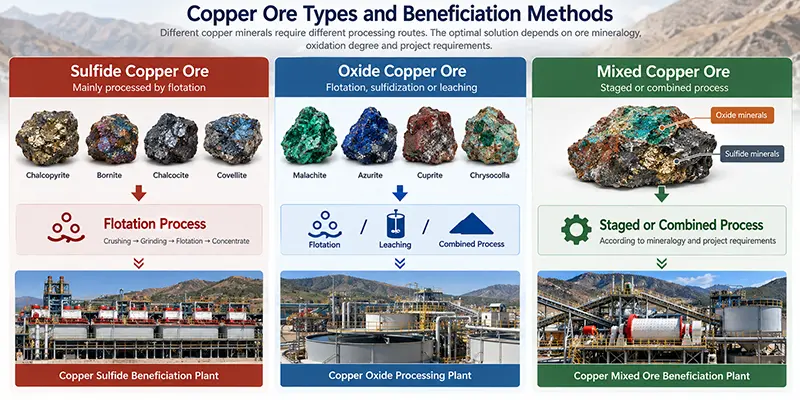
Copper Ore Types and Their Beneficiation Methods
The first step in designing a copper beneficiation plant is determining which copper minerals need to be recovered.
Mineralogy often has a greater influence on process selection than the total copper grade alone.
Sulfide Copper Ore
Common sulfide copper minerals include chalcopyrite, bornite, chalcocite and covellite.
Froth flotation is generally the principal beneficiation method because valuable sulfide minerals can be selectively separated from gangue after sufficient liberation.
A typical route is:
Crushing → Grinding → Classification → Conditioning → Flotation → Concentrate Dewatering
The exact number of rougher, scavenger and cleaner stages depends on ore characteristics and the required balance between recovery and concentrate grade.
Oxide Copper Ore
Typical oxide copper minerals include malachite, azurite, cuprite and chrysocolla. Their flotation behavior can differ considerably from that of sulfide minerals.
Depending on mineralogy and oxidation degree, the process may involve sulfidization flotation, direct or indirect leaching, or a combined beneficiation and hydrometallurgical route.
An oxide copper plant should therefore not copy the flowsheet of a conventional sulfide copper flotation plant.
The differences among the principal recovery routes are discussed further in Copper Flotation vs Heap Leaching.
Mixed Copper Ore
Mixed ores contain both sulfide and oxidized copper minerals. Their processing can be more difficult because the two mineral groups may respond differently to grinding, reagents and flotation conditions.
A staged or combined process may therefore be required.
The sulfide-to-oxide ratio, mineral associations, liberation characteristics and recovery response should be established before the final flowsheet is selected.
Copper Beneficiation Process Flow
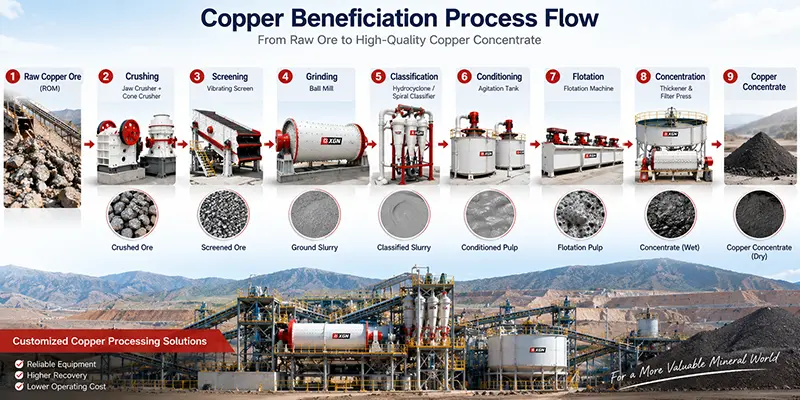
For a conventional sulfide copper ore, a complete beneficiation process can be summarized as:
ROM Copper Ore → Crushing → Screening → Grinding → Classification → Conditioning → Flotation → Concentrate Thickening and Filtration → Copper Concentrate
Each stage affects the next.
Poor crushing control increases the load on grinding. Insufficient grinding leaves copper minerals locked with gangue. Excessive grinding may generate unnecessary fines and consume additional energy. Unstable classification changes flotation feed size, while poor flotation control affects both recovery and final concentrate grade.
A copper beneficiation plant should therefore be designed as an integrated circuit rather than as a collection of independent machines.
Stage 1: Copper Ore Crushing and Screening
Run-of-mine copper ore is normally too large for direct grinding. The crushing section reduces the ore to a controlled size suitable for the grinding circuit.
Primary Crushing
Large ore is first reduced by a jaw crusher.
Primary crusher selection should consider:
Maximum feed size
Ore hardness
Abrasiveness
Required throughput
Downstream crushing arrangement
Target grinding feed size
XINGAONAI’s PEV jaw crusher is designed for primary crushing in mining and other hard-rock applications.
Crusher type should not be selected from compressive strength alone. Material abrasiveness, moisture, feed size, capacity and product requirements must be considered together. See How to Select a Crusher by Material Hardness, Abrasiveness and Capacity for a more detailed selection method.
Secondary and Tertiary Crushing
After primary crushing, a cone crusher can further reduce hard and abrasive copper-bearing ore before grinding.
For large plants, closed-circuit secondary or tertiary crushing can produce a more controlled ball mill feed and reduce unnecessary variation in the grinding circuit.
XINGAONAI’s XHP multi-cylinder cone crusher is designed for secondary and tertiary crushing of medium-to-hard ores and rocks.
Screening
Vibrating screens separate material according to particle size.
Oversize material can be returned to the crusher, while correctly sized material proceeds to the grinding section.
The target crushing product should be selected according to ore characteristics and grinding requirements rather than by simply pursuing the smallest possible crusher discharge.
Producing a finer crusher product may reduce part of the grinding duty, but excessive crushing can increase wear and generate additional fine material. The entire comminution circuit should therefore be evaluated together.
Stage 2: Copper Ore Grinding and Classification
Crushing reduces ore size, but grinding performs a different task: mineral liberation.
Copper minerals must be sufficiently liberated from gangue before effective flotation can occur.
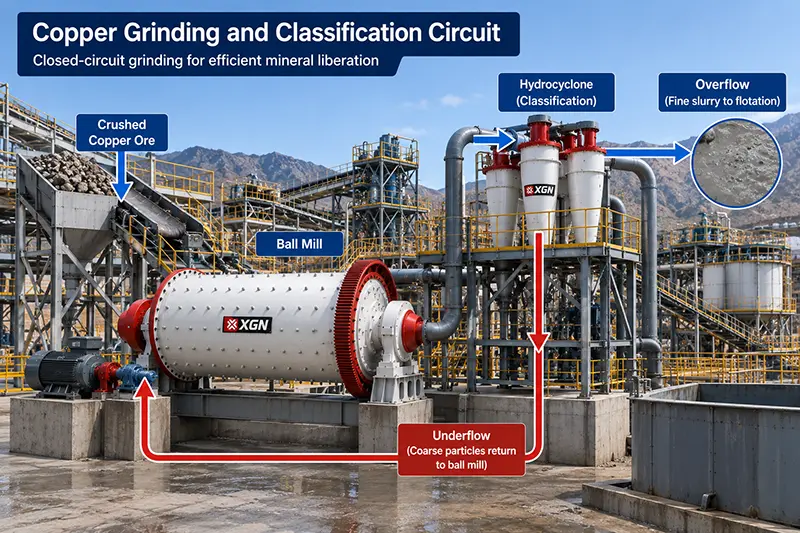
A common circuit is:
Crushed Copper Ore → Ball Mill → Classifier or Hydrocyclone → Flotation Feed
Oversize particles from classification return for further grinding, while sufficiently fine particles advance to flotation.
The Ball Mill is therefore one of the core machines in a copper beneficiation plant.
XINGAONAI ball mills are designed for metal-ore grinding, including copper ore, and can operate in closed circuit with a spiral classifier or hydrocyclone.
A spiral classifier separates fine overflow from the coarse sand fraction that needs to return to the mill.
The choice between a hydrocyclone and a spiral classifier depends on the required cut size, plant capacity, available space, slurry conditions and process-control requirements. Their operating differences are explained in Hydrocyclone vs Spiral Classifier.
How Fine Should Copper Ore Be Ground?
There is no universal grinding size for copper beneficiation.
The optimum P80 depends on:
Copper mineral grain size
Degree of mineral liberation
Gangue mineral associations
Ore hardness and grindability
Flotation response at different particle sizes
Risk of overgrinding and slime generation
Target concentrate grade
Target copper recovery
The objective is not to grind copper ore as fine as possible. It is to grind it sufficiently to achieve effective liberation at an acceptable energy cost.
This distinction is important because finer grinding generally requires more energy. Excessive fines can also create additional flotation and dewatering problems.
The target P80 should be established through size-by-size mineralogical analysis and flotation testing. A single generic value should not be applied to all copper ores.
Stage 3: Copper Flotation Process
After grinding and classification, sufficiently liberated sulfide copper minerals can be separated by froth flotation.
The basic principle is to modify mineral surface properties so that selected copper-bearing particles attach to air bubbles and rise into the froth, while unwanted gangue remains primarily in the slurry.
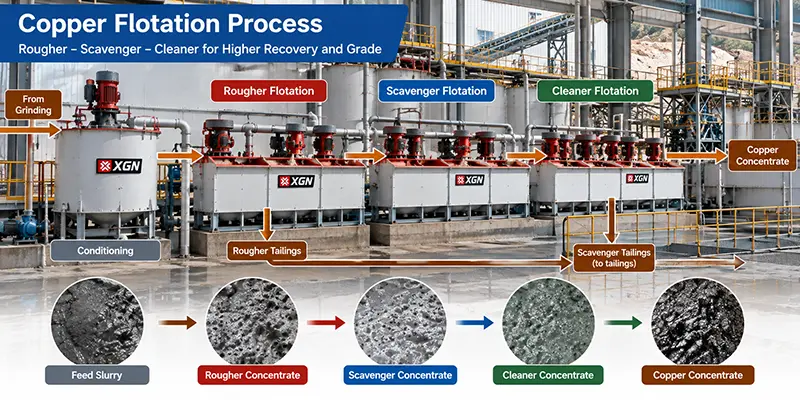
A typical flotation circuit can include:
Conditioning → Rougher Flotation → Scavenger Flotation → Cleaner Flotation → Copper Concentrate
The actual circuit may include multiple cleaning stages, recirculation or concentrate regrinding depending on the ore.
Conditioning
Before flotation, the slurry enters an agitation tank where reagents are mixed with the ore pulp.
Uniform conditioning helps stabilize reagent distribution and creates the required chemical environment before the slurry enters the flotation cells.
Important operating variables include:
Slurry density
Conditioning time
Agitation intensity
Reagent addition sequence
pH
Water chemistry
The appropriate conditioning conditions should be established through testing rather than copied from a different ore.
Rougher Flotation
The primary objective of rougher flotation is generally recovery.
The rougher circuit attempts to recover a high proportion of the floatable copper minerals from the feed, even if the first concentrate does not yet meet the required final grade.
A low rougher recovery can create losses that are difficult to recover in later stages.
Scavenger Flotation
Scavenger flotation treats the rougher tailings to recover additional valuable minerals that were not captured during roughing.
This stage can reduce copper losses to final tailings.
Scavenger concentrate may be returned to an earlier stage, sent to regrinding or treated separately, depending on its mineral composition and liberation.
Cleaner Flotation
Cleaner flotation focuses more strongly on concentrate quality.
The rougher concentrate is upgraded by rejecting entrained or floated gangue. Depending on mineralogy and concentrate specifications, one or several cleaning stages may be necessary.
The Flotation Machine can be used for mineral separation operations including roughing, scavenging and cleaning.
Its operating conditions must be matched to slurry characteristics, residence-time requirements and the required balance between copper recovery and concentrate grade.
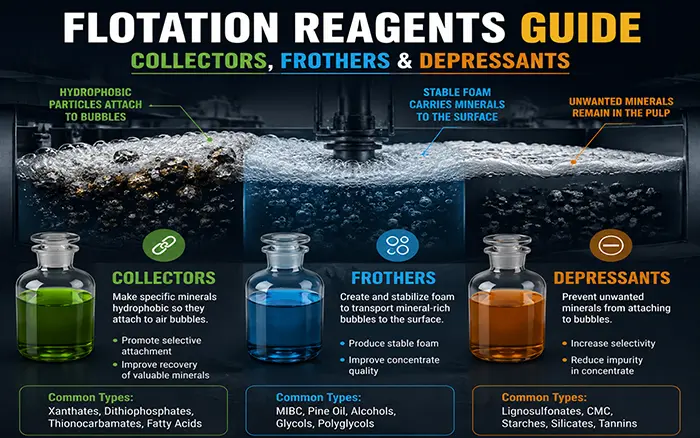
Copper Flotation Reagents
Flotation performance depends not only on equipment but also on slurry chemistry and reagent selection.
| Reagent type | Main function |
|---|---|
| Collector | Makes selected copper minerals more hydrophobic |
| Frother | Helps form and stabilize flotation froth |
| Activator | Enhances the flotation response of selected minerals |
| Depressant | Suppresses unwanted minerals or gangue |
| pH modifier | Creates a suitable chemical environment |
Reagent selection and dosage should not be treated as a universal recipe.
Copper mineralogy, pyrite content, gangue composition, water chemistry, pH, particle size and flotation objectives can all change the optimum reagent scheme.
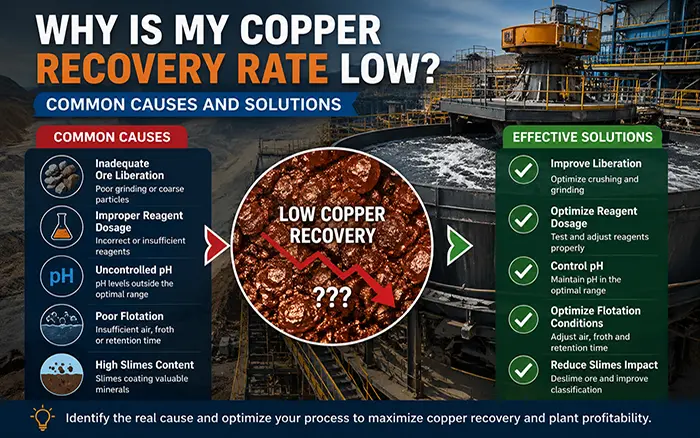
Increasing collector dosage does not necessarily solve a recovery problem. If the copper minerals remain locked with gangue, the underlying problem may be insufficient liberation rather than an inadequate reagent dosage.
Excessive collector or frother addition can also increase gangue recovery, reduce selectivity and create unstable froth.
Laboratory and pilot flotation tests are therefore important before a full-scale reagent program is finalized. See the Flotation Reagents Guide for the functions and selection considerations of common reagent groups.
Stage 4: Copper Concentrate Thickening and Dewatering
Flotation does not produce a dry final product. Copper concentrate normally leaves the flotation circuit as a slurry containing a substantial amount of water.
The downstream process may include:
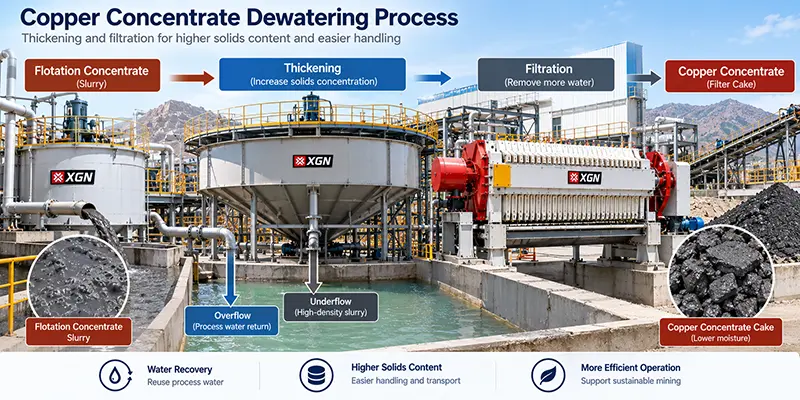
Flotation Concentrate → Thickening → Filtration → Copper Concentrate Cake
Thickening increases the solids concentration and recovers process water. Filtration then removes additional moisture to make the concentrate easier to handle, transport, store or feed into downstream metallurgical operations.
A Plate and Frame Filter Press can be used for concentrate filtration and solid-liquid separation.
Filter selection should consider:
Concentrate particle-size distribution
Feed solids concentration
Required cake moisture
Filtration rate
Cycle time
Cloth selection
Feed pressure
Required daily capacity
Recovered water may be returned to the processing circuit where water quality permits, reducing freshwater demand.
Water chemistry should still be monitored because dissolved ions and residual reagents in recycled water may affect flotation performance.
How Copper Ore Type Changes the Beneficiation Process
A successful copper beneficiation flowsheet must respond to mineralogy rather than treating every copper ore in the same way.
| Ore type | Main processing challenge | Possible route |
|---|---|---|
| Sulfide copper | Liberation and selective sulfide recovery | Grinding and flotation |
| Oxide copper | Different surface chemistry and flotation response | Sulfidization flotation and/or leaching |
| Mixed copper | Sulfide and oxide minerals in the same ore | Staged or combined process |
| Copper-pyrite ore | Selectivity between Cu and Fe sulfides | Selective flotation |
| Copper-gold ore | Recovery of multiple valuable minerals | Copper flotation with a gold recovery strategy |
| Copper-molybdenum ore | Separation of Cu and Mo minerals | Bulk flotation followed by selective separation |
These are process directions rather than fixed flowsheets.
Two deposits classified as the same broad ore type can still require different grinding sizes, reagent systems, flotation stages and equipment configurations.
Key Factors Affecting Copper Recovery and Concentrate Grade
Copper recovery and concentrate grade should be considered together.
Maximizing recovery without sufficient selectivity can increase gangue recovery and lower concentrate grade. Conversely, excessively aggressive cleaning may improve grade while losing valuable copper minerals.
1. Mineral Liberation
Copper minerals that remain locked with gangue cannot be separated efficiently simply by adding more flotation reagents.
Grinding must first provide adequate liberation.
2. Grinding Fineness
Coarse particles may contain insufficiently liberated copper minerals, while excessive grinding can increase fines and energy consumption.
An appropriate P80 should be established through mineralogical and flotation testing.
3. Classification Efficiency
Unstable classification can send coarse material into flotation or return excessive fine material to the mill.
Both situations reduce circuit efficiency.
4. Reagent Scheme
Collector type and dosage, frother dosage, depressants, activators and pH modifiers must match the actual mineral system.
5. Flotation Operating Conditions
Airflow, pulp level, slurry density, residence time, agitation and froth conditions all influence separation.
6. Rougher–Scavenger–Cleaner Balance
The circuit should be optimized as a system.
Roughing and scavenging primarily protect recovery, while cleaning improves concentrate quality.
If plant performance is below target, first identify whether the main problem is liberation, classification, chemistry or cell operation. The article Why Is My Copper Recovery Rate Low? provides a structured troubleshooting method.
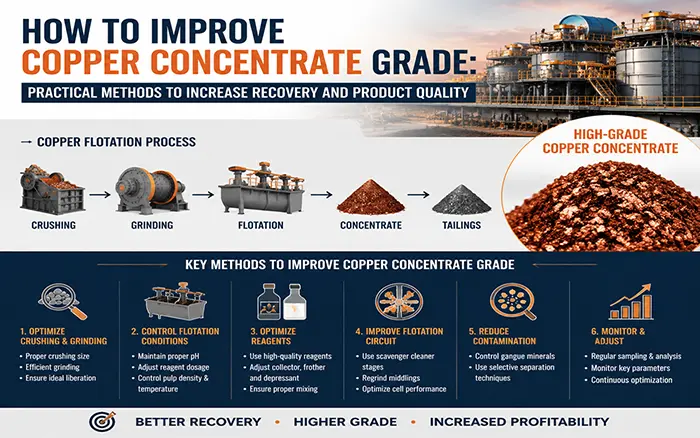
When recovery is acceptable but the product contains too much gangue, see How to Improve Copper Concentrate Grade.
Copper Beneficiation Equipment
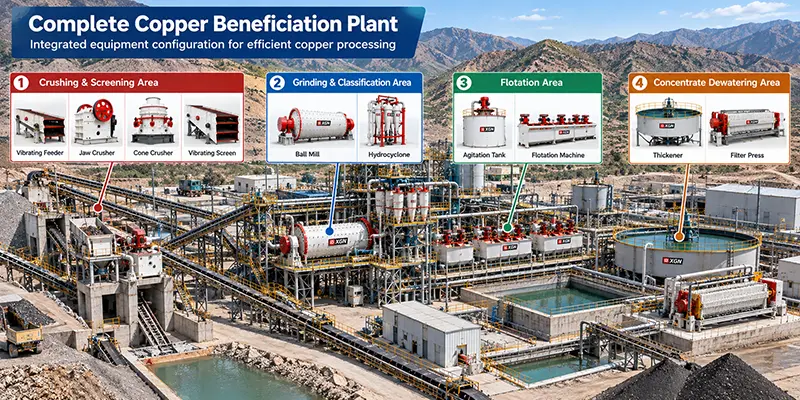
A complete copper ore processing plant may require equipment from several categories rather than one standalone flotation machine.
| Process stage | Typical equipment | Main function |
|---|---|---|
| Feeding | Vibrating or apron feeder | Provide stable ore feeding |
| Primary crushing | Jaw crusher | Reduce run-of-mine ore |
| Secondary crushing | Cone crusher | Prepare ore for grinding |
| Screening | Vibrating screen | Control crushing product size |
| Grinding | Ball mill | Liberate copper minerals |
| Classification | Spiral classifier or hydrocyclone | Separate fine and coarse particles |
| Conditioning | Agitation tank | Mix slurry and reagents |
| Separation | Flotation machine | Recover copper minerals |
| Thickening | Thickener | Increase concentrate solids |
| Filtration | Filter press | Reduce concentrate moisture |
| Tailings handling | Dewatering equipment | Recover water and manage tailings |
XINGAONAI provides crushing, grinding, classification, agitation, flotation and filtration equipment that can be integrated into complete mineral-processing lines.
Equipment should be selected according to the process duty. A machine should not be added to the flowsheet merely because it is commonly used in other copper plants.
Copper Beneficiation Plant Configuration
The final plant configuration depends on ore characteristics and project objectives.
For a relatively straightforward sulfide copper ore, the route may be:
Crushing → Grinding → Classification → Conditioning → Flotation → Dewatering
For a more complex sulfide ore, additional processing stages may be required:
Multi-Stage Crushing → Closed-Circuit Grinding → Roughing → Scavenging → Cleaning → Regrinding → Final Cleaning → Dewatering
Mixed or oxidized ores may require a substantially different flowsheet involving sulfidization, leaching or a combined recovery strategy.
This is why equipment should be selected after the process route is defined, not the other way around.
What Information Is Needed to Design a Copper Beneficiation Plant?
Before selecting crushers, mills, flotation cells and dewatering equipment, the engineering team should obtain enough information to define the process conditions.
Important project data include:
Copper mineral type
Head grade
Sulfide-to-oxide ratio
Mineralogical composition
Feed size
Required plant capacity
Ore hardness
Bond Work Index
Mineral liberation size
Target concentrate grade
Target copper recovery
Water availability
Site altitude and climate
Power supply
Tailings requirements
Where sufficient test data are available, these inputs can be used to establish a preliminary flowsheet, mass balance, equipment configuration and grinding and flotation requirements.
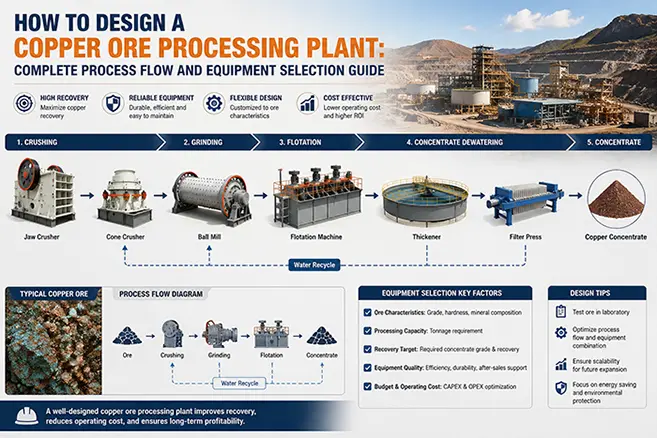
The broader design sequence is discussed in How to Design a Copper Ore Processing Plant.
XINGAONAI can configure the crushing, grinding, classification, flotation and dewatering stages around the actual ore and required capacity instead of applying a fixed processing line to every project.