Copper recovery rate is one of the most important performance indicators in a copper beneficiation plant. Even a small decrease in recovery can result in significant revenue losses over the life of a mining project. While operators often focus on concentrate grade, maximizing copper recovery is equally essential for improving the overall economics of mineral processing.
A decline in copper recovery is rarely caused by a single issue. Instead, it is usually the result of multiple factors, including ore variability, inadequate mineral liberation, improper reagent dosage, unstable flotation conditions, equipment wear, or poor process control.
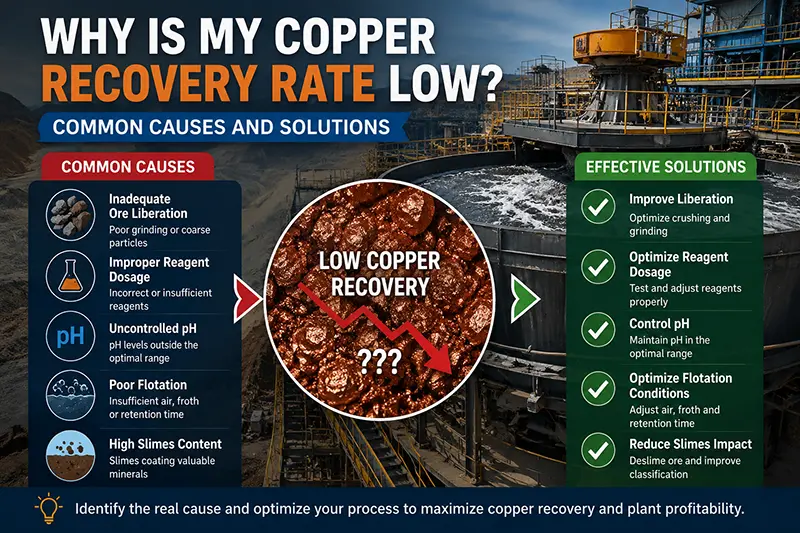
This guide explains the most common reasons why copper recovery rates are low, how to diagnose the underlying causes, and the practical solutions that can help improve flotation performance and increase metal recovery.
What Is Copper Recovery Rate?
Copper recovery rate refers to the percentage of copper in the feed ore that is successfully recovered into the final concentrate.
It can be expressed as:
Copper Recovery (%) = (Copper in Concentrate ÷ Copper in Feed) × 100
For many sulfide copper flotation plants, recovery rates typically range between 85% and 95%, although the achievable recovery depends on ore mineralogy, plant design, and operating conditions.
Why Does Copper Recovery Rate Decrease?
Recovery losses generally occur because valuable copper minerals fail to report to the concentrate. Instead, they remain in tailings or become trapped within gangue minerals.
The most common reasons include:
Poor mineral liberation
Changes in ore characteristics
Incorrect reagent dosage
Inefficient flotation conditions
Equipment problems
Process instability
Excessive oxidation
Inadequate maintenance
Understanding which factor is responsible is the first step toward improving recovery.
Cause 1: Inadequate Mineral Liberation
Copper minerals must be separated from surrounding gangue before flotation can recover them efficiently.
If grinding is insufficient:
Copper remains locked within waste rock.
Flotation collectors cannot effectively attach to copper minerals.
Valuable copper is lost to tailings.
Solution
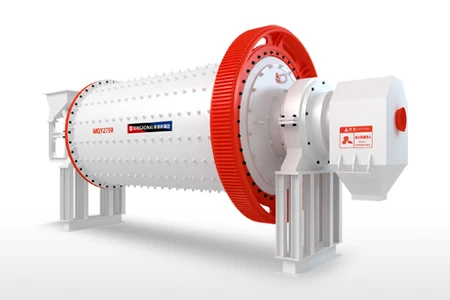
Improve grinding performance by:
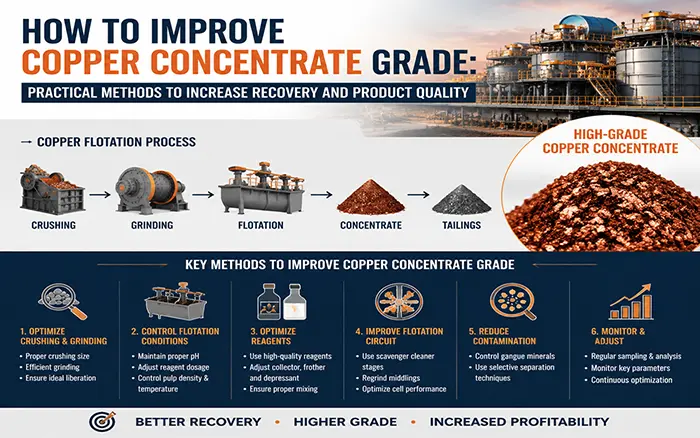
Optimizing grind size
Monitoring particle size distribution
Improving hydrocyclone classification
Maintaining consistent mill operation
Performing regular liberation analysis
Proper mineral liberation provides the foundation for high flotation recovery.
Cause 2: Changes in Ore Mineralogy
Ore characteristics often vary throughout the life of a mine.
Common changes include:
Lower copper grades
Increased oxidation
Higher clay content
More fine particles
Increased pyrite content
Greater amounts of complex sulfides
Different ore types require different flotation strategies.
Solution
Regularly conduct:
Mineralogical analysis
Metallurgical testing
Ore blending
Process optimization
Adjust operating parameters whenever significant changes in ore characteristics occur.
Cause 3: Incorrect Reagent Dosage
Flotation reagents play a critical role in separating copper minerals from gangue.
Common reagent problems include:
Insufficient collector dosage
Excess collector consumption
Poor frother selection
Incorrect depressant dosage
Improper pH regulation
Overdosing reagents can be just as harmful as underdosing.
Solution
Optimize:
Reagent addition points
Regular laboratory flotation tests can determine the most effective reagent scheme.
Cause 4: Poor Grinding Performance
Grinding directly influences flotation efficiency.
Problems include:
Uneven particle size
Excessive coarse particles
Overgrinding
High circulating load
Worn grinding media
Each of these conditions reduces flotation efficiency.
Solution
Improve grinding by:
Maintaining stable feed rates
Monitoring mill power
Optimizing grinding media size
Improving classification efficiency
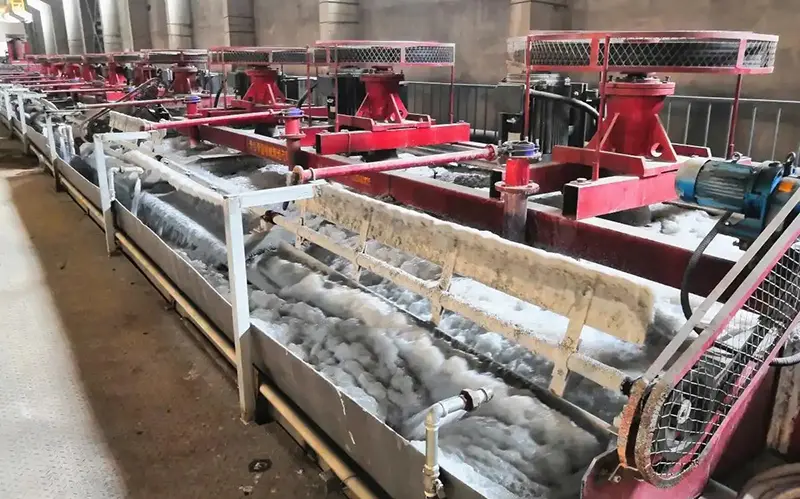
Cause 5: Flotation Circuit Instability
Stable flotation conditions are essential for maintaining high recovery.
Common operational issues include:
Unstable pulp density
Variable air flow
Fluctuating froth depth
Short residence time
Poor level control
Even small fluctuations may significantly affect recovery.
Solution
Maintain consistent operating conditions through:
Automatic level control
Stable pulp density
Air flow monitoring
Online instrumentation
Routine process inspections
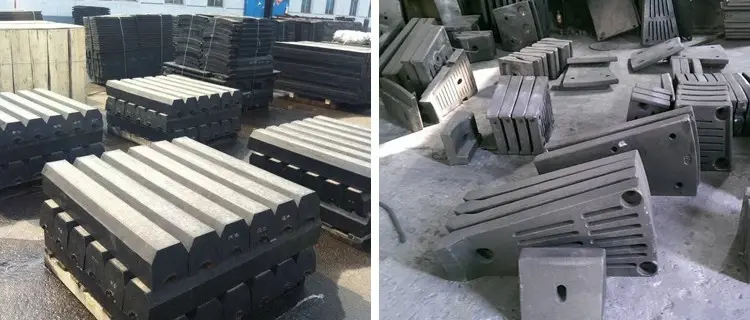
Cause 6: Equipment Wear
Mechanical wear gradually reduces flotation performance.
Common wear points include:
Impellers
Stators
Pump components
Hydrocyclones
Screen panels
Worn equipment affects slurry flow, air dispersion, and particle classification.
Solution
Implement preventive maintenance programs and replace worn components before performance deteriorates.
Cause 7: Excessive Slime Generation
Very fine particles often reduce flotation selectivity.
Slimes can:
Consume reagents
Reduce bubble attachment
Increase entrainment
Lower concentrate quality
Reduce copper recovery
Solution
Reduce slime generation by:
Optimizing grinding
Improving classification
Removing excessive fines where practical
Adjusting flotation conditions
Cause 8: Poor Water Quality
Process water chemistry directly affects flotation behavior.
Potential problems include:
High dissolved salts
Excess suspended solids
Unstable pH
Organic contamination
Hard water
Solution
Maintain consistent water quality through:
Water recycling management
Water treatment
Routine chemical monitoring
Process water blending
Cause 9: Inadequate Process Monitoring
Recovery losses often remain unnoticed until laboratory results become available.
Without real-time monitoring, corrective actions may be delayed.
Solution
Modern plants increasingly install:
Online grade analyzers
Flow meters
Density meters
Particle size analyzers
Automated sampling systems
Advanced Process Control (APC)
Continuous monitoring allows operators to identify problems before significant recovery losses occur.
Cause 10: Poor Operator Practices
Even highly automated plants depend on skilled operators.
Common issues include:
Delayed adjustments
Incorrect reagent preparation
Inconsistent inspections
Poor communication
Inadequate training
Solution
Invest in:
Operator training
Standard operating procedures
Process documentation
Performance reviews
Continuous improvement programs
Well-trained operators can often identify problems before they impact recovery.
Systematic Troubleshooting Process
When copper recovery declines, avoid making random operating changes.
A structured troubleshooting process should include:
Review recent recovery trends.
Check feed ore characteristics.
Verify grinding performance.
Inspect flotation conditions.
Evaluate reagent consumption.
Examine equipment condition.
Review process water quality.
Analyze tailings mineralogy.
Confirm instrumentation accuracy.
Implement corrective actions and monitor results.
A systematic approach helps identify root causes more efficiently and minimizes unnecessary production losses.
Technologies That Help Improve Copper Recovery
Modern copper concentrators increasingly adopt advanced technologies to stabilize recovery and improve plant performance.
Examples include:
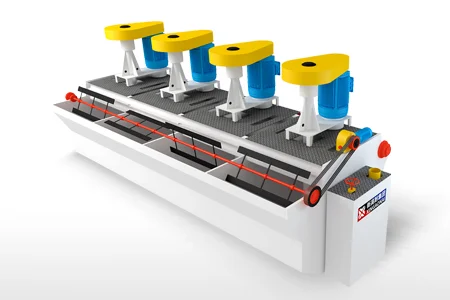
High-efficiency flotation cells
Fine grinding technologies
Automated reagent dosing systems
AI-based process optimization
Machine vision froth monitoring
Digital twin simulations
Predictive maintenance systems
Online mineral analyzers
These technologies reduce process variability while improving both recovery and operating efficiency.
Best Practices for Maintaining High Copper Recovery
Successful plants typically follow several long-term strategies:
Conduct regular metallurgical testing.
Maintain stable ore blending.
Optimize grind size continuously.
Monitor flotation performance in real time.
Calibrate instruments regularly.
Replace worn equipment proactively.
Improve operator training.
Review process data on a routine basis.
Consistent optimization is more effective than occasional adjustments after problems occur.
Conclusion
A low copper recovery rate is usually the result of multiple interacting factors rather than a single equipment failure or operating mistake. Ore variability, insufficient mineral liberation, unstable flotation conditions, incorrect reagent selection, and inadequate process monitoring are among the most common causes of recovery losses.
By applying a structured troubleshooting approach, upgrading critical equipment, and continuously optimizing grinding, flotation, and process control, mining companies can improve copper recovery, reduce metal losses in tailings, and increase the overall profitability of their beneficiation operations. Continuous monitoring and data-driven decision-making are essential for maintaining stable, high-performance copper processing plants.