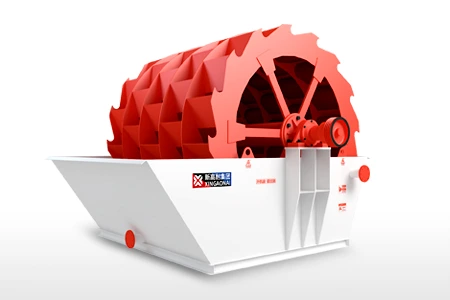
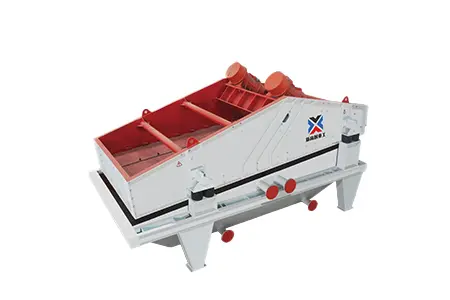
Wheel and spiral sand washing machines both remove clay, silt, stone powder and other unwanted fines from sand and aggregate. However, they use different washing and conveying mechanisms and therefore suit different feed conditions and production requirements.
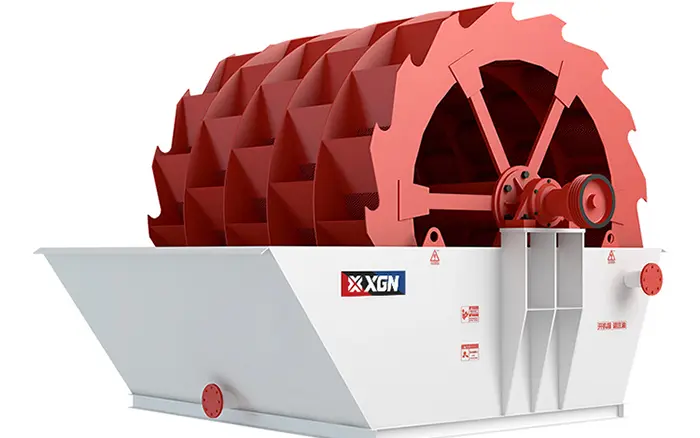
A wheel sand washer uses rotating buckets or blades to agitate, lift and drain the material. It generally offers a compact structure, straightforward operation and effective preliminary dewatering.
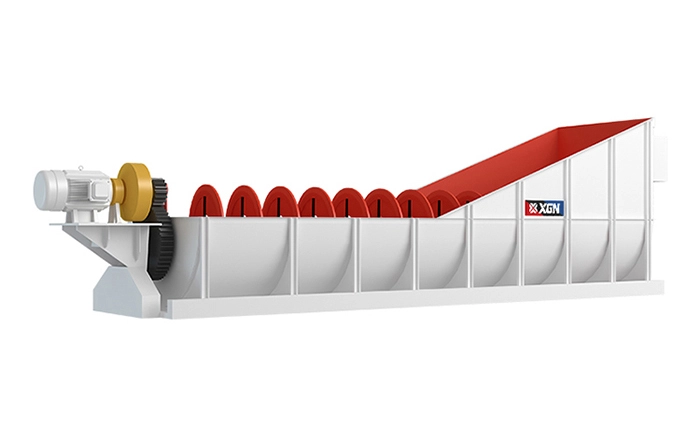
A spiral sand washer uses one or two rotating screws to agitate and convey sand through an inclined water-filled trough. It normally provides longer material retention, more continuous agitation and greater wet-classification capability.
Neither machine is universally better. The correct choice depends on:
Feed particle size
Clay and silt content
Required washing intensity
Desired product grading
Fine-sand recovery requirements
Available water
Final moisture target
Plant capacity and layout
Quick selection: Choose a wheel sand washer for relatively clean sand when compact installation and preliminary dewatering are important. Consider a spiral sand washer when the process requires stronger continuous agitation, desliming and wet classification. Strongly bonded clay may require a log washer or attrition scrubber rather than either machine alone.
Wheel vs Spiral Sand Washing Machine: Quick Comparison
| Factor | Wheel sand washing machine | Spiral sand washing machine |
|---|---|---|
| Main mechanism | Rotating wheel or buckets | Rotating inclined screw |
| Washing action | Lifting, turning and rinsing | Continuous agitation and conveying |
| Washing intensity | Moderate | Moderate to relatively strong |
| Retention time | Usually shorter | Usually longer |
| Wet classification | Limited | Better control through water and overflow |
| Fine-sand loss | Often lower under suitable conditions | May be higher if water and overflow are not controlled |
| Preliminary dewatering | Generally effective | Moderate; downstream dewatering may be required |
| Water requirement | Often lower | Can be higher depending on the process |
| Plant footprint | Generally compact | Usually requires a longer installation area |
| Maintenance focus | Buckets, wheel, bearings and drive | Spiral blades, shaft, trough, bearings and drive |
| Typical feed | Relatively clean or moderately contaminated sand | Material requiring more agitation and desliming |
| Common configuration | Sand washing and lifting | Washing, desliming, classification and conveying |
Actual performance depends on the model, feed gradation, clay characteristics, water-flow settings and complete washing-circuit design.
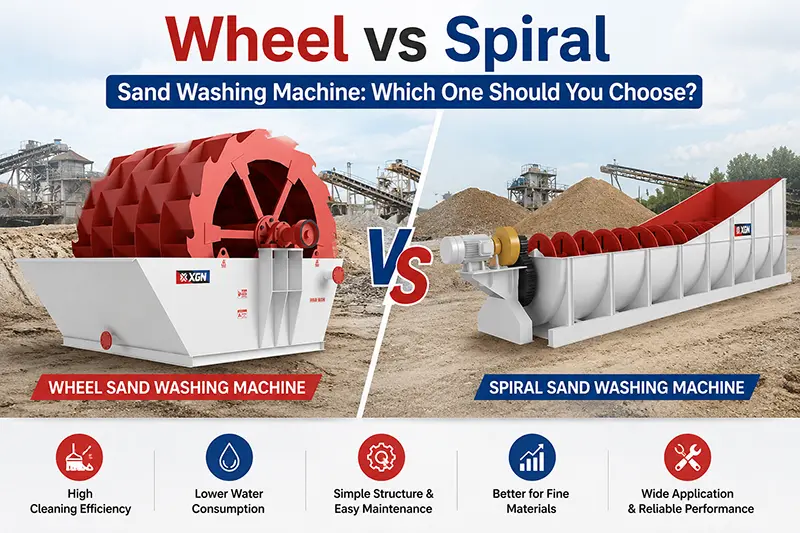
What Is a Wheel Sand Washing Machine?
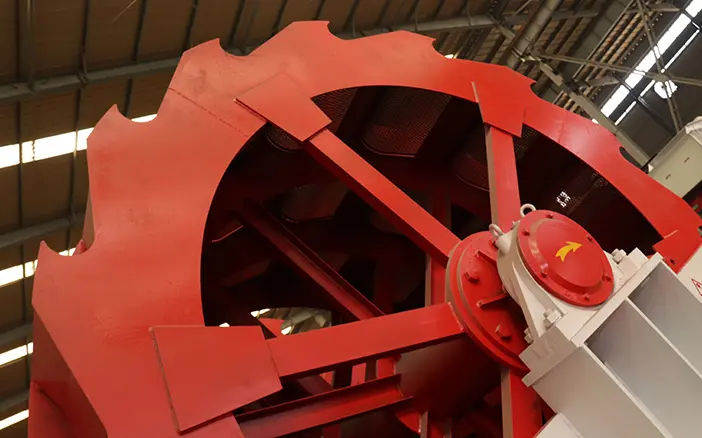
A wheel sand washing machine uses a rotating wheel fitted with buckets or blades. The lower part of the wheel operates inside a water-filled tank.
As the wheel rotates, the material is agitated and rinsed. The buckets collect the washed sand, lift it above the water level and allow free water to drain before discharging the material.
The simplified process is:
Feed → Agitation and Washing → Bucket Lifting → Drainage → Discharge
A wheel bucket sand washing machine is commonly considered for manufactured sand, river sand and aggregate applications where the feed contains manageable levels of dust, silt or loose impurities.
Main characteristics
Compact equipment layout
Relatively simple mechanical structure
Effective lifting and preliminary drainage
Suitable for continuous sand washing
Usually retains coarse and medium sand effectively
Relatively straightforward maintenance
Can be integrated into manufactured-sand production lines
A wheel washer is not necessarily suitable for every clay-rich feed. Its cleaning ability depends on the type and amount of contamination, retention time and water conditions.
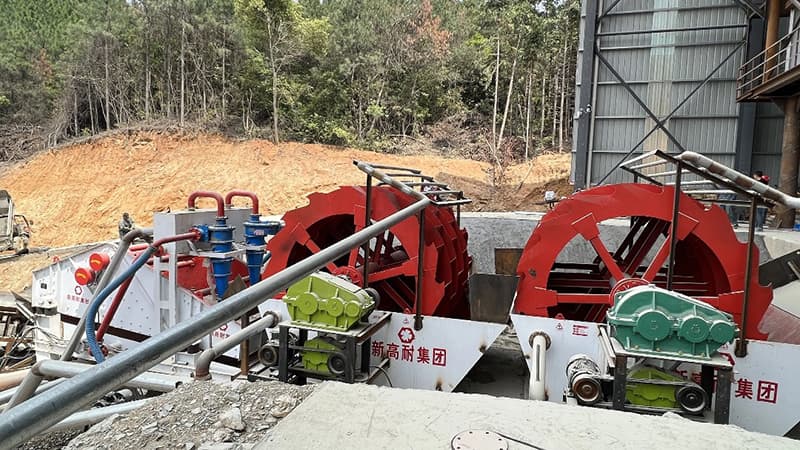
What Is a Spiral Sand Washing Machine?
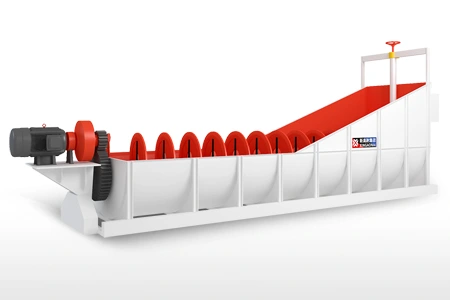
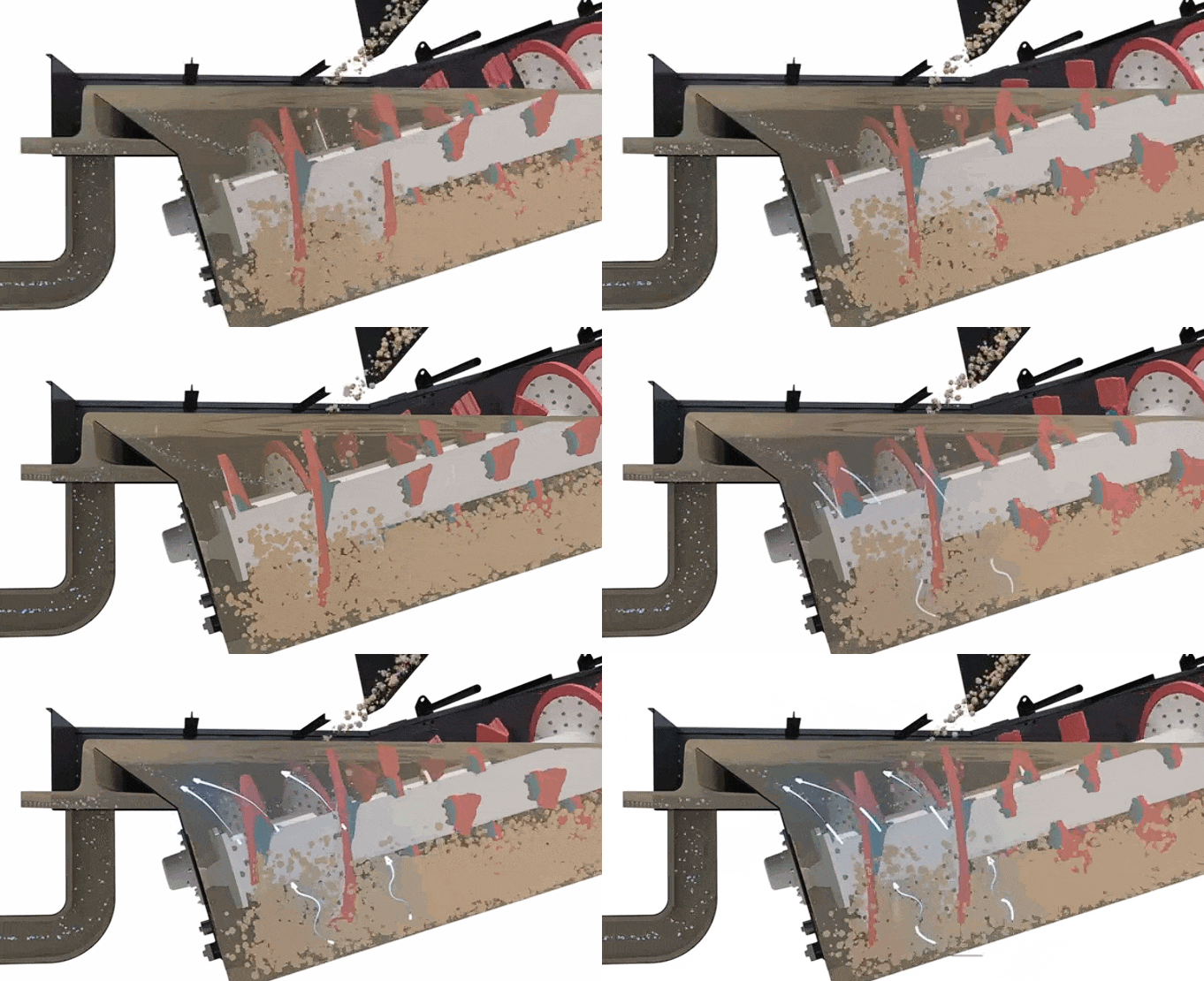
A spiral sand washing machine, also called a screw sand washer or sand screw, uses a rotating spiral shaft inside an inclined washing trough.
The spiral blades agitate the sand–water mixture, loosen surface contaminants and continuously move the settled sand toward the upper discharge end. Fine suspended particles leave the machine with the overflow water.
The simplified process is:
Feed → Spiral Agitation → Desliming and Separation → Inclined Conveying → Drainage → Discharge
A spiral sand washing machine is commonly considered when the process requires continuous agitation, desliming, wet classification or longer contact between the feed and process water.
Main characteristics
Continuous agitation and conveying
Longer washing path
Effective desliming capability
Wet-classification function
Single- or double-spiral configurations
Suitable for continuous-duty operation
Can handle a range of sand and fine-aggregate feeds
For a detailed process explanation, read the working principle of a screw sand washing machine.
1. Difference in Washing Action
The biggest difference is how the machines move and clean the material.
Wheel sand washer
The rotating buckets or blades turn the material inside the washing tank. Sand is rinsed, collected and lifted from the water.
The washing path is relatively compact, making this design suitable for feeds that do not require prolonged scrubbing.
Spiral sand washer
The screw continuously agitates the sand inside a longer inclined trough. The material remains in contact with water while being conveyed toward the discharge end.
This arrangement can provide more retention time and more continuous agitation, which may improve desliming when the feed contains a higher proportion of loose silt or surface contamination.
However, the spiral washer should not be described as a substitute for every type of scrubbing equipment. Compact clay lumps and strongly bonded clay coatings may require a log washer or attrition scrubber.
2. Clay and Silt Removal
Loose dust and dispersed silt can usually be removed by either type of machine when the equipment is correctly selected and operated.
The appropriate choice changes when the material contains more difficult contamination.
| Feed condition | Possible selection |
|---|---|
| Light dust and loose silt | Wheel washer may be sufficient |
| Moderate surface contamination | Either machine, depending on required capacity and grading |
| Higher proportion of loose clay and silt | Spiral washer may provide more washing contact |
| Sticky or compact clay lumps | Consider log washing or attrition scrubbing |
| High-value fine sand | Add a fine-sand recovery system |
Material testing is more reliable than selecting equipment based only on a stated mud-content percentage.
3. Fine-Sand Recovery
Fine-sand loss affects both product yield and wastewater treatment load.
A wheel washer often performs well when the product consists mainly of medium and coarse sand. Its bucket-lifting action can retain much of the settled product while allowing water to drain.
A spiral washer uses overflow to remove suspended fines. If the water velocity is too high or the overflow level is incorrectly set, useful fine particles may leave with the dirty water.
Fine-sand loss depends on:
Feed particle-size distribution
Percentage of particles below the target cut size
Water-flow rate
Slurry concentration
Overflow level
Machine loading
Particle settling characteristics
When the overflow contains valuable fine sand, a hydrocyclone, dewatering screen or fine-sand recovery unit can be added to the circuit.
4. Preliminary Dewatering
Wheel washers generally provide effective preliminary drainage because the buckets lift the sand above the washing pool before discharge.
Spiral washers also allow water to drain as the screw conveys the material up the inclined trough. However, the discharged product may still contain more moisture than required for immediate stockpiling or transport.
If lower final moisture is required, either type of washer can be followed by a dewatering screen.
The washing machine should not be expected to replace a dedicated dewatering system in every application.
5. Water Consumption
A wheel sand washer often operates with a smaller washing pool and may require less process water under comparable conditions.
A spiral washer may require more water to maintain the washing pool, suspend contaminants and control the overflow. However, actual water consumption depends on the machine size, feed characteristics and required washing result.
Water demand should be evaluated together with:
Water-recycling system
Settling pond or thickener capacity
Slurry concentration
Required product cleanliness
Fine-sand recovery
Local water availability
Both systems can use recycled process water if its suspended-solids concentration is suitable for the required product quality.
6. Wet Classification
A spiral washer normally provides greater wet-classification capability because the separation process is influenced by water flow, settling behaviour and overflow conditions.
This can help remove excess fine particles while retaining the settled sand.
A wheel washer primarily focuses on washing, lifting and draining. Although some fine contaminants leave with the water, it generally offers less classification control than a properly operated spiral washer.
Choose the equipment according to the required product gradation rather than washing appearance alone.
7. Processing Capacity
Both machines are available in different sizes and configurations.
Spiral washers can be supplied with one or two screws. Double-spiral models generally provide a larger washing and conveying area than comparable single-spiral models, but capacity should not be estimated solely from the number of screws.
Wheel washers are also available in different diameters and widths. Their capacity depends on the tank design, bucket arrangement, wheel speed and material characteristics.
Actual throughput is affected by:
Bulk density
Feed gradation
Moisture content
Clay content
Required washing quality
Water supply
Machine loading
Downstream equipment capacity
Use the manufacturer’s model-specific technical table rather than a general capacity statement.
8. Maintenance and Wear
Wheel sand washer maintenance
Common inspection points include:
Wheel buckets or blades
Screen or perforated sections
Bearings
Drive assembly
Tank
Fasteners
Discharge chute
Its relatively compact design can make routine inspection and component replacement straightforward.
Spiral sand washer maintenance
Common inspection points include:
Spiral blades and wear edges
Spiral shaft
Shaft connections
Lower and upper bearings
Reducer and drive assembly
Washing trough
Overflow outlet
Support frame
Spiral blades and trough surfaces can experience significant abrasion when processing quartz-rich or otherwise abrasive materials.
Maintenance cost should be evaluated from feed abrasiveness, operating hours and replacement-part availability—not only from machine structure.
9. Installation and Plant Layout
Wheel washers are generally compact and can be installed in relatively limited spaces.
Spiral washers have a longer inclined trough and may require more longitudinal space. The foundation must also support the machine, slurry load and dynamic forces.
The complete layout should include space for:
Feed and discharge conveyors
Water pipelines
Overflow channels
Settling or recycling systems
Dewatering equipment
Maintenance access
Wear-part replacement
Product stockpiles
Equipment footprint alone should not determine the selection.
Which Machine Is Better for Manufactured Sand?
Manufactured sand often contains crusher dust and fine particles generated during crushing and shaping.
A wheel washer may be suitable when:
The feed contains mainly loose dust
Strong scrubbing is not required
Fine-sand retention is important
Compact installation is preferred
Preliminary dewatering is required
A spiral washer may be considered when:
More continuous agitation is needed
The material requires desliming
Wet classification is important
The feed contains more loose clay or silt
A longer washing path is beneficial
When manufactured sand contains valuable fines, the washer should be combined with an appropriate recovery system.
Which Machine Is Better for River Sand?
River sand can contain silt, clay, organic matter and lightweight contaminants.
A wheel washer may be sufficient for relatively clean river sand containing loose silt. A spiral washer may be more suitable when longer washing and desliming are required.
Read more about processing considerations in River Sand Washing Machine.
The final selection should be based on particle-size analysis and contamination testing rather than the material name alone.
Which Machine Is Better for Silica or Quartz Sand?
Silica and quartz sand can be highly abrasive. Equipment selection should consider both washing performance and component wear.
A spiral washer may be used when wet classification and desliming are required. A wheel washer may be considered for simpler washing duties involving relatively clean material.
For higher-purity industrial silica sand, one washer may not be sufficient. The process may also require attrition scrubbing, hydraulic classification, magnetic separation or chemical treatment.
See Silica Sand Washing Machine for additional process considerations.
Selection Matrix
| Project requirement | Recommended starting point |
|---|---|
| Relatively clean medium or coarse sand | Wheel sand washer |
| Compact plant layout | Wheel sand washer |
| Strong preliminary drainage | Wheel sand washer |
| Low to moderate washing requirement | Wheel sand washer |
| Continuous desliming and conveying | Spiral sand washer |
| Longer washing retention time | Spiral sand washer |
| Wet-classification requirement | Spiral sand washer |
| Higher throughput | Compare large wheel and double-spiral models |
| Strongly bonded clay | Log washer or attrition scrubber may be needed |
| Valuable fine particles in overflow | Add hydrocyclone or fine-sand recovery |
| Low final moisture target | Add dewatering screen |
| Limited fresh water | Design a closed-loop water-recycling system |
Information Required Before Selecting a Sand Washer
Before requesting equipment selection, prepare the following information:
Material type
Maximum feed size
Particle-size distribution
Required capacity in tonnes per hour
Clay and silt content
Whether the clay is loose or strongly bonded
Required finished-product grading
Maximum acceptable fines content
Required discharge moisture
Available fresh and recycled water
Project location
Available installation space
Upstream and downstream equipment
This information is more useful than selecting a machine from a general product name or nominal capacity.
Conclusion
The main difference between wheel and spiral sand washing machines is how they agitate, convey, classify and drain the material.
Choose a wheel sand washing machine when the feed is relatively clean, the plant requires a compact layout and effective preliminary drainage, and extensive wet classification is unnecessary.
Choose a spiral sand washing machine when the process requires continuous agitation, longer washing contact, desliming and greater control over wet classification.
For difficult clay-bound materials or strict product specifications, neither machine should be selected in isolation. Material testing and complete process design are necessary to determine whether scrubbing, classification, fine-sand recovery or additional dewatering equipment is required.