A screw sand washing machine cleans and classifies sand through the combined action of a rotating spiral, process water and an inclined washing trough. The spiral agitates the feed to loosen clay, silt and surface contaminants, while water carries suspended fine particles toward the overflow. At the same time, the screw conveys the settled sand upward, allowing part of the water to drain before the washed material leaves the discharge end.
This continuous process combines washing, desliming, wet classification, conveying and preliminary dewatering in one machine. However, the final washing result depends on the feed gradation, clay content, water flow, screw speed, overflow level and equipment configuration.
For equipment specifications and available models, see the XINGAONAI spiral sand washing machine.
Quick answer: A screw sand washing machine works by stirring sand in water with a rotating spiral. Fine contaminants remain suspended and leave with the overflow, while heavier sand settles and is conveyed up the inclined trough for drainage and discharge.
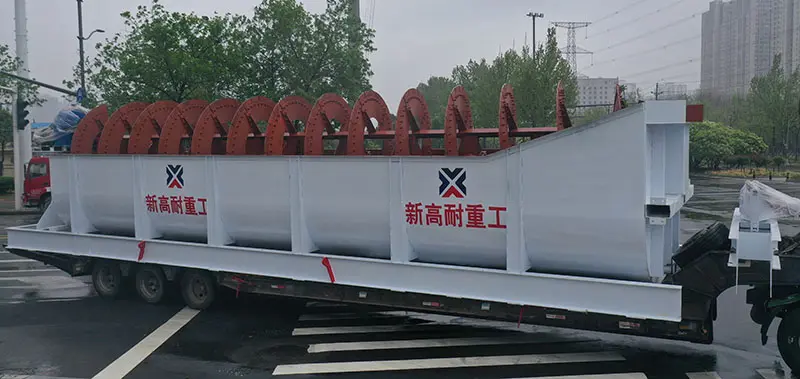
How Does a Screw Sand Washing Machine Work?
The working principle of a screw sand washing machine can be divided into five continuous stages: feeding, agitation, hydraulic separation, spiral conveying and discharge.
1. Feeding the Sand–Water Mixture
River sand, manufactured sand, crushed sand or fine aggregate enters the lower section of the inclined washing trough through a conveyor, chute or controlled feeding device.
Process water is introduced into the trough to form a washing pool. The feed rate must be matched to the machine’s capacity. Excessive or uneven feeding can reduce washing efficiency, overload the screw and increase the risk of material accumulation.
The feed should be distributed as evenly as possible so that the material can contact the process water and spiral blades effectively.
2. Agitation and Surface Cleaning
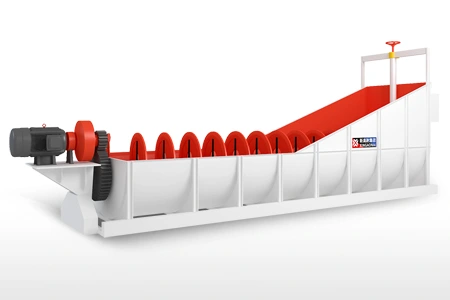
A motor and reducer drive the spiral shaft at a controlled speed. As the spiral rotates, its blades continuously lift, turn and move the sand inside the water-filled trough.
This movement creates friction:
Between individual sand particles
Between the sand and spiral blades
Between the material and the washing trough
The combined agitation helps loosen clay coatings, stone powder, silt and other contaminants attached to the particle surfaces.
Washing performance depends on how easily the contaminants disperse in water. Soft silt and loose dust are generally easier to remove than strongly bonded clay. Materials containing compact clay lumps may require a log washer or attrition scrubber before the sand-washing stage.
3. Hydraulic Separation and Overflow
Once the fine contaminants are loosened, they become suspended in the wash water. The water flow carries these particles toward the overflow outlet, where they leave the machine with the dirty water.
Separation is not determined by particle density alone. It is also affected by:
Particle size
Particle shape
Settling velocity
Water velocity
Slurry concentration
Overflow level
Retention time
Coarser and heavier sand particles settle toward the bottom of the trough, while sufficiently fine or slow-settling particles are more likely to leave with the overflow.
The overflow water can be directed to a settling pond, thickener or water-recycling system. If valuable fine sand is being lost, a hydrocyclone or fine-sand recovery system may be installed downstream.
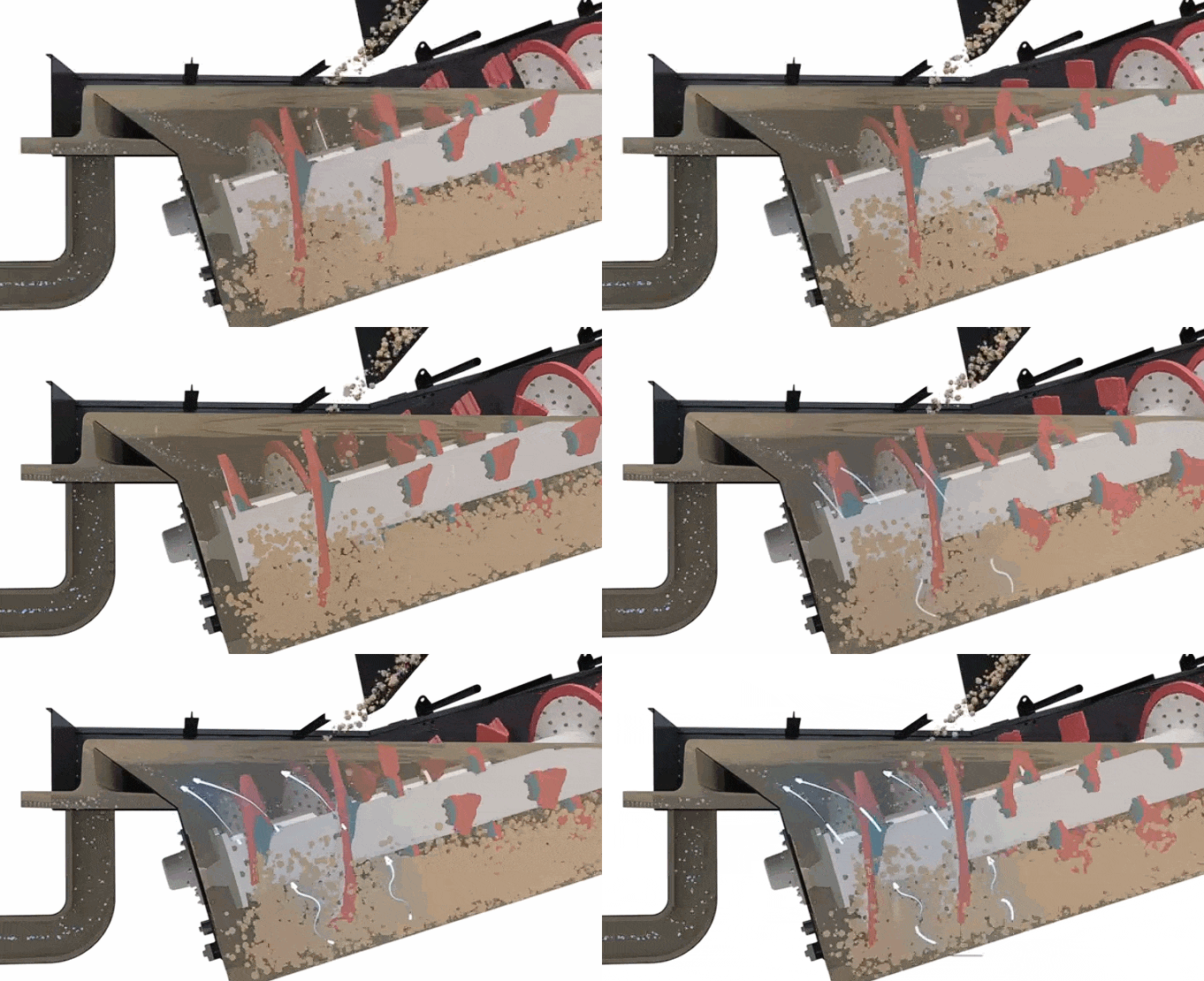
4. Spiral Conveying and Preliminary Dewatering
After washing, the settled sand is captured by the rotating spiral blades and gradually conveyed upward along the inclined trough.
As the material moves above the water level, free water drains back into the washing zone. This provides preliminary dewatering before discharge.
A screw washer normally reduces the amount of free water in the material, but it does not always produce stockpile-ready sand. Where a lower final moisture content is required, the machine can be followed by a dewatering screen.
5. Washed Sand Discharge
The washed sand reaches the upper end of the trough and is discharged by gravity onto a conveyor, dewatering screen or stockpile.
The process operates continuously:
Feeding → Agitation → Desliming → Hydraulic Separation → Spiral Conveying → Drainage → Discharge
Stable feeding and water supply are essential. Rapid changes in feed volume or slurry concentration can affect both product cleanliness and fine-particle recovery.
Main Components and Their Functions
A screw sand washing machine has a relatively simple structure, but each component affects washing performance and operating reliability.
| Component | Main function |
|---|---|
| Washing trough | Holds the sand–water mixture and provides the washing and separation zone |
| Spiral shaft | Transfers rotational force through the machine |
| Spiral blades | Agitate, wash and convey the sand |
| Motor | Supplies power to the machine |
| Reducer | Reduces motor speed and increases output torque |
| Drive assembly | Transfers power from the motor and reducer to the spiral shaft |
| Bearings | Support the rotating shaft |
| Feed inlet | Introduces material into the lower washing section |
| Overflow outlet | Discharges water containing suspended fines and contaminants |
| Discharge outlet | Delivers the washed and partially dewatered sand |
| Support frame | Maintains equipment alignment and installation angle |
Wear conditions should be monitored around the spiral blades, trough, shaft connections and lower bearing assembly because these areas operate in direct contact with wet and abrasive material.

What Controls the Washing Performance?
The working principle remains the same across different machine sizes, but the result can vary significantly with the operating conditions.
Feed Rate
Overfeeding reduces the available washing time and may prevent the spiral from turning the material effectively. Underfeeding may reduce plant efficiency and create unstable discharge.
The feed rate should remain within the capacity of the selected model.
Feed Particle-Size Distribution
A feed containing a large proportion of fine particles behaves differently from one dominated by coarse sand. Excessive fines can increase the slurry concentration and overflow loss.
The feed gradation should therefore be evaluated before selecting the machine and water-flow settings.
Clay and Silt Content
Loose dust and dispersed silt are relatively easy to wash away. Sticky clay coatings and compact clay lumps require more agitation and retention time.
A screw washer should not automatically be expected to break down every type of clay. Material testing is recommended for feeds with high or strongly bonded clay content.
Water Flow
Too little water can result in poor impurity removal. Excessive water flow may carry useful fine sand into the overflow.
Water flow should be adjusted according to:
Feed volume
Fine-particle content
Required product cleanliness
Overflow condition
Fine-sand recovery requirements
Screw Speed
The screw must rotate fast enough to agitate and convey the material but not so fast that it creates excessive turbulence, wear or fine-sand loss.
The correct operating speed depends on the machine design and should follow the manufacturer’s settings.
Water Level and Overflow Setting
The overflow level affects the depth of the washing pool, retention time and separation of fine particles.
An incorrect setting can cause either inadequate desliming or unnecessary loss of usable sand. Adjustments should be made gradually while monitoring both the washed product and overflow.
Trough Inclination
The installation angle affects conveying speed, material retention time and drainage.
The machine should be installed according to its structural design. Changing the angle without engineering evaluation may reduce washing efficiency or increase mechanical load.
Single-Spiral vs Double-Spiral Sand Washers
A single-spiral washer uses one screw shaft and is generally selected for lower or moderate throughput requirements.
A double-spiral washer uses two parallel spiral assemblies. It provides a wider washing and conveying area and is normally selected for higher feed rates.
A double-spiral configuration does not automatically produce exactly twice the capacity. Actual throughput depends on:
Screw diameter and length
Motor power
Feed gradation
Material density
Clay content
Water supply
Required washing quality
Model selection should be based on the real operating conditions rather than the number of spiral shafts alone.
Screw Sand Washer vs Wheel Sand Washer
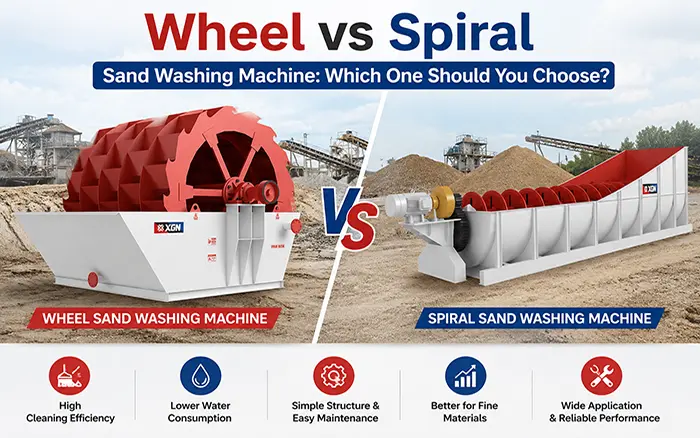
A screw sand washer uses an inclined spiral to agitate, classify and convey material. It is generally considered when stronger agitation, longer retention time or wet classification is required.
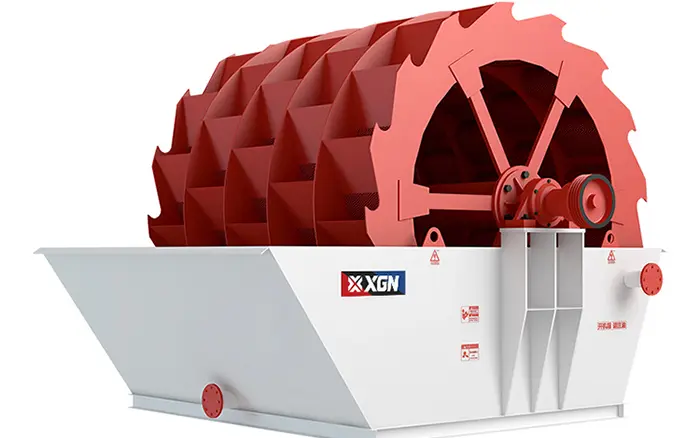
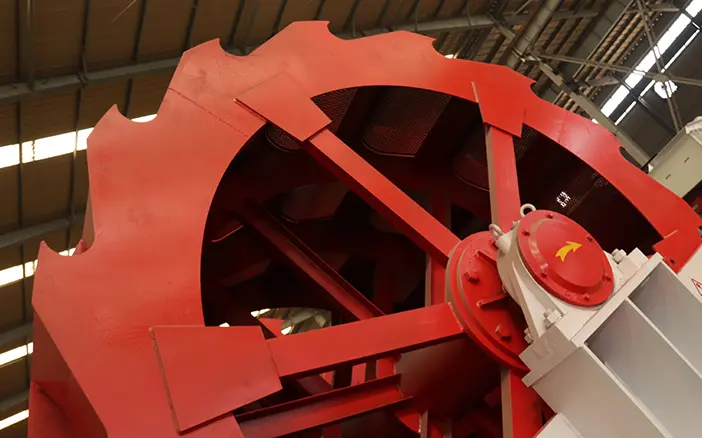
A wheel sand washer uses rotating buckets or blades to lift washed sand from a water tank. It usually has a compact structure and can provide effective washing and drainage for relatively clean sand.
The correct choice depends on material contamination, required product gradation, fine-sand recovery, available water and plant layout.
For a detailed comparison, read Wheel vs Spiral Sand Washing Machine.
Typical Applications
Screw sand washing machines can be used in:
Manufactured-sand production
River-sand processing
Aggregate washing plants
Quarry operations
Concrete aggregate preparation
Quartz and silica sand processing
Selected mineral-washing circuits
Construction-material recycling
Suitability should be confirmed from the feed size, particle-size distribution, abrasion, clay content and required final product specification.
For specific materials, see:
How to Improve Screw Sand Washing Efficiency
Operators should monitor the complete washing circuit rather than adjusting only the screw washer.
Recommended checks include:
Maintain a stable and evenly distributed feed.
Avoid exceeding the rated processing capacity.
Keep the water supply consistent.
Inspect the overflow for excessive usable sand.
Adjust the water level gradually.
Remove accumulated material from the trough.
Inspect spiral blades and trough liners for wear.
Check the reducer, shaft and bearing condition.
Maintain correct machine alignment.
Use a hydrocyclone or fine-sand recovery system when the overflow contains valuable fines.
Install a dewatering screen when lower product moisture is required.
Test the feed material before final equipment selection.
Conclusion
The working principle of a screw sand washing machine combines mechanical agitation, hydraulic separation, spiral conveying and preliminary dewatering. The rotating spiral loosens impurities and transports the settled sand, while process water removes suspended clay, silt and fine contaminants through the overflow.
Reliable operation depends on more than the machine itself. Feed consistency, water flow, particle-size distribution, clay characteristics, overflow control and downstream recovery equipment must all be considered when designing the washing circuit.
To select a suitable model, provide XINGAONAI with your material type, feed size, required capacity, clay content, target grading and water conditions.