

Silver has traditionally been associated with jewelry, investment, coins, and tableware. However, its industrial role has become increasingly important as the global economy moves toward electrification, renewable energy, and advanced electronics.
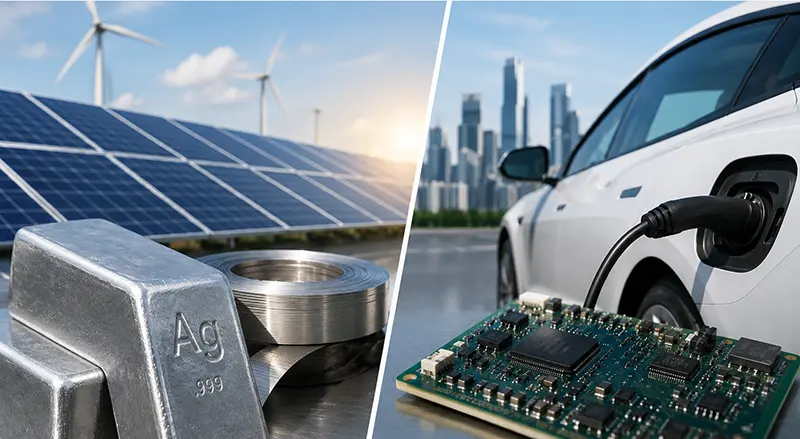
Among the most important growth areas are solar photovoltaic (PV) panels and electric vehicles (EVs). Both technologies rely on silver's excellent electrical conductivity, making the metal an important component in electrical contacts, conductive materials, power systems, and electronic components.
As solar installations expand and vehicle electrification accelerates, industrial applications are becoming a larger part of the overall silver market. This shift has important implications for mining companies, silver processors, manufacturers, investors, and downstream industries.
But rising industrial demand does not automatically mean that silver consumption will continue increasing at the same rate forever. Manufacturers are also working to reduce the amount of silver used per component, develop alternative materials, improve manufacturing efficiency, and increase recycling.
Understanding these competing forces is essential for evaluating the future of silver demand, supply, and processing.
Why Is Silver Important for Modern Industry?
Silver has a combination of physical and chemical properties that makes it difficult to replace completely in some applications.
Its most important industrial characteristics include:
Extremely high electrical conductivity
High thermal conductivity
Good reflectivity
Excellent solderability
Resistance to oxidation under many conditions
High electrical performance in small quantities
These properties make silver useful in applications where reliability and conductivity are more important than the material's relatively high cost.
Unlike bulk industrial metals such as copper or aluminum, silver is often used in relatively small quantities within high-value components. This means even modest changes in technology or manufacturing volume can influence total silver consumption.
How Solar Panels Drive Silver Demand
Solar photovoltaic technology has become one of the most important industrial applications for silver.
In conventional crystalline silicon solar cells, silver-containing conductive pastes are used to create electrical contacts on the cell. These contacts collect and transport the electricity generated when sunlight strikes the semiconductor.
The simplified energy path is:
Sunlight → Solar Cell → Electrical Current → Metal Contacts → Module → Inverter → Grid
Silver plays an important role in the electrical contact stage.
Where Is Silver Used in Solar Panels?
Silver is primarily associated with the conductive metallization of photovoltaic cells.
The material needs to provide:
Low electrical resistance
Reliable electrical contact
Good adhesion
Long-term durability
Compatibility with high-volume manufacturing
Because photovoltaic modules are produced on a massive scale, even a small amount of silver per cell can translate into substantial aggregate demand.
This creates an interesting relationship between silver demand and solar panel production: demand can increase even if the amount of silver used in each individual cell declines.
The Silver-Intensity Challenge in Solar Manufacturing
One of the most important trends in the photovoltaic industry is reducing silver consumption per watt of solar capacity.
Manufacturers have strong economic incentives to use less silver because silver is a relatively expensive material.
Technological improvements can include:
Narrower conductive lines
Improved screen-printing techniques
More efficient metallization
Copper-based alternatives
Silver-coated copper materials
Advanced cell architectures
This creates two opposing trends.
Solar capacity increases silver demand
More solar cells mean more conductive contacts and potentially more silver consumption.
Technology reduces silver consumption
Manufacturers are simultaneously attempting to reduce the amount of silver required for each cell.
Therefore, future silver demand from solar power depends not only on how many panels are installed but also on how much silver is consumed per unit of generating capacity.
Silver Demand from Electric Vehicles
Electric vehicles contain significantly more electrical and electronic systems than conventional internal-combustion vehicles.
Silver can be found in various electrical and electronic components, including:
Electrical contacts
Switches
Relays
Sensors
Circuit boards
Power electronics
Charging infrastructure
EVs also depend on sophisticated battery management, power conversion, control, and communication systems.
As vehicle electrification expands, demand for highly conductive and reliable electrical materials may increase.
Why EVs Can Increase Silver Consumption
The transition from internal-combustion vehicles to electric vehicles involves much more than replacing an engine with a battery.
An EV typically contains a complex electrical architecture involving:
Battery → Battery Management System → Inverter → Electric Motor → Electronic Control Systems
Charging equipment adds another layer of electrical infrastructure.
Silver's electrical properties make it useful in some of these applications, particularly where compact components must provide reliable electrical performance.
However, silver consumption varies considerably between vehicle designs, manufacturers, component suppliers, and generations of technology. Therefore, it is more useful to discuss EVs as a source of incremental industrial demand rather than assume that every vehicle contains the same amount of silver.
Solar Energy vs EVs: Which Uses More Silver?
Solar power and EVs affect the silver market in different ways.
| Factor | Solar Panels | Electric Vehicles |
|---|---|---|
| Main application | Photovoltaic cells | Electrical & electronic systems |
| Demand driver | Solar capacity additions | Vehicle electrification |
| Silver intensity | Influenced by cell technology | Influenced by vehicle architecture |
| Technology trend | Reducing silver per watt | Improving electrical efficiency |
| Infrastructure impact | Solar farms and grid systems | Charging networks and power systems |
| Long-term outlook | Strongly linked to PV deployment | Linked to EV adoption and electrification |
Solar photovoltaic manufacturing currently represents a particularly important industrial application because of the enormous scale of global solar deployment.
EV growth, meanwhile, creates a broader demand effect across vehicles, charging infrastructure, power electronics, and electrical systems.
Other Industrial Applications of Silver
Solar panels and EVs are not the only sources of industrial silver demand.
Silver is also used in:
Electronics
Silver is found in electrical contacts, conductive pastes, printed electronics, switches, and other components.
The continued expansion of connected devices and electronic systems supports industrial demand.
Brazing and Soldering
Silver-containing alloys are used where strong, reliable joints are required.
Applications include:
HVAC equipment
Refrigeration systems
Automotive components
Electrical systems
Industrial machinery
Medical Applications
Silver's antimicrobial properties make it useful in selected medical products and coatings.
Examples include:
Wound-care products
Medical coatings
Antimicrobial surfaces
Specialized devices
Chemical Industry
Silver-based catalysts are used in certain chemical manufacturing processes.
One important application is the production of ethylene oxide, a chemical intermediate used to manufacture various industrial and consumer products.
Water Treatment
Silver-containing technologies can be used in selected antimicrobial water treatment applications, although their use depends on the specific system and regulatory requirements.
How Industrial Demand Is Changing the Silver Market
Historically, silver demand was strongly associated with jewelry, silverware, photography, and investment.
Industrial applications have become increasingly important because silver is now connected to several structural trends:
Renewable energy expansion
Electrification
Digitalization
Electronics manufacturing
Advanced transportation
Infrastructure modernization
This makes silver different from commodities whose demand is dominated by a single industry.
The market is increasingly influenced by several technological sectors simultaneously.
The Supply Challenge: Silver Is Not Produced Only from Silver Mines
One important characteristic of the silver market is that a significant portion of silver production comes as a byproduct of mining other metals.
Silver can be recovered during the processing of:
Lead-zinc ores
This means silver supply does not respond to silver prices alone.
For example, a mine may continue producing silver because its primary economic driver is copper, lead, zinc, or gold. Conversely, reduced production from those mining sectors can affect silver availability even if silver demand remains strong.
This makes the relationship between silver demand and silver supply particularly complex.
Why Increasing Silver Demand Does Not Immediately Create More Supply
Mining projects require substantial capital, exploration, permitting, infrastructure, construction, and commissioning.
Even when higher silver prices create an incentive to develop new resources, additional production can take years to reach the market.
Existing mines may also face:
Declining ore grades
Higher energy costs
Deeper mining conditions
More complex mineralogy
Increasing environmental requirements
Higher processing costs
As a result, the silver market cannot always respond quickly to changes in industrial demand.
Can Technology Reduce Silver Demand?
Yes.
Silver's relatively high value gives manufacturers a strong incentive to reduce material consumption.
Potential approaches include:
Thrifting
Using less silver while maintaining component performance.
Substitution
Replacing silver with materials such as copper or aluminum where technically feasible.
Improved Manufacturing
Increasing production precision can reduce material losses.
Recycling
Recovering silver from industrial scrap and end-of-life products can provide an additional source of supply.
However, substitution is not always straightforward. A replacement material must provide acceptable conductivity, reliability, durability, cost, and manufacturing compatibility.
The Growing Importance of Silver Recycling
Recycling can help supplement primary silver production.
Potential secondary sources include:
Electronic waste
Photovoltaic manufacturing scrap
Industrial catalysts
Electrical components
Jewelry
Silver-bearing industrial waste
Recycling efficiency depends on collection rates, silver concentration, processing costs, and the complexity of the material.
As industrial applications grow, improving recovery from manufacturing waste and end-of-life products could become increasingly important.
What Does Rising Industrial Demand Mean for Silver Mining?
Growing industrial demand could create opportunities throughout the silver supply chain.
For mining companies, this may increase interest in:
New silver deposits
Expansion of existing mines
Polymetallic deposits
Silver-rich lead-zinc ores
Silver-bearing copper deposits
Improved beneficiation technology
For mineral processors, higher-value recovery may justify investments in more efficient crushing, grinding, flotation, gravity separation, and leaching circuits.
The economic value of silver is particularly important in polymetallic deposits because silver can contribute significantly to overall project economics even when it is not the primary commodity.
Implications for Silver Ore Processing Plants
Increasing attention to industrial silver demand also highlights the importance of efficient silver recovery.
The appropriate processing route depends on how silver occurs in the ore.
Native and Coarse Silver
Gravity separation may be useful when silver is sufficiently liberated and coarse.
Sulfide Silver Minerals
Flotation is commonly considered for silver-bearing sulfide ores and polymetallic deposits.
Oxidized or Free-Milling Ores
Leaching may provide an effective recovery route when the mineralogy supports it.
Complex Polymetallic Ores
A combined flowsheet may be required to recover silver together with lead, zinc, copper, or gold.
Therefore, increasing silver demand does not simply require more mining. It also increases the importance of metallurgical recovery, ore characterization, and processing efficiency.
Key Factors That Will Shape Future Silver Demand
Several variables will determine how rapidly industrial silver demand changes.
Solar Installation Growth
Higher global photovoltaic deployment generally supports demand for silver-containing conductive materials.
Silver Intensity per Solar Cell
If manufacturers reduce silver consumption faster than solar capacity grows, the impact on total demand could be moderated.
EV Adoption
Increasing EV production and charging infrastructure can support demand for silver-containing electrical components.
Electronics Growth
Expansion in semiconductors, consumer electronics, industrial automation, and connected devices can create additional demand.
Substitution
Copper and other materials may replace silver in applications where technical requirements allow.
Recycling
Higher recovery rates can provide secondary supply and reduce dependence on newly mined material.
What Could Limit Industrial Silver Demand?
Industrial demand is not guaranteed to rise indefinitely.
Potential limiting factors include:
Reduced silver use per component
Material substitution
Slower solar installation growth
Changes in EV manufacturing technology
Improved manufacturing efficiency
Higher recycling rates
Economic downturns affecting industrial production
Therefore, forecasting silver demand requires evaluating both technology adoption and material intensity.
What Does This Mean for the Silver Market?
The silver market is increasingly connected to the global transition toward electrification and renewable energy.
Solar panels create demand through photovoltaic metallization, while EVs contribute through electrical and electronic components. Electronics, chemical manufacturing, brazing alloys, and other applications add further industrial demand.
At the same time, manufacturers are reducing silver intensity, exploring substitutes, and improving recycling.
The result is a dynamic market shaped by both demand growth and technological efficiency.
Conclusion
Silver demand from solar panels and EVs is becoming an increasingly important factor in the global silver market. Solar photovoltaic manufacturing requires silver-containing conductive materials, while electric vehicles and charging infrastructure rely on a growing range of electrical and electronic components.
However, future demand will depend on more than simply the number of solar panels or EVs produced. Silver intensity, material substitution, manufacturing efficiency, recycling, and technological innovation will all influence how much silver is ultimately required.
On the supply side, the market faces another structural challenge: a substantial share of silver production is associated with lead, zinc, copper, and gold mining. This means silver supply cannot always respond rapidly to changes in silver-specific demand.
For mining companies and mineral processing businesses, these trends reinforce the importance of efficient resource development and improved silver recovery. As industrial applications continue to evolve, understanding both the technology driving demand and the mineral processing systems supplying the metal will be essential for evaluating the future of silver.