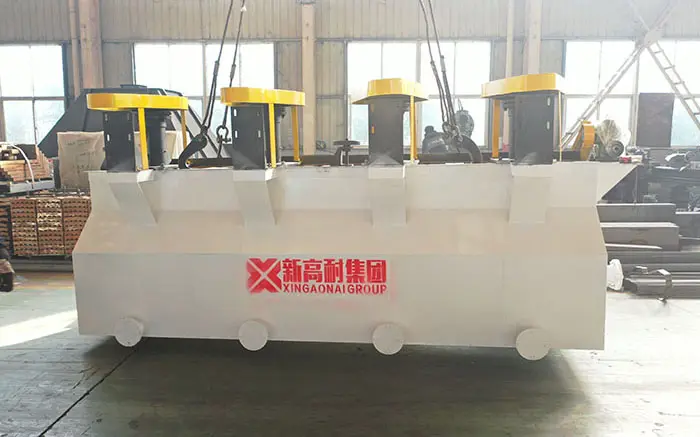
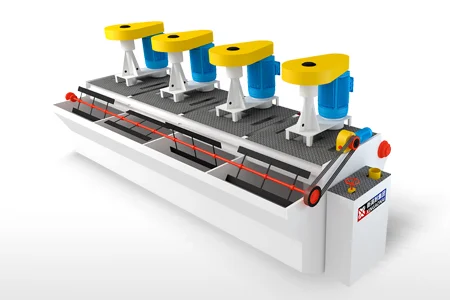
Flotation machines are widely used in mineral processing plants to separate valuable minerals from gangue based on differences in surface wettability. By combining slurry agitation, controlled aeration, and flotation reagents, they can process a wide range of metallic and non-metallic ores.
The main advantages of flotation machines include high separation efficiency, good mineral selectivity, wide material adaptability, continuous operation, adjustable process parameters, and compatibility with multi-stage beneficiation circuits. However, their actual performance depends on ore characteristics, particle liberation, reagent selection, operating conditions, and equipment configuration.
This guide examines the key advantages of flotation machines, their limitations, suitable applications, and the factors to consider when selecting flotation equipment.
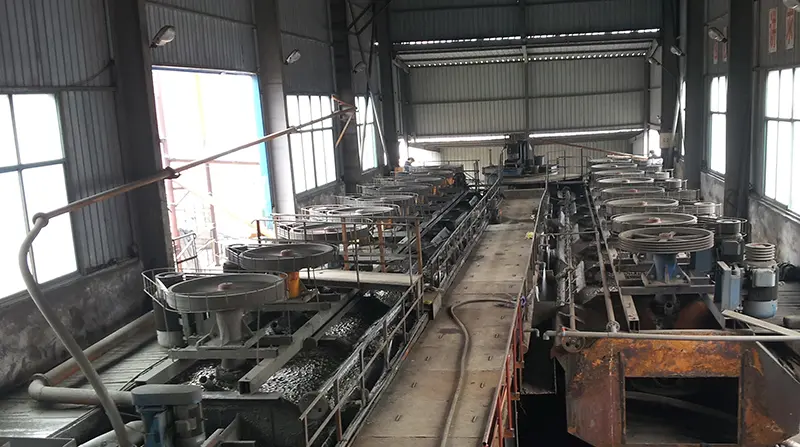
What Is a Flotation Machine?
A flotation machine, also called a flotation cell, is mineral processing equipment that separates valuable minerals from unwanted gangue by using air bubbles and differences in mineral surface properties.
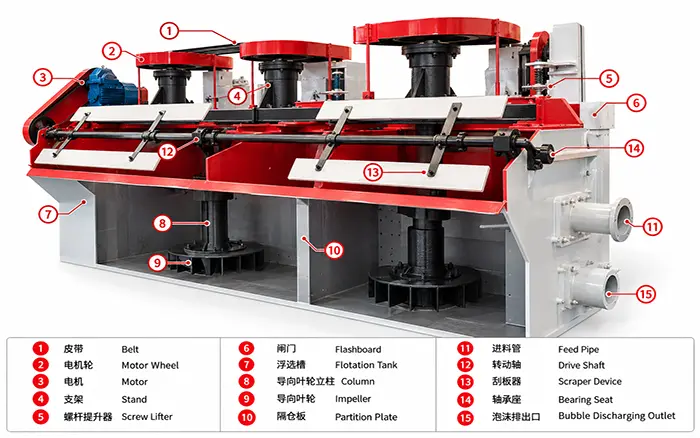
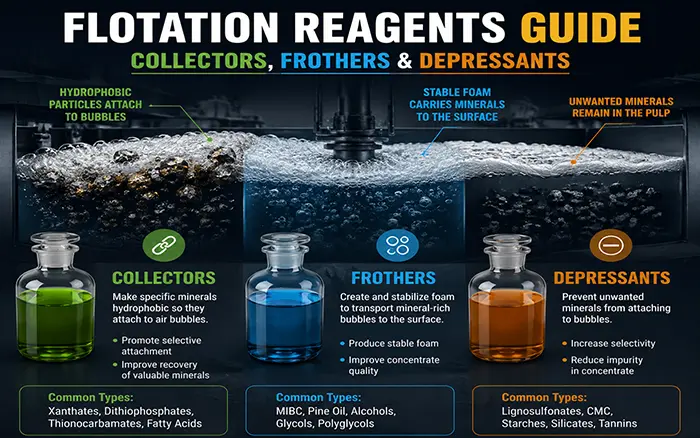
Ground ore is mixed with water to form a slurry. Collectors, frothers, depressants, and other reagents are added according to the mineral composition. Inside the flotation cell, the impeller agitates the slurry and disperses air into bubbles.
Hydrophobic mineral particles attach to the bubbles and rise to the surface, where they form a mineral-rich froth. Hydrophilic gangue particles remain in the slurry and are discharged separately.
For a detailed explanation of this process, read How Does a Flotation Machine Work?
1. High Separation Efficiency
One of the main advantages of flotation machines is their ability to recover fine mineral particles that may be difficult to separate by gravity concentration alone.
When the ore has been properly ground and the valuable minerals are sufficiently liberated, flotation creates frequent contact between mineral particles and air bubbles. Properly conditioned hydrophobic particles attach to bubbles and report to the froth concentrate.
Flotation efficiency is commonly evaluated using two indicators:
Recovery: The percentage of valuable mineral recovered from the feed.
Concentrate grade: The proportion of valuable mineral in the final concentrate.
A well-designed flotation circuit balances recovery and concentrate grade. Increasing recovery without controlling gangue entrainment may lower product quality, while producing an excessively high-grade concentrate may result in valuable mineral losses.
Actual results depend on the mineral composition, liberation size, pulp density, reagent scheme, airflow rate, froth depth, and residence time.
2. Good Selectivity Between Minerals
Flotation can selectively separate minerals with similar particle sizes or densities. This is especially important when gravity or screening methods cannot achieve effective separation.
The selective action is created by adjusting mineral surface chemistry. Collectors make target minerals more hydrophobic, while depressants prevent unwanted minerals from floating. Activators, pH regulators, and other modifiers further control the separation response.
Flotation can be used to separate:
Copper minerals from pyrite and gangue
Lead minerals from zinc minerals
Fluorite from calcite or quartz
Graphite from silicate gangue
Sulfide minerals from oxide and non-sulfide minerals
Coal fines from ash-forming impurities
Because mineral selectivity depends strongly on chemical conditions, the reagent system should be established through laboratory tests and adjusted according to the actual ore.
For more information about collectors, frothers, depressants, and modifiers, see the Flotation Reagents Guide.
3. Ability to Process Fine Mineral Particles
After grinding, many valuable minerals are liberated at relatively fine particle sizes. These particles may not respond well to conventional gravity separation because their settling behavior is strongly affected by water resistance and surface forces.
Flotation is particularly useful for processing liberated fine particles. The large combined surface area of dispersed air bubbles provides more opportunities for bubble-particle collision and attachment.
However, finer is not always better. Excessive grinding may produce slimes that:
Consume more flotation reagents
Coat the surfaces of valuable minerals
Increase gangue entrainment
Reduce flotation selectivity
Make froth control more difficult
The grinding circuit should therefore achieve sufficient mineral liberation without producing unnecessary ultrafine material.
4. Wide Range of Mineral Applications
Another important advantage is the adaptability of flotation machines to different ores and mineral-processing objectives.
Typical applications include:
Copper, lead, zinc, nickel, and molybdenum sulfide ores
Gold-bearing sulfide ores
Fluorite, graphite, phosphate, feldspar, and talc
Spodumene and other lithium-bearing minerals
Iron ore reverse flotation
Coal slime and fine coal beneficiation
The same basic flotation equipment may be used for roughing, scavenging, and cleaning by changing the operating parameters and circuit configuration.
A flotation machine should not be selected based only on the name of the mineral. Ore mineralogy, oxidation degree, liberation characteristics, clay content, water chemistry, and required concentrate quality must also be considered.
5. Adjustable Operating Parameters
Flotation machines provide operators with several adjustable parameters. This makes it possible to respond to changes in ore properties and plant operating conditions.
Important variables include:
Airflow rate
Impeller speed
Pulp density
Froth depth
Slurry level
Reagent type and dosage
Pulp pH
Feed rate
Residence time
For example, insufficient air may reduce the number of bubbles available for particle attachment. Excessive air can produce unstable froth, increased turbulence, or greater gangue entrainment.
Similarly, low impeller speed may provide inadequate slurry suspension and air dispersion, while excessive speed can increase wear, power consumption, and particle detachment.
Operators should change one major variable at a time and monitor its effect on recovery, concentrate grade, froth appearance, and tailings losses.
More operating guidance is available in What Factors Affect Flotation Machine Efficiency?.
6. Suitable for Continuous Processing
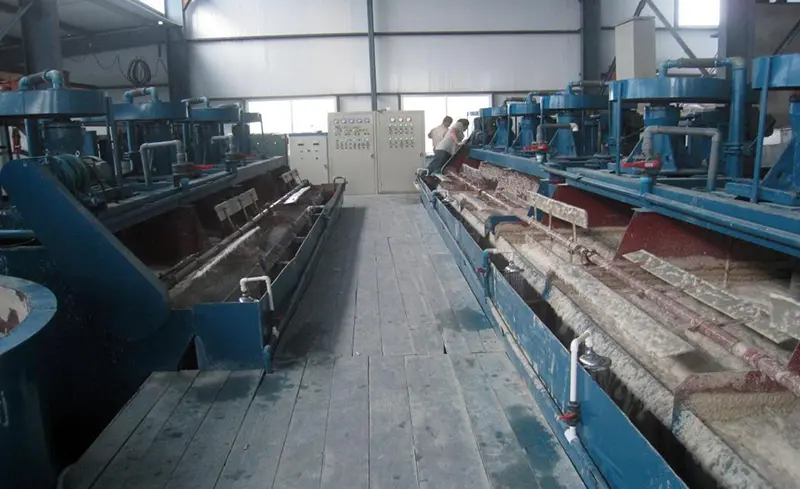
Industrial flotation machines are designed for continuous operation. Slurry enters the first cell and passes through a series of connected cells, while mineralized froth is continuously removed from the surface.
Continuous processing provides several operational benefits:
Stable production under consistent feed conditions
Easier integration with grinding and classification equipment
Scalable processing capacity
Continuous concentrate and tailings discharge
Convenient arrangement of multiple flotation stages
For stable operation, the feed flow, pulp level, air supply, and reagent addition must remain properly controlled. Sudden changes in ore grade or slurry density can affect the performance of the entire flotation circuit.
7. Flexible Circuit Configuration
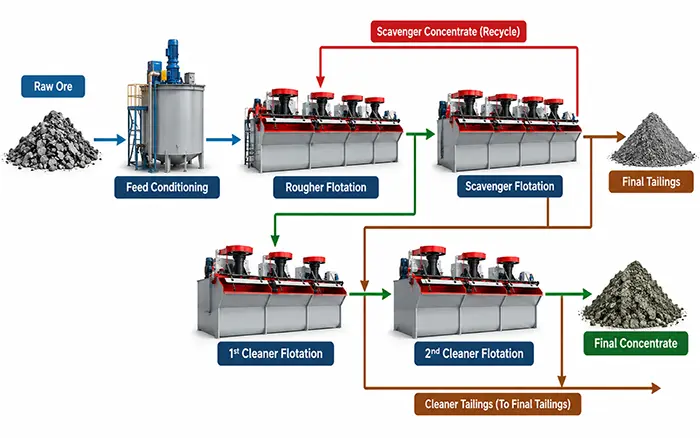
A single flotation stage is rarely sufficient for complex ores. One of the strongest advantages of flotation equipment is its ability to operate in different circuit positions.
Rougher Flotation
The rougher stage recovers as much valuable mineral as practical from the fresh feed. Its main objective is usually high recovery rather than final concentrate grade.
Scavenger Flotation
The scavenger stage treats rougher tailings to recover valuable minerals that were not collected during the first flotation stage.
Cleaner Flotation
The cleaner stage upgrades rougher concentrate by removing entrained or weakly attached gangue. Multiple cleaning stages may be used when a higher concentrate grade is required.
Intermediate streams can also be recycled to balance recovery and concentrate grade. This flexibility allows engineers to configure the circuit according to ore characteristics and final product requirements.
See Flotation Flowsheet: Rougher, Scavenger & Cleaner Design for a detailed explanation of flotation circuit design.
8. Scalable Equipment Configuration
Flotation machines are available in different cell volumes and configurations, allowing them to serve laboratory testing, pilot plants, small mines, and larger mineral-processing operations.
When plant capacity increases, engineers may:
Install larger flotation cells
Increase the number of cells
Arrange cells in parallel banks
Add rougher, scavenger, or cleaner stages
Upgrade air and reagent control systems
The modular nature of flotation circuits also makes phased plant expansion possible. Nevertheless, increasing cell volume alone does not guarantee better performance. Residence time, mixing intensity, air dispersion, froth transport, and feed distribution must be evaluated together.
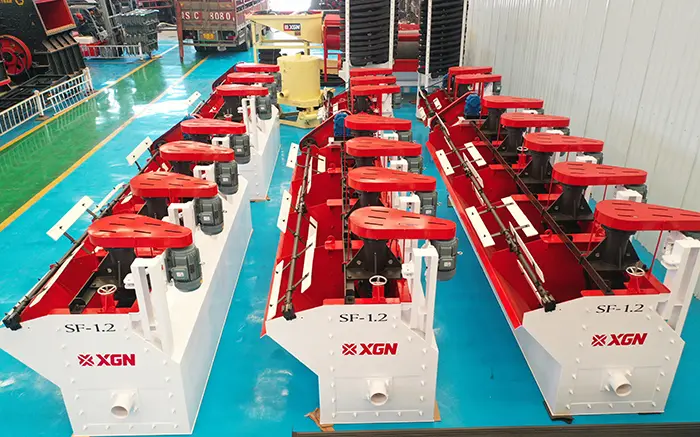
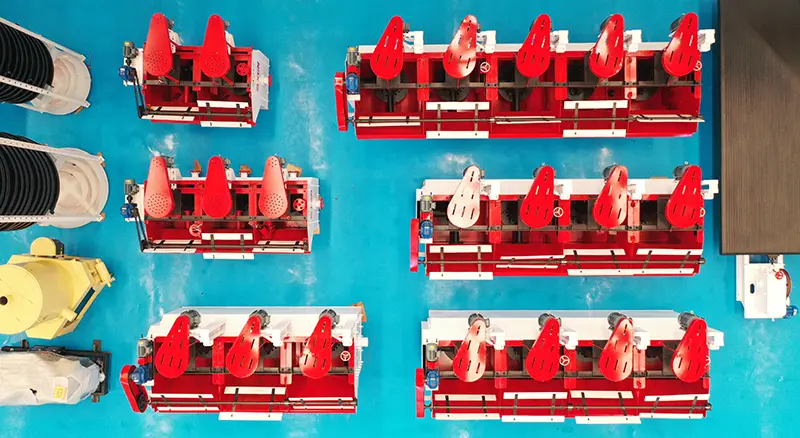
XINGAONAI’s SF Series Flotation Machine is available in multiple effective cell volumes for different mineral-processing capacities and flotation duties.
Additional Operational Advantages
In addition to the main benefits above, a properly configured mechanical flotation machine can provide several practical advantages.
Effective Slurry Suspension
The impeller circulates slurry through the cell and helps prevent coarse particles from settling. Stable suspension improves contact among minerals, reagents, and air bubbles.
Integrated Agitation and Aeration
In a self-aspirating mechanical flotation machine, the rotor-impeller system may perform both slurry agitation and air induction. This can simplify the equipment layout in suitable applications.
Visible Froth Conditions
Operators can observe froth color, bubble size, mobility, stability, and mineral loading. These visual indicators support routine process adjustments, although they should be combined with sampling and metallurgical data.
Adaptability to Process Changes
Airflow, slurry level, froth depth, and reagent dosage can be adjusted when feed conditions change. Modern control systems can further improve consistency through automated slurry-level and airflow regulation.
What Are the Limitations of Flotation Machines?
Although flotation offers important beneficiation advantages, it is not the best solution for every material or separation task.
Its main limitations include:
The ore normally requires crushing and grinding before flotation.
Performance depends strongly on mineral liberation.
Reagent consumption increases operating costs.
Clay and ultrafine slimes may reduce selectivity.
Water chemistry can affect reagent behavior.
Impellers, stators, cover plates, and other components wear over time.
Skilled operation and regular metallurgical monitoring are required.
Flotation tailings and process water require proper management.
Very coarse or poorly liberated particles may have low recovery.
These limitations do not eliminate the value of flotation. They show why laboratory testing, suitable equipment selection, and stable process control are essential.
Flotation Machine vs. Gravity Separation
Flotation and gravity separation are not direct substitutes in every application. Their suitability depends on mineral properties and liberation size.
Separation basis:
Flotation machines separate minerals according to differences in surface wettability. Gravity equipment separates materials mainly according to differences in density.
Fine-particle recovery:
Flotation is generally more effective for suitable fine, liberated minerals. Gravity-separation efficiency often decreases as particle size becomes finer.
Reagent requirements:
Flotation usually requires collectors, frothers, and modifiers. Gravity separation often uses few or no chemical reagents.
Process control:
Flotation involves more operating variables, including airflow, reagent dosage, froth depth, and pulp conditions. Gravity separation is normally simpler to operate.
Mineral selectivity:
Flotation can achieve highly selective separation by changing surface chemistry. Gravity separation depends primarily on the density difference between minerals.
Typical applications:
Flotation is commonly used for sulfide ores and fine non-metallic minerals. Gravity separation is widely used for gold, tin, tungsten, and other high-density minerals.
Many beneficiation plants combine gravity separation and flotation. Gravity equipment may first recover liberated coarse particles, while flotation treats finer material or more complex mineral associations.
How to Select a Flotation Machine
Selecting flotation equipment requires more than comparing cell volume or motor power. The following information should be evaluated before choosing a model.
1. Ore Characteristics
Identify the valuable minerals, gangue composition, oxidation degree, density, hardness, clay content, and natural floatability.
2. Liberation Size
Determine the grinding size required to release valuable minerals from gangue. This influences bubble-particle attachment, suspension requirements, and reagent consumption.
3. Required Capacity
Calculate the slurry flow rate, percentage of solids, dry ore throughput, and required residence time. These values help determine the total cell volume and number of flotation cells.
4. Flotation Duty
Specify whether the machine will be used for roughing, scavenging, or cleaning. Each duty may have different operating priorities.
5. Aeration and Agitation Requirements
Evaluate whether self-aspirating or externally aerated flotation equipment is more suitable. Air dispersion and mixing intensity should match the ore properties and particle-size distribution.
6. Maintenance Conditions
Consider access to the impeller, stator, shaft, bearings, scraper system, and tank lining. Easy inspection and replacement help reduce equipment downtime.
For guidance on wear inspection and component replacement, read Flotation Machine Parts: Functions, Wear Signs & Replacement.
7. Metallurgical Test Results
Whenever possible, equipment selection should be based on laboratory or pilot-scale flotation tests. Testing helps determine the reagent scheme, required residence time, expected recovery, concentrate grade, and suitable circuit configuration.
Conclusion
The advantages of flotation machines extend beyond their ability to separate valuable minerals from gangue. They offer good selectivity, effective treatment of fine liberated particles, adjustable operation, continuous processing, flexible circuit design, and scalability for different plant capacities.
However, these advantages can only be achieved when the ore is adequately liberated and the airflow, agitation, pulp conditions, reagent scheme, and flotation circuit are properly controlled.
Before selecting a flotation machine, operators should complete mineralogical analysis and flotation tests, determine the required capacity and residence time, and evaluate the intended rougher, scavenger, or cleaner duty.
XINGAONAI provides SF Series Flotation Machines and mineral-processing equipment for different ore types and production requirements. Submit your ore type, feed size, processing capacity, and target concentrate specifications to receive equipment-selection and process-configuration recommendations.