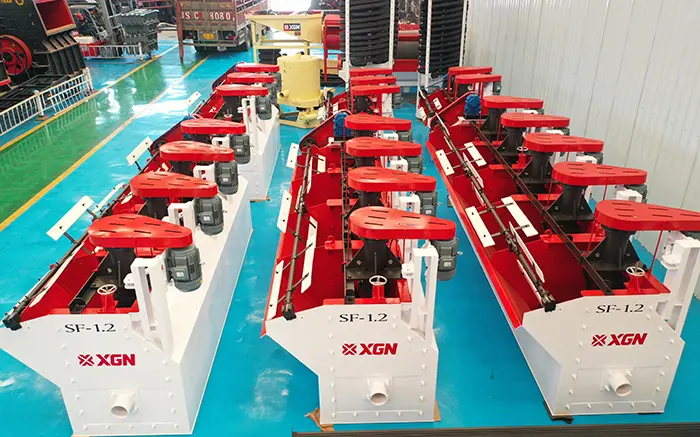
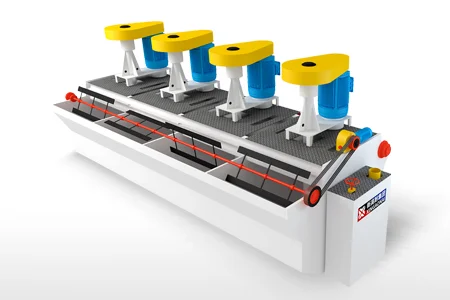
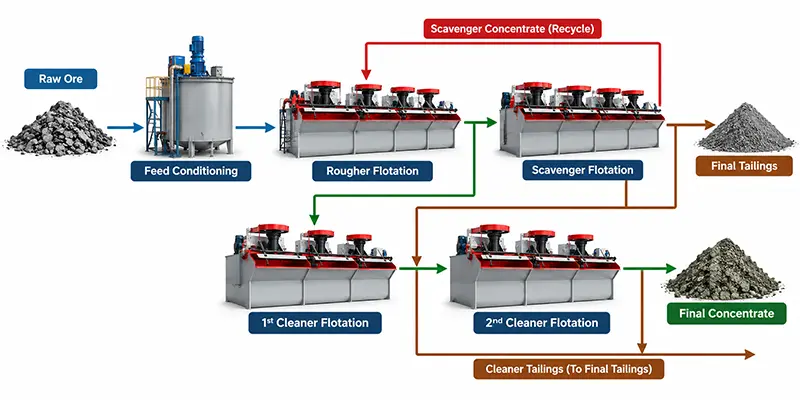
A flotation flowsheet shows how slurry, concentrate, tailings and intermediate products move through a flotation circuit. Its purpose is not simply to connect several flotation cells. A good flowsheet must produce the required concentrate grade while recovering as much valuable mineral as economically practical.
Most mineral flotation circuits contain rougher, scavenger and cleaner stages. More complex circuits may also include concentrate regrinding, cleaner scavenging and several middlings recycle streams. However, adding more stages does not automatically improve performance. Each stage should solve a specific separation problem identified by mineralogical analysis and flotation testing.
This guide explains how to arrange the main stages of a flotation flowsheet, determine where intermediate products should return and decide whether a regrinding stage is necessary.
What Does a Flotation Flowsheet Show?
A flotation flowsheet is a process diagram that identifies the major separation stages and the direction of each material stream. At minimum, it should show:
Fresh flotation feed
Conditioning stage
Rougher concentrate and tailings
Scavenger concentrate and final tailings
Cleaner feed, concentrate and tailings
Middlings recycle streams
Regrinding stage, if required
Final concentrate
Sampling and control points
A detailed engineering flowsheet may also include slurry flow rates, percentage solids, particle size, stream grades, mass recovery and water balance data.
The flowsheet should make it possible to follow every stream through the circuit. If a cleaner tailing or scavenger concentrate is recycled, its destination must be clearly identified. Undefined recycle streams make it difficult to calculate circulating load and may conceal a future capacity problem.
The Three Main Flotation Stages
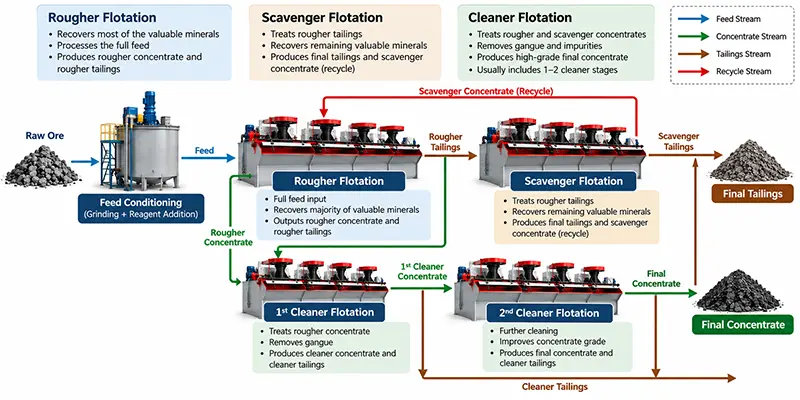
The rougher, scavenger and cleaner stages perform different duties. Treating them as interchangeable sections often results in poor flowsheet design.
Rougher Flotation
The rougher stage receives the conditioned fresh feed. Its main objective is to recover the majority of the floatable valuable mineral before it enters the tailings stream.
A rougher concentrate does not normally need to meet the final product grade. It may contain locked gangue, entrained fine particles and other floatable minerals. These impurities are removed later in the cleaning circuit.
The rougher stage should therefore prioritize recovery while producing a concentrate that can be upgraded efficiently.
Scavenger Flotation
The scavenger stage treats rougher tailings and attempts to recover valuable particles that were not collected in the rougher cells.
Scavenger concentrate normally has a lower grade than rougher concentrate. Depending on its mineralogy and particle size, it may be:
Returned to the rougher feed
Combined with rougher concentrate
Sent to a regrinding stage
Returned to an intermediate rougher cell
The scavenger tailing usually becomes the final flotation tailing. For this reason, tailings assays and mineralogical examination are important when evaluating whether the scavenger stage has sufficient capacity.
Cleaner Flotation
The cleaner circuit upgrades rougher concentrate by rejecting entrained or weakly attached gangue. Its primary objective is concentrate grade rather than maximum mass recovery.
One cleaner stage may be sufficient for a well-liberated, selectively floatable mineral. A difficult ore may require two or more cleaning stages.
Every additional cleaning stage may improve grade, but it can also increase valuable-mineral losses and circulating load. The number of cleaner stages should therefore be based on test results rather than a standard circuit template.
| Flotation stage | Main feed | Primary objective | Main product |
|---|---|---|---|
| Rougher | Conditioned fresh feed | Recover most floatable valuable mineral | Rougher concentrate |
| Scavenger | Rougher tailings | Recover remaining valuable mineral | Scavenger concentrate |
| Cleaner | Rougher or reground concentrate | Improve concentrate grade | Final concentrate |
How to Select the Basic Circuit Structure
The simplest technically acceptable flowsheet is usually the best starting point. Additional equipment and recycle loops should only be introduced when test data demonstrate a need.
Use a Simple Rougher–Cleaner Circuit When:
Valuable minerals are adequately liberated at the primary grind size.
Rougher recovery is satisfactory.
One cleaning stage can achieve the target concentrate grade.
Rougher tailings contain little recoverable valuable mineral.
Cleaner tailings have a small mass flow.
A simple circuit is easier to control and normally has a lower circulating load.
Add Scavenger Flotation When:
Rougher tailings contain recoverable liberated mineral.
The valuable mineral has relatively slow flotation kinetics.
High overall recovery is economically important.
Feed conditions fluctuate enough to cause valuable mineral to pass through the rougher bank.
Before adding scavenger capacity, determine why the mineral reports to rougher tailings. If the remaining mineral is locked with gangue, extending flotation time alone may not solve the loss.
Add Another Cleaner Stage When:
The first cleaner concentrate remains below the required grade.
Additional upgrading can be achieved without unacceptable recovery loss.
Gangue rejection improves under lower mass-pull conditions.
Cleaner test results show a clear grade improvement between stages.
If poor concentrate grade is caused mainly by inadequate liberation, adding cleaner cells may create more circulating load without reaching the required specification.
Where Should Middlings Return?
Middlings are intermediate products that are neither final concentrate nor final tailings. Typical middlings include cleaner tailings and scavenger concentrates.
The return point should match the particle size, mineral grade and flotation response of the stream.
Cleaner Tailings
First-cleaner tailings often return to the rougher concentrate stream or the cleaner feed. Returning them directly to fresh rougher feed is also possible, but this may increase rougher circulating load.
Tailings from a later cleaner stage are frequently returned to the preceding cleaner stage because their grade and flotation characteristics are closer to that part of the circuit.
Scavenger Concentrate
Scavenger concentrate may return to the rougher feed when the particles remain sufficiently liberated. If it contains locked composites, regrinding before recycling may be more effective.
Combining all scavenger concentrate directly with final cleaner feed can reduce cleaner performance because this stream may contain a large proportion of slow-floating gangue.
Avoid Uncontrolled Circulating Load
Every recycled stream adds material to an upstream stage. When several middlings streams are repeatedly returned, the internal flow can become much larger than the fresh feed.
Excessive circulating load may cause:
Flotation cell overloading
Unstable pulp levels
Higher reagent consumption
Increased gangue entrainment
Reduced effective residence time
Difficulty maintaining concentrate grade
The mass flow and grade of each recycle stream should be included in the flotation mass balance.
When Is Regrinding Necessary?
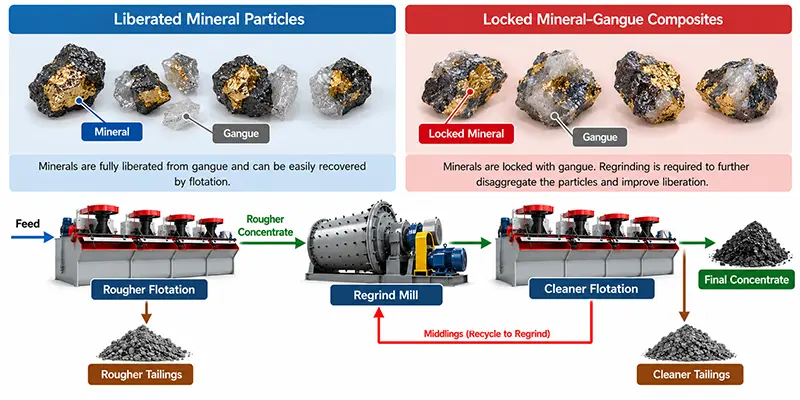
Regrinding should be added when mineralogical analysis shows that valuable minerals in rougher concentrate or middlings remain locked with gangue at the primary grind size.
It should not be added merely because cleaner concentrate grade is low.
A typical regrinding decision considers:
Which stream contains the locked particles?
How much of the valuable mineral is locked?
What regrind size is required to improve liberation?
Does finer grinding improve cleaner grade or recovery?
Does the finer material cause slime coating or entrainment?
Is the expected metallurgical improvement worth the additional energy and equipment cost?
Common regrinding arrangements include:
Rougher concentrate regrinding before cleaner flotation
Scavenger concentrate regrinding before recycling
Combined rougher and scavenger concentrate regrinding
Regrinding of selected cleaner middlings
Selective regrinding is often preferable to grinding the entire circuit feed more finely. It directs energy toward the smaller stream that contains locked valuable minerals.
A Practical Flotation Flowsheet Design Sequence
A reliable flotation flowsheet should be developed from test data in a logical sequence.
1. Define the Feed and Product Targets
Collect the basic design information before arranging the circuit:
Ore mineralogy
Head grade and grade variability
Valuable and gangue mineral associations
Feed particle-size distribution
Mineral liberation by size
Required concentrate grade
Target recovery
Plant throughput
Water chemistry and water availability
Average feed data alone may be insufficient. The flowsheet should also be checked against lower-grade, harder or more complex ore types expected during operation.
2. Run Rougher Kinetic Tests
Rougher tests show how quickly the valuable mineral floats and how recovery and concentrate grade change with time.
The results help determine:
Whether the mineral is fast or slow floating
A preliminary rougher residence time
The approximate rougher mass pull
Whether late-floating fractions are economically recoverable
Whether a scavenger stage is justified
This step defines the recovery potential of the front end of the circuit.
3. Test Cleaner Performance
Cleaner tests determine whether rougher concentrate can reach the required product grade.
The tests should compare:
One or more cleaning stages
Open-circuit and recycle conditions
Concentrate dilution before cleaning
Cleaning with and without regrinding
The recovery loss at each cleaning stage
The objective is not to maximize cleaner grade without limits. It is to find a practical balance between final grade and overall recovery.
4. Examine Intermediate Products
Mineralogical analysis should be performed on important loss streams, particularly:
Rougher tailings
Scavenger concentrate
First-cleaner tailings
Final cleaner tailings
Regrind products
This determines whether valuable-mineral losses are caused by poor liberation, weak flotation response or hydraulic entrainment.
5. Conduct Locked-Cycle Testing
Open-circuit tests do not fully represent an industrial plant because intermediate products are not continuously returned.
A locked-cycle test repeatedly recycles selected middlings to simulate the proposed closed circuit. It helps estimate:
Steady-state concentrate grade
Overall recovery
Final tailings grade
Recycle-stream mass flow
Circulating load
The effect of middlings on circuit stability
The test should continue until the important stream weights and grades approach a stable condition. If the circuit fails to stabilize, the proposed return points or cleaner arrangement may need to be revised.
6. Complete the Mass and Water Balance
The final flowsheet should include a mass balance for every major stream.
For each stream, record where available:
Dry solids flow
Slurry flow
Percentage solids
Valuable-mineral grade
Metal or mineral distribution
Water flow
Particle-size distribution
The balance reveals where recycled material accumulates and provides the basis for sizing cells, pumps, pipes, sumps and regrinding equipment.
7. Select Flotation Cell Capacity
Preliminary flotation working volume can be estimated from slurry flow and the residence time established by test work:
Required working volume ≈ slurry flow rate × required residence time
This is only a starting estimate. Final selection must also consider effective cell volume, froth volume, air dispersion, feed variability, short-circuiting, availability and the number of cells required for stage-by-stage control.
The selected flotation machine must suit its assigned rougher, scavenger or cleaner duty. A cell chosen only from nominal throughput may not provide the required metallurgical residence time.
For readers who need the cell-level separation mechanism rather than circuit arrangement, see how a flotation machine works.
Conceptual Rougher–Scavenger–Cleaner Flowsheet
A conventional conceptual circuit may be arranged as follows:
Grinding Product
      ↓
Conditioning
      ↓
Rougher Flotation ─────→ Rougher Tailings
      ↓                         ↓
Rougher Concentrate      Scavenger Flotation
      ↓                         ↓
Regrinding, if needed     Final Tailings
      ↓                         ↑
Cleaner 1 ←──── Scavenger Concentrate
      ↓
Cleaner 2
      ↓
Final Concentrate
Cleaner tailings may return to the previous cleaning stage or to the rougher concentrate stream. The correct destination depends on their grade, particle size and liberation characteristics.
This diagram should be treated as a design framework rather than a universal flowsheet. A graphite, copper, lead-zinc or fluorite ore may require a different number of stages and different recycle routes.
Test Results That May Require a Flowsheet Change
| Test result | Possible flowsheet response | Check before changing |
|---|---|---|
| Liberated valuable mineral remains in rougher tailings | Add or expand scavenger duty | Confirm flotation kinetics and reagent conditions |
| Cleaner concentrate is below grade | Add cleaning capacity or reduce mass pull | Check whether the problem is poor liberation |
| Cleaner tailings contain locked composites | Regrind selected middlings | Confirm liberation improvement at the proposed size |
| Scavenger concentrate has low grade and high mass | Regrind, redirect or treat separately | Calculate its effect on circulating load |
| Recycle streams increase during locked-cycle tests | Change return points or simplify the circuit | Identify which stream is accumulating |
| Performance changes sharply between ore types | Add operating flexibility or separate treatment campaigns | Verify ore variability and blending options |
Common Flotation Flowsheet Design Mistakes
Copying a Flowsheet from Another Ore
Two deposits containing the same valuable metal may have very different mineral associations and liberation requirements. A flowsheet that works for one deposit may perform poorly on another.
Adding Too Many Recycle Loops
Recycling every intermediate product may appear to protect recovery, but it can create a high and unstable circulating load. Low-value middlings should not be recycled indefinitely without a defined treatment objective.
Regrinding Without Mineralogical Evidence
Finer grinding increases energy consumption and may generate slimes. Regrinding should target a stream containing recoverable locked mineral.
Using Only Open-Circuit Test Results
Open tests may overestimate cleaner performance because returned middlings are absent. Locked-cycle testing provides a better indication of how the proposed circuit behaves under recycle conditions.
Ignoring Feed Variability
A circuit designed around one composite sample may not handle future changes in grade, mineralogy or hardness. Representative ore types should be tested separately.
Omitting Sampling and Bypass Points
A practical flowsheet should allow operators to sample important streams, isolate equipment and adjust recycle destinations. These provisions make commissioning and future optimization easier.
Operating variables will still affect the final result after commissioning. They should be addressed separately through the factors affecting flotation machine efficiency, rather than expanding the flowsheet article into a general operating guide.
Information Required for Flotation Flowsheet Design
Before requesting a circuit proposal, provide the equipment supplier or process engineer with:
Representative ore samples
Mineralogical analysis
Head grade and expected grade range
Feed particle-size distribution
Liberation data by size fraction
Required concentrate grade
Target mineral recovery
Planned throughput
Existing grinding and classification conditions
Available flotation test results
Water quality information
Site elevation and available plant space
If some of this information is unavailable, additional laboratory testing may be required before the equipment arrangement can be finalized.
Conclusion
A successful flotation flowsheet begins with mineralogy and test work—not with a fixed equipment list. Rougher flotation should recover most of the valuable mineral, scavenger flotation should minimize final tailings losses, and cleaner flotation should achieve the required concentrate grade.
Regrinding and middlings recycle should only be included when they solve a demonstrated liberation or separation problem. Before final equipment selection, the proposed circuit should be checked using locked-cycle testing and a complete mass and water balance.
By keeping the circuit as simple as the ore allows, a mineral processing plant can reduce circulating load, improve operating stability and achieve a more reliable balance between concentrate grade and recovery.