
Granite is one of the most common and widely used rocks on Earth. It forms the foundation of continents, shapes mountain ranges, and has been a preferred building material for thousands of years. From ancient Egyptian obelisks to modern kitchen countertops, granite's durability and aesthetic appeal make it indispensable. Understanding the types of granite rock requires looking at three main characteristics: mineral composition, color, and texture. This article explains how geologists classify granite, why it comes in so many colors, what different textures mean, and how granite is used across various industries.
What Is Granite?
Granite is a coarse- to medium-grained intrusive igneous rock that is rich in quartz and feldspar. It forms when magma (silicate melt) cools slowly deep within the Earth's crust. The slow cooling allows large mineral crystals to grow, giving granite its characteristic speckled or granular appearance that you can see with the naked eye.
Mineral Composition and Classification
The mineral composition is the foundation for understanding the types of granite rock. According to geologists, granite belongs to a broader family called granitic rocks, which are classified based on mineral composition and texture.
Essential Minerals
Three minerals are always present in granite.
Quartz: Makes up 20 to 60 percent of the rock. It appears as glassy, clear, white, or gray crystals and is very hard and resistant to weathering.
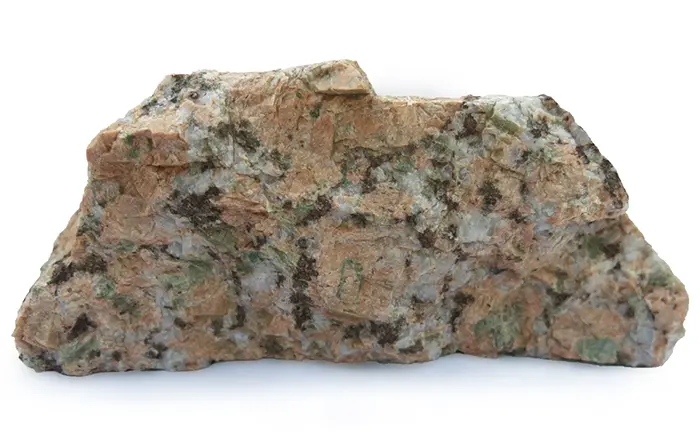
Feldspar: The most abundant mineral in granite, accounting for up to 65 to 90 percent of the composition. There are two types: alkali feldspar (often pink or salmon-colored) and plagioclase feldspar (usually white or gray). Their relative abundance provides the basis for granite classification.
Mica: Occurs as small, shiny flakes. Biotite is black or dark brown. Muscovite is light-colored or clear.
Minor and Accessory Minerals
Additional minerals may include hornblende, pyroxene, garnet, sphene, and apatite. These are present in smaller amounts but can affect the rock's color and physical properties.
Scientific Classification (IUGS)
The International Union of Geological Sciences (IUGS) defines granite as a plutonic rock containing 20 to 60 percent quartz, with feldspar composition falling between specific ratios. Using the QAPF diagram (which stands for Quartz, Alkali feldspar, Plagioclase feldspar, and Foid), geologists distinguish granite from similar rocks like granodiorite and tonalite.
Source Classification: I‑Type and S‑Type Granite
Beyond mineral percentages, granite is also classified by its source material.
I‑type (Igneous source) granite: Forms from the melting of older igneous rocks that have not been altered by surface weathering. I‑type granites typically contain moderate amounts of aluminum oxide (Al₂O₃) and high amounts of sodium oxide (Na₂O). Amphibole and clinopyroxene are common in I‑type varieties. These granites are often found in large batholiths stretching from Alaska through California into Mexico.
S‑type (Sedimentary source) granite: Forms from the partial melting of meta‑sedimentary rocks. S‑type granites have high Al₂O₃ content and relatively low Na₂O. Instead of amphibole, they may contain garnet, cordierite, or sillimanite. S‑type granites are known from New England and Northern Nigeria, among other areas.
Both types may also contain biotite and muscovite.
Color Variations: Why Granite Comes in Many Colors
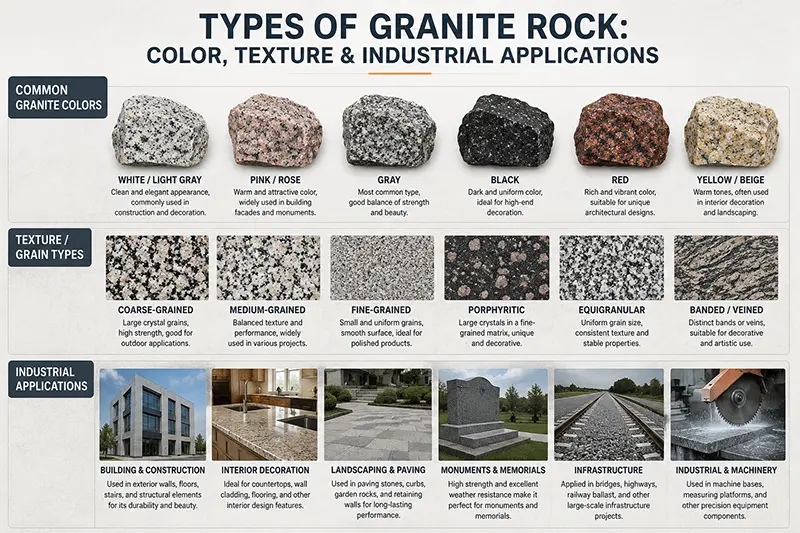
The mineral composition directly determines the color of granite. Different combinations of minerals create a wide natural palette ranging from white and gray to pink, red, green, and even blue.
| Color | Primary Mineral(s) Responsible | Notes |
|---|---|---|
| Pink or red | Potassium feldspar (pink or salmon-colored) | Usually fairly coarse-grained; common in Wells and Mount Katahdin, Maine |
| White or gray | Plagioclase feldspar (white or "blue" feldspar) | Typically finer-grained than pink granites; clear or smoky quartz, biotite or muscovite micas |
| Black | Gabbro, norite, or diorite (not true granite) | Contains dark feldspars, amphiboles, and pyroxenes. Must have at least 20% quartz to be classified as granite |
| Blue | "Blue" feldspars | Usually finer-grained and contains biotite or muscovite micas |
| Green | Muscovite or other green minerals | Less common; sometimes found in commercial granite |
According to the Maine Geological Survey, commercial granites fall into three general color classes: pink or red, white, blue, or gray, and black. Pink or red granites contain pink or salmon-colored feldspar, clear to smoky quartz, and black biotite mica or hornblende. White, gray, or blue granites are usually finer-grained and contain "blue" or white feldspars, clear or smoky quartz, and biotite or muscovite micas. So-called black granite is generally gabbro, norite, or diorite, containing dark-colored feldspars, amphiboles, and pyroxenes.
Is Dark Granite Actually Granite?
Not all dark rocks sold as "black granite" are true granite. True granite must contain at least 20 percent quartz. Many dark rocks marketed as black granite are actually gabbro—a coarse-grained mafic rock composed primarily of plagioclase feldspar, augite, and olivine, with very little quartz. Gabbro is formed from mafic magmas that are much lower in silica (around 45 to 55 percent) compared to granite (over 65 percent). While gabbro shares granite's durability and coarse-grained texture, their chemical compositions are distinctly different. The key distinction between granite and gabbro is not by color but by chemical composition.
Texture: From Phaneritic to Porphyritic
Understanding the types of granite rock also requires looking at texture, which refers to the size, shape, and arrangement of mineral grains. The cooling history of the magma determines the final texture.
Phaneritic Texture
Most granite has a phaneritic texture, meaning the crystals are large enough to be seen with the naked eye. Grain sizes range from:
Fine-grained: crystals less than 1 mm
Medium-grained: crystals 1 to 5 mm
Coarse-grained: crystals 5 to 10 mm
Very coarse-grained: crystals over 10 mm
Most granites have a uniform grain size within the medium to coarse range (1 to 5 mm average).
Porphyritic Texture
Porphyritic granite contains larger crystals called phenocrysts embedded in a finer-grained groundmass. The rock underwent two stages of cooling: larger crystals formed first during slow cooling deep underground, then the remaining magma cooled faster, forming the finer groundmass around them. Porphyritic granite often features large pink feldspar phenocrysts (10 to 30 mm long) in a matrix of white feldspar, quartz, and biotite.
Pegmatitic Texture
Pegmatitic granite has exceptionally large crystals, often over 2 cm across, sometimes reaching several meters in length. This texture forms when water-rich magma allows crystals to grow to enormous sizes.
Industrial Applications of Granite
Granite has been extensively used in construction for millennia. Ancient Egyptians used granite for obelisks and temple columns. Romans used granite for building foundations and road paving. Today, the types of granite rock determine their suitability for different applications.
| Application | Industry | Key Reason |
|---|---|---|
| Countertops | Residential & commercial kitchens | Heat resistance, scratch resistance, aesthetics |
| Flooring tiles | Building construction | Hardness, wear resistance, variety of colors |
| Wall cladding | Commercial buildings, hotels | Aesthetic appeal, weather resistance |
| Monuments & memorials | Cemetery industry | Durability, ability to hold fine details |
| Dimension stone | Construction industry | Ashlar, curbing, flagstone |
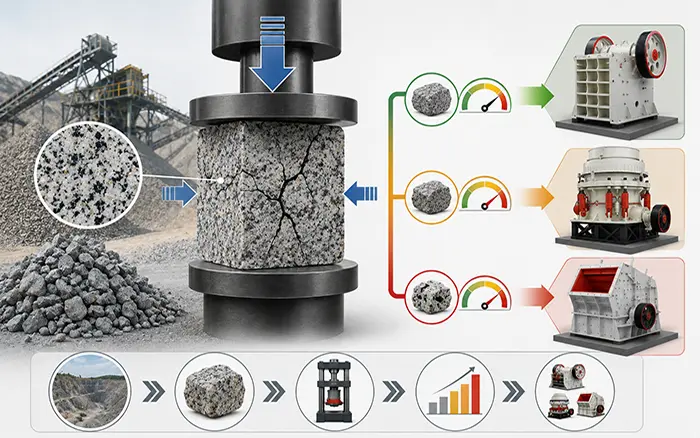
| Crushed aggregate | Road construction | High compressive strength |
Building and Construction
Granite is widely used as a dimension stone for buildings, bridges, and monuments. Polished granite slabs (often 2 cm thick) are used for exterior facings of banks and office buildings. Granite is also cut into floor tiles (30 cm by 30 cm) and used in shopping malls, hotels, and private homes. For outdoor applications, granite is used for paving stones, curb stones, flagstones for roofs and walkways, and other decorative uses such as carvings and statues.
Countertops and Interiors
Granite countertops are among the most popular choices for kitchens and bathrooms due to the stone's heat resistance, scratch resistance, and low maintenance. Granite slabs can be custom cut to specific dimensions and thicknesses and finished in polished, honed, flamed, or sandblasted surfaces to suit different design requirements.
Monuments and Memorials
Granite's ability to hold fine detail and resist weathering makes it the preferred material for tombstones, memorials, and statues. The continuing demand for granite in cemetery memorials remains a steady market for the industry.
Industrial and Commercial Uses
Beyond construction, granite serves many commercial purposes, including laboratory bench tops, curling stones, gemstones, and as a feed additive for livestock. In the construction industry, granite is used as dimension stone, for cement manufacture, as road aggregate, and for making natural cement and refractories.
Physical Properties of Granite
The types of granite rock share key physical properties that make them valuable for industrial applications.
| Property | Typical Value |
|---|---|
| Mohs hardness | 5 to 7 (sometimes up to 8) |
| Density | 2.54 to 2.76 g/cm³ |
| Compressive strength | 96 to 310 MPa |
| Porosity | 0.1 to 4% |
| Water absorption | Typically less than 0.4% |
Granite is highly thermally stable, showing no significant changes with temperature variations. This property provides excellent fire protection and makes granite suitable for use in tanks that store caustic materials, as it is highly resistant to chemical erosion.
Conclusion
Granite is a versatile and durable rock that has served human civilization for millennia. The types of granite rock are classified by mineral composition (quartz, feldspar, and mica proportions), color (from white to pink to black, each tied to specific mineral content), texture (from fine-grained phaneritic to porphyritic with large phenocrysts), and industrial application (from kitchen countertops to monumental architecture). Understanding the full range of granite types helps geologists interpret Earth's history and enables builders and designers to select the right stone for the right job.