Granite is one of the most common rocks on Earth. It forms the foundation of continents and is used for countertops, buildings, and monuments. But what exactly is granite made of? The granite mineral composition is what gives this rock its beauty, strength, and variety. In this article, you will learn about the minerals that make up granite, how they affect its appearance and properties, and the different types of granite based on composition.
What Is Granite?
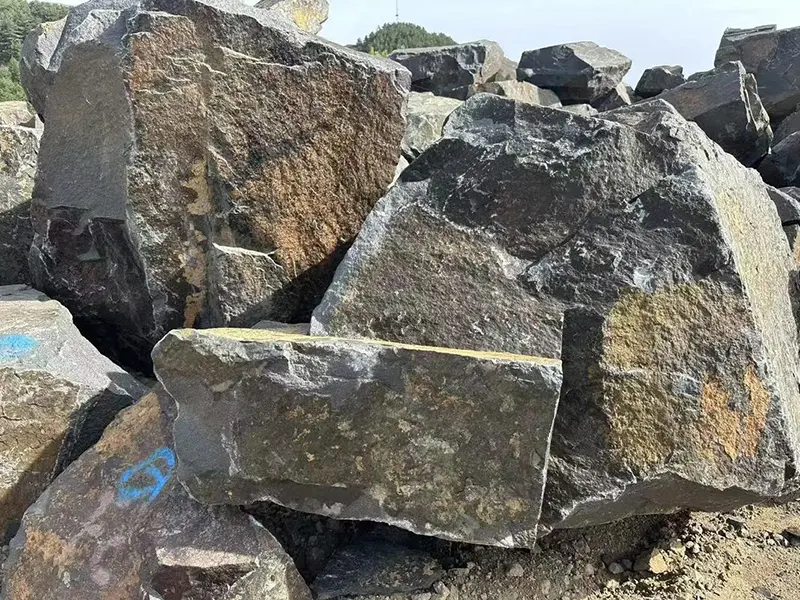
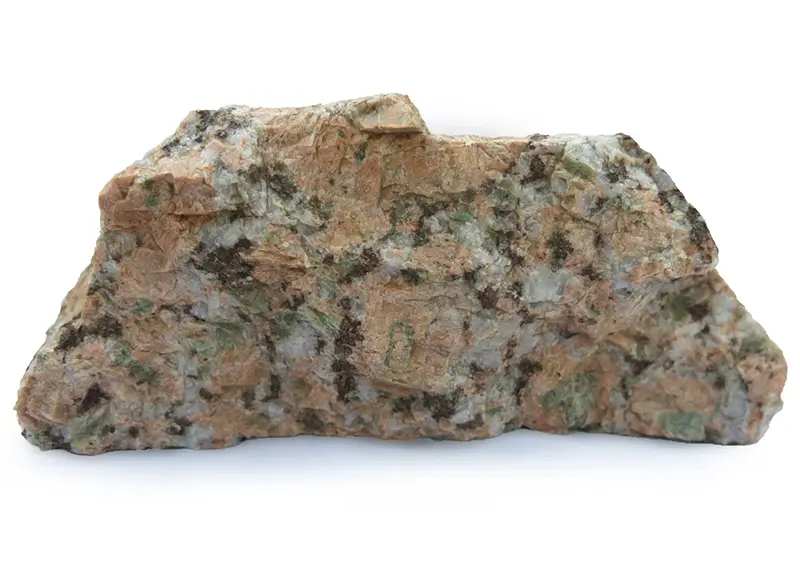
Granite is an intrusive igneous rock. That means it forms deep underground when molten rock (magma) cools slowly. The slow cooling allows large crystals to grow. You can often see the individual mineral grains with your naked eye. This is why granite has a speckled appearance.
Granite makes up most of the continental crust. It is the most common plutonic rock found on Earth. Its name comes from the Latin word "granum," which means "grain." This refers to the visible crystals in the rock.
Essential Minerals in Granite
The granite mineral composition consists of three main essential minerals. These minerals must be present for a rock to be called granite.
Quartz
Quartz is one of the most important minerals in granite. It makes up 20 to 50 percent of the rock's volume. In rare cases, quartz content can reach 50 to 60 percent. Quartz appears as glassy, clear, white, or gray crystals. It is very hard and resistant to weathering. Quartz does not have a specific cleavage. Instead, it breaks with a curved, glass-like fracture.
Feldspar
Feldspar is the most abundant mineral in granite. It makes up more than half of the rock in most cases. There are two types of feldspar in granite.
Potassium feldspar (also called alkali feldspar) often appears pink, light flesh-red, or grayish-white. The pink color in many granites comes from potassium feldspar. Common varieties include orthoclase and microcline.
Plagioclase feldspar is the second type. It is usually white or gray. In most granites, the amount of potassium feldspar is greater than the amount of plagioclase. The ratio is about two-thirds potassium feldspar and one-third plagioclase.
Mica
Mica is the third essential mineral. It appears as small, shiny flakes. There are two common types of mica in granite. Biotite is black or dark brown. It gives granite its dark specks. Muscovite is light-colored or clear. It is less common but often found in two-mica granites.
Minor and Accessory Minerals
The granite mineral composition also includes minor and accessory minerals. These are present in smaller amounts, but they can affect the rock's color and properties.
Biotite and hornblende are common secondary minerals. Hornblende is a dark green or black mineral from the amphibole group. In some granites, you may find small amounts of pyroxene.
Accessory minerals are present in very tiny amounts. Common ones include magnetite, titanite (sphene), zircon, apatite, and tourmaline. These minerals are often too small to see without a microscope.
Chemical Composition of Granite
The granite mineral composition determines its chemical makeup. Granite is a felsic rock, meaning it is rich in silica (SiO₂). The silica content of granite is typically above 66 percent.
Here is the worldwide average chemical composition of granite by weight percent:
SiO₂ (silica): 72.04%
Al₂O₃ (alumina): 14.42%
K₂O (potassium oxide): 4.12%
Na₂O (sodium oxide): 3.69%
CaO (calcium oxide): 1.82%
FeO (iron(II) oxide): 1.68%
Fe₂O₃ (iron(III) oxide): 1.22%
MgO (magnesium oxide): 0.71%
TiO₂ (titanium dioxide): 0.30%
P₂O₅ (phosphorus pentoxide): 0.12%
MnO (manganese oxide): 0.05%
As you can see, silica and alumina make up most of granite's composition. The high silica content makes granite light in color compared to darker rocks like basalt.
Classification Using the QAPF Diagram
Geologists classify granite using a tool called the QAPF diagram. QAPF stands for quartz, alkali feldspar, plagioclase feldspar, and foid (feldspathoid). The diagram is for coarse-grained plutonic rocks.
For a rock to be classified as granite, it must meet these mineral composition requirements:
Quartz content between 20 and 60 percent of the total
Alkali feldspar makes up 35 to 90 percent of the total feldspar.
Plagioclase makes up the remaining feldspar.
Granite can be subdivided into two main types on the QAPF diagram: syenogranite and monzogranite. The diagram helps geologists distinguish granite from similar rocks like granodiorite and tonalite.
Types of Granite Based on Mineral Composition
The granite mineral composition varies, leading to different types of granite. Here are the most common varieties.
Biotite granite: Contains biotite as the main dark mineral. This is the most common type.
Two-mica granite: Contains both biotite and muscovite. It is common in certain geological settings.
Hornblende granite: Contains hornblende instead of mica.
Alaskite: Contains almost no dark minerals. It is nearly white and consists mainly of feldspar and quartz.
Geologists also classify granites by their source rocks. I-type granites come from igneous source rocks. They contain moderate amounts of Al₂O₃ and high amounts of Na₂O. S-type granites come from sedimentary source rocks. They have high Al₂O₃ and lower Na₂O. I-type granites often contain amphibole and pyroxene. S-type granites may contain garnet, cordierite, and sillimanite.
Color Variations in Granite
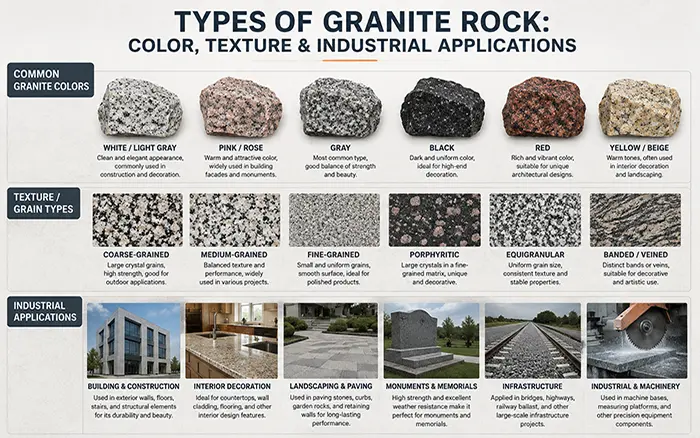
The granite mineral composition directly affects the rock's color. Light-colored granites have more quartz and feldspar. Pink granites get their color from potassium feldspar that contains oxidized iron. White or gray granites have plagioclase feldspar as the main feldspar. Dark-colored granites contain more dark minerals like biotite and hornblende. Black granites are not true granites. They are usually gabbro or basalt.
Physical Properties Related to Mineral Composition
The granite mineral composition gives this rock its well-known physical properties.
Hardness: Granite ranks 6 to 7 on the Mohs hardness scale. This makes it harder than a steel knife blade (about 5.5). Quartz is very hard (7), while feldspar is slightly softer (6).
Density: Granite has a density of 2.63 to 2.75 grams per cubic centimeter. This high density comes from the tightly packed crystal structure.
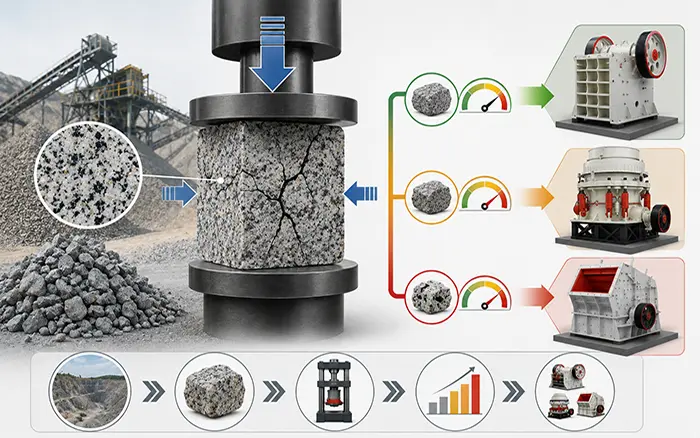
Compressive strength: Granite can resist 100 to 300 MPa of pressure. This is why it is used for load-bearing structures.
Color: The color depends on the proportions of light and dark minerals.
Texture: Granite has a coarse-grained, granular texture. The grains are interlocking, which makes the rock strong.
Where Is Granite Found?
Granite is found on all continents. It forms large bodies called batholiths. These can be hundreds or thousands of square kilometers in size. Major granite deposits exist in the United States, Canada, Brazil, China, India, and countries throughout Europe and Africa. The largest exposed granite batholith in North America is the Sierra Nevada range in California.
Common Uses of Granite
The granite mineral composition makes it useful for many applications.
Building stone: Granite is used for countertops, flooring, and wall cladding.
Monuments and memorials: Its durability and ability to hold fine details make it perfect for gravestones and statues.
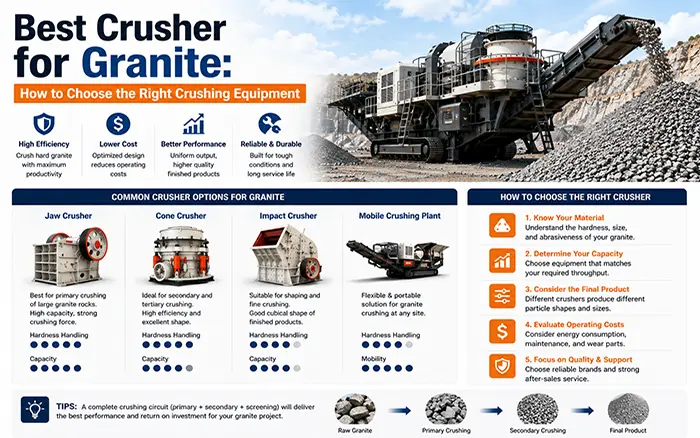
Construction aggregate: Crushed granite is used in concrete and road construction.
Paving and curbing: Granite blocks are used for streets, walkways, and borders.
Granite has been used as a building material for thousands of years. The Great Wall of China contains granite sections that are still standing today.
Conclusion
The granite mineral composition is what makes this rock so special. Quartz, feldspar, and mica are the essential minerals. Their proportions determine the rock's color, hardness, and appearance. Accessory minerals add variety and character. Whether you see a pink countertop, a gray building facade, or a black monument, you are looking at the result of a unique combination of minerals. Understanding granite mineral composition helps you appreciate why this rock has been valued for centuries.