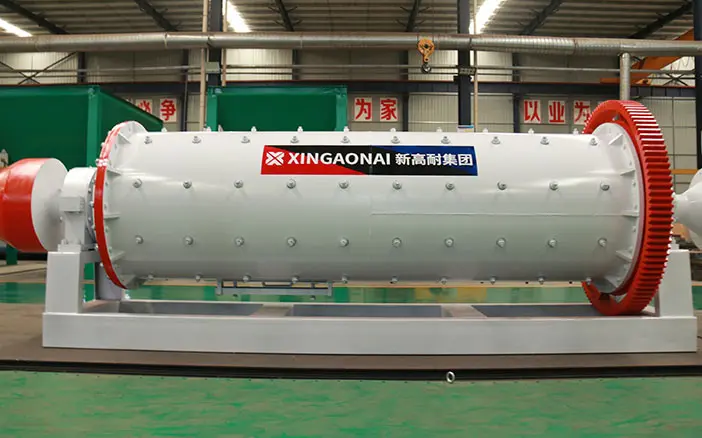
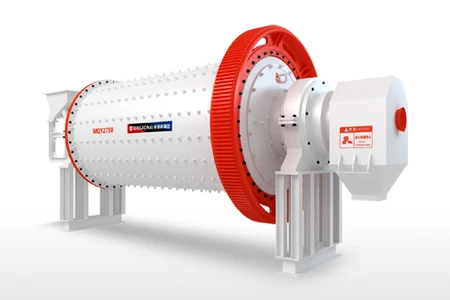
A mining ball mill grinds prepared ore to help liberate valuable minerals from the surrounding gangue. It normally operates as part of a processing circuit that includes feed preparation, grinding, classification and downstream separation.
Its purpose is not simply to produce the finest possible material. The required grind depends on mineral texture, liberation characteristics and the needs of flotation, magnetic separation, gravity concentration or another recovery process.
A suitable mill must therefore be evaluated together with the ore and the complete flowsheet.
This guide explains where a mining ball mill fits, how its configuration affects the circuit and what information is needed before selecting equipment.

Where Does a Mining Ball Mill Fit in the Flowsheet?
A conventional mineral-processing route may include:
Crushing → Feed preparation → Ball milling → Classification → Mineral separation → Dewatering
Other arrangements are possible. A ball mill may follow another grinding stage, or it may regrind a selected concentrate or intermediate stream.
The material entering the mill must suit the selected equipment. Its maximum size, particle-size distribution, hardness, abrasiveness and moisture condition affect the grinding duty.
Upstream crushing and storage also influence consistency. A stable supply of prepared ore is easier to manage than alternating coarse surges and periods of starvation.
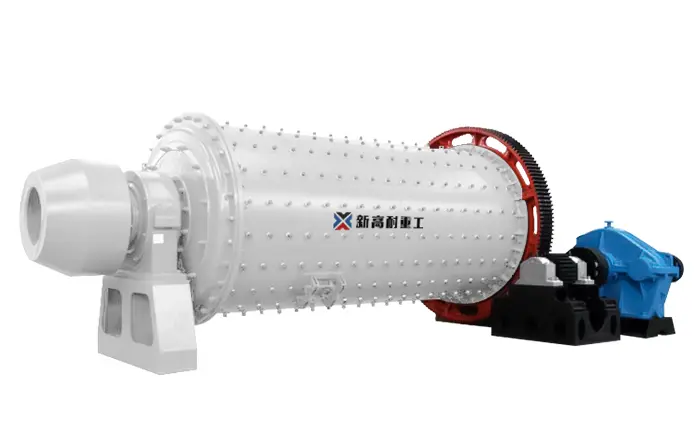
The XINGAONAI Ball Mill product page provides the available equipment reference. The appropriate configuration must be confirmed against the project’s actual grinding requirements.
Mineral Liberation Determines the Grinding Target
Valuable minerals are often locked within particles containing several mineral species.
Grinding breaks these composite particles and exposes more of the valuable mineral to the next process. However, the relationship between size reduction and recovery varies between deposits.
Insufficient Grinding
If particles remain too coarse, valuable minerals may remain locked with gangue.
Possible consequences include:
Poor separation;
Valuable mineral losses to tailings;
Excessive middlings;
Difficulty achieving concentrate quality.
Excessive Grinding
Grinding beyond the useful requirement can increase energy and media consumption. It can also create fine particles that are difficult to recover or dewater in the selected process.
The effect depends on the mineral and recovery method. Some ores require a fine grind, while others benefit from recovering liberated material before further size reduction.
Define a Target Distribution
A grinding target should describe a particle-size distribution, commonly using a value such as P80—the size through which 80% of the product passes.
P80 does not describe every particle in the stream. The coarse fraction, fines content and mineral-by-size distribution may also matter.
Select the target from representative testwork and downstream process requirements rather than applying one fineness to every gold, copper or iron ore.
How Does a Mining Ball Mill Grind Ore?
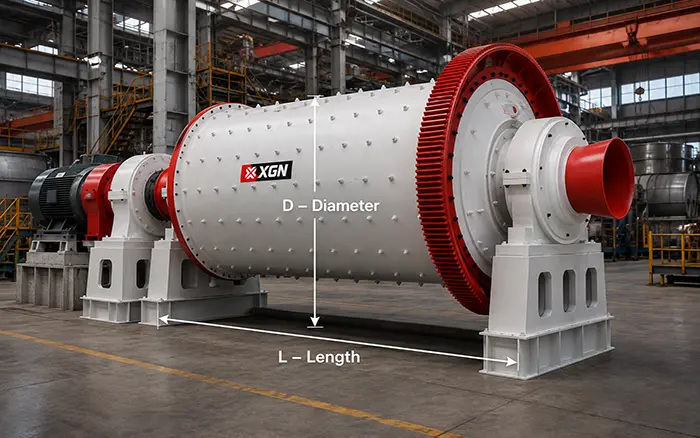
The rotating shell moves the grinding charge. Grinding media interact with the ore through impact, compression and abrasion.
Liners protect the shell and influence charge movement. The feed, media, water where used and discharge arrangement interact to determine the mill’s operating condition.
The mill discharge contains a distribution of particle sizes. It should not be assumed that every particle leaves only after reaching the final target.
For the detailed mechanical sequence, refer to how a ball mill works.
Separate Three Configuration Decisions
Wet or dry grinding, discharge design and circuit arrangement describe different aspects of a mining ball mill.
| Decision | Options to evaluate | Main question |
|---|---|---|
| Grinding environment | Wet or dry | What material condition does the process require? |
| Discharge arrangement | Overflow or grate discharge | How should material leave the selected mill? |
| Circuit arrangement | Open or closed circuit | Is external classification and return required? |
These options should be combined through process design. “Wet,” “overflow” and “closed circuit” are not interchangeable descriptions.
Wet Grinding or Dry Grinding?
Wet Grinding
Wet grinding produces a slurry that can be transferred to classification and suitable downstream separation processes.
Its evaluation includes:
Water availability and quality;
Slurry solids concentration;
Ore density;
Slurry viscosity;
Pumping requirements;
Classification;
Downstream water balance.
Adding water does not automatically solve clay-related problems. Clay can affect slurry behavior, classification and separation, so representative testing remains important.
Dry Grinding
Dry grinding may be considered where the product or downstream process requires dry material.
Its design introduces requirements for:
Material transport;
Air handling;
Dust collection;
Feed moisture;
Temperature management;
Product collection.
A mill should not be changed between wet and dry service without reviewing the discharge, liners, transport system, auxiliaries and operating requirements.
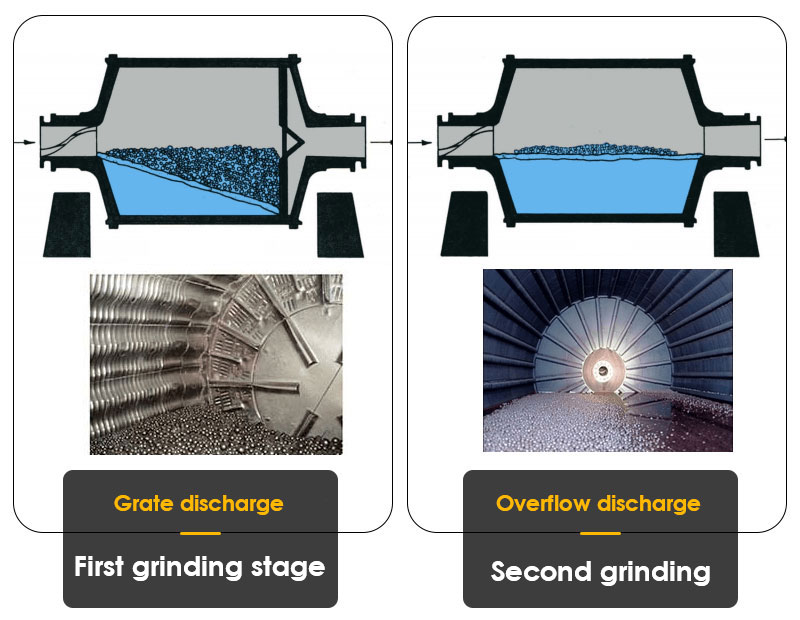
Overflow or Grate Discharge?
Overflow Discharge
In a typical wet overflow arrangement, slurry leaves through the discharge trunnion as the internal level permits.
Its behavior depends on mill geometry, charge condition, slurry properties and operating duty.
An overflow arrangement does not independently guarantee a specified final particle size.
Grate Discharge
A grate-discharge arrangement uses a discharge grate and associated components to control material exit and retain grinding media as designed.
The arrangement affects slurry hold-up and discharge capacity. It also introduces components whose wear and condition influence operation.
The grate should not be described as a precision classifier that allows only finished-size particles to leave.
Choose from the Complete Duty
Discharge selection should consider:
Required throughput;
Available grinding power;
Slurry transport;
Material characteristics;
Product requirements;
Wear and maintenance;
Classification arrangement.
Ore name alone is insufficient. A gold-ore project does not automatically require overflow discharge, and a hard-ore project does not automatically require grate discharge.
Why Classification Matters
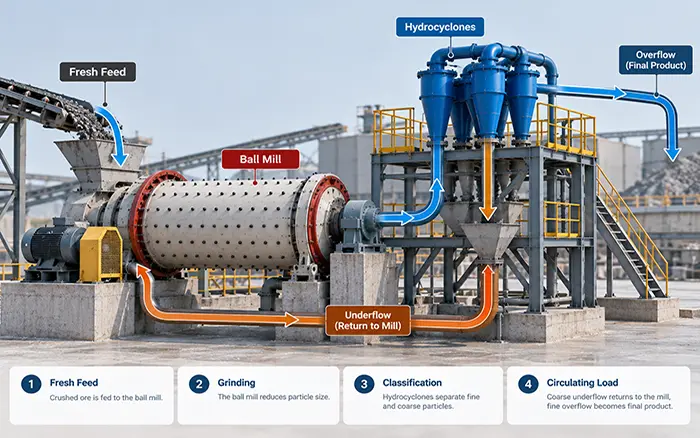
In a closed grinding circuit, the classifier separates the mill discharge into streams with different particle-size distributions.
The finer stream proceeds to the next process. The coarser stream returns for further grinding.
A simplified wet circuit is:
Fresh ore + Return material → Ball mill → Classifier → Fine product
Classifier coarse stream → Return to ball mill
Classification is not perfect. Fine particles can return with the coarse stream, and coarse particles can report to the product.
The circuit must therefore be assessed using the final classified product, rather than mill discharge alone.
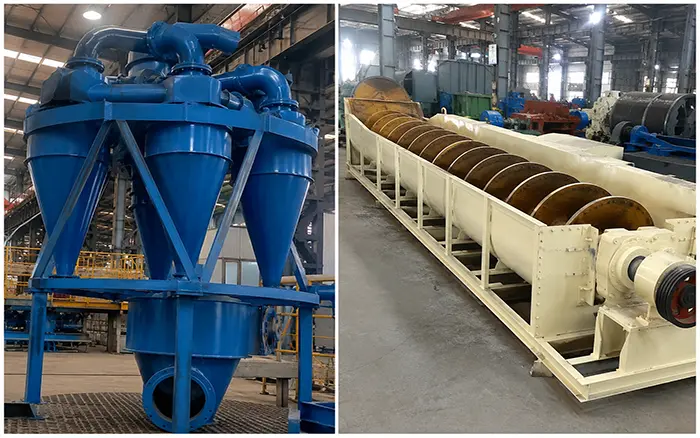
Spiral Classifier or Hydrocyclone?
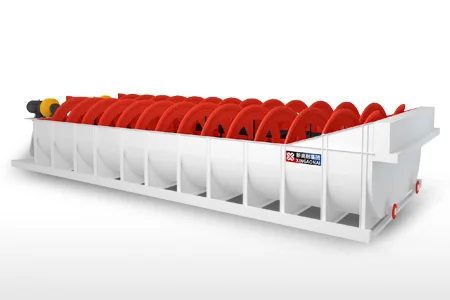
A Spiral Classifier can separate slurry through differences in settling behavior and mechanically return settled material.
A hydrocyclone uses a pressurized slurry feed and a different separation mechanism.
Selection depends on the required separation, solids and slurry properties, flow rate, layout and control requirements.
For the detailed comparison, see hydrocyclone vs spiral classifier.
Fresh Feed Is Not Total Mill Feed
Returned material adds to the flow entering a closed-circuit mill.
Keep separate records for:
New ore entering the circuit;
Material returning from classification;
Total solids entering the mill;
Final circuit product.
The circulating load guide explains the definitions and calculations.
Match Grinding to the Next Recovery Stage
Flotation
Flotation requires an appropriate balance between liberation and particle size.
A grind that is too coarse can leave minerals locked. Excessive fine material may also create difficulties, depending on the ore and flotation conditions.
The target should be established through metallurgical testing, with attention to both recovery and concentrate quality.
Magnetic Separation
Grinding may be required to separate magnetic minerals from gangue.
Some flowsheets use staged grinding and separation so that selected streams receive further treatment. This can avoid sending every particle through the same amount of grinding.
Gravity Concentration
Gravity recovery can be sensitive to particle-size distribution and mineral liberation.
Where appropriate, recovering liberated valuable material before further grinding may be evaluated. The recovery location and equipment must be determined from testwork and the flowsheet.
Concentrate Regrinding
A regrind duty treats a selected stream rather than necessarily processing the complete fresh ore feed.
Its required fineness, solids characteristics and energy demand can differ substantially from primary grinding. Depending on the duty, alternative grinding technologies may also need evaluation.
What Must Be Defined Before Selecting a Mill?
A useful grinding-duty specification includes:
| Project information | Why it matters |
|---|---|
| Dry-solids throughput | Establishes the amount of new ore to process |
| Feed-size distribution and F80 | Defines the incoming grinding duty |
| Target product distribution and P80 | Defines the required result |
| Grindability test results | Supports energy and equipment evaluation |
| Mineralogy and liberation | Connects grinding with recovery |
| Ore density and abrasiveness | Influences loading, wear and operating conditions |
| Wet or dry process | Determines material-handling requirements |
| Classification arrangement | Affects return flow and final product control |
| Ore variability | Indicates how the duty may change |
| Site utilities and layout | Affects installation and auxiliary systems |
For power estimation, dimensions and the engineering selection sequence, use the ball mill sizing guide.
A catalogue capacity is a reference under stated conditions. It is not a guarantee that the same mill will process every ore at the same rate and fineness.
Define the Complete Grinding Package
A mill quotation should state the boundary of supply.
Depending on the project, the grinding section may require:
Feed-handling equipment;
Mill and drive;
Liners;
Initial grinding-media charge;
Lubrication equipment;
Classification equipment;
Sumps and slurry pumps;
Water connections;
Electrical controls and instrumentation;
Maintenance access and lifting arrangements.
Confirm what is included and what another contractor must supply.
For wet circuits, sump volume, pump duty and classification capacity need to match the process. For dry circuits, the air and product-handling systems require the same attention.
Evaluate Performance at the Circuit Outlet
Higher feed rate alone does not demonstrate better grinding performance.
Review throughput together with:
Final product-size distribution;
Downstream recovery;
Concentrate quality where relevant;
Energy use;
Grinding-media consumption;
Classification behavior;
Availability;
Operating stability.
If throughput increases while the product becomes too coarse, the downstream process may lose performance.
Similarly, a finer product may consume additional energy without providing a useful recovery benefit.
Use consistent sampling and measurement methods so comparisons reflect actual process changes.
Routine servicing and shutdown planning belong in the ball mill maintenance guide.
Information to Send with a Mining Ball Mill Enquiry
Prepare:
Ore type and available mineralogical information;
Representative test results;
Required dry-solids throughput;
Feed-size distribution;
Target product-size distribution;
Downstream recovery process;
Wet or dry grinding requirement;
Proposed classification arrangement;
Water availability and quality;
Electrical supply;
Site layout and environmental conditions;
Required equipment and service scope.
If testwork is incomplete, identify which values are assumptions. A preliminary proposal should state the information still needed for final selection.
Define the Grinding Duty Before the Machine
A mining ball mill should be selected around the ore’s liberation requirement and the complete processing circuit.
Confirm the feed, required product, throughput, classification and downstream recovery needs before comparing mill dimensions or nominal capacity.
Send XINGAONAI the available ore tests, flowsheet and project information to request a preliminary grinding-circuit proposal.