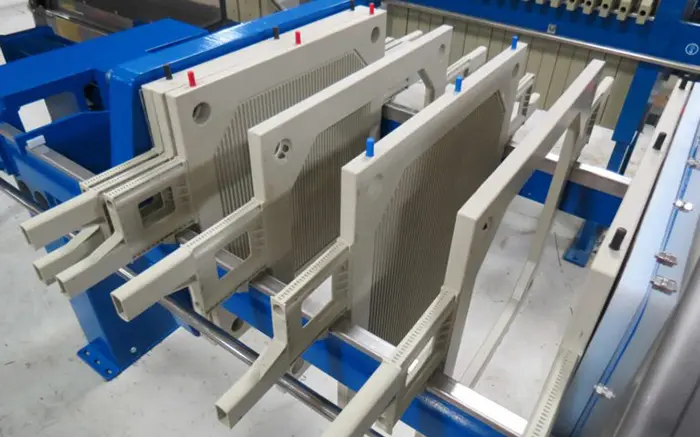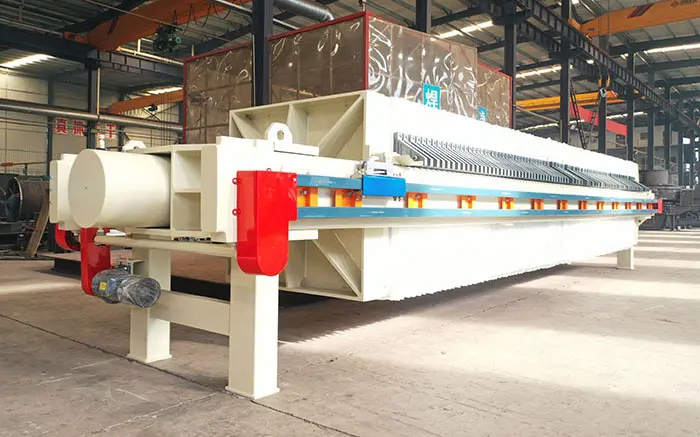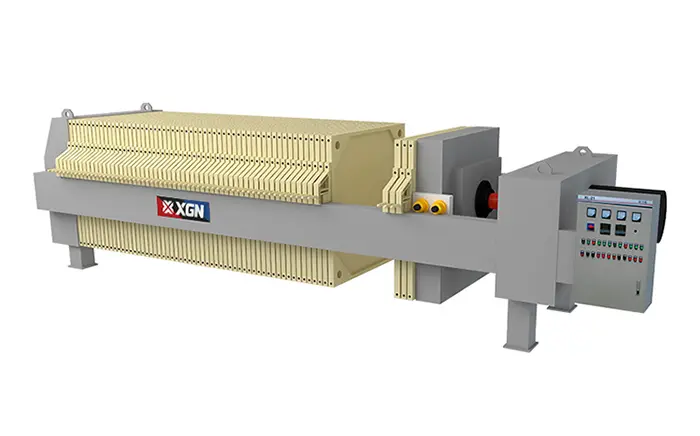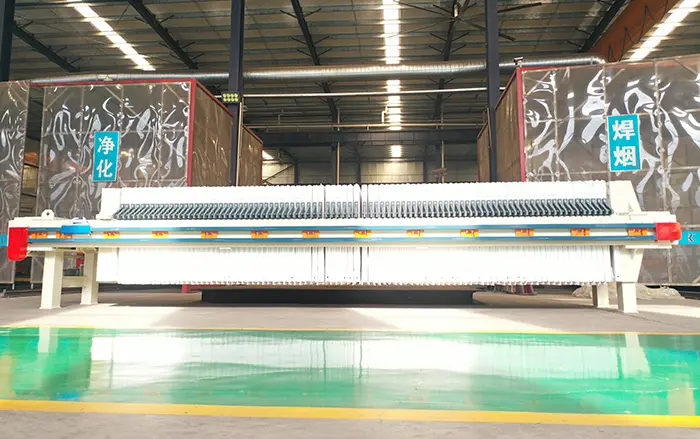
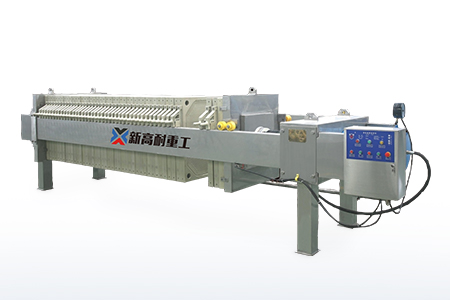
A plate and frame filter press may experience slurry leakage, cloudy filtrate, slow filtration, uneven cake formation, difficult cake discharge, plate damage or hydraulic-system faults. Effective troubleshooting starts by identifying the symptom, determining whether the press must be stopped, and checking the simplest causes before adjusting process settings.
The slurry feed system and hydraulic closing system perform different functions. The feed pump generates slurry-side filtration pressure, while the hydraulic system closes and holds the plate-and-frame pack. These pressures must not be treated as interchangeable.
This guide provides a symptom-based troubleshooting process for an industrial Plate and Frame Filter Press.
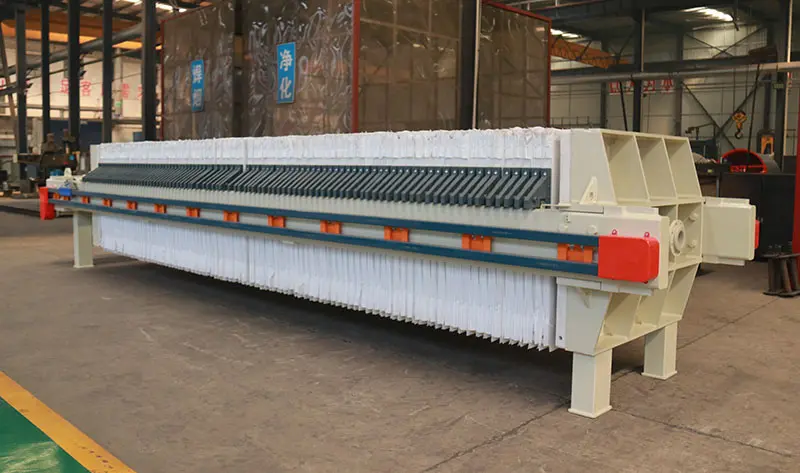
Safety Before Troubleshooting
Never open, adjust or service a filter press while slurry-side pressure or stored hydraulic energy remains in the system.
Before inspection:
Stop the slurry feed pump.
Isolate the feed line.
Release slurry-side pressure.
Isolate electrical and hydraulic energy.
Apply the site’s lockout/tagout procedure.
Verify that pressure gauges indicate a safe condition.
Confirm that the plate pack cannot move unexpectedly.
Wear the required personal protective equipment.
Do not increase feed pressure, hydraulic pressure or relief-valve settings unless the change is permitted by the model-specific manual and authorized by qualified personnel.
Quick Filter Press Troubleshooting Table
| Symptom | First checks | Common causes | Action level |
|---|---|---|---|
| Slurry leaking between plates | Feed pressure, alignment and sealing surfaces | Residual cake, folded cloth, insufficient closing force, excessive feed pressure | Stop if spraying or increasing |
| Cloudy filtrate | Identify the affected outlet | Torn cloth, incorrect installation, cloth bypass | Isolate and inspect |
| Slow filtration | Feed condition, pressure and cloth permeability | Cloth blinding, fine particles, high viscosity, blocked piping | Planned inspection unless pressure is abnormal |
| Wet filter cake | Cycle endpoint and chamber filling | Incomplete cake formation, low solids, uneven filling | Process investigation |
| Uneven cake thickness | Feed distribution and individual chambers | Blocked feed port, misalignment, cloth blockage | Inspect before next cycle |
| Difficult cake discharge | Cake condition and cloth surface | Sticky cake, unsuitable cloth, incomplete cake formation | Process adjustment after testing |
| Plate or frame crack | Component condition and pressure history | Overpressure, impact, misalignment, incomplete filling | Stop immediately |
| Hydraulic pressure loss | Oil level, external leakage and valves | Hose, seal, pump or valve fault | Stop and inspect |
| Abnormal noise or movement | Plate pack, follower and guide rails | Misalignment, obstruction or loose component | Stop immediately |
| Feed pressure rises rapidly | Filtrate outlets and feed path | Blockage, closed valve, blinded cloth | Stop feeding immediately |
Problem 1: Slurry Leakage Between Plates and Frames
Leakage between plates and frames is one of the most visible filter press problems. A small leak can quickly develop into pressurized slurry spraying from the plate pack.
Possible Causes
Residual filter cake on the sealing surfaces
Wrinkled or incorrectly positioned filter cloth
Misaligned plates or frames
Insufficient plate-closing force
Excessive slurry feed pressure
Cracked or deformed plate or frame
Blocked feed channel causing uneven pressure
Incorrect plate-and-frame sequence
Damaged gasket, if the selected design uses gaskets
Not every plate and frame filter press uses separate rubber seals. Do not assume that leakage is always caused by an aged gasket.
Inspection Procedure
Stop the feed pump.
Isolate the feed line.
Fully release slurry-side pressure.
Open the press only after confirming a safe condition.
Inspect sealing surfaces for residual cake.
Check whether filter cloth is folded or displaced.
Verify plate-and-frame alignment.
Inspect components for cracks or deformation.
Review the recorded feed pressure.
Check whether the closing system maintained the required condition.
Corrective Actions
Clean all sealing surfaces.
Reinstall displaced filter cloth.
Replace torn or damaged cloth.
Correct the plate-and-frame alignment.
Inspect and repair the closing system if it cannot maintain the required force.
Replace cracked or deformed components.
Investigate pressure excursions before restarting.
Do not compensate for leakage by increasing hydraulic pressure beyond the specified setting.
Problem 2: Cloudy Filtrate
Cloudy filtrate indicates that solid particles are passing through or around the filtration medium.
Possible Causes
Torn or punctured filter cloth
Incorrect filter-cloth installation
Cloth not covering the filtration area correctly
Cloth bypass around an edge or feed opening
Incorrect cloth permeability
Loose cloth fastening
Cracked plate or frame
Initial fine-particle passage before the cake layer forms
Diagnostic Procedure
Identify which filtrate outlet produces cloudy liquid.
Determine whether turbidity occurs only during startup or throughout the cycle.
Stop or isolate the affected filtration path according to the operating procedure.
Depressurize the press.
Inspect the corresponding cloth and filtration section.
Check cloth dimensions, fit and fastening.
Inspect the plate and frame for damage.
Compare the cloth specification with the slurry particle size.
Corrective Actions
Replace damaged cloth.
Reinstall incorrectly positioned cloth.
Clean the cloth and drainage surfaces using an approved method.
Verify that the cloth specification is suitable for the slurry.
Replace damaged structural components.
Review operating pressure if cloth damage occurs repeatedly.
Persistent cloudy filtrate should not be ignored. Continued operation may cause product loss, filtrate contamination or further filter-cloth damage.
Problem 3: Slow Filtration
Slow filtration increases cycle time and reduces the number of batches completed per shift.
Possible Causes
Blinded or clogged filter cloth
Increased fine-particle content
Higher slurry viscosity
Changed solids concentration
Lower slurry temperature
Reduced feed-pump performance
Restricted feed pipe
Partially closed or blocked valve
Blocked filtrate outlets or drainage grooves
Excessive cake thickness
Faulty pressure or flow instrument
Diagnostic Sequence
Compare the current slurry with previous normal batches.
Check solids concentration, temperature and visible slurry condition.
Review feed-pressure and cycle-time records.
Check feed-pump performance.
Inspect feed lines and valves.
Compare filtrate flow from individual outlets.
Check for blocked drainage channels.
Inspect filter-cloth permeability and condition.
Review frame thickness and cake condition.
Confirm that pressure instruments are working correctly.
Corrective Actions
Clean or replace blinded filter cloth.
Remove restrictions in the feed or filtrate path.
Repair the feed pump if it cannot maintain the required operating condition.
Evaluate a different cloth specification.
Review frame thickness and filtration endpoint.
Perform filtration testing if the slurry properties have changed.
Do not automatically increase feed pressure. Slow filtration caused by blocked outlets or blinded cloth may become more dangerous if pump output is increased.
Problem 4: Wet Filter Cake
A wet cake does not necessarily indicate a mechanical failure. It may result from the slurry, incomplete filling or an unrealistic cake-moisture target.
Possible Causes
Filtration stopped too early
Frames not completely filled
Low slurry solids concentration
Fine or compressible solids
High slurry viscosity
Unsuitable filter cloth
Uneven feed distribution
Excessive frame thickness
Feed-pump performance below the required level
Target moisture below what standard pressure filtration can achieve
Diagnostic Procedure
Compare the actual cycle time with previous stable cycles.
Check filtrate flow near the end of filtration.
Inspect cake thickness in different frames.
Confirm slurry solids concentration.
Check for partially filled chambers.
Review feed pressure without exceeding the rated limit.
Inspect filter cloth for blinding.
Compare the target moisture with filtration-test results.
Corrective Actions
Confirm that all frames fill uniformly.
Review the filtration endpoint.
Evaluate a more appropriate filter cloth.
Review frame thickness.
Stabilize slurry preparation and solids concentration.
Perform representative filtration testing.
Consider another dewatering stage if standard pressure filtration cannot meet the target economically.
Longer filtration or higher pressure does not always produce a proportionally drier cake.
Problem 5: Uneven Filter Cake Thickness
Uneven cake thickness indicates that slurry or filtrate is not flowing uniformly through the plate-and-frame pack.
Possible Causes
Blocked feed port
Restricted feed manifold
Uneven slurry distribution
Misaligned plates or frames
One or more blinded cloth sections
Air trapped in the feed system
Incomplete chamber filling
Feed stopped too early
A blocked filtrate outlet
Incorrect plate-and-frame assembly
Diagnostic Procedure
Compare cakes from the front, middle and rear of the plate pack.
Identify chambers with unusually thin or incomplete cakes.
Inspect the corresponding feed ports.
Compare filtrate flow from nearby outlets.
Check cloth permeability by position.
Verify plate-and-frame alignment.
Review the startup feeding sequence.
Check for restrictions in the feed manifold.
Corrective Actions
Clean blocked feed ports and manifolds.
Restore proper plate-and-frame alignment.
Clean or replace affected cloth.
Correct the plate-and-frame assembly sequence.
Review controlled startup feeding.
Repair blocked or damaged filtrate outlets.
Repeated uneven cake formation should be investigated before the next production cycle.
Problem 6: Difficult Cake Discharge
A filter cake should release from the cloth without damaging the plates, frames or filtration medium. Sticky or incompletely formed cake can significantly increase discharge time.
Possible Causes
Sticky or compressible solids
Incomplete cake formation
High residual cake moisture
Unsuitable cloth surface
Blinded filter cloth
Cake remaining in frame corners
Plate or frame misalignment
Irregular cake thickness
Chemical interaction between the slurry and cloth
Corrective Actions
Review the filtration endpoint.
Confirm that the frames fill completely.
Evaluate cloth with improved cake-release characteristics.
Clean cloth using the approved method.
Review frame thickness.
Stabilize slurry preparation.
Perform laboratory testing before adding flocculants or other treatment chemicals.
Inspect the plate-shifting mechanism, if fitted.
Do not strike plates or frames with unsuitable metal tools. Impact may crack components or damage sealing surfaces.
Cake washing is not automatically a solution to poor cake release. Washing is normally used to remove dissolved material from a cake and may increase moisture.
Problem 7: Filter Plate or Frame Cracking
A cracked plate or frame is a serious condition.
Stop the Press Immediately
Do not continue operating with a visibly cracked or significantly deformed component.
Possible Causes
Feed pressure above the rated limit
Incomplete or uneven chamber filling
Residual cake on sealing surfaces
Misalignment
Impact during handling or cake discharge
Incorrect plate-and-frame sequence
Chemical incompatibility
Temperature above the material rating
Fatigue or previous damage
Corrective Actions
Isolate and depressurize the machine.
Replace the damaged part with the correct specification.
Inspect neighboring plates and frames.
Review feed-pressure history.
Check the feed-pump control and pressure protection.
Inspect sealing surfaces for residual cake.
Verify plate-and-frame alignment.
Confirm chemical and temperature compatibility.
The hydraulic relief valve protects the hydraulic closing circuit. It may not protect the slurry feed side against overpressure. Slurry-side pressure control must be provided by the feed-pump and piping design.
Problem 8: Hydraulic Pressure Loss
The hydraulic system closes and holds the plate-and-frame pack. Loss of hydraulic pressure can prevent correct closure or allow unexpected movement.
Possible Causes
Low hydraulic oil level
External oil leak
Damaged hose or fitting
Worn cylinder seal
Contaminated hydraulic oil
Faulty hydraulic pump
Relief-valve fault
Control-valve fault
Air in the hydraulic circuit
Incorrect pressure setting
Corrective Actions
Stop the press.
Isolate electrical and hydraulic energy.
Inspect for visible leakage.
Check the oil level and condition.
Inspect hoses, fittings and the cylinder.
Test pump and valve performance according to the manual.
Bleed air only using the approved procedure.
Replace damaged parts with components of the specified rating.
Never inspect a suspected hydraulic leak with bare hands while the system is pressurized. High-pressure hydraulic fluid can penetrate the skin.
Problem 9: Press Will Not Reach the Closing Condition
The filtration cycle must not begin if the plate pack cannot reach or maintain the specified closing condition.
Possible Causes
Low hydraulic oil level
External hydraulic leakage
Internal cylinder leakage
Hydraulic pump fault
Control- or relief-valve problem
Plate pack longer than the permitted length
Residual cake on sealing surfaces
Misaligned plates or frames
Mechanical obstruction
Incorrectly installed cloth
Damaged guide rails or follower
Corrective Actions
Do not start slurry feeding.
Check plate-pack length and component sequence.
Remove residual cake from sealing surfaces.
Correct plate-and-frame alignment.
Check for mechanical obstruction.
Inspect hydraulic pressure and leakage.
Have qualified personnel inspect the cylinder, pump and valves.
Do not bypass a pressure switch or safety interlock to force the press into operation.
Problem 10: Feed Pressure Rises Too Quickly
A rapid, unexplained increase in feed pressure may indicate that slurry or filtrate cannot flow through the intended path.
Possible Causes
Closed filtrate outlet
Blocked drainage channel
Blinded filter cloth
Closed or incorrectly positioned valve
Blocked feed port
Frames already filled
Sudden increase in slurry viscosity
Changed solids concentration
Faulty pressure instrument
Downstream filtrate restriction
Required Action
Stop or reduce feeding according to the operating procedure.
Then:
Verify valve positions.
Inspect filtrate outlets.
Check for blocked drainage channels.
Review slurry properties.
Check the pressure instrument.
Inspect cloth condition after safe depressurization.
Do not continue increasing pump output to overcome an unexplained pressure rise.
Problem 11: Abnormal Noise or Plate-Pack Movement
Unexpected noise or movement may indicate misalignment, obstruction or mechanical failure.
Possible Causes
Misaligned plate-and-frame pack
Loose mechanical components
Damaged plate shifter
Worn guide rail
Obstruction along the plate pack
Uneven closing movement
Hydraulic-cylinder problem
Cracked component
Excessive feed pressure
Corrective Actions
Stop the machine.
Isolate all energy sources.
Inspect the plate pack and follower.
Check guide rails and shifting equipment.
Inspect for cracked or loose components.
Verify closing-system alignment.
Do not restart until the cause has been identified.
When to Stop the Filter Press Immediately
Stop the press immediately if:
A plate or frame is visibly cracked.
Slurry sprays from the plate pack.
Feed pressure rises rapidly without a known cause.
Hydraulic pressure is suddenly lost.
The plate pack moves unexpectedly.
A hose, pipe or fitting leaks under pressure.
Abnormal mechanical impact or movement occurs.
An electrical burning smell, smoke or overheating is detected.
A safety guard or interlock fails.
Personnel may be exposed to pressurized slurry.
The machine cannot maintain the closing condition.
When uncertain, stop, isolate and inspect the equipment rather than continuing production.
Troubleshooting Records
Operating records help distinguish an equipment fault from a change in slurry properties.
Record the following information for each cycle:
| Inspection item | Information to record |
|---|---|
| Feed pressure | Normal range and abnormal peaks |
| Filtrate flow | Change from startup to cycle completion |
| Filtrate clarity | Outlet showing abnormal turbidity |
| Cycle time | Difference from previous normal cycles |
| Cake condition | Thickness, moisture and release behavior |
| Slurry condition | Solids concentration, temperature and visible changes |
| Filter cloth | Damage, blinding and alignment |
| Plates and frames | Cracks, deformation and sealing condition |
| Hydraulic system | Oil level, leakage and pressure stability |
| Corrective action | Work completed and result after restart |
Comparing records from normal and abnormal cycles can reveal gradual changes in cloth permeability, slurry composition, pump performance or equipment condition.
For normal startup, monitoring, shutdown and cake-discharge procedures, see the plate and frame filter press operation guide.
Preventing Recurring Problems
Troubleshooting should identify the root cause, not only restore the press temporarily.
Useful preventive actions include:
Keep sealing surfaces free of residual cake.
Inspect filter cloth for damage and displacement.
Record feed pressure and cycle time.
Monitor filtrate flow and clarity.
Confirm plate-and-frame alignment.
Keep feed and filtrate channels clear.
Check the hydraulic system for leakage.
Follow the specified feed-pressure limit.
Investigate changes in slurry properties.
Replace damaged components before failure.
Train operators to recognize immediate shutdown conditions.
Cleaning frequency should be based on cloth permeability, cake release and filtrate quality. Universal instructions such as washing after every cycle may cause unnecessary labor or cloth damage.
Conclusion
Effective plate and frame filter press troubleshooting begins with safety, symptom identification and a logical inspection sequence.
Leakage, cloudy filtrate, slow filtration, wet cakes and uneven cakes may result from filter-cloth condition, changed slurry properties, blocked flow paths or incorrect operating conditions. Cracked components, rapid pressure increases, hydraulic pressure loss and unexpected plate-pack movement require immediate shutdown.
Do not use higher pressure as a universal solution. Feed pressure, hydraulic pressure and plate-closing force perform different functions and must remain within the limits of the selected equipment.
Understanding the plate and frame filter press working principle and the machine’s plate-and-frame construction can help maintenance teams identify the correct inspection point.
For model-specific specifications or equipment selection, review the available industrial plate and frame filter press and provide slurry data, operating records and a clear description of the fault.