Belt feeders and apron feeders both withdraw bulk material from a hopper or bin and deliver it to downstream equipment at a controlled rate. However, they use different carrying surfaces and are designed for different loading conditions.
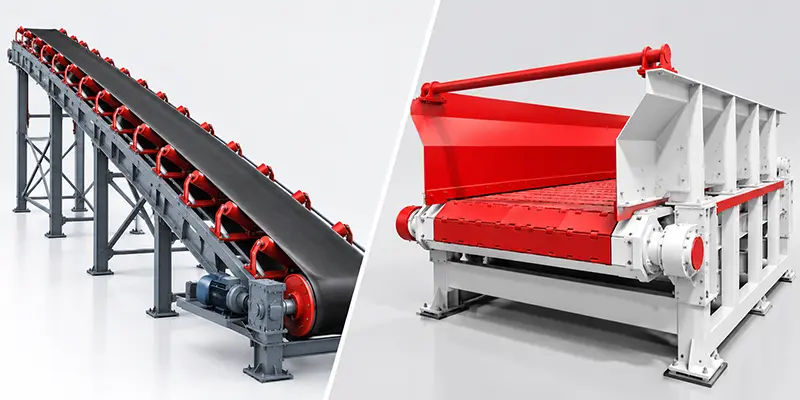
A belt feeder uses a continuous flexible belt supported by pulleys, idlers or a slider bed. It is generally suitable for relatively controlled loading, smaller particle sizes and applications requiring smooth or accurate material flow.
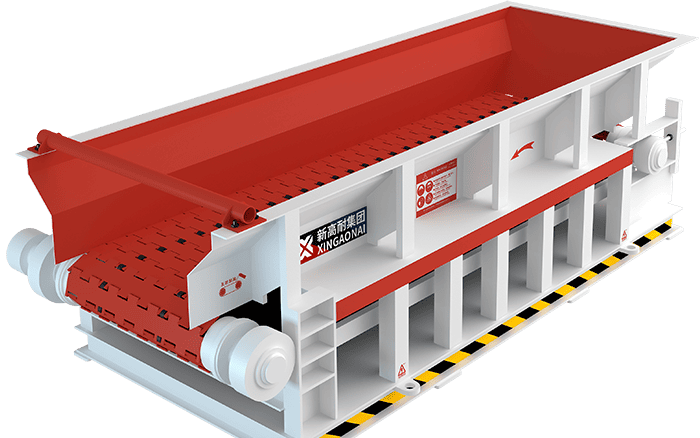
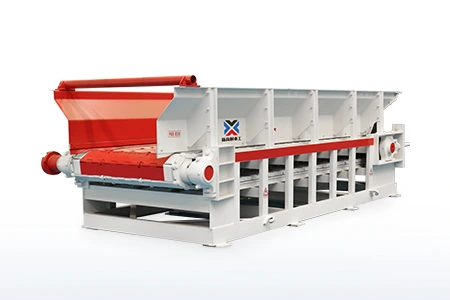
An apron feeder uses overlapping steel pans attached to heavy-duty chains. Its rigid construction makes it suitable for coarse, sharp, abrasive or impact-loaded material that could damage a conventional belt.
Neither feeder is universally better. The correct choice depends on:
Maximum lump size
Material abrasiveness and shape
Loading impact
Required feed rate
Hopper pressure
Moisture and stickiness
Material temperature
Required installation length
Feed-control accuracy
Maintenance resources
Initial and lifecycle cost
This guide compares belt feeder vs apron feeder performance and provides a practical selection process for mining, quarrying, aggregate, cement and bulk-material handling applications.
Quick Comparison: Belt Feeder vs Apron Feeder
| Selection Factor | Belt Feeder | Apron Feeder |
|---|---|---|
| Carrying surface | Continuous flexible belt | Overlapping steel pans |
| Drive arrangement | Drive pulley and belt | Chains, sprockets and drive shaft |
| Typical material condition | Fine to medium-sized, reasonably controlled material | Coarse, sharp, abrasive and impact-loaded material |
| Resistance to direct impact | Limited by belt construction and loading design | Generally better suited to severe impact |
| Resistance to sharp particles | Requires careful belt and loading-zone selection | Steel pans provide greater resistance |
| Material temperature | Limited by the selected belt specification | Better suited to elevated temperatures when correctly designed |
| Feed control | Well suited to controlled and gravimetric feeding | Normally controlled volumetrically through chain speed |
| Equipment weight | Generally lighter | Generally heavier |
| Structural requirement | Usually lower | Usually higher |
| Maintenance focus | Belt tracking, belt surface, pulleys and cleaners | Pans, chains, sprockets, rollers and bearings |
| Initial cost | Often lower for suitable applications | Usually higher because of heavier construction |
| Severe-duty reliability | Application-dependent | Designed for demanding primary feeding conditions |
| Best use | Controlled feeding of smaller or less damaging material | Heavy-duty extraction from hoppers and bins |
This table provides general guidance. Final selection must be based on the actual material and installation conditions.
What Is a Belt Feeder?
A belt feeder is a short, variable-speed belt system installed beneath a hopper, bin or stockpile outlet. Its primary purpose is to extract material and regulate the rate at which it enters the next process.
Its main components usually include:
Reinforced conveyor belt
Drive pulley
Tail pulley
Idlers or slider support
Drive motor and gearbox
Belt take-up system
Skirt boards
Loading-zone liners
Belt cleaners
Speed and load-monitoring devices
The feed rate is determined by the material cross-section on the belt and the belt speed. A variable-frequency drive can adjust speed to match downstream demand.
When integrated with weighing equipment and a control system, a belt feeder can provide gravimetric feed control. This is useful when the process requires a measured mass flow rather than only a stable volumetric flow.
Typical Belt Feeder Applications
Belt feeders are commonly considered for:
Crushed ore beneath a surge bin
Coal and similar bulk materials
Sand and fine aggregate
Fertilizer and industrial minerals
Controlled feeding to crushers, mills or screens
Proportioning material into a process
Applications requiring weight-based feed control
Material that should be handled relatively gently
A belt feeder should not be confused with a belt conveyor. A feeder controls material withdrawal from a storage outlet and must resist hopper pressure. A conveyor primarily transports material after it has already been discharged at a controlled rate.
What Is an Apron Feeder?
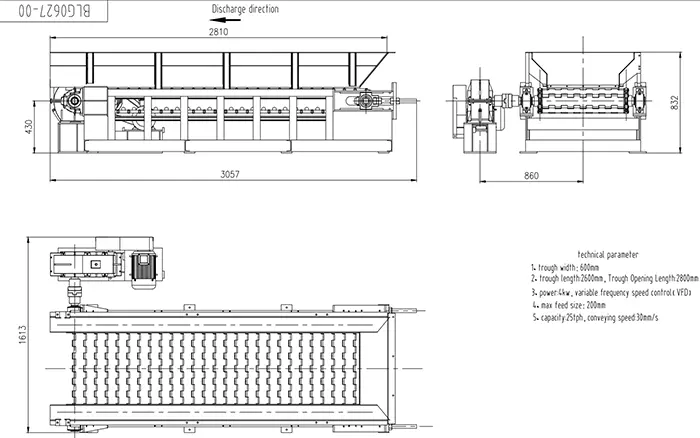
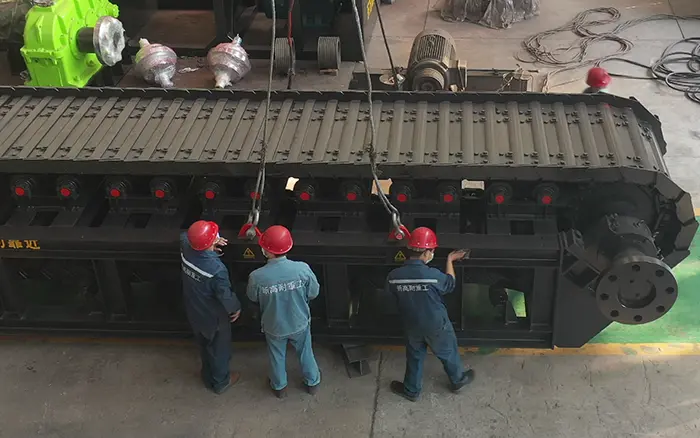
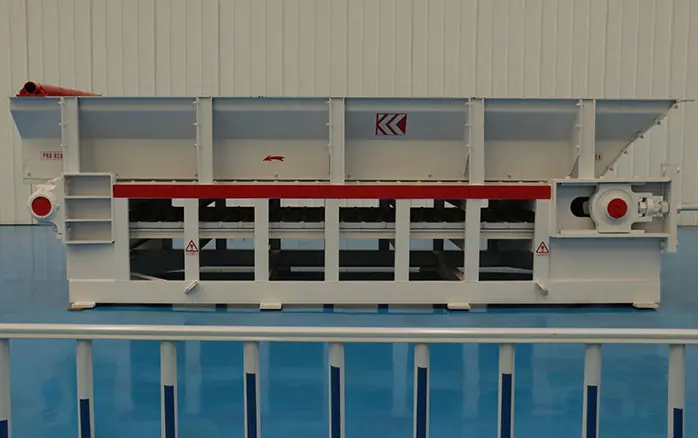
An apron feeder uses a series of steel pans mounted across parallel traction chains. A motor and gearbox turn the drive shaft and sprockets, pulling the chains and pans beneath a hopper.
The pans form a rigid carrying surface capable of resisting heavier impact and more aggressive material than a conventional belt.
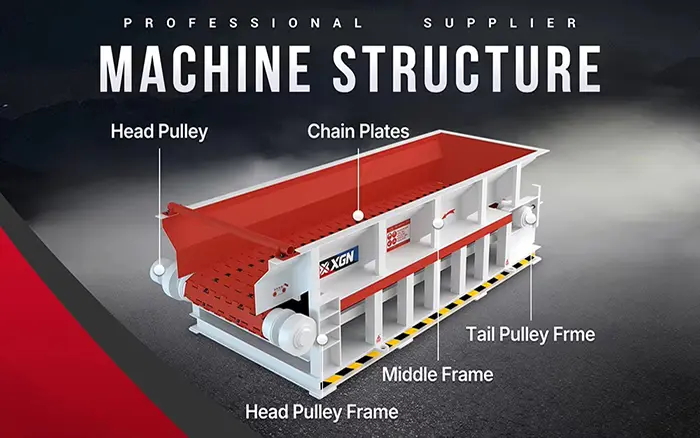
Major components include:
Steel apron pans
Traction chains
Drive sprockets
Drive and tail shafts
Motor and gearbox
Couplings
Support rollers
Return rollers
Take-up system
Bearings and seals
Main frame
Skirt boards and liners
The operating sequence is explained separately in the apron feeder working principle guide.
Typical Apron Feeder Applications
Apron feeders are commonly used for:
Run-of-mine ore
Large rock and coarse aggregate
Sharp or highly abrasive material
Primary crusher feeding
Loading beneath truck-dump or loader-fed hoppers
Material with irregular large lumps
Applications with high static hopper pressure
Severe loading and difficult operating environments
Material that may damage a flexible belt
Apron feeders normally operate at relatively low speed while producing a controlled and continuous discharge from the hopper.
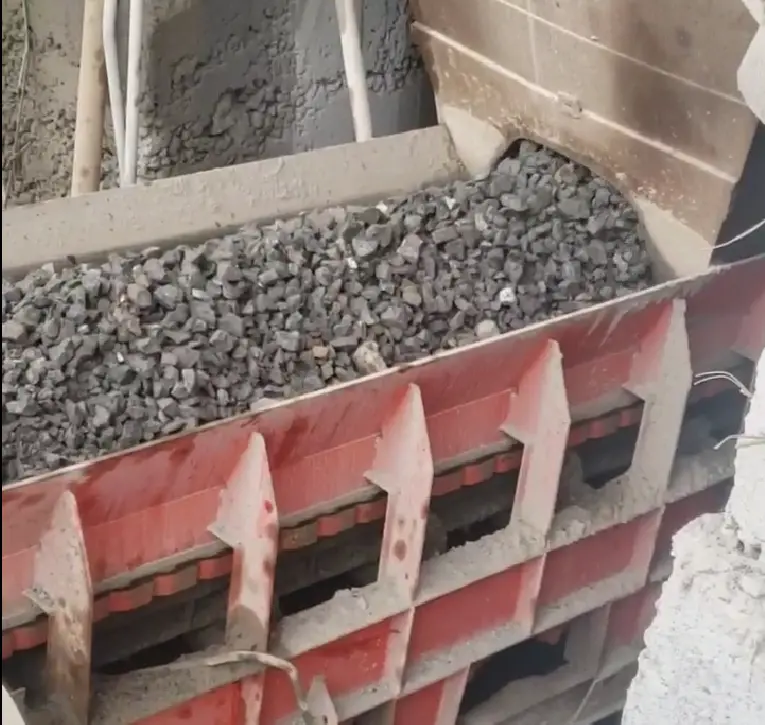
Key Differences Between Belt Feeders and Apron Feeders
1. Carrying Surface
The most visible difference is the surface that carries the material.
A belt feeder uses a continuous flexible belt. The belt can provide a smooth, sealed carrying surface, making it suitable for smaller particles and applications where spillage or material degradation must be controlled.
An apron feeder uses individual steel pans connected to chains. The rigid pans are better able to resist impact from large or sharp material.
The steel construction does not mean an apron feeder is unaffected by impact. Excessive drop height or poorly controlled loading can still crack pans, loosen fasteners and damage support components.
2. Maximum Lump Size
Maximum lump size is one of the most important selection criteria.
A belt feeder may handle coarse material when the belt, loading zone and impact-support system are correctly designed. However, large irregular rocks can cut, puncture or overload the belt.
An apron feeder is generally preferred when large lumps fall directly from a hopper or loading machine. Pan width, pan strength, chain capacity and the support arrangement must still be sized for the actual lump size and loading method.
Do not select a feeder only from the average particle size. The largest expected lump and the frequency of oversized material are more important for evaluating impact risk.
3. Abrasiveness and Particle Shape
Fine abrasive material can wear both types of feeders, but the wear mechanisms differ.
On a belt feeder, abrasive or sharp particles can:
Cut or gouge the belt cover
Become trapped between the belt and skirt
Damage pulley lagging
Increase cleaner wear
Enter the return side of the belt
Cause accelerated cover loss
On an apron feeder, abrasive material can wear:
Pan surfaces
Pan overlaps
Skirt liners
Chains
Sprockets
Support rollers
Hopper and chute liners
For extremely sharp, coarse or impact-loaded material, an apron feeder normally provides a more durable carrying structure. For fine abrasive material with controlled loading, a correctly specified belt feeder may still be practical.
4. Loading Impact
Loading impact depends on lump mass, drop height, material velocity and the condition of the material bed already on the feeder.
A belt can be damaged if large rocks fall directly onto an unsupported section. Impact beds, bars, idlers and a controlled material cushion may be required.
An apron feeder is better suited to heavy impact, but the loading area must still be designed correctly. Pans should be adequately supported, and the hopper should direct material into the intended loading zone.
Reducing uncontrolled drop height can improve the service life of both feeder types.
5. Hopper Pressure and Starting Load
Feeders installed beneath a storage bin may be subjected to substantial material pressure. The drive must overcome:
Material shear resistance at the hopper outlet
Friction between material and skirts
Internal material friction
Feeder inclination
Mechanical resistance
Starting load after a shutdown
Material compaction
Obstructions or buildup
A heavy-duty apron feeder is often selected for demanding hopper-extraction conditions because its chains and steel pans can provide high pulling capacity.
A belt feeder can also operate beneath a hopper, but the belt tension, pulley traction, skirt friction and starting conditions must be calculated for the application.
Catalogue capacity alone does not confirm that a feeder can start under a full hopper.
6. Feed-Rate Control
Both feeder types can regulate material flow by changing operating speed.
A belt feeder controls capacity through:
Belt width
Material bed depth
Belt speed
Hopper-outlet geometry
Material bulk density
An apron feeder controls capacity through:
Effective pan width
Material bed depth
Chain speed
Hopper-outlet geometry
Material bulk density
Belt feeders are often selected when accurate gravimetric feeding is required because a belt scale or weighing system can continuously measure material flow.
Apron feeders usually provide controlled volumetric feeding. They can still be integrated with process controls, but speed control alone does not directly measure mass flow when bulk density changes.
7. Wet or Sticky Material
Neither feeder automatically solves every sticky-material problem.
Wet or cohesive material may:
Bridge inside the hopper
Build up on skirts
Adhere to the belt or pans
Accumulate on return components
Restrict the discharge opening
Increase starting resistance
A belt feeder may require effective cleaners and return-side management to control carryback.
An apron feeder may tolerate severe material conditions more effectively, but sticky fines can still accumulate between pans, around chains or beneath the return section.
Hopper geometry, liners, outlet size and material-flow testing may be more important than feeder type alone.
8. Material Temperature
The allowable temperature for a belt feeder depends on the belt compound, exposure time and operating environment. Standard rubber belts may be unsuitable for hot material, while specialized heat-resistant belts have their own limits.
Steel apron pans are generally better suited to elevated-temperature material. However, chains, bearings, seals, lubrication and structural expansion must also be considered.
The expected normal and maximum material temperatures should be included in the equipment specification.
9. Installation Length and Layout
Belt feeders are usually compact and can suit installations where a relatively smooth, enclosed or clean material path is required.
Apron feeders are heavier and may require:
Stronger support structures
More installation space
Greater maintenance access
Lifting provisions for heavy parts
Adequate clearance around chains and rollers
Neither machine should be treated as a long-distance conveyor without an application-specific review. Feeders are primarily designed to extract and regulate material rather than transport it over long distances.
10. Maintenance Requirements
Belt Feeder Maintenance
Common inspection areas include:
Belt surface
Belt tracking
Splices
Pulleys
Idlers
Skirt seals
Belt cleaners
Take-up system
Drive components
Material buildup
Belt replacement can require significant downtime, particularly where access is limited.
Apron Feeder Maintenance
Common inspection areas include:
Apron pans
Pan fasteners
Chains
Pins and bushings
Sprockets
Support rollers
Return rollers
Bearings
Take-up system
Drive components
Frame alignment
The apron feeder parts guide explains the function and inspection points of these components. Detailed chain wear and replacement considerations are covered in the apron feeder chain guide.
Belt Feeder vs Apron Feeder Cost
The purchase price should not be the only deciding factor.
A belt feeder often has:
A lower equipment weight
A simpler supporting structure
Fewer heavy mechanical components
A lower initial cost for suitable applications
Belt, splice and cleaner replacement costs
Potential costs from belt damage or carryback
An apron feeder often has:
A higher initial equipment cost
A heavier support structure
More chains, rollers and mechanical components
Higher individual replacement-part costs
Better resistance to severe impact and sharp material
Lower risk of carrying-surface failure in appropriate heavy-duty applications
The lowest purchase price may become expensive if the feeder is unsuitable for the material. Lifecycle cost should include:
Equipment purchase
Civil and structural work
Installation
Power consumption
Routine maintenance
Replacement parts
Planned downtime
Unplanned downtime
Material spillage
Production losses
Expected operating life
An apron feeder should not be selected merely because it appears more durable, and a belt feeder should not be selected merely because it is less expensive.
When Should You Choose a Belt Feeder?
A belt feeder is usually worth evaluating when:
Material size is relatively controlled
Loading impact is moderate
Particles are not likely to cut or puncture the belt
Smooth material handling is important
Fine material must be contained
Accurate gravimetric control is required
The feeder must integrate with weighing equipment
Installation weight or space is limited
The application does not require an extremely heavy-duty carrying surface
Typical examples include controlled withdrawal of crushed ore, coal, sand or processed material from a surge bin.
When Should You Choose an Apron Feeder?
An apron feeder is usually preferred when:
Material contains large or irregular lumps
Sharp particles could damage a belt
Material is highly abrasive
The feeder receives severe impact loading
Heavy hopper pressure must be overcome
Full-load starting is required
The installation is part of a primary crushing station
Operating conditions are severe
A steel carrying surface is required
Reliability under heavy-duty loading is more important than minimum equipment weight
XINGAONAI’s BLG Series apron feeder has a published capacity range of 200–800 t/h and a maximum feed size of up to 500 mm. Final selection must still consider the material, hopper and operating conditions.
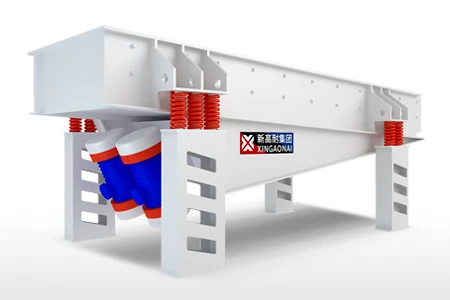
When Should You Consider a Vibrating Feeder Instead?
A belt feeder and an apron feeder are not the only available options.
A vibrating feeder may be considered when:
Material is free-flowing
Controlled forward movement can be produced through vibration
Primary scalping is required
The application suits a trough or grizzly arrangement
Direct extraction through a flexible belt is unnecessary
Severe chain-and-pan construction is unnecessary
The choice between belt, apron and vibrating feeders should be based on material behavior and plant requirements rather than equipment familiarity.
Practical Feeder Selection Matrix
| Application Condition | Preferred Starting Point |
|---|---|
| Fine or processed material requiring gravimetric control | Belt feeder |
| Crushed material under a controlled surge bin | Belt feeder |
| Large, sharp run-of-mine ore | Apron feeder |
| Severe direct loading impact | Apron feeder |
| Primary crusher feed from a heavy-duty hopper | Apron feeder |
| Hot material beyond the selected belt’s limit | Apron feeder |
| Free-flowing material with possible pre-screening | Vibrating feeder |
| Long-distance transportation | Belt conveyor rather than a feeder |
| Sticky material | Requires application-specific flow evaluation |
| Highly variable bulk density with mass-flow requirements | Weighed belt feeder or additional measurement system |
| Very limited structural capacity | Belt or vibrating feeder may be easier to accommodate |
| Frequent oversized lumps | Apron feeder, with correctly designed hopper and pan width |
This matrix is intended for preliminary screening. It does not replace engineering calculations.
How to Choose Between a Belt Feeder and an Apron Feeder
Use the following selection process before requesting a quotation.
Step 1: Define the Material
Record:
Material name
Maximum lump size
Typical size distribution
Bulk density range
Moisture content
Clay content
Abrasiveness
Particle shape
Material temperature
Tendency to bridge or compact
Step 2: Define the Loading Method
Specify whether the hopper is filled by:
Truck
Wheel loader
Excavator
Conveyor
Crusher
Stockpile reclaim system
Another feeder
Also provide the expected material drop height and maximum surge load.
Step 3: Define the Required Capacity
Provide:
Normal capacity
Peak capacity
Minimum required feed rate
Required turndown range
Whether mass-flow measurement is required
Expected bulk-density variation
Step 4: Define the Hopper Interface
Provide:
Hopper-outlet width
Hopper-outlet length
Hopper-wall angles
Liner material
Material head
Skirt length
Available drawings
The feeder and hopper must be designed as a connected system.
Step 5: Define the Plant Layout
Confirm:
Required feeder length
Horizontal or inclined installation
Available installation space
Discharge height
Foundation and structural limits
Maintenance access
Lifting access
Downstream equipment
Step 6: Evaluate Maintenance Risk
Compare the consequences of:
Belt damage
Chain wear
Pan damage
Sprocket replacement
Material carryback
Spillage
Component lead time
Planned shutdown duration
Unplanned production loss
Step 7: Compare Lifecycle Cost
Request quotations that clearly state:
Equipment scope
Drive specification
Wear-part materials
Control system
Structural requirements
Spare-parts package
Installation support
Documentation
Exclusions
For apron feeder projects, the apron feeder design and sizing guide explains the information needed for capacity, width and drive selection.
Application Examples
Primary Crusher Feed
A hopper receives large, irregular rock from trucks or loaders. The material is abrasive and produces heavy impact.
Likely choice: Apron feeder.
The steel pans, chains and heavy-duty support system are better suited to severe primary feeding conditions.
Crushed Ore Under a Surge Bin
Material has already passed through primary crushing. Lump size is controlled, and the plant requires a stable measured feed rate to the next process.
Likely choice: Belt feeder.
A weighing system can be incorporated if gravimetric control is required.
Coal or Fine Bulk Material
The material is relatively uniform and must be extracted continuously from a bin with limited spillage.
Likely choice: Belt feeder, subject to fire, dust, moisture and flow requirements.
Hot or Sharp Material
The material temperature or particle shape could damage a conventional rubber belt.
Likely choice: Apron feeder, provided the chains, bearings, lubrication and surrounding structure are designed for the temperature.
Free-Flowing Aggregate With Scalping Requirements
The plant needs controlled feeding and wants to remove smaller particles before the crusher.
Likely choice: Vibrating feeder with an appropriate grizzly section.
Information Required for a Feeder Recommendation
Send the following information to the equipment supplier:
Material name
Maximum feed size
Particle-size distribution
Bulk density range
Moisture content
Abrasiveness
Material temperature
Normal capacity
Peak capacity
Required feed-control accuracy
Hopper-outlet dimensions
Material head above the feeder
Loading equipment
Material drop height
Required feeder length
Installation angle
Downstream equipment
Site voltage and frequency
Ambient conditions
Plant or hopper drawing
A qualified apron feeder manufacturer should review this information before confirming the machine configuration.
Conclusion
The belt feeder vs apron feeder decision should be based on the material and loading conditions, not on capacity alone.
Choose a belt feeder when the material is relatively controlled, smooth handling is important or accurate gravimetric feeding is required.
Choose an apron feeder when the application involves large lumps, sharp or abrasive material, high hopper pressure, severe impact or heavy-duty primary feeding.
Before final selection, evaluate maximum lump size, material behavior, hopper geometry, starting load, required control accuracy, installation structure and lifecycle cost as one connected system.
For an apron feeder recommendation, send XINGAONAI the material data, required capacity, maximum feed size and hopper or plant layout. This allows the feeder configuration to be evaluated against the actual operating conditions.