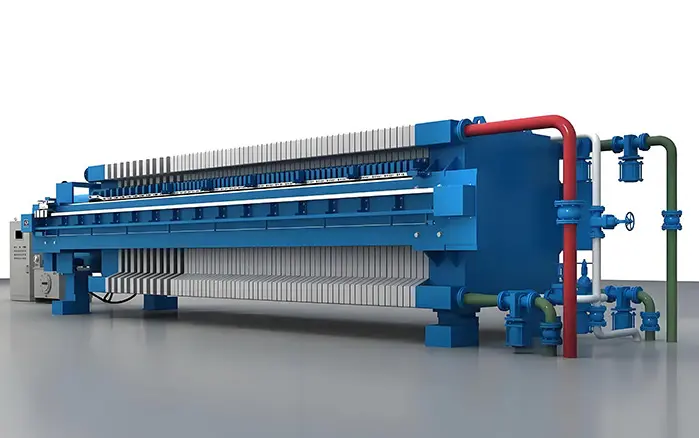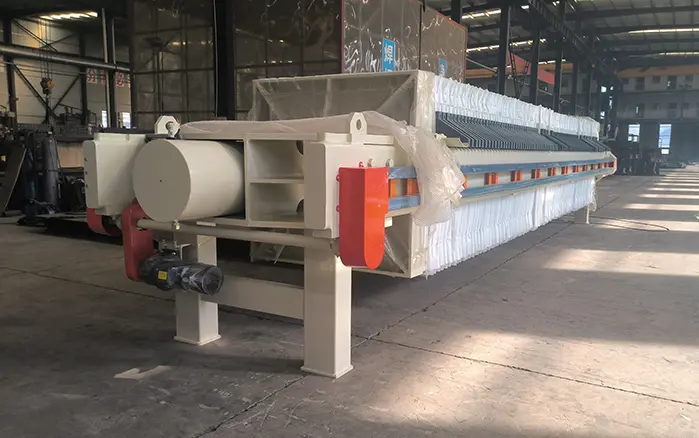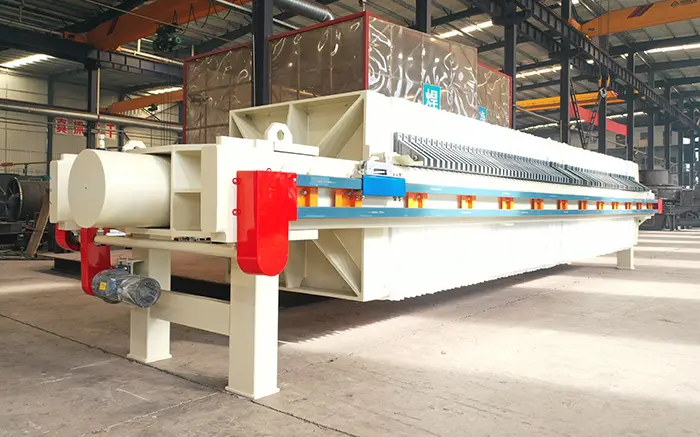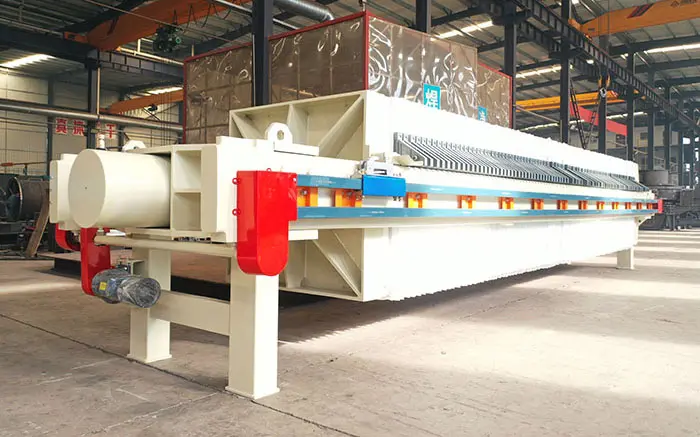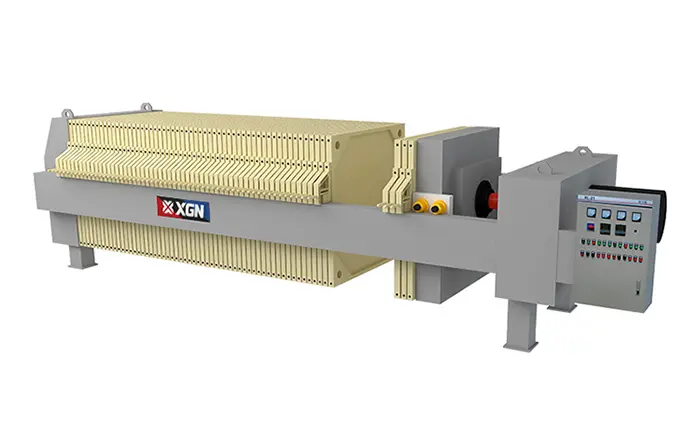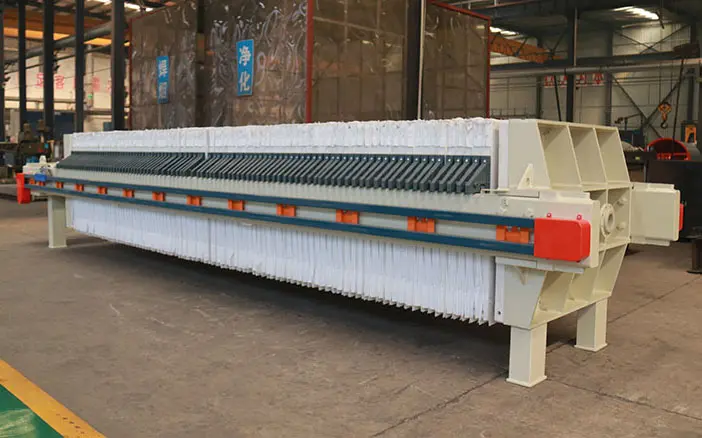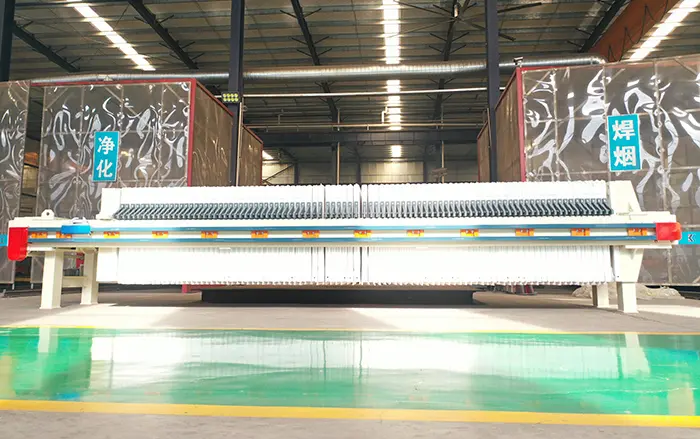
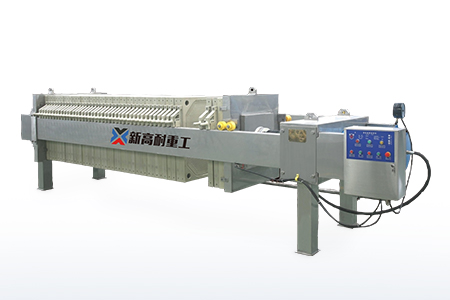
A plate and frame filter press offers flexible filter-cloth selection, defined cake-chamber volume and reliable batch solid-liquid separation. Its main limitations are batch operation, manual work on basic models, sensitivity to filter-cloth condition and potentially long filtration cycles for fine or viscous slurries.
Whether it is the right filtration equipment depends on the slurry properties, required dry-solids throughput, target filtrate quality, desired cake condition, available labor and permitted cycle time. Its advantages should therefore be evaluated under actual process conditions instead of relying on universal capacity, cake-moisture or filtration-accuracy claims.
XINGAONAI supplies an industrial Plate and Frame Filter Press for mineral concentrates, tailings, coal slime and industrial-slurry dewatering.
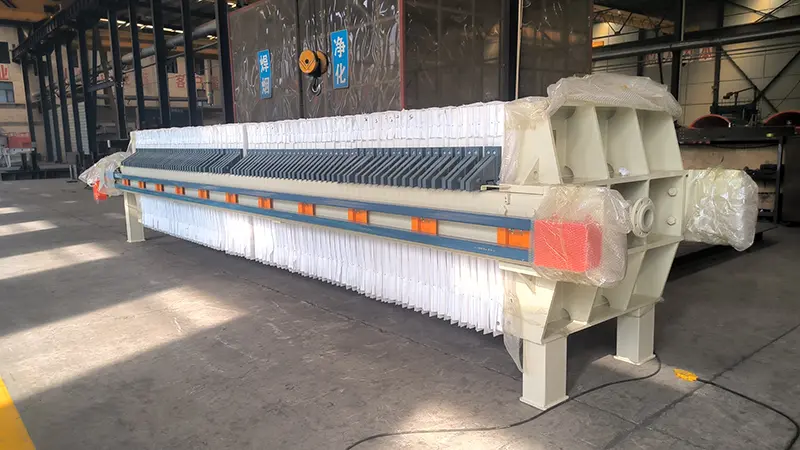
Advantages and Disadvantages at a Glance
| Factor | Potential advantage | Possible limitation |
|---|---|---|
| Filtrate quality | Filter cloth can be selected for the required solid retention | Damaged or unsuitable cloth can cause cloudy filtrate |
| Cake formation | Hollow frames provide a defined cake volume | Fine or thick cakes may extend the filtration cycle |
| Operation | Relatively simple batch-filtration sequence | Opening and cake discharge create non-filtration time |
| Flexibility | Plate, frame and cloth materials can be configured | Chemical and temperature compatibility must be verified |
| Maintenance | Main filtration components are accessible | Cloth cleaning and replacement can require labor |
| Automation | Hydraulic closing and plate shifting may be available | Higher automation increases investment and complexity |
| Capacity | Machine size can be matched to a defined batch duty | The machine does not provide truly continuous filtration |
| Process visibility | Open filtrate outlets allow visual monitoring when fitted | Operators must regularly observe flow and clarity |
How a Plate and Frame Filter Press Works
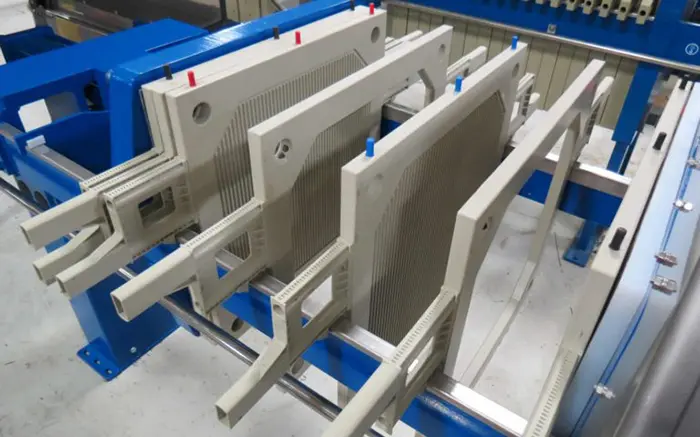
A plate and frame filter press consists of alternating filter plates and hollow frames, with filter cloth installed between each plate and frame.
The closing system compresses the plate pack. A feed pump then delivers slurry into the hollow frames and creates the pressure required for filtration. Liquid passes through the filter cloth and drainage grooves, while solid particles remain inside the frames and form filter cakes.
When the selected filtration endpoint is reached, the feed pump stops, pressure is released, and the plates and frames open for cake discharge.
The hydraulic closing system holds the plate pack closed. It does not directly force liquid through the filter cloth. For a detailed process explanation, see the plate and frame filter press working principle.
Advantages of a Plate and Frame Filter Press
1. Flexible Filter-Cloth Selection
One of the main advantages of a plate and frame filter press is the ability to select filter cloth according to the process requirements.
Important cloth-selection factors include:
Particle-size distribution
Required filtrate clarity
Slurry pH
Operating temperature
Chemical compatibility
Cake-release characteristics
Cleaning method
Filtration-cycle requirements
Polypropylene, polyester, nylon and other materials may be considered depending on the application. The weave and permeability of the cloth also affect solid retention and filtrate flow.
A finer filtration medium may improve filtrate clarity but increase resistance and extend the filtration cycle. Cloth selection therefore requires a balance between clarity, throughput, cake release and service life.
A guaranteed particle-retention or suspended-solids value should be based on testing with a representative slurry.
2. Defined Cake-Chamber Volume
Separate hollow frames create the spaces in which filter cakes form. Frame thickness and the number of chambers determine the available cake volume per cycle.
This makes it possible to configure a press according to:
Required batch volume
Expected cake thickness
Slurry solids concentration
Daily dry-solids throughput
Planned number of cycles
Cake-discharge requirements
A thicker frame holds more solids per cycle, but the cake may require more time to form and may retain more liquid. A thinner frame may shorten the filling cycle but require more frequent cake discharge.
The correct frame thickness should therefore be determined from filtration performance rather than capacity alone.
3. Visible Filtrate Monitoring
When the press uses an open-filtrate configuration, operators can observe the flow and clarity from individual outlets.
This can help identify:
A damaged filter cloth
Incorrect cloth installation
Uneven chamber filling
A blocked filtrate channel
Abnormal flow from one plate-and-frame section
Visible monitoring can be useful in processes where operators need to locate the source of cloudy filtrate.
Not every machine uses an open-filtrate arrangement. Closed-filtrate collection may be selected when the liquid must be contained, collected in a pipe or protected from exposure.
4. Accessible Filtration Components
Once the press is safely depressurized and opened, the main filtration components are accessible for inspection and cleaning.
Operators can inspect:
Filter plates
Hollow frames
Filter cloths
Sealing surfaces
Feed ports
Drainage grooves
Filtrate outlets
Accessibility can simplify routine inspection and component replacement. However, accessible components do not automatically mean low maintenance cost. Cleaning and cloth replacement may still require significant labor, especially on large manual presses.
5. Configurable Materials
Plates, frames, filter cloths, piping and structural surfaces may be configured according to the slurry and operating environment.
Selection considerations include:
Acidity or alkalinity
Solvent exposure
Abrasive solids
Slurry temperature
Cleaning chemicals
Mechanical loading
Contamination requirements
Material compatibility must be confirmed for the complete system. Selecting a chemically resistant filter cloth alone is not sufficient if the plates, frames, seals, pipes or pumps are unsuitable for the same slurry.
6. Optional Automation
Depending on the machine configuration, automation may include:
Hydraulic plate closing
Automatic pressure control
Automatic plate shifting
Filtrate-flow monitoring
Cloth washing
Drip trays
Cake conveyors
Process alarms
Automation can reduce manual work and shorten non-filtration time. Its value depends on cycle frequency, cake-release characteristics and the operator’s requirements.
Sticky cakes may still require manual assistance even when an automatic plate shifter is installed. Automation should therefore be selected according to actual material behavior.
7. Suitable for Batch Product Recovery
A plate and frame filter press can be useful when the solid cake is the valuable product or when each batch must be handled separately.
Possible duties include:
Mineral concentrate filtration
Recovery of chemical solids
Pigment and ceramic slurry filtration
Coal-slime dewatering
Selected industrial-sludge applications
The product can also be useful when operators need to inspect the cake or filtrate from individual batches.
For application-specific considerations, see the guide to plate and frame filter press applications.
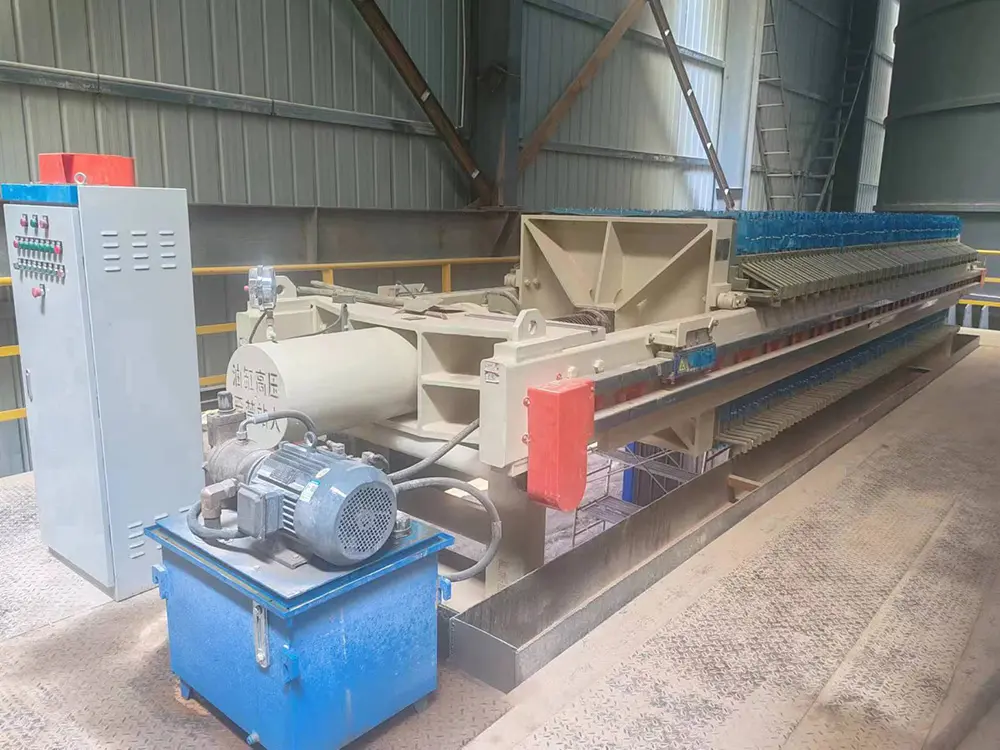
Disadvantages of a Plate and Frame Filter Press
1. Batch Operation
A plate and frame filter press operates in cycles rather than continuously.
A complete cycle normally includes:
Closing the plate-and-frame pack
Feeding slurry
Forming the filter cake
Stopping the feed
Releasing pressure
Opening the press
Discharging the cake
Inspecting or cleaning the cloth
Closing the press for the next batch
No filtration occurs during depressurization, opening, cake discharge and preparation for the next batch. This non-filtration time reduces the number of cycles that can be completed per day.
High-throughput applications may require:
A larger press
More filter area
Shorter cycle times
Automated plate shifting
Surge tanks
Multiple presses operating in parallel
Batch operation does not mean the equipment is unsuitable for large plants, but the complete filtration system must be sized for the required daily throughput.
2. Labor Requirements
Manual machines require operators to:
Open the press
Separate plates and frames
Remove filter cakes
Inspect filter cloths
Clean sealing surfaces
Reassemble the plate pack
Automatic plate shifting can reduce this work, but it may not eliminate manual intervention. Sticky, soft or incompletely formed cakes may remain attached to the cloth.
Labor requirements should be estimated from:
Number of cycles per shift
Number and size of plates and frames
Cake-release behavior
Cloth-cleaning frequency
Automation level
Site safety procedures
3. Sensitivity to Filter-Cloth Condition
Filter cloth is central to filtration performance.
Cloth that is damaged, blinded, folded or incorrectly installed can cause:
Cloudy filtrate
Reduced filtrate flow
Longer cycle times
Leakage between plates and frames
Uneven cake formation
Difficult cake release
Cloth life varies with slurry abrasiveness, chemical compatibility, pressure, cleaning practices and daily cycle frequency. It should not be estimated using a universal number of months.
For symptom-based inspection guidance, see the plate and frame filter press troubleshooting guide.
4. Long Filtration Cycles for Difficult Slurries
Fine, compressible or viscous solids can form a cake with high resistance to liquid flow.
This may cause:
Slow filtrate flow
Long chamber-filling time
Extended filtration cycles
High residual cake moisture
Reduced daily throughput
The result may be improved through suitable cloth selection, slurry pretreatment or process adjustment. However, not every slurry can be made economical in a plate and frame press.
Representative filtration testing is recommended when the material contains:
Very fine particles
Highly compressible solids
Sticky solids
High viscosity
Unusual chemical properties
A wide particle-size distribution
Diluting the slurry is not automatically a solution. Although dilution may reduce viscosity, it also increases the amount of liquid that must pass through the press.
5. Leakage Risk
Leakage can occur between plates and frames if the sealing system is not in good condition.
Common causes include:
Cake residue on sealing surfaces
Misaligned plates or frames
Wrinkled cloth
Incorrect cloth installation
Damaged filtration components
Insufficient closing force
Excessive feed pressure
Blocked feed or filtrate channels
The plate pack must be correctly aligned and compressed before slurry feeding begins. Operators must also keep the sealing surfaces clean.
6. Space and Access Requirements
The installation must provide space for:
The press frame
Hydraulic or mechanical closing equipment
Feed piping
Filtrate piping
Plate-and-frame opening
Cake discharge
Cloth replacement
Maintenance access
Cake collection equipment
The press may also require a collection tray, cake conveyor or floor opening below the discharge area.
It is not accurate to claim that a plate and frame press is always larger or smaller than a membrane press. Installation space depends on filter area, plate size, opening arrangement and automation configuration.
7. Capacity Cannot Be Determined from Filter Area Alone
Filter area is an important specification, but it does not determine actual throughput by itself.
Capacity is also affected by:
Total frame volume
Slurry solids concentration
Cake density
Filtration time
Feed-pump performance
Cloth permeability
Cake discharge time
Number of cycles per day
Two presses with the same filtration area can deliver different dry-solids throughput when processing different slurries.
A reliable capacity estimate requires process data and, where necessary, laboratory or pilot testing.
8. Standard Pressure Filtration May Not Meet Every Cake-Moisture Target
A standard plate and frame filter press removes liquid using feed-pump pressure. It does not include the additional cake-squeezing stage used in a membrane filter press.
If very low cake moisture is required, standard filtration may not achieve the target economically.
Possible alternatives include:
Longer filtration time
Air blowing, if compatible with the equipment and process
Slurry pretreatment
A membrane filter press
Thermal drying after filtration
A different dewatering technology
The correct option depends on the slurry and the economic value of removing additional moisture.
Plate and Frame vs Membrane Filter Press
| Factor | Plate and Frame Filter Press | Membrane Filter Press |
|---|---|---|
| Cake chamber | Formed by separate hollow frames between plates | Formed using recessed and flexible membrane plates |
| Filtration type | Batch | Batch |
| Initial filtration | Feed-pump pressure | Feed-pump pressure |
| Additional squeezing | Normally not included | Membranes apply additional pressure after initial filtration |
| Cake thickness | Mainly determined by frame thickness | Determined by chamber and membrane design |
| Cake moisture | Depends on slurry and operating cycle | May be reduced further for suitable slurry |
| Mechanical complexity | Relatively simple filtration structure | Additional membrane and squeeze-control system |
| Maintenance focus | Cloths, plates, frames and closing system | Cloths, plates, membranes and squeeze system |
| Typical reason to select | Standard pressure filtration meets the process target | Additional dewatering justifies the added equipment |
A membrane filter press is not a continuous machine. It still operates in batches.
It also does not automatically provide a better result for every slurry. The benefit of membrane squeezing depends on cake compressibility, initial filtration performance and the value of removing additional liquid.
When a Plate and Frame Filter Press Is a Good Fit
Consider a plate and frame filter press when:
Batch filtration is acceptable.
The slurry forms a filterable and releasable cake.
Flexible filter-cloth selection is important.
Individual filtrate monitoring is useful.
The required throughput can be achieved within the available cycles.
The process benefits from defined frame volume.
The selected materials are compatible with the slurry.
Standard pressure filtration can meet the cake requirement.
When to Consider Another Dewatering Method
Another filtration or dewatering technology may be more suitable when:
The process requires genuinely continuous operation.
The solids form an extremely compressible cake.
The cake adheres strongly to the filter cloth.
Filtration time is too long for the required throughput.
Manual cake discharge is unacceptable.
The target cake moisture cannot be reached by standard pressure filtration.
The slurry chemistry or temperature exceeds the available material limits.
The value of additional liquid removal justifies membrane squeezing or thermal drying.
Information Required for Equipment Selection
Before selecting a filter press, provide:
Slurry name and chemical composition
Solids concentration
Particle-size distribution
Slurry temperature
Slurry pH
Required dry-solids throughput
Required operating hours per day
Target filtrate quality
Target cake condition or moisture
Available installation space
Preferred manual or automatic operation
Available utilities and power supply
A representative slurry sample may be required when throughput or cake condition must be guaranteed.
Conclusion
The main advantages of a plate and frame filter press are flexible filter-cloth selection, defined cake volume, accessible filtration components and configurable automation. It can provide effective batch separation when the slurry forms a filterable cake and the required throughput fits the available cycle time.
Its principal limitations are batch operation, labor requirements, sensitivity to cloth condition, leakage risk and potentially long cycles for fine or viscous slurries.
The final decision should be based on dry-solids throughput, filtration time, target filtrate quality, cake condition, labor availability and total operating cost—not on universal cake-moisture or filtration-accuracy claims.
Review the available industrial plate and frame filter press models and provide representative slurry data when requesting equipment selection or a performance assessment.