Fluorite is a mineral composed primarily of calcium fluoride (CaF₂). In industrial markets, the commercial mineral product is commonly referred to as fluorspar.
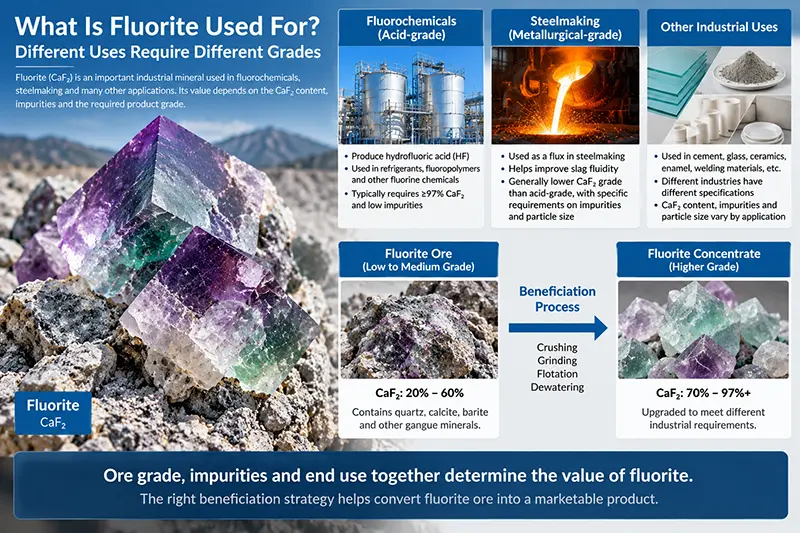
Its industrial importance comes from its role as a source of fluorine and as a functional raw material in several manufacturing processes. Major applications include fluorochemical production, steelmaking, and selected uses in cement, glass, and ceramics.
However, not all mined fluorite ore can enter these markets directly.
The potential use of a fluorite ore depends strongly on its CaF₂ content, impurity composition, and the specifications of the final concentrate. This is why understanding fluorite uses also requires understanding ore grade and product quality.
What Are the Main Uses of Fluorite?
From an industrial perspective, fluorite products can be divided into several broad application groups.
| Fluorite Product | Main Application | Key Quality Concern |
|---|---|---|
| Acid-grade fluorspar | Hydrofluoric acid and fluorochemicals | High CaF₂ and strict impurity control |
| Metallurgical-grade fluorspar | Steelmaking and metallurgical flux | CaF₂, impurities and particle size |
| Other industrial grades | Cement, glass, ceramics and related uses | Application-specific specifications |
The distinction matters because different industries do not require exactly the same fluorite product.
Fluorite for Hydrofluoric Acid and Fluorochemicals
One of the most important applications of high-grade fluorspar is the production of hydrogen fluoride, commonly referred to as hydrofluoric acid in aqueous form.
Hydrogen fluoride is an important intermediate for many inorganic and organic fluorine compounds.
Acid-grade fluorspar generally requires a high CaF₂ content, commonly around 97% or higher. However, CaF₂ percentage alone does not determine whether a concentrate meets an acid-grade specification.
Silica, calcium carbonate and other impurities may also need to remain within specified limits.
Therefore:
A high CaF₂ grade does not automatically mean that a fluorite concentrate qualifies as acid grade.
The complete product specification matters.
Fluorite as a Metallurgical Flux
Fluorspar also has a long history of use as a flux in steelmaking and other metallurgical operations.
Products intended for these applications are commonly classified as metallurgical-grade fluorspar.
Compared with acid-grade material, metallurgical products can generally use lower CaF₂ grades. But it would be misleading to classify every product below 97% CaF₂ as metallurgical grade.
Particle size and impurity levels may also affect whether the product meets a particular buyer's requirements.
For a fluorite project, the better approach is therefore:
Target Market → Product Specification → Processing Target
rather than choosing a processing target based only on a general grade category.
What Are the Other Industrial Uses of Fluorite?
Fluorite can also be used in cement, glass, ceramics, enamel, welding materials and other industrial applications.
These markets may have different requirements for CaF₂, silica, calcium carbonate, iron and particle size.
This means fluorite use should not be determined from CaF₂ percentage alone.
A more useful relationship is:
End Use → Required Product Quality → Acceptable Concentrate Specification
This distinction becomes especially important when evaluating whether a particular ore can be converted into a saleable product.
What Does Fluorite Ore Grade Mean?
It is important to distinguish between ore grade and concentrate grade.
Ore grade describes the fluorite content of the material entering the processing plant. The remaining material may consist of quartz, calcite, barite and other gangue minerals.
Concentrate grade describes the quality of the fluorite-rich product after beneficiation.
Crushing, grinding and separation do not create CaF₂. Instead, processing removes part of the gangue and concentrates the fluorite already present in the ore.
Therefore, a market requirement for high-grade concentrate does not mean that the run-of-mine ore must naturally have the same CaF₂ content.
The more useful question is:
Can this ore be technically and economically upgraded to the required product specification?
For a broader explanation of how fluorite is upgraded, see the Fluorite Beneficiation Process.
Why Does Fluorite Ore Grade Matter?
Ore grade indicates how much fluorite is present relative to gangue.
If two ores are intended to produce similar concentrate specifications, a lower-grade ore generally requires more gangue to be rejected per unit of fluorite product.
However, this does not mean that every low-grade ore is difficult to process or that every high-grade ore is easy to process.
Mineralogy and liberation can be equally important.
A relatively high-grade ore in which fluorite is finely intergrown with calcite may present a difficult selective separation problem. A lower-grade ore with favorable liberation characteristics may behave differently.
Ore evaluation should therefore consider:
CaF₂ Grade + Gangue Mineralogy + Liberation + Target Product Specification
rather than CaF₂ grade alone.
Why Are Impurities as Important as CaF₂ Grade?
Consider two concentrates that both contain more than 97% CaF₂.
They may still have different commercial value.
The reason is the composition of the remaining material.
Silica and calcium carbonate are particularly important impurities in many high-grade fluorite products. Other impurities may also be restricted depending on the final application.
A more complete concentrate evaluation therefore considers:
CaF₂ + SiO₂ + CaCO₃ + Other Impurities + Moisture + Particle Size
This also explains why two deposits with similar CaF₂ grades may require different beneficiation targets.
Does Higher Fluorite Grade Always Mean Higher Value?
Increasing CaF₂ grade can help a concentrate meet a higher-value market specification, but higher grade does not always translate directly into higher economic value.
Producing an additional increase in concentrate purity may require finer liberation, additional cleaning stages, tighter process control or sacrificing part of the fluorite recovery.
If the additional processing cost or recovery loss exceeds the value gained from the higher product grade, maximizing CaF₂ may not be the most economical strategy.
The objective should therefore not simply be:
Produce the highest possible CaF₂ grade.
A more practical target is:
Produce a marketable fluorite concentrate at an economically reasonable recovery.
How Does Ore Grade Affect Fluorite Processing Decisions?
Ore grade is one input into process design, but it should always be evaluated together with gangue mineralogy.
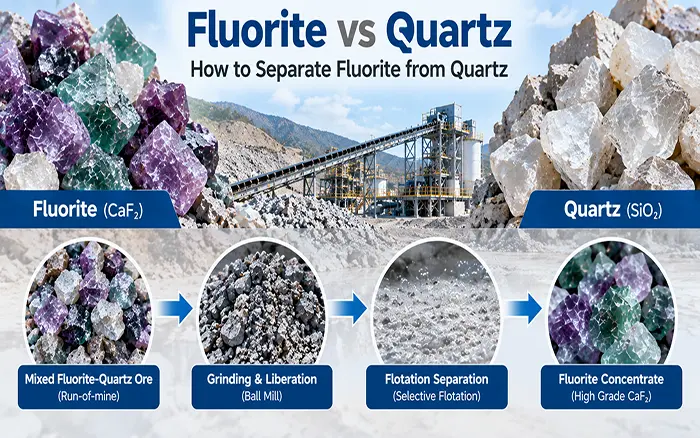
For quartz-rich fluorite ore, mineral liberation and selective removal of silica become important. The detailed separation problem is discussed in Fluorite vs Quartz: How to Separate Fluorite from Quartz.
For calcite-rich ore, the challenge can shift toward selective separation between two calcium-bearing minerals. See Fluorite vs Calcite: How to Separate Them by Flotation.
The relationship can therefore be summarized as:
Ore Grade → Mineralogy → Product Specification → Beneficiation Target
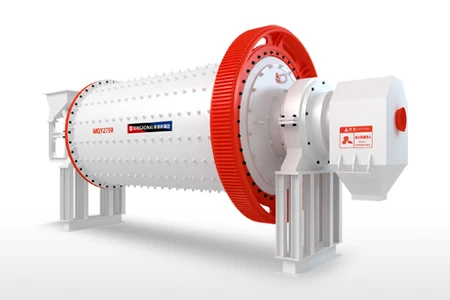
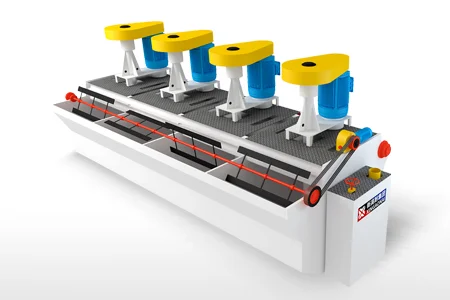
The actual crushing, grinding, flotation and dewatering equipment should then be selected according to the ore characteristics, flowsheet and capacity requirements. For a detailed discussion of how these sections are combined into a complete production system, see Fluorite Processing Plant: Design & Equipment Configuration.
Ore Grade Matters Because the End Product Matters
The intended use of fluorite ultimately determines what product quality the market requires.
Fluorochemical applications generally demand high-purity acid-grade material. Metallurgical applications have different grade, impurity and sizing requirements, while other industrial users may follow their own specifications.
Therefore, evaluating fluorite ore should go beyond one question:
How much CaF₂ does the ore contain?
It should also ask:
What are the main gangue minerals?
What product specification must be achieved?
Can the ore reach that specification economically?
These questions connect fluorite uses, ore grade and concentrate quality much more effectively than CaF₂ percentage alone.