In mining, metallurgy, construction, chemical processing, and manufacturing, bulk materials must be moved from storage bins or hoppers to downstream equipment like crushers, screens, or conveyors. The equipment that handles this critical first step is the vibrating feeder. Understanding the vibrating feeder working principle helps operators select the right equipment, optimize production, and reduce maintenance costs. This guide explains how vibrating feeders work, their key components, different types, applications, and selection criteria.
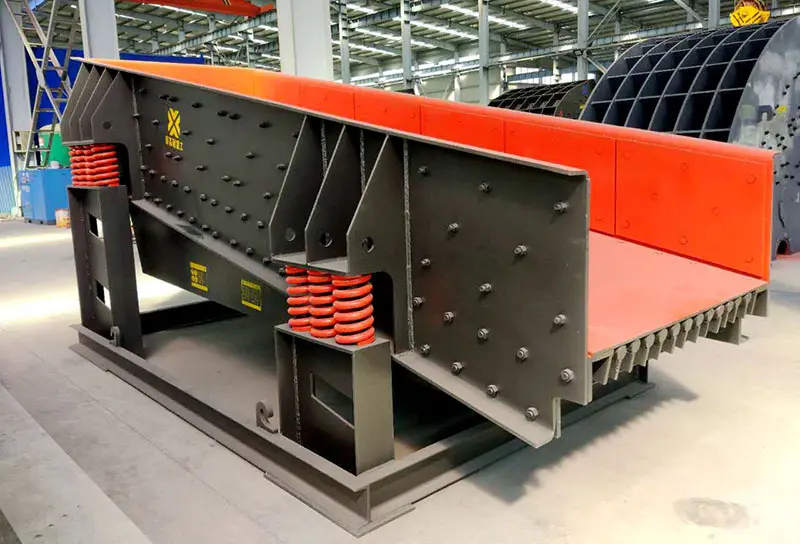
What Is a Vibrating Feeder?
A vibrating feeder is a mechanical device that transports bulk materials from a storage hopper or bin to downstream equipment using controlled vibration. It provides a stable, continuous flow of material, which is essential for preventing blockages and ensuring that crushers and screens operate efficiently.
Unlike belt feeders or apron feeders that rely on mechanical dragging, vibrating feeders use oscillation to create a fluid-like motion in the material, allowing for precise flow control. When activated, the feeder trough vibrates at a specific frequency and amplitude, moving the material forward in a series of small hops.
Vibrating Feeder Working Principle
The vibrating feeder working principle is based on generating controlled vibrations that cause material to move along a trough or tray. Here is a step-by-step explanation.
1. Vibration Generation
A vibration source—either an electromagnetic drive or one or more unbalanced motors—produces oscillatory forces at a specific frequency and amplitude. In electromagnetic feeders, an electromagnet pulls a spring-mounted trough toward it at mains frequency (50 or 60 Hz). When the current alternates, the magnet releases, and the springs return the trough. In motor-driven feeders, one or two electric motors with unbalanced weights create centrifugal force as they rotate, generating vibration that is transmitted to the trough.
2. Material Movement
The vibration is transmitted to the trough, which is mounted on springs or resilient mounts that allow it to move freely while isolating vibration from the supporting structure. As the trough vibrates, the material inside is subjected to a series of small, rapid movements. During each vibration cycle, the trough accelerates forward and then returns. The material, due to its inertia, tends to stay in place during the forward acceleration but is thrown slightly forward during the return stroke. This "micro-throwing" action moves the material along the trough toward the discharge end.
3. Flow Control
One of the most valuable aspects of the vibrating feeder working principle is the ability to precisely control material flow. By adjusting the intensity of the vibration (amplitude) or the frequency, operators can increase or decrease the feed rate in real time. Electromagnetic feeders achieve this by varying the voltage supplied to the electromagnet, which changes the amplitude of vibration. Motor-driven feeders adjust feed rate by altering motor speed or the angle of the unbalanced weights, which changes the centrifugal force and thus the vibration intensity.
Key Components of a Vibrating Feeder
Several components work together to ensure the vibrating feeder working principle operates efficiently.
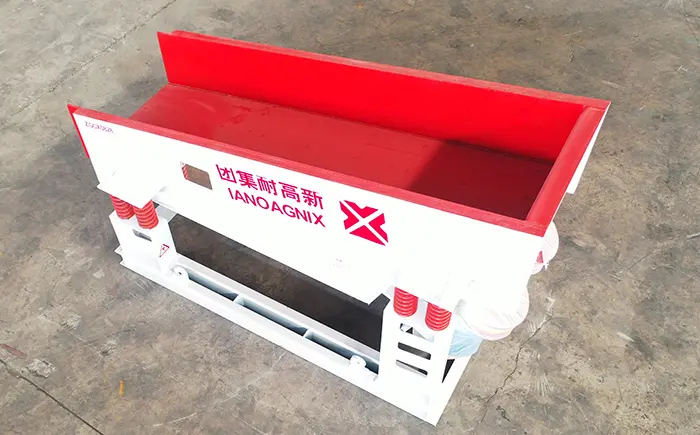
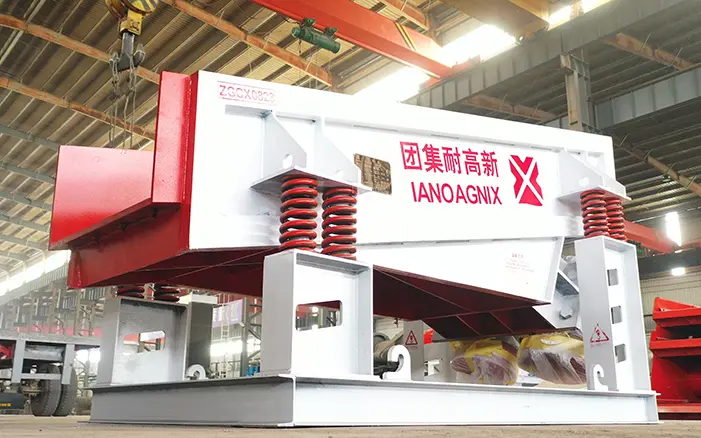
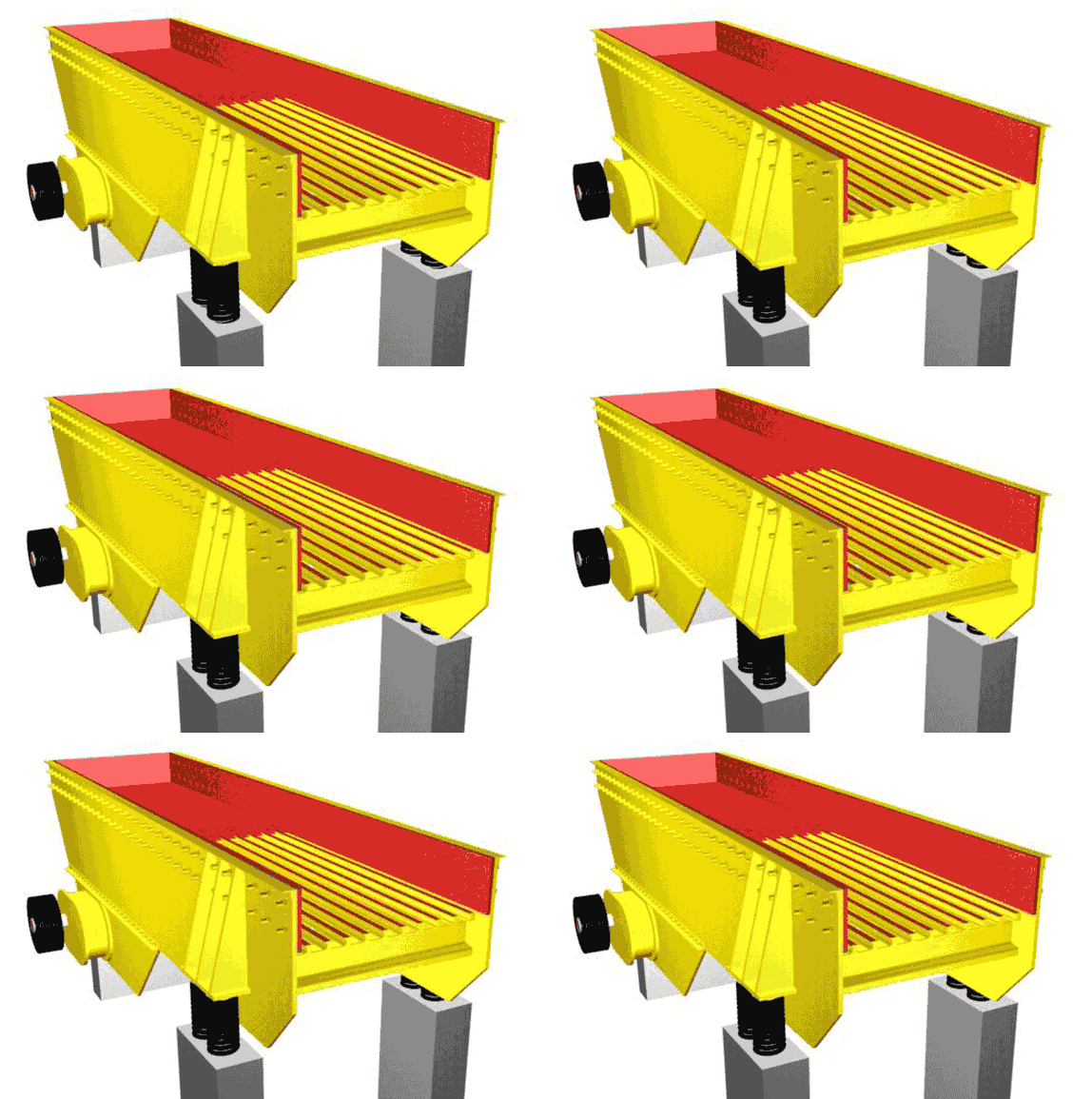
Feeder Trough (Pan or Tray): The material-carrying surface. It can be made of carbon steel, stainless steel, or abrasion-resistant materials. The trough may be open or enclosed to contain dust.
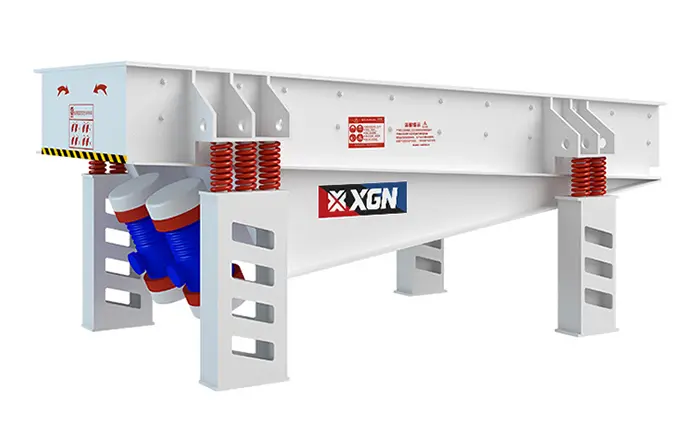
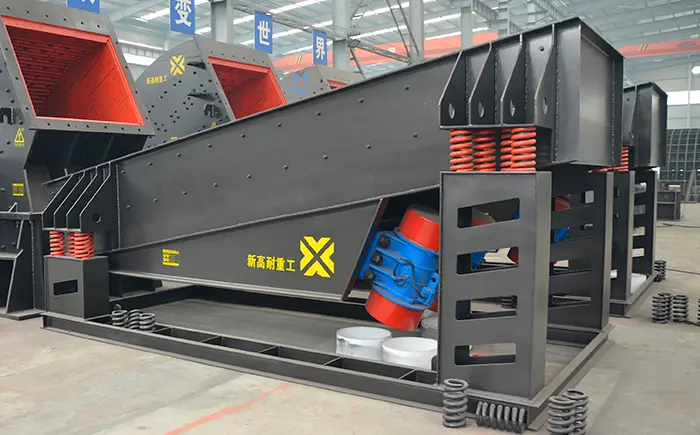
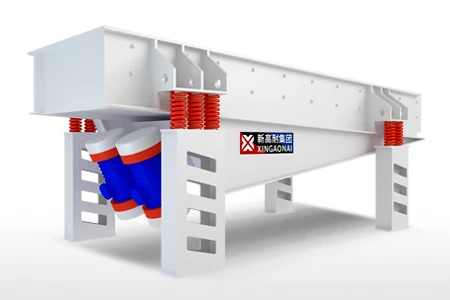
Vibration Source (Exciter/Motor): Generates the vibration force. This can be an electromagnetic drive (with a coil, magnet, and flat springs) or one or more electric motors with unbalanced weights.
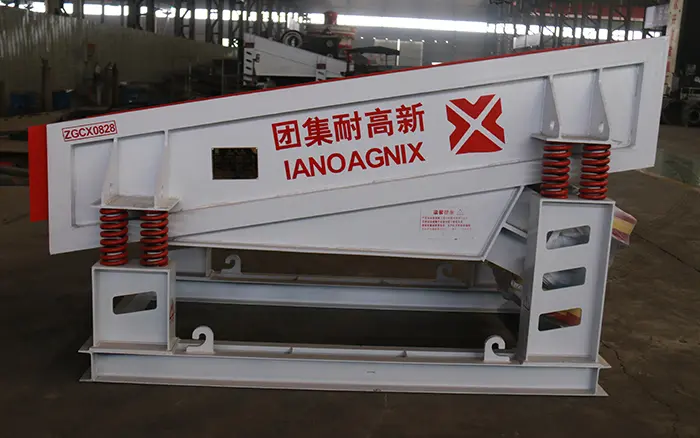
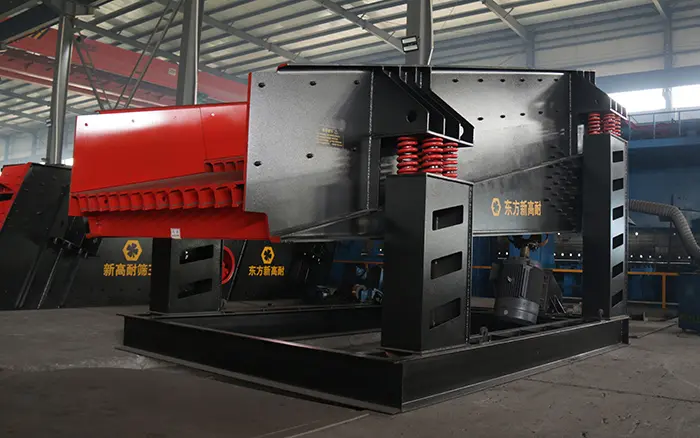
Springs or Resilient Mounts: Support the trough and allow it to vibrate freely while isolating vibration from the supporting structure. Common spring types include coil springs, rubber springs, and leaf springs. They are tuned to work with the exciter to achieve optimal vibration.
Controller (for electromagnetic feeders): Adjusts vibration intensity and feed rate. It accepts a 4-20mA feedback signal for automated flow control in larger plants.
Base Frame: The stationary support structure that holds the entire assembly and is anchored to the floor or foundation.
Types of Vibrating Feeders
While the fundamental vibrating feeder working principle is consistent, there are several distinct types designed for different applications.
Electromagnetic Vibrating Feeders
These operate at high frequencies (3,000–3,600 vibrations per minute) and use electromagnets to generate vibration. They offer precise control and are ideal for free-flowing materials in the chemical, food, and pharmaceutical industries. Their compact design makes them suitable for tight spaces.
Motor-Driven (Unbalanced Motor) Vibrating Feeders
These use one or two motors with unbalanced weights. Single-motor designs produce circular motion, while two-motor designs (with motors rotating in opposite directions) produce linear motion. These feeders are robust and well-suited for heavy-duty applications such as mining and aggregate processing, where they handle large volumes of abrasive materials.
Natural Frequency (Resonance) Feeders
These feeders operate at or near the natural frequency of the spring system, achieving high amplitudes with relatively low energy input. The tuned spring system stores and releases energy with each cycle, consuming very little electric power. They are ideal for applications requiring gentle material handling, such as food products or fragile materials.
Vibrating Grizzly Feeders
These combine the functions of feeding and scalping into one unit. They have a pan section at the feed end and a grizzly bar section at the discharge end. As material travels toward the grizzly bars, finer particles settle to the bottom and pass through the openings, bypassing the crusher. This reduces the amount of material entering the crusher, lowering wear and energy consumption.
Vibrating Feeder vs. Other Feeder Types
When selecting a feeder, it is helpful to understand how vibrating feeders compare to other common types.
Vibrating Feeder vs. Belt Feeder
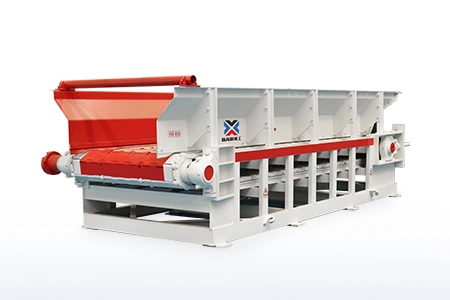
Belt feeders use a continuous belt (rubber, PVC, or metal) driven by pulleys. Vibratory feeders are more precise, have lower maintenance, and are more energy-efficient for small to medium-sized materials. Belt feeders are better for larger, heavier, or abrasive materials and longer conveying distances.
Vibrating Feeder vs. Apron Feeder
Apron feeders consist of cast manganese pans bolted to a dozer-style chain and are built to withstand extreme impact loading, handling very hard, abrasive, and large lumps. Vibrating feeders are gentler, more precise, and have a lower initial cost, but apron feeders offer superior durability for the toughest primary applications.
Common Applications of Vibrating Feeders
The efficiency of the vibrating feeder working principle makes these machines suitable for a wide range of industries.
Mining and Quarrying: Feeding run-of-mine material to primary crushers, often with grizzly sections to remove fines before crushing.
Aggregates and Sand Production: Feeding sand, gravel, and crushed stone to screens, crushers, and washing plants.
Food and Pharmaceutical Processing: Metering ingredients, feeding packaging lines, and handling delicate products without damage.
Recycling and Waste Management: Handling construction and demolition waste, scrap metal, and glass cullet.
Chemical and Cement Industries: Feeding powders and granules to mixers, mills, and packaging equipment with precise control.
Factors Affecting Vibrating Feeder Performance
Understanding the vibrating feeder working principle is only part of the equation. Several factors influence performance and should be considered when selecting a feeder.
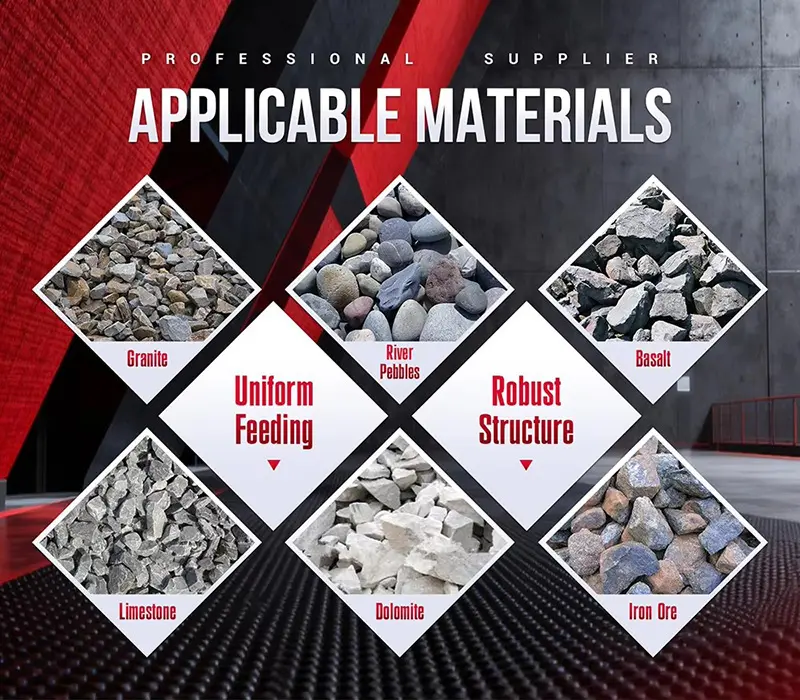
Material Characteristics: Bulk density, particle size and shape, moisture content, and abrasiveness all affect material flow. Wet or sticky materials may require specialized trough liners to prevent clogging. For fragile materials (e.g., flavored food products), too intense a vibration can damage the product or knock off coatings. Vibrating feeders are also excellent for high-temperature materials in heavy-duty applications.
Feed Rate Requirements: The required throughput (tons per hour) determines the size of the trough and the power of the drive unit. Oversizing increases cost and energy consumption, while undersizing creates production bottlenecks.
Installation Considerations: The feeder should be mounted on a structure capable of supporting its weight and isolating vibration from surrounding equipment. Proper hopper outlet and skirt plate design ensure uniform material loading across the trough.
Maintenance and Troubleshooting
Regular maintenance ensures optimal performance. Common issues related to the vibrating feeder working principle include:
Reduced or Low Output. Check for insufficient motor power, loose spring clamps, incorrect voltage, or material blockage. Ensure the vibration motor's power and vibration force meet requirements, and replace or adjust springs to maintain normal amplitude.
No Vibration or Intermittent Operation. This may be due to a blown fuse, short-circuited coil, or control failure. Check fuses, input voltage, and output voltage. If voltage is reaching the feeder coil, inspect the coil for an open circuit.
Material Not Moving Despite Vibration. The trough may be clogged with sticky material, or the installation angle may be too small. Clean the trough promptly, and consider adding wear-resistant liners or anti-stick coatings. Increase the inclination angle appropriately to speed up material flow.
Excessive Vibration Transfer. This indicates worn isolation springs or inadequate mounting. Check suspension and keep the feeder clear of the hopper and all other objects.
Unstable Power Supply. Low or fluctuating voltage weakens motor performance. Stabilize the power supply to keep the feeder working efficiently.
A daily visual inspection routine helps prevent problems. Regularly check amplitude, vibration motor current, and motor surface temperature. Ensure consistent amplitude front-to-back, with no lateral swinging, and stable motor current. Keep the feeder clean with a mild degreaser and lint-free cloth, avoiding abrasive cleaners.
Conclusion
The vibrating feeder working principle is based on generating controlled vibrations that cause material to move along a trough in a series of small hops. By adjusting the amplitude and frequency of these vibrations, operators can precisely control the feed rate. Vibrating feeders offer uniform feeding, low energy consumption, high reliability, and adjustable feed rates. They are essential for handling a wide range of materials, from powders to large bulk solids, in industries such as mining, aggregates, food processing, and chemical manufacturing. Understanding how vibration frequency, amplitude, and direction affect material movement is key to maximizing productivity and equipment lifespan.