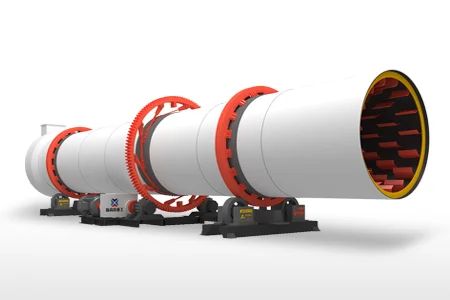
Selecting a rotary dryer manufacturer involves much more than comparing drum diameter, production capacity and equipment price.
A rotary dryer must be designed around the material, required water evaporation rate, heat source, airflow, retention time, dust load and target outlet moisture. If these conditions are not evaluated correctly, even a mechanically well-built dryer may consume excessive fuel, produce inconsistent moisture or become a production bottleneck.
A capable manufacturer should therefore provide both equipment and engineering support. The supplier must understand how the dryer interacts with feeding equipment, the combustion system, exhaust fan, dust collector, discharge conveyor and plant control system.
This guide explains how to evaluate a rotary dryer manufacturer, what information should be included in a quotation and how XINGAONAI configures industrial drying equipment for different bulk materials.
What Should a Rotary Dryer Manufacturer Provide?
A rotary dryer manufacturer should not select equipment from wet-feed capacity alone. The manufacturer should evaluate the complete drying duty and define the conditions under which the required performance can be achieved.
A professional project proposal should normally address:
Processed material
Wet-feed capacity
Dry-solids throughput
Inlet moisture
Target outlet moisture
Required water evaporation rate
Material bulk density
Particle-size distribution
Material stickiness and abrasiveness
Maximum allowable material temperature
Available heat source
Co-current or counter-current airflow
Exhaust-gas volume
Dust collection
Drum dimensions
Retention time
Motor and drive requirements
Installation layout
Control and instrumentation
Required auxiliary equipment
Installation and commissioning scope
The equipment model should be the result of this evaluation—not the starting point.
For buyers who are still comparing drying technologies, the introductory guide what is a rotary dryer explains the basic equipment structure and suitable applications.
XINGAONAI Rotary Dryer Product Range
XINGAONAI manufactures industrial rotary dryers for continuous drying of granular and powdery bulk materials.
The published product range currently covers drum sizes from Φ1.2 × 8 m to Φ3.6 × 28 m.
| Parameter | Published XINGAONAI range |
|---|---|
| Drum specification | Φ1.2 × 8 m to Φ3.6 × 28 m |
| Cylinder volume | 9–285 m³ |
| Published production capacity | 1.9–76.0 t/h |
| Installation slope | 3–5% |
| Published maximum inlet temperature | 700–800°C |
| Main motor power | 7.5–160 kW |
The production-capacity figures in a model table are reference values. Actual capacity depends on the processed material, inlet moisture, target outlet moisture, bulk density, particle size, heat input and operating conditions.
The published maximum inlet temperature is also not automatically the correct operating temperature for every project. Heat-sensitive materials may require substantially lower temperatures. The manufacturer must determine the appropriate gas-temperature profile according to the material and product-quality requirements.
Start with the Water Evaporation Requirement
The most important sizing value is often not the wet-feed capacity. It is the quantity of water that must be removed per hour.
For moisture values expressed on a wet basis:
Dry solids rate = Wet feed rate × (1 − Inlet moisture)
Dried product rate = Dry solids rate ÷ (1 − Outlet moisture)
Water evaporation rate = Wet feed rate − Dried product rate
Example Calculation
Suppose a plant must process 20 t/h of material with:
Inlet moisture: 20%
Target outlet moisture: 5%
The dry-solids rate is:
20 × (1 − 0.20) = 16 t/h
The dried-product rate is:
16 ÷ (1 − 0.05) = approximately 16.84 t/h
The required water evaporation rate is:
20 − 16.84 = approximately 3.16 t/h
The dryer, heat source, exhaust fan and dust-removal system must therefore be designed around the removal of approximately 3.16 tonnes of water per hour under the defined feed conditions.
If only “20 t/h capacity” is provided, the manufacturer does not have enough information to complete a reliable thermal selection.
Information the Manufacturer Needs About the Material
Material properties affect feeding, heat transfer, retention time, dust generation, wear and final product quality.
Before selecting a dryer, provide the following information.
Material Name and Composition
Identify the actual material instead of using only a general description such as “ore,” “sand” or “powder.”
Mineral concentrate, river sand, fly ash, clay and biomass all behave differently inside a rotating drum.
Inlet and Outlet Moisture
Provide:
Normal inlet moisture
Maximum inlet moisture
Target outlet moisture
Acceptable outlet-moisture variation
Measurement method
Seasonal moisture changes should also be reported. A dryer sized only for average moisture may become overloaded during a wet season.
Particle-Size Distribution
Include both the normal particle range and maximum lump size.
Fine particles can be carried into the exhaust system, while large or irregular particles may require additional retention time or a different flight arrangement.
Bulk Density
Bulk density affects volumetric loading, material residence and the mechanical load on the drum and drive system.
Stickiness and Flowability
Sticky clay, sludge and wet fine material may accumulate on the drum wall or internal flights. The design may require modified feeding, internal geometry or upstream mechanical dewatering.
Abrasiveness
Sand, slag, ore and other abrasive materials can wear the feed chute, flights and discharge section. The manufacturer should evaluate material selection and replaceable wear protection.
Heat Sensitivity
Some materials can tolerate a relatively high drying-gas temperature, while others may degrade, oxidize, discolor or create a fire risk.
The selected temperature must reflect the material’s safe operating limit.
How a Rotary Dryer Removes Moisture
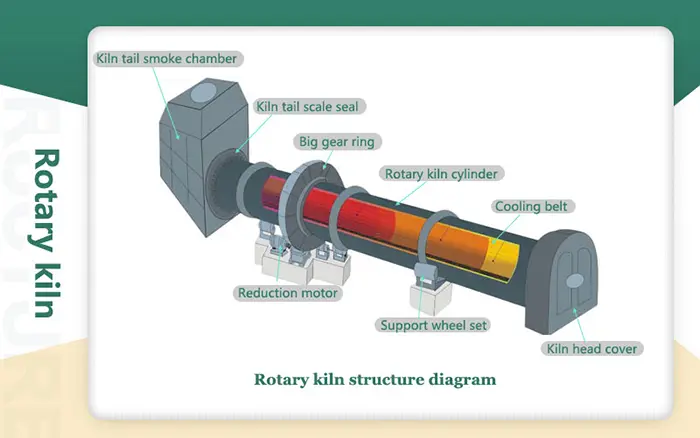
In a direct rotary dryer, wet material enters a slightly inclined rotating drum. Internal flights lift and cascade the material through the drying-gas stream, increasing the exposed surface area.
As the material moves through the drum:
Wet material is introduced at a controlled rate.
The flights lift and distribute the material.
Hot gas transfers heat to the material.
Moisture evaporates and enters the exhaust stream.
Dried material leaves through the discharge system.
Exhaust gas passes through dust-removal equipment.
The detailed operating sequence is covered in how does a rotary dryer work. For equipment selection, evaluate the complete drying duty, project scope and supplier engineering support.
Co-Current vs. Counter-Current Airflow
The airflow direction must be selected according to material behavior and the required drying profile.
Co-Current Drying
In a co-current dryer, the wet material and hot gas enter from the same end and travel in the same direction.
This arrangement allows the hottest gas to contact the wettest material. As material moisture decreases, the gas temperature also decreases.
Co-current flow may be considered when:
The wet feed can absorb high initial heat
The final dried product should avoid the highest gas temperature
Rapid initial surface-moisture removal is beneficial
Product-temperature control is important
Counter-Current Drying
In a counter-current dryer, hot gas enters from the discharge end and moves opposite to the material.
The driest material contacts the hottest gas near the discharge area.
This arrangement may be considered when:
The material tolerates higher final-stage temperatures
A strong final drying effect is required
Higher thermal driving force near discharge is beneficial
Product heating is acceptable
The manufacturer should not select the airflow arrangement from a generic rule. Material temperature limits, dust generation, final moisture and exhaust conditions must all be evaluated.
Why Flight Design Matters
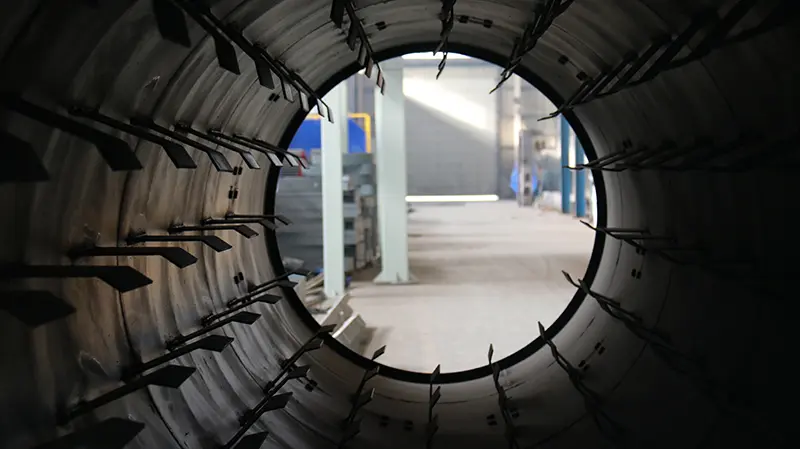
Flights are the internal plates that lift and distribute material as the drum rotates.
Their purpose is to form an effective material curtain through the drying-gas stream. A poor curtain allows hot gas to pass through empty areas of the drum, reducing heat-transfer efficiency.
Flight design depends on:
Material size
Bulk density
Stickiness
Abrasiveness
Drum loading
Rotation speed
Air velocity
Drying stage
Required residence time
A single flight pattern may not perform equally well along the entire drum. Wet material near the inlet may require a different lifting and distribution action from partially dried material near the discharge end.
Buyers processing difficult material should ask how the flight arrangement will be adapted to the project. The engineering considerations are explained further in the rotary dryer flight design guide.
Selecting the Heat Source
The available fuel affects operating cost, burner design, combustion chamber configuration, gas temperature and emission-control requirements.
The XINGAONAI rotary drying system can be configured around hot gas produced from heat sources such as:
Natural gas
Diesel
Coal
Biomass
Suitable waste-heat systems
The final choice should consider:
Local fuel availability
Fuel price
Required heat output
Temperature-control accuracy
Fuel consistency
Ash production
Combustion emissions
Site permits
Storage and handling
Maintenance capability
A low-cost fuel does not always produce the lowest drying cost. Poor combustion control, inconsistent fuel quality or high ash production may increase cleaning, maintenance and emission-control expenses.
Ask the manufacturer to identify:
Required thermal input
Expected fuel consumption under stated conditions
Burner or furnace scope
Combustion-air requirements
Temperature-control method
Maximum and normal operating temperatures
Startup and shutdown sequence
Required safety interlocks
A Complete Rotary Drying System
A rotary dryer normally operates as part of a complete process line.
The system may include:
Wet-material hopper
Metering feeder
Feed conveyor
Combustion chamber or hot-air furnace
Rotary dryer
Discharge conveyor
Cyclone separator
Dust collector
Induced-draft fan
Exhaust stack
Temperature instruments
Moisture-monitoring equipment
Electrical and PLC control system
The scope must be defined clearly in the quotation. Otherwise, one supplier may quote only the rotary drum while another quotes a complete operational drying line, making the two prices impossible to compare directly.
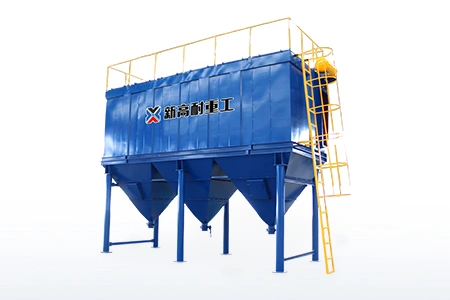
For high dust loads or strict particulate-control requirements, the exhaust system may include a pulse jet bag filter. Filter media must be selected according to gas temperature, moisture, chemical composition and dust characteristics.

Materials Commonly Processed in Rotary Dryers
XINGAONAI rotary dryers may be evaluated for compatible bulk materials in mining, aggregate, metallurgy, building materials, fertilizer and biomass applications.
| Material | Main selection consideration |
|---|---|
| River or manufactured sand | Abrasion, fine-particle carryover and target moisture |
| Mineral concentrate | Inlet moisture, particle size, oxidation and dust recovery |
| Iron or copper ore | Density, abrasion and required downstream moisture |
| Slag | Variable moisture, bulk density and wear |
| Coal or coal gangue | Combustion safety, volatile matter and dust control |
| Fly ash | Fine-particle entrainment and dust-collector capacity |
| Clay | Stickiness, buildup and feed preparation |
| Limestone powder | Dust generation and product-temperature limits |
| Gypsum | Temperature control and possible material changes |
| Fertilizer | Corrosion, heat sensitivity and product degradation |
| Wood chips or sawdust | Fire risk, particle carryover and temperature control |
| Biomass pellets | Product breakage, fines and combustion safety |
Material compatibility should be confirmed through actual process information. The fact that a material can be dried in a rotary drum does not mean that every standard dryer configuration will be suitable.
Published XINGAONAI Model Selection Range
The current XINGAONAI product table includes multiple models covering different drum dimensions and nominal production capacities.
| Drum specification | Published capacity |
|---|---|
| Φ1.2 × 8 m | 1.9–2.4 t/h |
| Φ1.2 × 10 m | 2.4–3.0 t/h |
| Φ1.5 × 12 m | 4.5–5.7 t/h |
| Φ1.5 × 14 m | 5.3–6.6 t/h |
| Φ1.5 × 15 m | 5.7–7.1 t/h |
| Φ1.8 × 12 m | 6.5–8.1 t/h |
| Φ1.8 × 14 m | 7.6–9.5 t/h |
| Φ2.2 × 12 m | 9.7–12.2 t/h |
| Φ2.2 × 14 m | 11.4–14.2 t/h |
| Φ2.2 × 16 m | 13.0–16.2 t/h |
| Φ2.4 × 14 m | 13.5–16.9 t/h |
| Φ2.4 × 18 m | 17.4–21.7 t/h |
| Φ2.4 × 20 m | 19.3–24.1 t/h |
| Φ2.4 × 22 m | 21.2–26.5 t/h |
| Φ2.6 × 24 m | 27.2–34.0 t/h |
| Φ3.0 × 20 m | 30.1–37.7 t/h |
| Φ3.0 × 25 m | 37.7–47.1 t/h |
| Φ3.2 × 25 m | 42.9–53.6 t/h |
| Φ3.6 × 28 m | 60.8–76.0 t/h |
These values should be treated as published reference capacities rather than universal guarantees.
Before selecting a model, compare the required duty with the complete rotary dryer specifications, including drum size, slope, drive power and expected operating conditions.
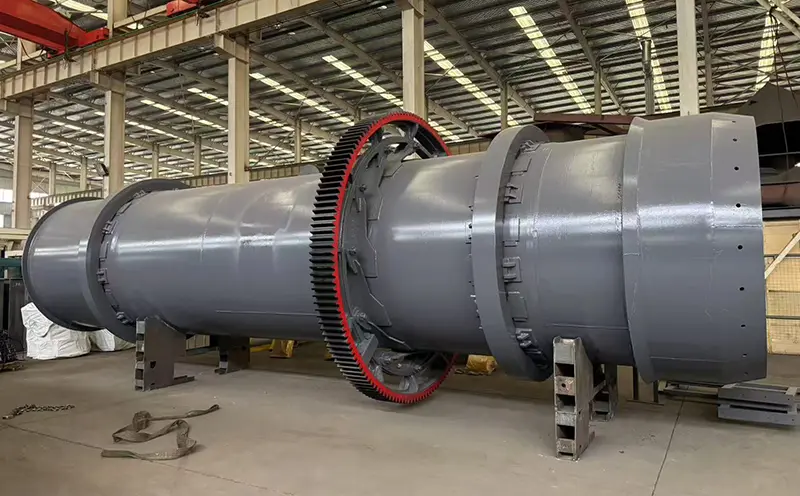
How to Evaluate Manufacturing Quality
Thermal design and mechanical manufacturing must be evaluated together.
A buyer should review the following areas.
Drum Shell
Check:
Plate material
Shell thickness
Circumferential and longitudinal weld quality
Shell roundness
Allowable runout
Reinforcement around tires and drive components
Thermal-expansion provisions
Tires and Support Rollers
Ask how the manufacturer controls:
Tire dimensions
Roller profile
Surface machining
Contact between tire and roller
Load distribution
Axial movement
Thrust-roller arrangement
Drive System
Review:
Motor power
Reducer specification
Coupling arrangement
Pinion and girth-gear materials
Gear contact
Backlash
Guarding
Lubrication method
Variable-speed requirements
Feed and Discharge Seals
Poor sealing allows uncontrolled cold air to enter the dryer. This may affect gas temperature, fuel consumption, draft stability and dust leakage.
Internal Flights
Confirm:
Flight material
Thickness
Attachment method
Replaceability
Wear allowance
Arrangement along the drum
Suitability for the actual material
Factory Inspection
Before shipment, buyers should define which inspections and records are required, such as:
Dimensional checks
Weld inspection
Shell runout measurement
Gear-contact inspection
Reducer and motor documentation
Trial rotation where applicable
Coating inspection
Packing list
Installation drawings
Foundation drawings
Operation and maintenance documentation
How to Compare Rotary Dryer Quotations
The lowest equipment price does not necessarily represent the lowest installed or operating cost.
Use the following comparison table.
| Comparison item | What to verify |
|---|---|
| Process basis | Material, feed rate, inlet moisture and outlet moisture |
| Evaporation duty | Tonnes of water removed per hour |
| Dryer model | Diameter, length, slope, speed and motor |
| Heat system | Fuel type, furnace or burner, thermal input and controls |
| Air system | Exhaust volume, fan pressure and draft-control method |
| Dust control | Cyclone, bag filter, scrubber or other equipment |
| Material handling | Feed and discharge conveyors included or excluded |
| Electrical scope | Motors, control cabinet, instruments and field wiring |
| Structural scope | Supports, platforms, guards and insulation |
| Documentation | Drawings, manuals and parts lists |
| Installation | Supervision, mechanical installation or excluded |
| Commissioning | Cold test, hot test and operator training |
| Performance conditions | Capacity and moisture guarantee basis |
| Spare parts | Startup spares and recommended long-term spares |
| Warranty | Coverage, period and exclusions |
| Shipping | Packing, freight and delivery terms |
The rotary dryer cost guide explains why heat source, dust collection, automation and auxiliary equipment can significantly affect the total project investment.
Performance Guarantees Must Have Defined Conditions
A useful performance guarantee must state the conditions under which it applies.
The guarantee should identify:
Processed material
Wet-feed capacity
Inlet moisture range
Target outlet moisture
Particle-size range
Bulk density
Fuel specification
Ambient conditions
Normal gas temperature
Maximum safe gas temperature
Allowed operating variation
Test duration
Sampling method
Moisture-measurement method
A guarantee stating only “capacity: 30 t/h” is incomplete because it does not define how much water is being removed or the required product condition.
Variable feed conditions may also require an agreed operating envelope rather than one fixed performance point.
Installation, Commissioning and Lifecycle Support
Manufacturer support should continue beyond equipment delivery.
Before ordering, confirm responsibility for:
Foundation and civil drawings
Installation instructions
Drum and support-system alignment
Gear and pinion adjustment
Electrical commissioning
Instrument calibration
Burner or furnace commissioning
Cold trial operation
Loaded trial operation
Temperature and draft adjustment
Operator training
Initial spare parts
Maintenance planning
Technical troubleshooting
Routine plant-level inspection and lubrication requirements are covered in the rotary dryer maintenance guide.
When the equipment requires specialist inspection, drum alignment, major mechanical repair or process diagnosis, refer to rotary dryer services.

Common Mistakes When Selecting a Manufacturer
Comparing Only Purchase Price
A low-cost dryer may require additional expenditure for the furnace, fan, dust collector, controls, platforms and installation.
Selecting by Wet Capacity Alone
Wet tonnes per hour do not define the evaporation duty.
Ignoring Maximum Inlet Moisture
A dryer selected for average moisture may fail to meet capacity during wetter operating periods.
Using a Standard Flight Arrangement for Every Material
Flight design must reflect material density, size, stickiness and drying behavior.
Failing to Define the Heat Source
Fuel availability, cost and emission requirements can change the entire drying-system design.
Ignoring Fine-Particle Carryover
Fine material may leave the drum with the exhaust gas, increasing dust-collector load and reducing product recovery.
Undersizing the Exhaust System
Insufficient airflow or fan pressure can cause unstable drying, dust leakage and moisture-control problems.
Accepting an Undefined Performance Guarantee
The guarantee must state feed and test conditions.
Forgetting Maintenance Access
The plant layout must provide access to:
Motors
Reducers
Pinions and gears
Support rollers
Thrust rollers
Bearings
Seals
Internal flights
Dust collectors
Fans
Failing to Define Equipment Boundaries
Every quotation should specify where the manufacturer’s scope begins and ends.
Information to Provide When Requesting a Quotation
Prepare the following information:
Material name and composition
Wet-feed capacity in t/h
Normal and maximum inlet moisture
Target outlet moisture
Particle-size distribution
Maximum particle size
Loose bulk density
Material temperature
Maximum allowable product temperature
Stickiness
Abrasiveness
Corrosiveness
Heat sensitivity
Available fuel
Local fuel properties
Power supply
Site altitude
Ambient temperature range
Local emission requirements
Available installation space
Required operating hours
Upstream feeding method
Downstream material-handling method
Required automation level
General arrangement drawing, if available
Representative material samples or laboratory drying-test results can improve the accuracy of the selection.
Choose a Manufacturer Based on Engineering Evidence
A reliable rotary dryer project begins with clearly defined process conditions.
The manufacturer should calculate the water evaporation duty, evaluate the material, select the airflow and heat source, determine the drum configuration and match the exhaust and dust-control systems to the drying requirement.
XINGAONAI’s current rotary dryer range covers multiple drum sizes and published capacities for compatible bulk materials. Final equipment selection should be based on actual material data rather than a nominal capacity alone.
Before requesting a proposal, prepare the wet-feed rate, inlet moisture, target outlet moisture, bulk density, particle size, available fuel and site requirements. This information allows the engineering team to develop a more accurate equipment configuration and quotation.