Rotary dryer services include mechanical inspection, condition assessment, drum alignment, tire and support-roller work, drive-system repair, seal replacement, internal-component repair, process troubleshooting, commissioning and operator training.
The correct service depends on the observed symptoms, operating history and condition of the complete drying system—not on one visibly worn component alone.
A professional service visit should do more than replace a failed part. It should identify why the failure occurred, document the dryer’s current mechanical condition, prioritize corrective work and establish measurements that can be compared during future inspections.
This guide explains:
When professional rotary dryer service is justified
What different service categories normally include
How inspection differs from alignment and repair
How to determine the correct repair sequence
What a professional service report should contain
What information a plant should prepare before requesting support
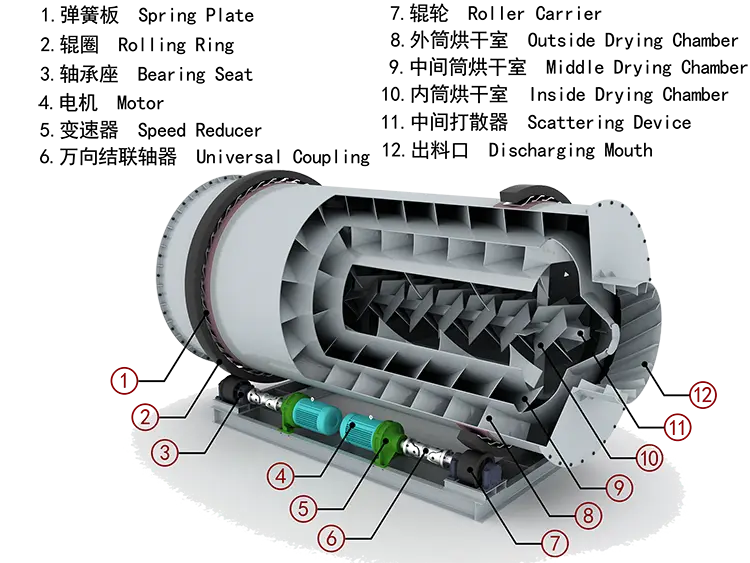
What Are Rotary Dryer Services?
Rotary dryer services are specialized engineering and maintenance activities used to keep the drum, support system, drive, seals, internals, heat source and airflow system operating as one coordinated unit.
Routine operator maintenance and professional service are related, but they are not identical.
Plant personnel normally handle tasks such as:
Visual inspections
Cleaning
Lubrication
Operating-log review
Basic operating adjustments
Monitoring temperature, vibration and product moisture
A qualified service team is generally required when the work involves:
Geometric measurement
Structural repair
Drum or roller alignment
Component machining
Vibration diagnosis
Burner or airflow tuning
Foundation correction
Major component replacement
Post-repair commissioning
The required service scope should be based on evidence collected from the equipment.
For example, replacing worn seals will not correct a persistent leak if excessive drum movement or misalignment immediately damages the new seals. Similarly, resurfacing a worn tire without identifying the underlying load-distribution or alignment problem may allow the same wear pattern to return.
| Service category | Main purpose | Typical scope |
|---|---|---|
| Mechanical inspection | Establish the current mechanical condition | Tires, support rollers, thrust rollers, gears, bearings, shell, bases, seals and internals |
| Process audit | Identify the cause of unstable drying performance | Feed variation, airflow, temperature profile, burner condition, retention time and material curtain |
| Drum alignment | Restore the intended rotational axis and load distribution | Centerline, slope, tire and roller position, support-base condition and drum tracking |
| Float or thrust correction | Control the drum’s axial position | Thrust-roller contact and controlled support-roller adjustment |
| Tire and roller service | Correct damaged or uneven load-bearing surfaces | Wear measurement, resurfacing, machining, repair or replacement |
| Drive-system service | Restore stable power transmission | Gear and pinion contact, backlash, coupling, reducer, motor and lubrication |
| Seal and breeching service | Reduce uncontrolled air and material leakage | Seal inspection, replacement and interface correction |
| Shell and internal repair | Restore structural integrity and drying performance | Shell sections, welds, flights, lifters and other internal components |
| Rebuild or retrofit | Extend service life or adapt the dryer to a changed duty | Component redesign, capacity-related modifications and control upgrades |
| Commissioning and training | Establish stable operation after installation or repair | Cold checks, loaded checks, operating procedures and personnel instruction |
For daily, weekly and scheduled plant-level work, refer to the rotary dryer maintenance guide. This article focuses on deciding when specialist inspection, alignment or repair is required.
When Should You Request Professional Rotary Dryer Service?
Professional service should be considered when:
A problem cannot be diagnosed reliably through routine operating checks
The same component failure repeatedly returns
Abnormal wear develops on tires, rollers or gears
The work affects the dryer’s geometry or load-bearing system
Performance declines even though normal maintenance has been completed
Major repair, relocation or foundation work has changed the equipment geometry
Safety or structural integrity may be affected
The following table can be used as an initial decision guide.
| Observed condition | Possible areas to investigate | Suitable first service |
|---|---|---|
| Abnormal vibration, chatter or grinding noise | Gear mesh, bearings, support rollers, tires, alignment, buildup or loose foundations | Operating inspection and vibration assessment |
| Uneven or rapid tire and roller wear | Alignment, roller slope, base settlement, load distribution or rolling-surface condition | Geometric inspection and alignment assessment |
| Continuous heavy contact with one thrust roller | Drum float, roller adjustment, slope or centerline | Alignment and float assessment |
| Hot bearings or repeated bearing failure | Lubrication, bearing fit, overload, shaft condition or misalignment | Mechanical inspection and root-cause analysis |
| Gear-tooth wear or unstable gear contact | Gear runout, pinion position, backlash, foundation movement or alignment | Drive-system and alignment inspection |
| Air or material leakage at the inlet or outlet | Worn seals, distorted interfaces, excessive drum movement or pressure imbalance | Seal and mechanical inspection |
| Inconsistent discharge moisture | Feed variation, flight condition, residence time, burner, airflow, buildup or sealing | Process audit combined with mechanical inspection |
| Dryer cannot reach its expected throughput | Material condition, feed system, airflow, heat input, buildup or mechanical restriction | Process and equipment audit |
| Cracks, shell distortion or damaged welds | Cyclic stress, local overheating, support condition or long-term misalignment | Structural assessment by qualified personnel |
| Problems begin after major repair or relocation | Changed geometry, support-base position, gear mesh or operating settings | Post-repair alignment and recommissioning |
These symptoms should not be treated as final diagnoses.
For example, vibration may be caused by misalignment, damaged rolling surfaces, poor gear contact, material buildup, loose structural connections or an unbalanced rotating component. The service provider should verify the cause before recommending replacement parts.
Operating Inspection vs. Shutdown Inspection
A complete rotary dryer assessment may require both an operating inspection and a controlled shutdown inspection. Each reveals different information.
Inspection While the Dryer Is Running
An operating inspection shows how the dryer behaves under actual thermal and mechanical load.
Depending on site rules and safe access, the service team may observe:
Noise and vibration patterns
Bearing and support temperatures
Tire and support-roller contact
Drum tracking
Thrust-roller contact
Gear and pinion operation
Seal leakage
Lubrication condition visible from safe inspection points
Shell movement and visible runout
Feed stability
Discharge consistency
Burner flame, draft and exhaust behavior, where applicable
These observations provide important operating context, but they do not replace shutdown measurements.
Guards must not be removed, and personnel must not enter hazardous areas while the equipment is operating. Any operating inspection must follow the plant’s safety rules and safe-access procedures.
Inspection During a Controlled Shutdown
A controlled shutdown provides access to components and measurement points that cannot be inspected safely during production.
The shutdown inspection may include:
Tire and support-roller surface profiles
Drum centerline and slope
Support-station geometry
Gear contact pattern and backlash
Bearing clearances and shaft condition
Shell-thickness measurements at selected locations
Weld, shell and structural inspection
Internal flight and lifter condition
Seal wear and mounting condition
Foundation, baseplate and anchor-bolt condition
Material buildup and internal obstruction
Burner, duct and dust-collection inspection
Before servicing or internal inspection, the plant must follow its site-specific energy-control procedure and all applicable local regulations.
In the United States, OSHA 29 CFR 1910.147 covers servicing and maintenance activities in which unexpected energization, machine start-up or the release of stored energy could injure employees.
Rotary Dryer Alignment and Drum Float Are Different
Rotary dryer alignment and drum float are related, but they are not the same condition.
What Is Rotary Dryer Alignment?
Alignment establishes the position of the drum and support system relative to the intended rotational axis.
An alignment assessment may examine:
Drum centerline
Drum slope
Support-base elevation
Tire position and geometry
Support-roller position and geometry
Shell runout
Foundation condition
Relationship between the drum and drive components
The objective is to distribute the load correctly and maintain a stable mechanical relationship between the drum, tires, support rollers, thrust rollers and drive.
What Is Drum Float?
Drum float describes the dryer’s axial position and movement between the thrust rollers.
A correctly operating drum should not remain heavily loaded against one thrust roller without an established engineering reason. Continuous contact can increase thrust-roller wear and may indicate incorrect roller adjustment, support geometry, drum slope or thermal behavior.
Small support-roller adjustments can influence axial movement. However, repeatedly adjusting rollers without confirming the complete dryer geometry may hide a larger mechanical problem.
Recommended Alignment Sequence
A responsible rotary dryer alignment process normally follows this sequence:
Review operating symptoms, equipment drawings, repair history and previous measurements.
Observe the dryer under normal operating load when safe and practical.
Measure the shell, tires, support rollers, bases and drive-system position.
Determine whether worn surfaces, foundation movement or structural damage must be corrected first.
Complete necessary resurfacing, repair or component replacement.
Align the support and drive system using an appropriate measurement method.
Verify drum movement, gear contact and thrust behavior after adjustment.
Record final measurements as a new maintenance baseline.
Alignment should be checked after work that can change the dryer’s geometry, including:
Support-roller replacement
Tire or roller resurfacing
Foundation correction
Baseplate work
Shell-section replacement
Dryer relocation
Major gear or pinion replacement
Drive-system modification
What Does Rotary Dryer Repair Include?
Rotary dryer repair can range from a planned component change to a major structural rebuild.
The repair should address both the damaged component and the condition that caused the damage.
Tires, Support Rollers and Thrust Rollers
These components carry, rotate and control the drum.
Inspection should consider:
Wear pattern
Contact width
Surface damage
Remaining diameter
Roundness and profile
Shaft condition
Bearing condition
Lubrication
Load distribution between support stations
Thrust-roller contact
Light or moderate surface damage may sometimes be corrected by controlled resurfacing or machining.
Severe section loss, cracking, deformation or dimensions below the acceptable repair limit may require replacement. The correct decision should be based on measurements, material condition, original design and approved repair limits—not on visual appearance alone.
Gear, Pinion, Coupling and Drive
Drive-system service may include checking:
Gear-tooth contact
Gear and pinion backlash
Girth-gear runout
Pinion position
Coupling alignment
Reducer condition
Motor performance
Lubrication condition
Mounting bolts
Drive-base stability
A new gear or pinion should not be installed until the support geometry and foundation condition have been checked. An unresolved alignment or foundation problem can damage newly installed drive components.
Seals and Breeching Interfaces
Worn or damaged seals can allow:
Hot air to escape
Cold ambient air to enter
Dust to leak into the surrounding area
Material to escape at the inlet or outlet
Dryer pressure to become unstable
Thermal efficiency to decline
Seal replacement is appropriate when the sealing elements have reached their wear limit.
However, the service team should also inspect drum movement, shell runout and the geometry of the seal interface. Excessive movement or distortion can quickly shorten the life of a replacement seal.
Shell, Welds and Structural Components
Shell cracks, deformation and damaged welds require an engineering assessment before repair.
The repair method depends on:
Damage location
Drum loading
Shell material
Temperature history
Crack direction and length
Local deformation
Support-system condition
Extent of section loss
Applicable welding and inspection requirements
Repairing a crack without identifying the stress that produced it may allow the damage to return.
Internal Flights and Lifters
Internal flights control how material is lifted, distributed and exposed to the drying gas.
Missing, bent, detached or badly worn flights can change:
Material curtain formation
Heat-transfer efficiency
Residence behavior
Material buildup
Final moisture uniformity
Carryover into the exhaust system
If internal performance is the main issue, review the rotary dryer flight design guide before deciding whether to restore the original arrangement or redesign the flights for changed feed conditions.
Put Rotary Dryer Repairs in the Correct Order
Repair sequence matters because one correction can change the mechanical conditions for the next.
1. Control Safety Hazards
Address missing guards, unstable structures, fire hazards, unsafe access and uncontrolled energy sources before beginning performance-related work.
2. Identify the Root Cause
Determine whether the observed wear or failure is driven by:
Misalignment
Incorrect loading
Poor lubrication
Material buildup
Temperature
Foundation movement
Structural distortion
Improper operation
Incompatible replacement parts
3. Restore Load-Bearing Components
Repair or replace damaged tires, rollers, bearings, shafts, support frames and bases as required.
4. Correct Geometry and Alignment
Establish the correct relationship between the drum, support stations and drive after major mechanical work has been completed.
5. Repair and Adjust the Drive System
Set gear contact, backlash, coupling alignment and lubrication using the corrected drum geometry.
6. Restore Seals and Internals
Complete seal, breeching, flight and internal-component work after drum movement has been brought under control.
7. Tune the Drying Process
Under operating load, verify:
Feed rate
Heat input
Airflow
Draft
Material curtain
Retention behavior
Exhaust condition
Discharge moisture
This sequence may be adjusted for the actual equipment condition. However, it helps prevent a common mistake: replacing the most visible damaged part while leaving the condition that caused the damage unchanged.
Preventive Service, Corrective Repair or Rebuild?
The appropriate service level depends on equipment condition, production risk, repair history and the dryer’s future operating duty.
| Equipment condition | Typical response | Main objective |
|---|---|---|
| Stable operation with no abnormal wear | Preventive inspection and baseline measurement | Detect changes before production is affected |
| Early wear, minor leakage or changing vibration | Targeted corrective maintenance | Stop deterioration and confirm the cause |
| Repeated component failure or declining performance | Root-cause audit and planned repair | Correct the system-level problem |
| Significant wear across several systems | Major shutdown repair or partial rebuild | Restore mechanical integrity and reliability |
| Structural damage, obsolete parts or changed process duty | Engineering review for rebuild, retrofit or replacement | Compare lifecycle cost and technical risk |
A rebuild is not automatically the most economical option.
The evaluation should consider:
Remaining condition of the shell
Condition of the support bases and foundations
Required future capacity
Energy requirements
Environmental requirements
Availability of replacement parts
Expected remaining operating life
Cost of production downtime
Extent of process changes
Cost and risk of repeated repairs
If the process requirement has changed substantially, a properly selected new rotary dryer may provide a more predictable result than repeatedly modifying equipment that is no longer suited to the application.
What Should a Rotary Dryer Service Report Include?
A useful service report is a maintenance and planning tool—not merely a list of observations.
It should allow the plant to:
Plan repair work
Establish priorities
Compare equipment condition over time
Prepare labor and replacement parts
Verify what was adjusted or repaired
Create a baseline for future inspections
Request the following information where relevant:
Equipment identification and service scope
Operating condition during inspection
Measurement methods
Instrument information
Photographs linked to specific findings
Recorded dimensions
Temperatures
Clearances
Vibration readings
Wear measurements
Alignment or geometry results
Condition of tires, rollers, bearings, gears, shell, seals and internals
Probable root causes
Alternative causes requiring additional testing
Findings prioritized by safety, urgency and production impact
Recommended repairs
Required repair sequence
Parts and materials required
Lifting and access requirements
Measurements after adjustment or repair
Items that could not be inspected
Remaining limitations
Recommended follow-up checks
Final measurements should be retained with the dryer’s maintenance history.
Trend data are often more useful than one isolated measurement because they show whether wear, temperature, vibration, gear contact or axial movement is changing over time.
Information to Prepare Before Requesting Service
Accurate equipment and process information helps the service provider determine the required personnel, instruments, parts and shutdown time.
Prepare as much of the following information as possible:
Dryer manufacturer, model, serial number and installation year
Drum diameter, length, slope and drive arrangement
Equipment drawings, manuals and previous service reports
Material name, bulk density, abrasiveness and particle-size range
Feed rate and expected production capacity
Inlet moisture and target outlet moisture
Heat source, operating temperature and airflow arrangement
Current symptoms and when they began
Photographs and videos taken from safe observation points
Recent temperature, motor-current, vibration and moisture records
Lubrication history
Recent component replacements
Previous alignment, grinding or foundation work
Available shutdown window
Site access restrictions
Available crane, scaffold and lifting capacity
Local safety, permit and contractor requirements
Spare parts already available at the plant
If the problem concerns capacity, fuel consumption or final moisture, provide representative feed and product data in addition to the mechanical information.
The relationship between feeding, drum rotation, lifting flights, gas flow and moisture removal is explained in How Does a Rotary Dryer Work?.
How to Evaluate a Rotary Dryer Service Provider
Do not evaluate a service provider only by response time or quoted repair price.
A low-cost repair can become expensive if it treats only the visible symptom and the same failure returns shortly afterward.
Ask whether the service provider can:
Demonstrate experience with large rotary equipment
Inspect the complete support and drive system
Explain its alignment and measurement methods
Distinguish mechanical problems from process problems
Work from existing drawings
Establish new field measurements when drawings are unavailable
Supply or manufacture compatible replacement parts
Perform or coordinate machining
Perform or coordinate qualified welding
Plan lifting and access requirements
Complete commissioning after repair
Meet the site’s safety and contractor requirements
Provide a written, prioritized condition report
Document measurements before and after repair
Support follow-up review after the dryer returns to operation
For a dryer manufactured by another supplier, confirm:
Whether the service provider accepts third-party equipment
What drawings are required
What field measurements must be taken
How replacement-part compatibility will be verified
Who is responsible for design approval
Whether installation and commissioning support are included
A replacement part should not be assumed to be interchangeable based only on nominal diameter, width, model description or apparent similarity.
What Determines Rotary Dryer Service Cost?
Rotary dryer service cost depends on the service scope, dryer condition and site requirements.
Important cost drivers include:
Inspection-only work versus repair work
Dryer diameter and length
Number of support stations
Plant location
Technician mobilization
Safe access to tires, rollers, gears and internals
Need for a production shutdown
Required measurement instruments
Number and specialization of service personnel
Crane and lifting requirements
Scaffolding requirements
Welding and machining requirements
Number and size of replacement components
Severity of structural damage
Foundation condition
Availability of drawings and maintenance records
Urgency of the service
Replacement-part lead time
Commissioning and follow-up support
Request a written scope that separates:
Inspection
Measurements
Engineering
Labor
Replacement parts
Machining
Welding
Lifting equipment
Scaffolding
Travel and mobilization
Commissioning
Optional work
If the decision involves equipment replacement rather than repair, compare the service proposal with the total installed investment discussed in the rotary dryer cost guide.
Frequently Asked Questions
How often should a rotary dryer receive a professional inspection?
There is no universal inspection interval for every rotary dryer.
Inspection frequency should reflect:
Manufacturer recommendations
Operating hours
Material abrasiveness
Operating temperature
Production criticality
Previous wear rate
Condition-monitoring trends
Repair history
A professional inspection is also justified after a major repair, foundation correction, relocation, significant process change or the appearance of abnormal wear, vibration or thrust behavior.
Can rotary dryer alignment be checked while the drum is running?
Operating observation can reveal drum tracking, bearing temperature, vibration, gear behavior, seal condition and thrust-roller contact. Some measurement systems can also collect selected information during operation.
However, physical adjustment and many geometric measurements normally require a planned shutdown and the site’s approved energy-control procedure.
The inspection method and shutdown requirements should be agreed upon before the service visit begins.
Does every worn tire or support roller need replacement?
No.
Some surface conditions may be suitable for controlled resurfacing or machining. Severe wear, cracking, deformation or insufficient remaining dimensions may require replacement.
The decision should be based on measurements, material condition, original design and approved repair limits.
Can a service provider work on a rotary dryer from another manufacturer?
Often yes, provided the service provider has suitable rotary-equipment experience and can obtain reliable dimensions, operating information and component data.
However, this capability should be confirmed before the service agreement is finalized. Missing drawings may increase the field-measurement scope and the time required to verify replacement parts.
Can mechanical service improve rotary dryer efficiency?
Mechanical service can improve performance when the efficiency loss is caused by:
Air leakage
Damaged or unsuitable flights
Material buildup
Incorrect drum movement
Drive-system problems
Unstable feeding
Seal damage
Mechanical restrictions
Related alignment conditions
Mechanical repair will not correct:
An undersized heat source
An unsuitable airflow configuration
Incorrect residence-time requirements
A fundamental mismatch between the dryer and the material
Incorrect process design
Insufficient dust-handling capacity
Mechanical and process conditions should therefore be evaluated together.
What is the difference between rotary dryer maintenance and professional service?
Routine maintenance includes regular cleaning, lubrication, visual inspection, operating-data review and planned replacement of normal wear parts.
Professional service is appropriate when the plant requires specialized measurements, alignment, structural repair, machining, vibration analysis, foundation correction or root-cause investigation beyond normal maintenance capability.
Should alignment be checked after replacing a tire or support roller?
Yes. Work on tires, support rollers, shafts, bases or foundations can change drum geometry and load distribution.
Alignment, gear contact and thrust behavior should be checked after the work and documented as a new maintenance baseline.
Conclusion
Effective rotary dryer services begin with diagnosis.
Inspection establishes the current equipment condition. Alignment restores the correct mechanical relationship. Repair addresses damaged components. Process review confirms whether the complete drying system can meet its required duty.
The most reliable service plan treats the dryer as one complete system. Tires, support rollers, thrust components, gears, seals, shell, flights, burner, airflow and feed conditions influence one another.
Repairing one visible symptom without evaluating the complete system can allow wear and performance problems to return.
Before requesting technical support, prepare:
Dryer model and drawings
Processed material
Feed rate
Inlet and target outlet moisture
Operating temperatures
Current symptoms
Maintenance and repair history
Photographs and videos
Available shutdown window
Site access and lifting conditions
The XINGAONAI technical team can use this information to review the application and determine the appropriate next inspection or engineering step.