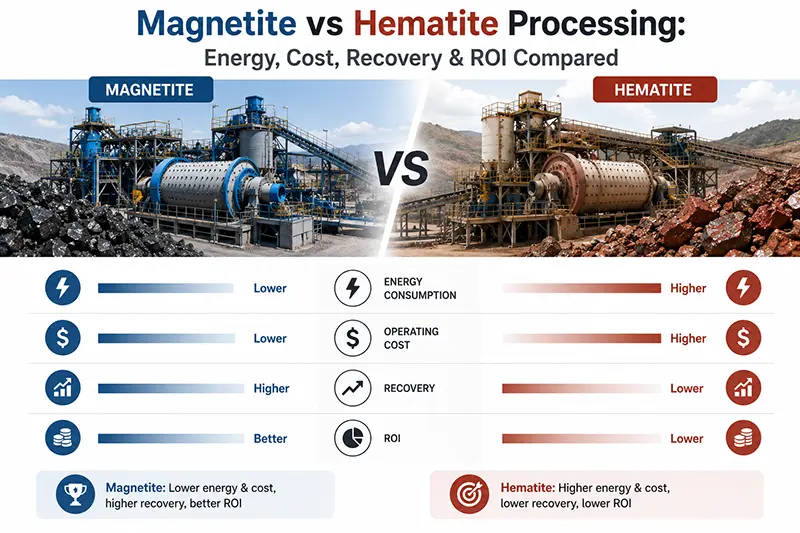
Magnetite and hematite are the two most important iron ore types used in steel production. Although both can produce high-grade iron concentrates, their mineral properties require different processing methods. As a result, energy consumption, operating costs, recovery rates, and return on investment (ROI) can vary significantly.
Understanding the differences between magnetite and hematite processing helps mining companies select the most suitable beneficiation strategy and maximize project profitability.
Understanding Magnetite and Hematite Ores
Before comparing processing methods, it is important to understand the characteristics of these two iron ore types.
Magnetite Ore
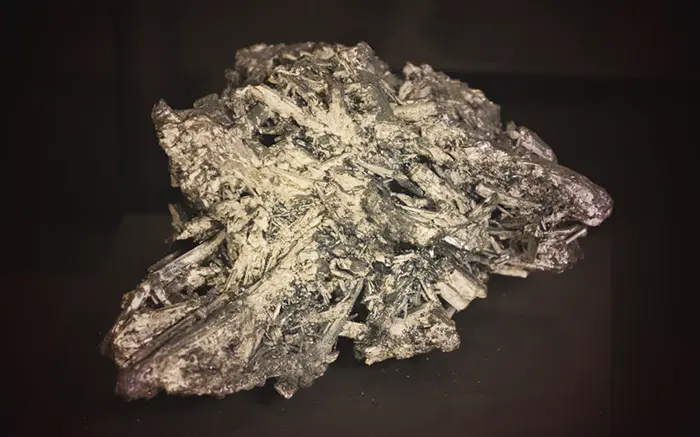
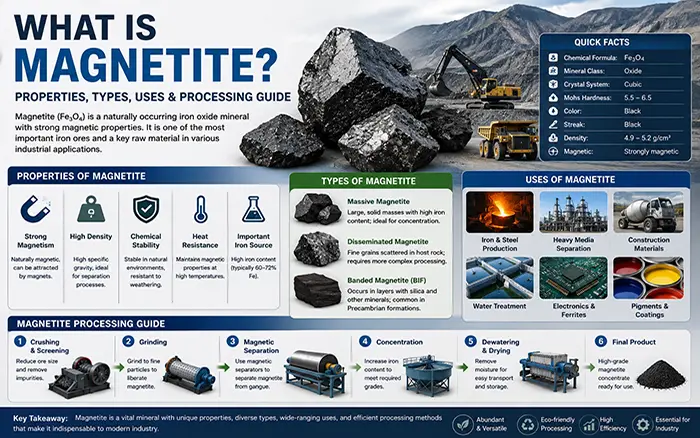
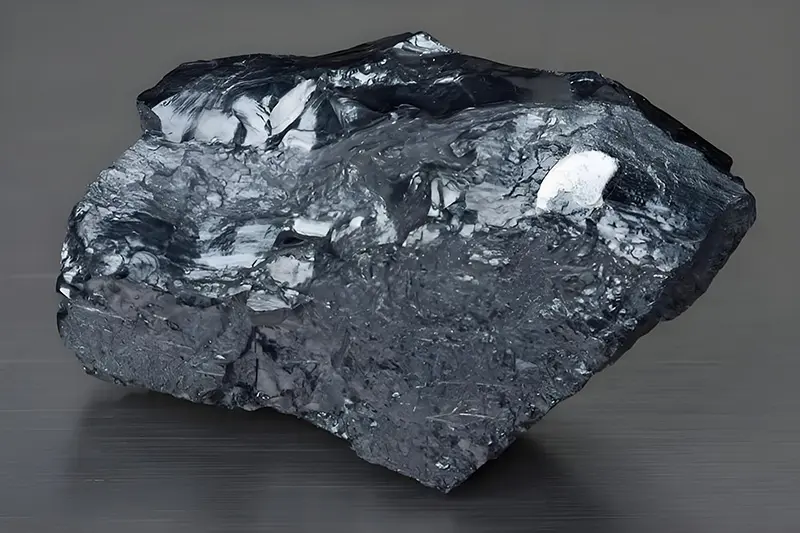
Magnetite (Fe₃O₄) contains approximately 72.4% iron in its pure form and is strongly magnetic. This magnetic property makes separation relatively efficient using magnetic separators.
Key characteristics include:
Strong magnetic response
Generally lower-grade deposits
Requires fine grinding for liberation
Suitable for magnetic separation processes
Hematite Ore
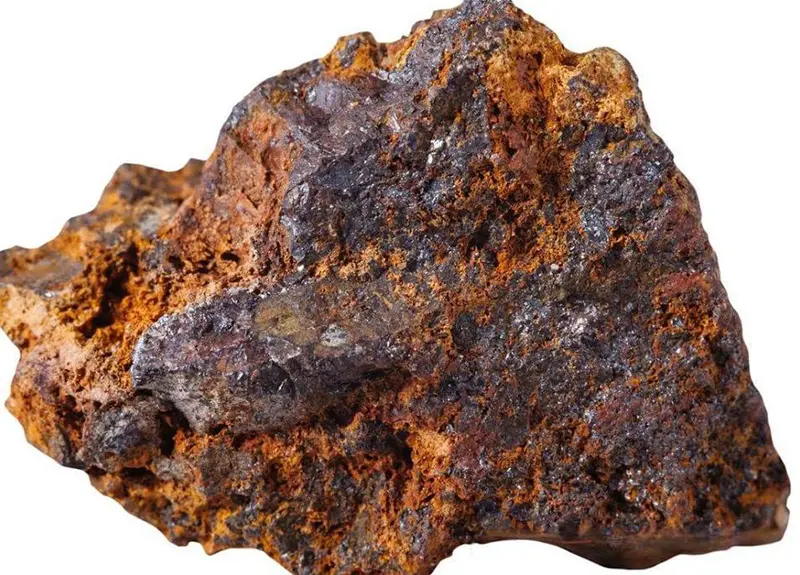
Hematite (Fe₂O₃) contains approximately 69.9% iron in its pure form and exhibits weak magnetic properties. Beneficiation often requires gravity separation, flotation, or high-intensity magnetic separation.
Key characteristics include:
Weakly magnetic or non-magnetic
Often found in higher-grade deposits
Easier liberation in some deposits
More complex beneficiation methods
Energy Consumption Comparison
Energy consumption is one of the largest operating expenses in iron ore processing.
Magnetite Processing Energy Requirements
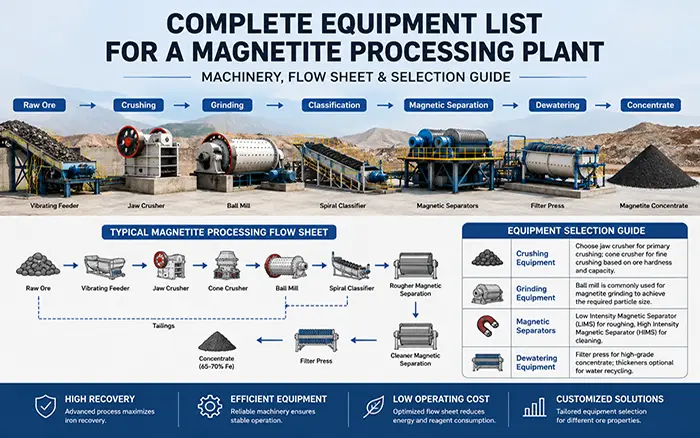
Magnetite beneficiation typically involves:
Multi-stage crushing
Fine grinding
Magnetic separation
Concentrate filtration
Because magnetite particles often require finer liberation, grinding energy consumption is usually higher.
However, magnetic separation itself is highly efficient and relatively low in energy demand.
Hematite Processing Energy Requirements
Hematite processing may require:
Crushing and screening
Gravity separation
Flotation
High-intensity magnetic separation
In some deposits, hematite can be upgraded with less grinding, reducing power consumption. However, complex beneficiation circuits may offset part of these energy savings.
Energy Comparison Summary
| Factor | Magnetite | Hematite |
|---|---|---|
| Grinding Energy | Higher | Lower to Moderate |
| Separation Energy | Lower | Higher |
| Overall Energy Demand | Moderate to High | Moderate |
The actual energy requirement depends on ore characteristics and plant design.
Processing Cost Comparison
Processing costs include energy, consumables, maintenance, labor, and equipment investment.
Magnetite Processing Costs
Advantages:
Efficient magnetic separation
Lower reagent consumption
Stable concentrate quality
Challenges:
Higher grinding costs
Larger power consumption for fine grinding
Hematite Processing Costs
Advantages:
Potentially lower grinding costs
Simpler processing for some high-grade ores
Challenges:
Higher reagent consumption in flotation
More complex separation circuits
Greater sensitivity to ore variability
Cost Comparison Summary
| Cost Factor | Magnetite | Hematite |
|---|---|---|
| Grinding Cost | Higher | Lower |
| Reagent Cost | Lower | Higher |
| Operating Stability | Higher | Moderate |
| Maintenance Cost | Moderate | Moderate to High |
Recovery Rate Comparison
Recovery rate directly affects plant profitability.
Magnetite Recovery
Because of its strong magnetic properties, magnetite can often achieve high recovery rates through magnetic separation.
Typical recovery rates:
85%–98%
Hematite Recovery
Hematite recovery depends heavily on ore characteristics and beneficiation methods.
Typical recovery rates:
70%–90%
Complex mineral associations can reduce recovery efficiency.
Recovery Comparison
| Parameter | Magnetite | Hematite |
|---|---|---|
| Typical Recovery | 85%–98% | 70%–90% |
| Process Stability | High | Moderate |
| Concentrate Consistency | High | Moderate |
ROI Comparison
Return on investment depends on capital expenditure, operating costs, product quality, and recovery rates.
Magnetite ROI
Magnetite projects often require:
Higher initial capital investment
Larger grinding circuits
More advanced processing equipment
However, the benefits include:
High recovery rates
Consistent concentrate quality
Stable long-term production
Hematite ROI
Hematite projects may offer:
Lower initial capital requirements
Faster project development
Simpler plant designs in some cases
However, ROI can be affected by:
Variable ore quality
Lower recovery rates
Higher reagent costs
ROI Assessment
For long-life mining projects, magnetite operations often provide stronger long-term returns due to higher recovery and concentrate quality.
For smaller deposits or higher-grade resources, hematite projects may achieve faster payback periods and lower upfront investment.
Factors Influencing the Best Processing Choice
Selecting between magnetite and hematite processing depends on several factors:
Ore Grade
Higher-grade hematite may require less beneficiation.
Ore Mineralogy
Mineral associations determine liberation and separation difficulty.
Energy Costs
Regions with high electricity prices may favor less energy-intensive processing routes.
Market Requirements
Premium iron concentrates may justify higher processing costs.
Project Scale
Large-scale projects often benefit from the long-term efficiency of magnetite beneficiation.
Choosing the Right Iron Ore Processing Strategy
The choice between magnetite and hematite processing should be based on detailed mineralogical testing, economic analysis, and long-term production goals. While magnetite beneficiation typically offers higher recovery rates and more consistent concentrate quality, hematite processing may provide lower upfront costs and simpler plant configurations for suitable deposits.
Understanding energy consumption, operating costs, recovery performance, and ROI helps mining companies develop the most profitable iron ore processing solution.