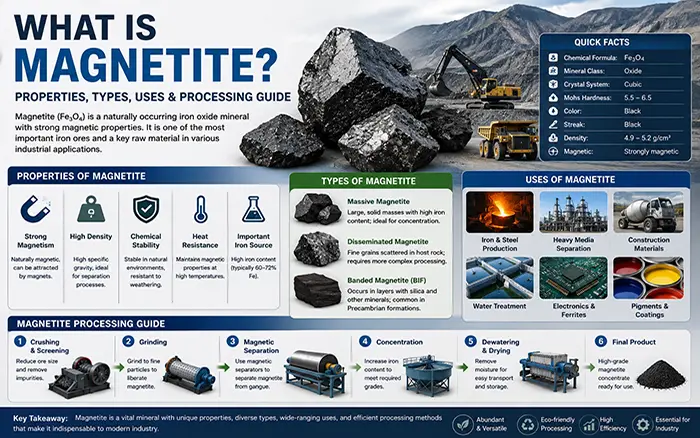
Magnetite is one of the world's most important iron ore resources due to its high iron content, excellent magnetic properties, and suitability for producing premium-grade concentrates. Unlike direct shipping ores (DSO), most magnetite deposits require beneficiation before they can be used in steelmaking. A typical processing plant involves several stages, including crushing, grinding, magnetic separation, dewatering, and tailings management.
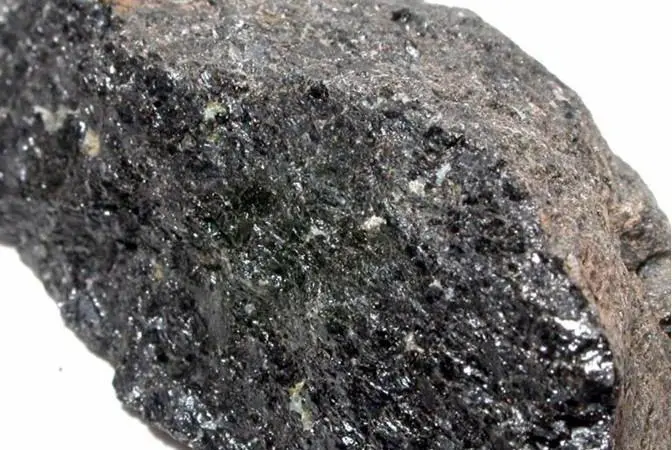
Choosing the correct equipment for each stage is critical to maximizing recovery, improving concentrate grade, reducing energy consumption, and lowering operating costs. Whether you are planning a new project or upgrading an existing facility, understanding the complete equipment list for a magnetite processing plant helps ensure efficient plant design and reliable production.
This guide introduces the complete magnetite beneficiation process, explains the function of each major machine, and provides practical recommendations for selecting equipment based on plant capacity and ore characteristics.
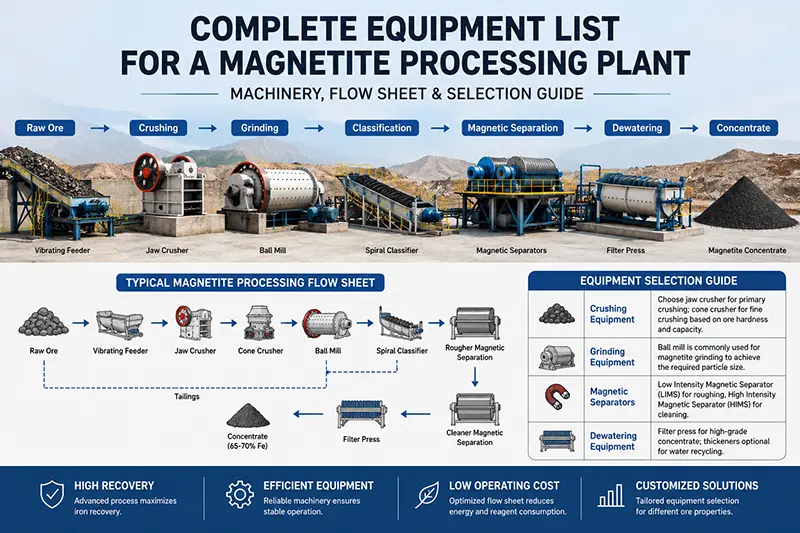
Typical Magnetite Processing Flow Sheet
A standard magnetite beneficiation plant generally follows the process below:
Raw Ore → Primary Crushing → Secondary Crushing → Grinding → Classification → Low Intensity Magnetic Separation (LIMS) → Regrinding (Optional) → Cleaning Magnetic Separation → Concentrate Thickening → Filtration → Final Magnetite Concentrate
Each stage requires specialized equipment designed to maximize mineral liberation and magnetic recovery.
Stage 1: Crushing Equipment
The crushing stage reduces large run-of-mine (ROM) ore into smaller particles suitable for grinding.
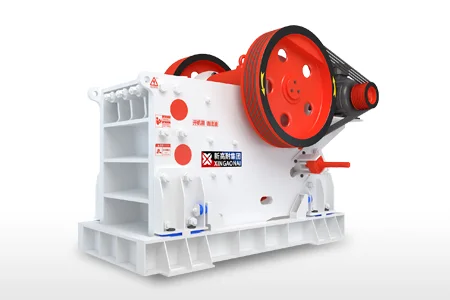
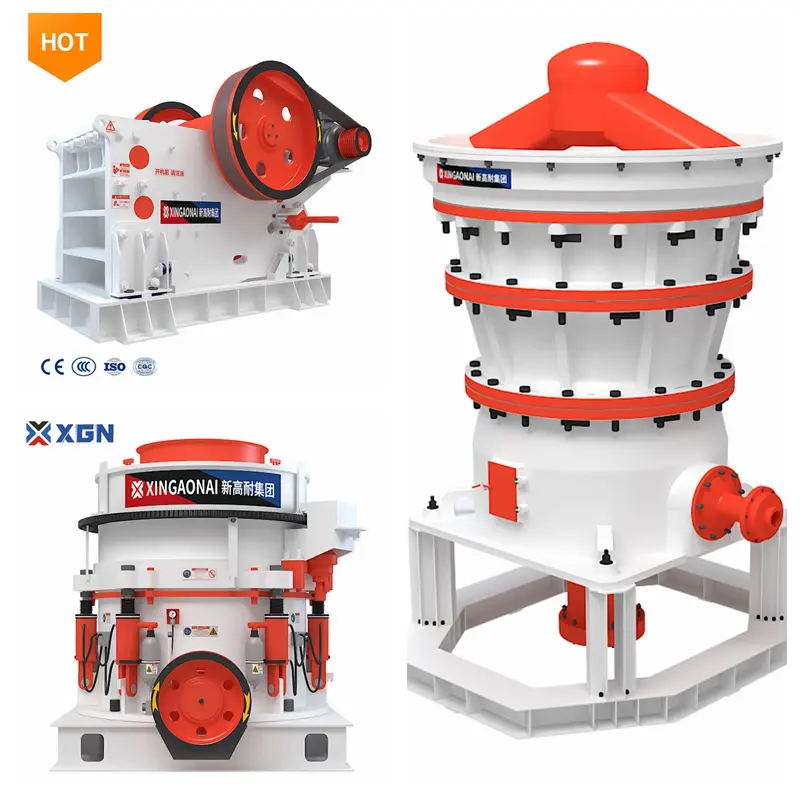
Jaw Crusher
The jaw crusher is usually the primary crusher.
Functions include:
Crushing large rocks up to 1,200 mm
Reducing material to 150–300 mm
Handling hard and abrasive ores
Providing reliable continuous operation
Jaw crushers are suitable for small to medium-sized magnetite plants.
Gyratory Crusher
Large-scale mines often use gyratory crushers instead of jaw crushers.
Advantages include:
Extremely high capacity
Continuous crushing
Lower operating cost per ton
Suitable for capacities above 1,000 TPH
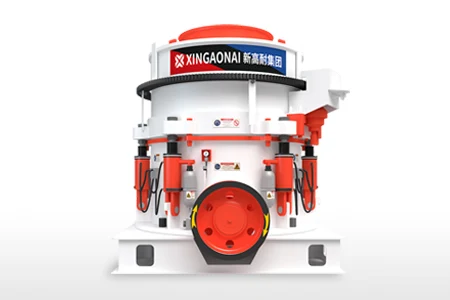
Cone Crusher
Cone crushers perform secondary and tertiary crushing.
Typical discharge size:
10–30 mm
Benefits include:
Uniform product size
High crushing efficiency
Reduced energy consumption in grinding
Improved downstream performance
Stage 2: Grinding Equipment
Grinding liberates magnetite from gangue minerals and is one of the most important stages in the beneficiation process.
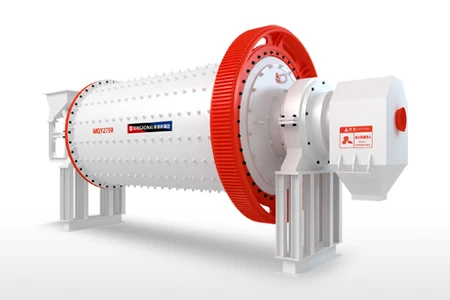
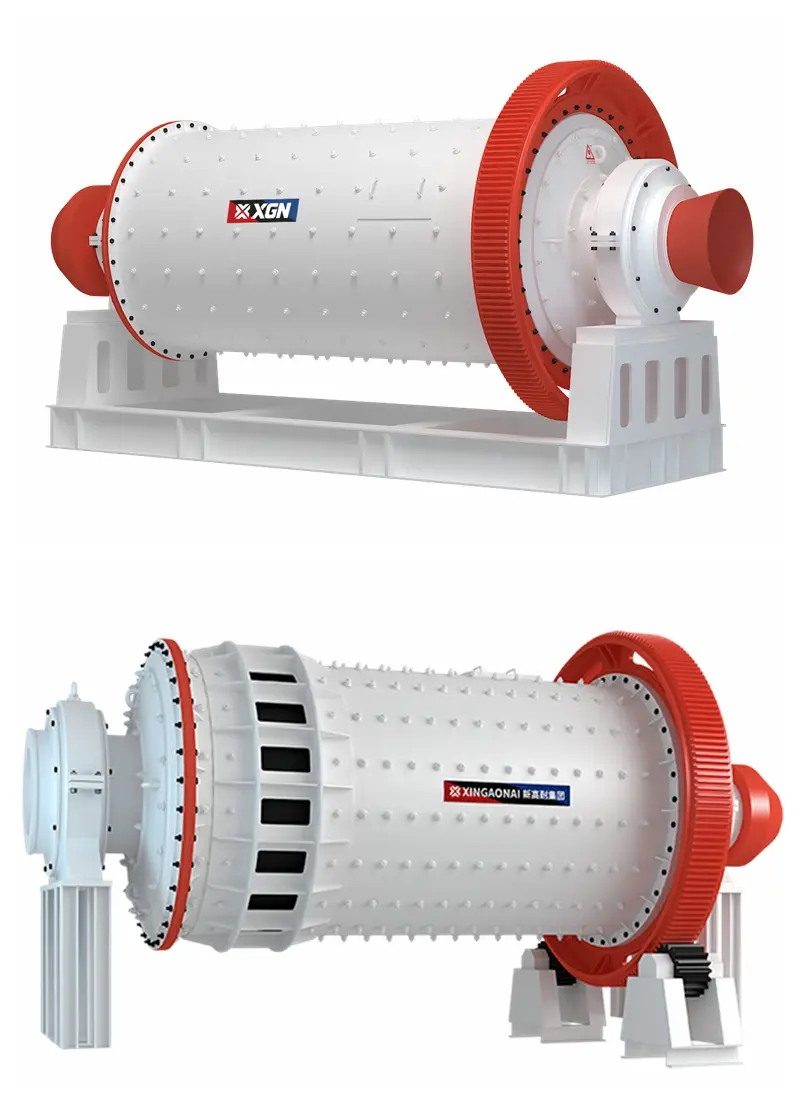
Ball Mill
Ball mills are the most widely used grinding machines for magnetite processing.
Advantages include:
High grinding efficiency
Stable operation
Suitable for fine grinding
Excellent compatibility with magnetic separation circuits
Typical grinding fineness:
70–90% passing 75 μm
Rod Mill
Rod mills are sometimes used before ball mills to reduce overgrinding.
Suitable for:
Coarse grinding
Feed preparation
Multi-stage grinding circuits
Stage 3: Classification Equipment
Proper classification ensures that only adequately ground material enters the magnetic separator.
Hydrocyclone
Hydrocyclones separate particles based on size.
Advantages include:
High classification efficiency
Compact design
Low operating cost
Continuous operation
Oversized particles are returned to the grinding circuit, while fine particles proceed to magnetic separation.
Stage 4: Magnetic Separation Equipment
Magnetic separation is the core of a magnetite processing plant.
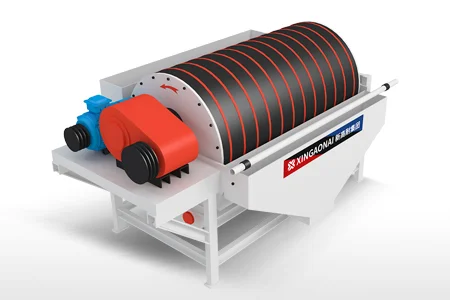
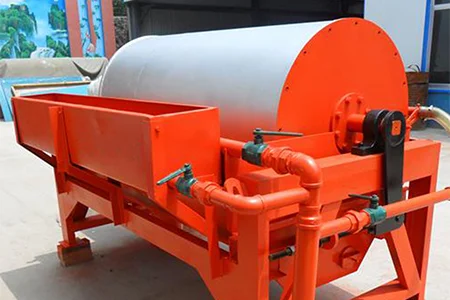
Low Intensity Magnetic Separator (LIMS)
Because magnetite is strongly magnetic, Low Intensity Magnetic Separation (LIMS) is the preferred beneficiation method.
Main advantages include:
High iron recovery
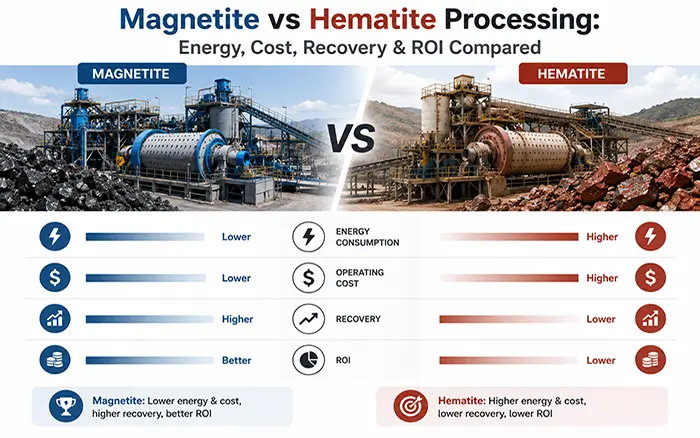
Low energy consumption
Continuous operation
Low maintenance
High processing capacity
Typical magnetic field strength:
800–2,000 Gauss (0.08–0.20 Tesla)
Rougher Magnetic Separator
The rougher separator performs the first recovery of magnetite after grinding.
Its primary objective is to maximize recovery.
Cleaner Magnetic Separator
Cleaner magnetic separators improve concentrate quality by removing remaining gangue minerals.
Multiple cleaning stages are common in high-grade concentrate production.
Scavenger Magnetic Separator
Scavenger separators recover magnetite remaining in tailings.
This reduces iron losses and increases overall plant recovery.
Stage 5: Regrinding Equipment (Optional)
For finely disseminated magnetite ores, intermediate concentrates may require additional grinding.
Common equipment includes:
Ball mills
Vertical stirred mills
Tower mills
Regrinding improves mineral liberation before final cleaning.
Stage 6: Concentrate Dewatering Equipment
After magnetic separation, concentrate slurry contains significant amounts of water and must be dewatered.
Thickener
The thickener increases slurry concentration before filtration.
Benefits include:
Water recovery
Reduced filtration load
Lower operating costs
Ceramic Vacuum Filter
Ceramic filters provide:
Low moisture content
Low energy consumption
High filtration efficiency
They are widely used in modern iron ore concentrators.
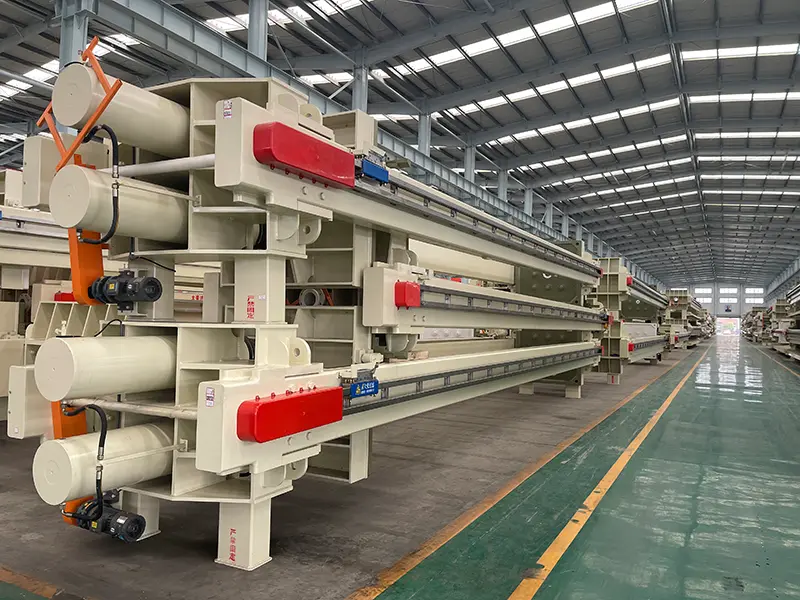
Plate and Frame Filter Press
Filter presses are suitable when very low concentrate moisture is required.
Advantages include:
High dewatering efficiency
Low final moisture
Easy transportation of concentrate
Stage 7: Tailings Handling Equipment
Modern processing plants require efficient tailings management.
Tailings Thickener
Functions include:
Water recovery
Reduced tailings volume
Improved environmental performance
Tailings Pumps
Heavy-duty slurry pumps transport tailings safely to storage facilities.
Tailings Storage Facility (TSF)
A properly designed TSF ensures:
Environmental compliance
Water recycling
Safe tailings disposal
Material Handling Equipment
Efficient material transportation is essential throughout the processing plant.
Common equipment includes:
Belt conveyors
Transfer conveyors
Feed hoppers
Vibrating feeders
Apron feeders
Stackers
Reclaimers
Proper conveying systems reduce labor costs and improve production efficiency.
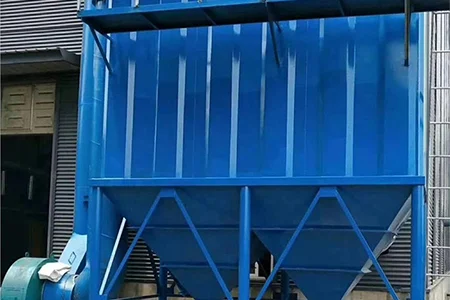
Dust Collection and Environmental Equipment
Modern beneficiation plants must comply with environmental regulations.
Common environmental equipment includes:
Bag dust collectors
Cyclone dust collectors
Water spray systems
Noise reduction equipment
Wastewater recycling systems
These systems improve workplace safety while reducing environmental impact.
Electrical and Automation Systems
Automation improves plant stability and reduces operating costs.
Typical systems include:
PLC control systems
SCADA monitoring
Variable Frequency Drives (VFDs)
Automatic sampling systems
Online particle size analyzers
Flow meters
Density meters
Metal detectors
Digital process control enables real-time monitoring and optimization of production.
Complete Equipment List for a Magnetite Processing Plant
| Process Stage | Main Equipment |
|---|---|
| Feeding | Hopper, Apron Feeder, Vibrating Feeder |
| Primary Crushing | Jaw Crusher or Gyratory Crusher |
| Secondary Crushing | Cone Crusher |
| Screening | Vibrating Screen |
| Grinding | Ball Mill, Rod Mill |
| Classification | Hydrocyclone |
| Magnetic Separation | Low Intensity Magnetic Separator (LIMS) |
| Regrinding | Ball Mill or Vertical Stirred Mill |
| Cleaning | Cleaner Magnetic Separator |
| Concentrate Thickening | Thickener |
| Filtration | Ceramic Filter or Filter Press |
| Tailings Treatment | Tailings Thickener, Slurry Pump, TSF |
| Material Handling | Belt Conveyor |
| Dust Collection | Bag Filter, Cyclone |
| Automation | PLC, SCADA, VFD |
How to Select the Right Equipment
Equipment selection depends on several technical and economic factors.
Consider:
Ore grade
Mineral liberation size
Plant capacity
Required concentrate grade
Recovery target
Water availability
Energy costs
Environmental regulations
Future expansion plans
Laboratory beneficiation tests and pilot-scale studies are recommended before selecting major equipment.
Why Equipment Integration Matters
Selecting high-quality machines is only one part of building a successful magnetite processing plant. The greatest efficiency is achieved when crushers, grinding mills, magnetic separators, dewatering equipment, and automation systems are properly integrated into a well-designed process flow.
A balanced circuit minimizes energy consumption, improves iron recovery, reduces operating costs, and ensures stable long-term production. Working with an experienced equipment manufacturer and conducting detailed process testing before plant construction can significantly improve the overall return on investment.