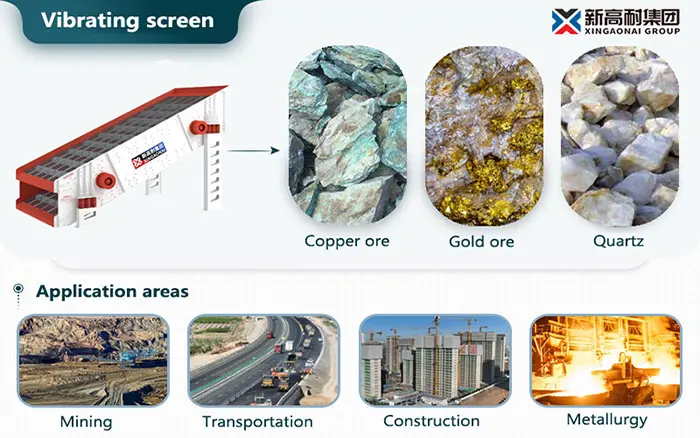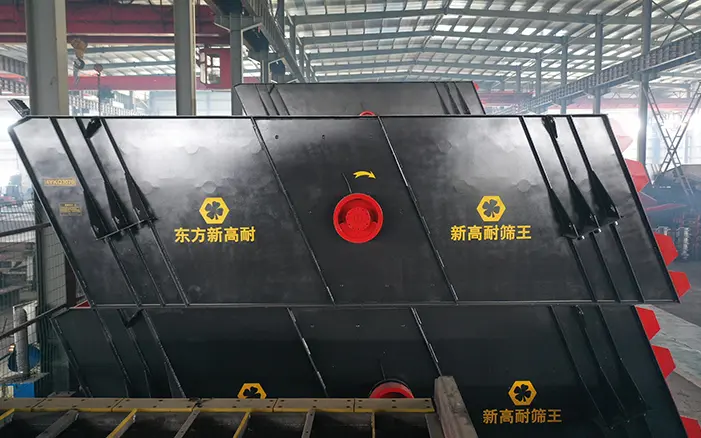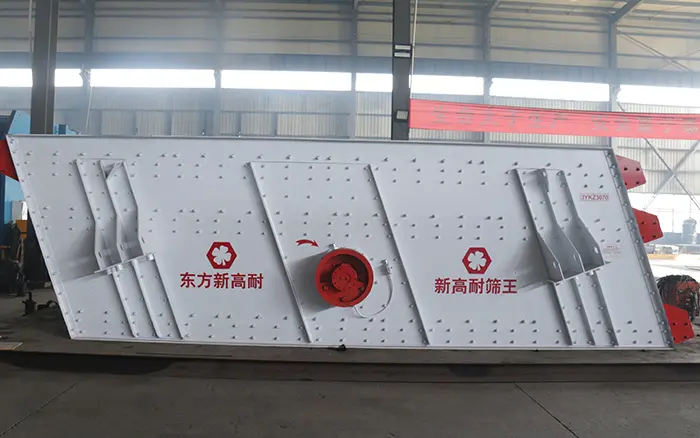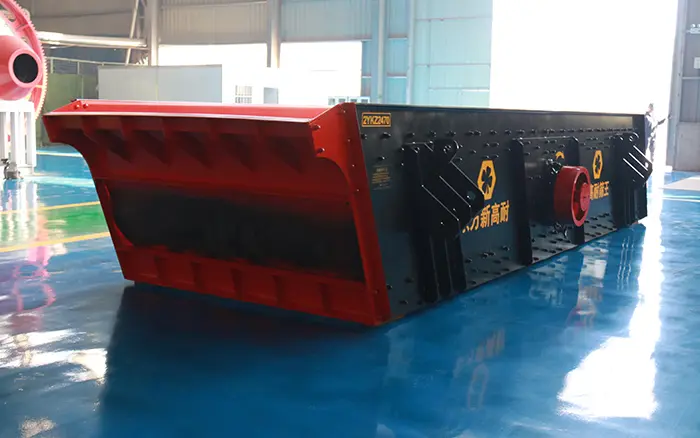
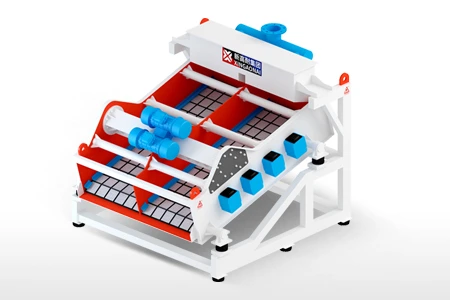
Choosing an industrial vibrating screen requires more than comparing machine dimensions and motor power. The correct screen must match the feed material, required capacity, separation size, moisture condition, number of products and installation layout.
An undersized screen can restrict the capacity of the entire production line. An incorrectly selected motion type may cause poor material distribution, low screening efficiency or frequent aperture blinding. An oversized machine, meanwhile, increases equipment, foundation and operating costs without necessarily improving product quality.
As a practical starting point:
Choose a circular vibrating screen for coarse and medium-sized aggregate or mineral classification where strong material stratification and high throughput are required.
Choose a linear vibrating screen when controlled material transport, horizontal or low-angle installation, or multiple product fractions are required.
Choose a high-frequency vibrating screen for fine classification, fine mineral screening or applications requiring high-frequency, low-amplitude vibration.
Consider wet screening, dewatering or anti-blinding measures when the feed contains significant moisture, clay or sticky fines.
The final model and screen size must still be confirmed using actual feed data and required operating conditions.
Vibrating Screen Selection Checklist
Before requesting a quotation or selecting a model, collect the following information:
| Required information | Why it matters |
|---|---|
| Material type | Influences screen motion, wear protection and media selection |
| Maximum feed size | Determines feed-end strength and acceptable aperture arrangement |
| Feed size distribution | Determines screen loading and the proportion of near-size particles |
| Required capacity | Determines screen width and total screening area |
| Required product sizes | Determines aperture sizes and the number of decks |
| Bulk density | Converts mass throughput into volumetric loading |
| Moisture content | Helps determine dry, wet or dewatering operation |
| Clay and sticky fines | Indicates the risk of blinding and material buildup |
| Abrasiveness | Determines screen media and wear-liner materials |
| Required efficiency | Influences screen length and effective deck area |
| Daily operating hours | Affects equipment duty, bearing design and maintenance planning |
| Installation conditions | Determines support structure, inclination and maintenance access |
| Project location | Affects motor selection, elevation correction and environmental protection |
If these parameters are incomplete, a manufacturer can provide only a preliminary recommendation.
Circular, Linear or High-Frequency Vibrating Screen?
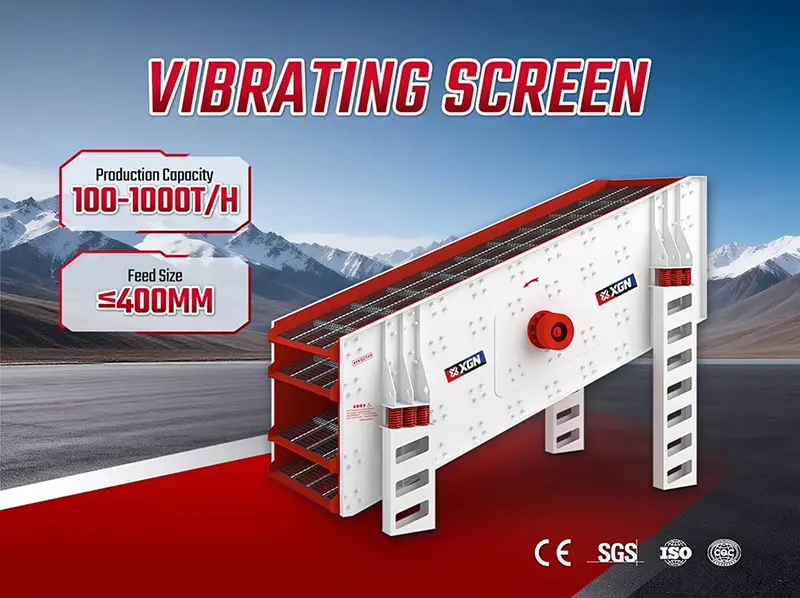
The first major decision is the required vibration motion. No single vibrating screen type is suitable for every material or separation task.
| Screen type | Typical strengths | Common applications |
|---|---|---|
| Circular vibrating screen | Strong material agitation, good stratification and high throughput | Aggregate, quarrying, mining and coarse mineral classification |
| Linear vibrating screen | Controlled material movement, flexible deck arrangement and low-angle installation | Mining, coal, bulk materials and multi-size classification |
| High-frequency vibrating screen | High-frequency, low-amplitude operation for fine particles | Fine mineral classification and fine-particle screening |
| Dewatering screen | Removes water while retaining solids | Sand washing, mineral concentrates and tailings treatment |
For a more detailed explanation of the available designs, see Types of Vibrating Screens.
Circular vibrating screen
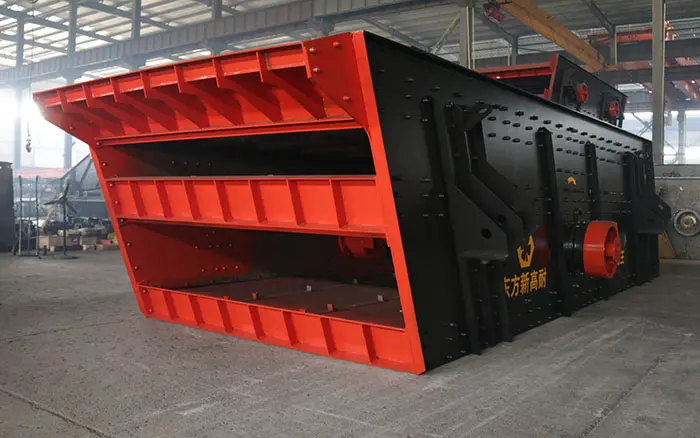
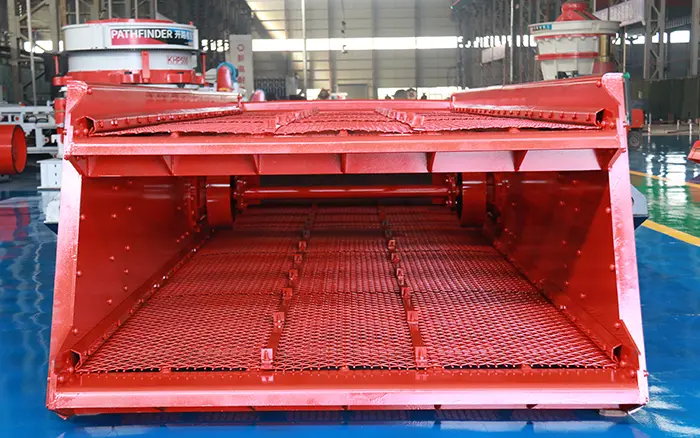
A Circular Vibrating Screen produces an approximately circular or elliptical material trajectory. The machine is normally installed at an inclined angle so that gravity and vibration move the material toward the discharge end.
This design is commonly used for:
Crushed stone classification
Quarry and aggregate production
Coal and mineral screening
Crusher discharge screening
Medium and coarse particle separation
Multi-deck aggregate production
Circular motion creates strong agitation of the material bed, helping smaller particles move downward and reach the screen apertures.
Linear vibrating screen
A Linear Vibrating Screen generally uses two synchronized vibration sources to generate a straight-line material trajectory.
Linear vibrating screens provide controlled material transport and can be configured for dry or wet classification across different bulk-material applications. Their suitability depends on feed size, bulk density, required capacity, deck arrangement and the specific machine design.
Typical applications include:
Mineral and coal classification
Aggregate sizing
Bulk-material separation
Multi-product screening
Horizontal or low-angle installations
Production lines with limited installation height
Linear screens should not be described only as machines for light, fine or low-hardness materials. Industrial linear screens can process heavier materials when their structure, excitation system and screen media are designed for the application.
High-frequency vibrating screen
A High Frequency Electromagnetic Vibrating Screen operates with relatively high vibration frequency and low amplitude.
It is generally considered for:
Fine mineral classification
Fine iron ore screening
Fine coal classification
Concentrate screening
Applications requiring controlled fine-particle separation
The achievable cut size and capacity depend on the machine model, screen media, feed concentration, particle-size distribution and operating conditions. They should be confirmed through manufacturer calculations or material testing.
Factor 1: Feed Material Characteristics
Material properties are the foundation of vibrating screen selection. Two plants requiring the same nominal capacity may need very different machines if their feed materials behave differently.
Particle-size distribution
The feed-size distribution indicates how much material is larger than, smaller than or close to the required aperture size.
Near-size particles are especially important. These are particles close to the aperture dimension and are generally more difficult to classify than material that is clearly oversized or undersized.
A feed containing a high percentage of near-size particles may require:
More screen area
Longer material retention time
More accurate feed distribution
A different aperture shape
A lower deck loading rate
A representative sieve analysis is therefore more useful than providing only the maximum feed size.
Bulk density
Bulk density affects the volume of material moving across the screen.
A screen processing 200 TPH of dense iron ore handles a different material volume from a screen processing 200 TPH of a lighter bulk material. Bulk density is therefore required when calculating deck loading and required screen width.
Particle shape
Rounded particles generally pass through apertures more easily than flat or elongated particles.
Elongated particles may pass through square apertures in an undesirable orientation or become trapped in the openings. Depending on the product specification, slotted apertures or a different screen-media design may be more suitable.
Abrasiveness
Granite, basalt, silica-rich materials and many metallic ores can cause rapid screen-media wear.
Highly abrasive applications may require:
Wear-resistant side liners
Polyurethane or rubber screen panels
Reinforced feed-box protection
Replaceable impact-zone panels
More frequent media inspections
The most wear-resistant media is not automatically the most efficient. Wear life, open area and screening capacity must be balanced.
Factor 2: Required Cut Size and Product Fractions
The required final products determine the aperture sizes and number of screen decks.
Aperture size
The aperture is selected according to the required separation size, but the nominal opening alone does not guarantee the final product specification.
Actual separation performance is also affected by:
Feed-size distribution
Particle shape
Screen-media thickness
Percentage of open area
Material moisture
Vibration parameters
Screen inclination
Feed rate
Required product purity
The selected aperture may need to be adjusted after considering these factors.
Aperture shape
Common aperture shapes include:
Square apertures: widely used for general aggregate and mineral classification.
Slotted apertures: provide greater open area and may help process elongated particles.
Round apertures: can provide a more controlled opening shape but usually have a lower open area.
Special anti-blinding apertures: used where pegging or clogging is likely.
Number of product fractions
A single-deck screen normally produces two material streams:
Oversize retained on the screen
Undersize passing through the screen
A double-deck screen can normally produce three size fractions, while a triple-deck screen can produce four fractions.
The required number of products should be determined before selecting the machine. Adding decks later may require major changes to the screen body, chutes, conveyors and supporting structure.
For additional information, see the Double Deck Vibrating Screen guide.
Factor 3: Required Capacity and Screen Size
Required throughput is one of the primary factors determining screen width and total deck area.
As a general engineering principle:
Screen width mainly affects material-carrying capacity.
Screen length mainly affects the time available for particles to stratify and pass through the apertures.
However, screen area should not be selected from throughput alone. The calculation must also consider:
Aperture size
Bulk density
Near-size particle content
Moisture
Screen inclination
Open area of the screen media
Number of decks
Required screening efficiency
Feed distribution
Material bed depth
Why catalogue capacity is not enough
Catalogue capacities are usually based on specified reference conditions. The same screen may achieve very different production rates when processing coarse dry aggregate, fine moist sand or clay-bearing mineral feed.
Therefore, capacity values should be treated as preliminary references rather than guaranteed production figures.
Capacity reserve
A reasonable design margin may be considered for:
Normal feed fluctuations
Seasonal changes in moisture
Variation between ore zones
Media wear
Future production increases
However, selecting a substantially oversized screen can raise capital cost and energy use. The design margin should be based on realistic operating variation rather than a fixed percentage applied to every project.
Factor 4: Moisture, Clay and Wet or Dry Screening
Moisture can significantly change how material behaves on a screen.
Fine wet particles may adhere to larger particles or block screen openings. Clay-bearing materials can coat the screening surface, reducing the effective open area and causing rapid performance loss.
Dry screening
Dry screening is generally suitable when:
Material flows freely
Screen apertures remain open
The product does not require washing
Water is unavailable or undesirable
Dust can be controlled appropriately
Dry screening is simpler because it does not require pumps, water supply, slurry collection or downstream dewatering equipment.
Wet screening
Wet screening should be considered when:
Fine particles adhere to coarse particles
Clay must be removed from the product
The finished aggregate requires washing
Dry apertures blind frequently
Fine-particle separation cannot be achieved reliably under dry conditions
Wet screening introduces additional requirements, including water supply, spray bars, slurry handling, drainage and water-recovery systems.
Dewatering
Dewatering screens are used primarily to remove water from solids rather than to produce multiple precise size fractions.
Common applications include:
Washed sand dewatering
Mineral concentrate dewatering
Fine coal treatment
Tailings treatment
Recovery of solids from slurry
The decision between dry screening, wet screening and dewatering should be based on material testing whenever moisture and clay conditions vary significantly.
Factor 5: Number of Screen Decks
The number of decks determines how many product sizes can be produced in one machine.
Single-deck screen
Choose a single-deck screen when:
Only one separation point is required.
The process needs an oversize and undersize product.
The screen is used for scalping before a crusher.
Maximum capacity through one screening surface is the priority.
Double-deck screen
Choose a double-deck screen when:
Three product streams are required.
A coarse top deck must protect a finer lower deck.
Space is limited and multiple separations must occur in one machine.
An aggregate plant needs two cut sizes.
Triple-deck screen
Choose a triple-deck screen when four products must be produced in a compact plant layout.
A triple-deck design can save floor space, but it also introduces:
More complicated chute arrangements
Restricted access to lower decks
More demanding feed distribution
Additional screen-media maintenance
Greater risk of product cross-contamination if discharge chutes are poorly designed
The number of decks should be selected together with the entire product-handling layout, not as an isolated equipment feature.
Factor 6: Screen Media
Screen media directly affects throughput, separation accuracy, wear life, blinding and maintenance cost.
| Screen media | Main advantage | Main limitation | Typical application |
|---|---|---|---|
| Woven wire mesh | High open area and good throughput | Shorter wear life in abrasive applications | Dry aggregate and general classification |
| Polyurethane panels | Good wear resistance and reduced noise | Lower open area than many wire meshes | Wet screening, abrasive materials and fine classification |
| Rubber panels | High impact resistance | Lower open area | Coarse feed zones and heavy-impact applications |
| Perforated plate | High structural strength | Limited open area | Heavy-duty scalping and very coarse material |
| Anti-blinding media | Helps keep apertures open | Application-specific design | Sticky, damp or difficult near-size material |
Choosing screen media
Use woven wire mesh when maximizing open area and screening capacity is important and wear conditions are manageable.
Use polyurethane when longer wear life, reduced noise or wet-screening performance is more important than maximum open area.
Use rubber media in areas exposed to high impact from large feed particles.
Use perforated plate for coarse scalping where structural strength is more important than fine separation efficiency.
In some applications, different media types can be used on different parts of the same deck. For example, impact-resistant panels may be installed at the feed end and higher-open-area media toward the discharge end.
Factor 7: Required Screening Efficiency
Screening efficiency describes how effectively the screen separates particles according to the required cut size.
Higher efficiency may require:
A longer screen deck
A lower deck loading rate
Better feed distribution
Greater open area
More suitable screen media
Optimized vibration amplitude and frequency
Better moisture control
More frequent cleaning or maintenance
Efficiency should not be considered independently from capacity. Increasing feed rate may increase total production but reduce separation accuracy. Reducing feed rate may improve efficiency but prevent the plant from reaching its production target.
The correct design balances throughput, product quality and operating cost.
Read more about the factors influencing Vibrating Screen Efficiency.
Factor 8: Installation and Plant Integration
A vibrating screen must fit into the complete production circuit.
Feed distribution
Material should be distributed as evenly as possible across the usable deck width.
Concentrating feed on one side of the screen can cause:
Uneven media wear
Localized overloading
Reduced effective screen area
Lower screening efficiency
Product contamination
Structural stress
A distribution chute or suitable feeding equipment may be required before the screen.
Supporting structure
The support structure must be designed for both the static weight of the equipment and the dynamic forces generated during operation.
The equipment manufacturer should provide the relevant load and installation information to the plant designer. The support platform should also allow space for:
Screen movement
Spring inspection
Motor or exciter maintenance
Screen-media replacement
Chute cleaning
Safe operator access
Upstream and downstream equipment
The screen capacity should be coordinated with:
Crushers
Feeders
Conveyors
Storage bins
Washing equipment
Grinding mills
Magnetic or gravity separators
Product stockpiles
A screen that is correctly sized by itself can still become a bottleneck if the feed chute is too narrow or if the discharge conveyor cannot handle the product flow.
Recommended Vibrating Screen by Application
| Application | Recommended starting point | Main selection considerations |
|---|---|---|
| Quarry aggregate classification | Circular vibrating screen | Feed size, deck number, product specification and abrasiveness |
| Crusher discharge screening | Circular or heavy-duty linear screen | Impact load, oversize content and feed distribution |
| Multi-product mineral classification | Linear or multi-deck screen | Number of fractions, capacity and installation layout |
| Fine mineral screening | High-frequency vibrating screen | Fine-particle distribution, media and feed condition |
| Wet aggregate washing | Wet vibrating screen | Water demand, clay content and slurry handling |
| Sand dewatering | Dewatering screen | Feed concentration, required final moisture and water recovery |
| Sticky or clay-rich material | Wet screening or anti-blinding design | Moisture, clay content and aperture size |
| Limited-height installation | Linear vibrating screen | Deck angle, discharge arrangement and structural clearance |
This table provides a preliminary direction only. Final equipment selection should be based on actual project data.
Common Vibrating Screen Selection Mistakes
Choosing only by hourly capacity
Two materials with the same TPH can require different screen areas because of differences in bulk density, particle-size distribution, moisture and aperture size.
Ignoring near-size particles
A high percentage of particles close to the aperture size can significantly reduce screening efficiency. A complete sieve analysis should therefore be provided.
Using maximum feed size as the only material parameter
Maximum feed size does not show the proportion of fines, near-size particles or coarse material in the feed. Full feed gradation is more useful.
Underestimating moisture and clay
A screen selected using dry material samples may underperform during wet seasons. Material samples should represent the most difficult expected operating condition.
Selecting screen media only by wear life
A thick, wear-resistant panel may last longer but provide less open area. This can reduce capacity unless additional screen area is provided.
Ignoring the feed chute
Poor feed distribution can prevent a correctly sized screen from using its full deck area.
Choosing the lowest purchase price
Purchase price should be evaluated together with:
Screen-media replacement cost
Power consumption
Maintenance labor
Production losses
Spare-parts availability
Expected service life
Product-quality stability
Information to Send the Manufacturer
For an accurate recommendation, provide:
Material name
Maximum feed size
Complete feed-size distribution
Required capacity in TPH
Required product sizes
Bulk density
Moisture content
Clay or sticky-fines content
Material abrasiveness
Required screening efficiency
Dry or wet operation
Required number of products
Daily operating hours
Available installation space
Project location and elevation
Upstream and downstream equipment
When possible, send representative material samples or laboratory test results. This is particularly useful for fine, wet, sticky or highly variable feeds.
Conclusion
Selecting an industrial vibrating screen is a multi-variable engineering decision. Capacity is important, but it cannot be considered separately from material behavior, cut size, screen motion, number of decks, screen media, moisture and plant layout.
Start by defining the feed material and required products. Then compare circular, linear and high-frequency screens according to the application. Finally, confirm the required deck area, media, drive system and installation arrangement with the manufacturer.
For coarse aggregate and mineral classification, consider the Circular Vibrating Screen. For controlled material transport and flexible deck arrangements, review the Linear Vibrating Screen. For fine-particle classification, consider the High Frequency Electromagnetic Vibrating Screen.
Provide your feed-size distribution, required capacity, product sizes, moisture content and project location so that the screen model can be selected according to actual operating conditions.