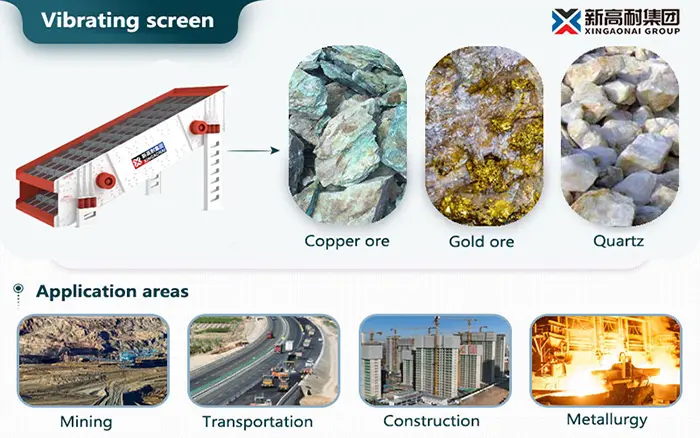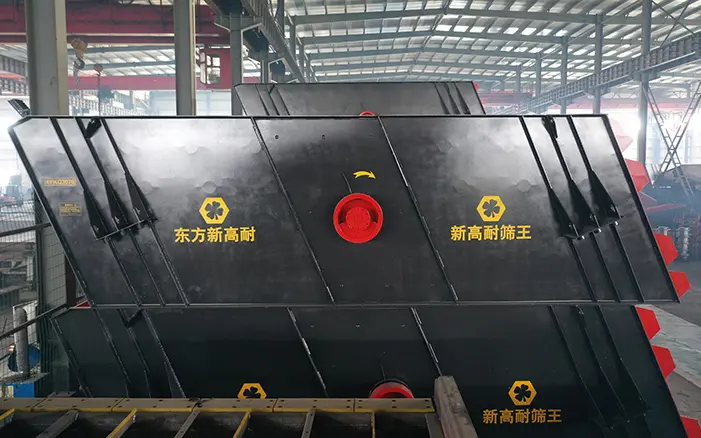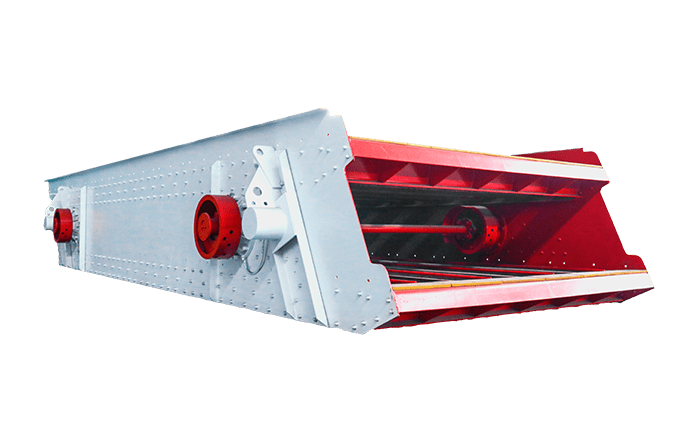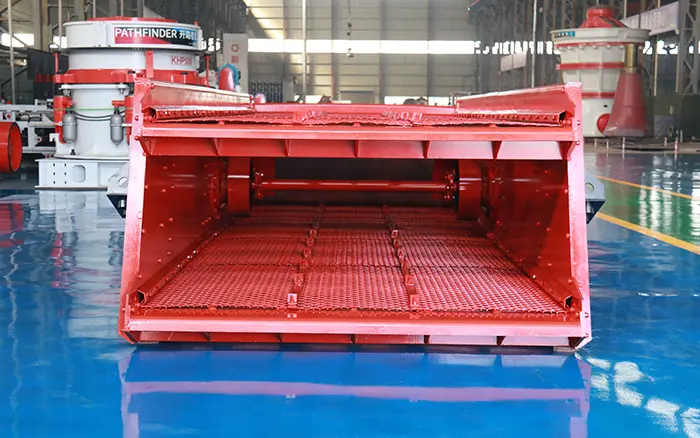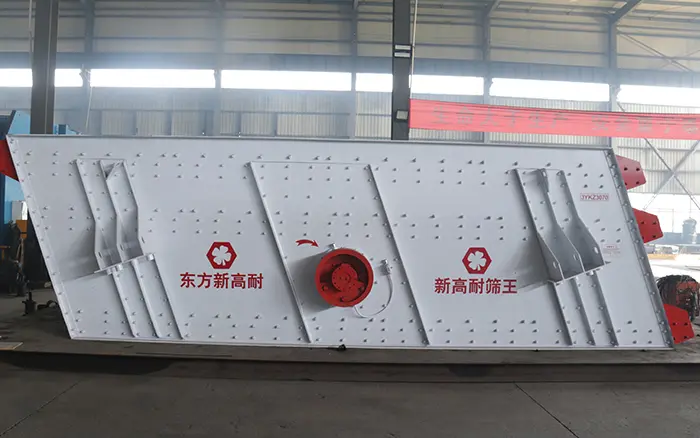
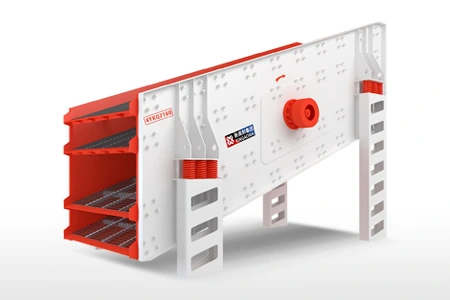
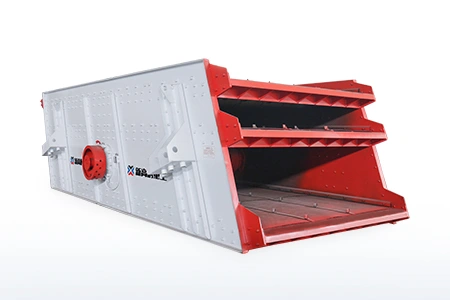
A double deck vibrating screen uses two screening surfaces installed one above the other to separate a single feed stream into up to three particle-size fractions. The upper deck removes the coarsest material, while material passing through it is classified again on the lower deck.
Double deck screens are commonly used in aggregate production, mining, quarrying and recycling when a process requires three product sizes but does not justify installing two separate screening machines. However, using two decks does not automatically guarantee higher capacity or better efficiency. Performance depends on feed gradation, moisture, near-size particle content, screen openings and available screening area.
This guide explains how a double deck vibrating screen works, how the two deck apertures should be arranged, how it differs from a single deck screen and what information is required for correct model selection.
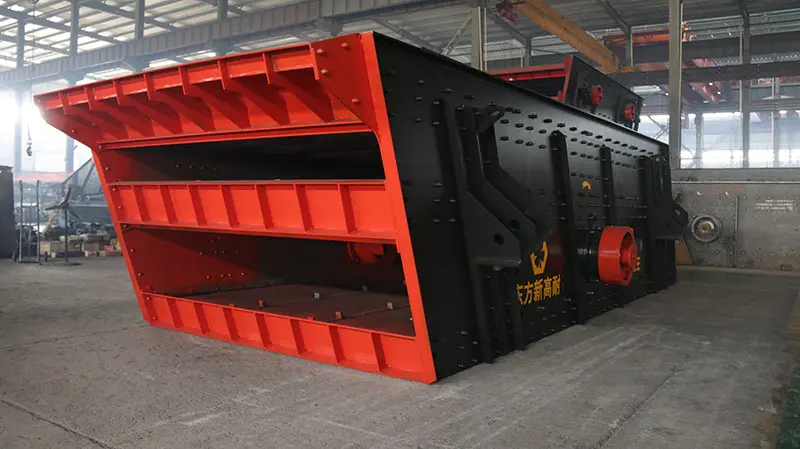
What Is a Double Deck Vibrating Screen?
A double deck vibrating screen is a screening machine with two screen decks arranged vertically inside one screen box. Each deck uses a selected aperture to make a different separation cut.
In a typical arrangement:
Material retained on the upper deck becomes the coarse product.
Material passing through the upper deck but retained on the lower deck becomes the intermediate product.
Material passing through both decks becomes the fine product.
A double deck screen can therefore produce up to three size fractions from one feed stream. The actual number of usable products depends on the discharge chutes and the plant process arrangement.
How Does a Double Deck Screen Produce Three Fractions?
Consider an aggregate plant that requires three products:
Larger than 20 mm
5–20 mm
Smaller than 5 mm
The upper deck uses a nominal 20 mm aperture. Material larger than this remains above the deck and exits through the coarse-product chute. Material passing through the upper deck falls onto the lower deck.
The lower deck uses a nominal 5 mm aperture. Material between 5 and 20 mm remains above the lower deck and becomes the intermediate product. Material smaller than 5 mm passes through the lower deck and becomes the fine product.
These values illustrate the deck arrangement only. The final apertures may need to differ from the nominal product sizes because particle shape, moisture, screen-media geometry and required product tolerance affect the practical separation point.
Working Principle of a Double Deck Vibrating Screen
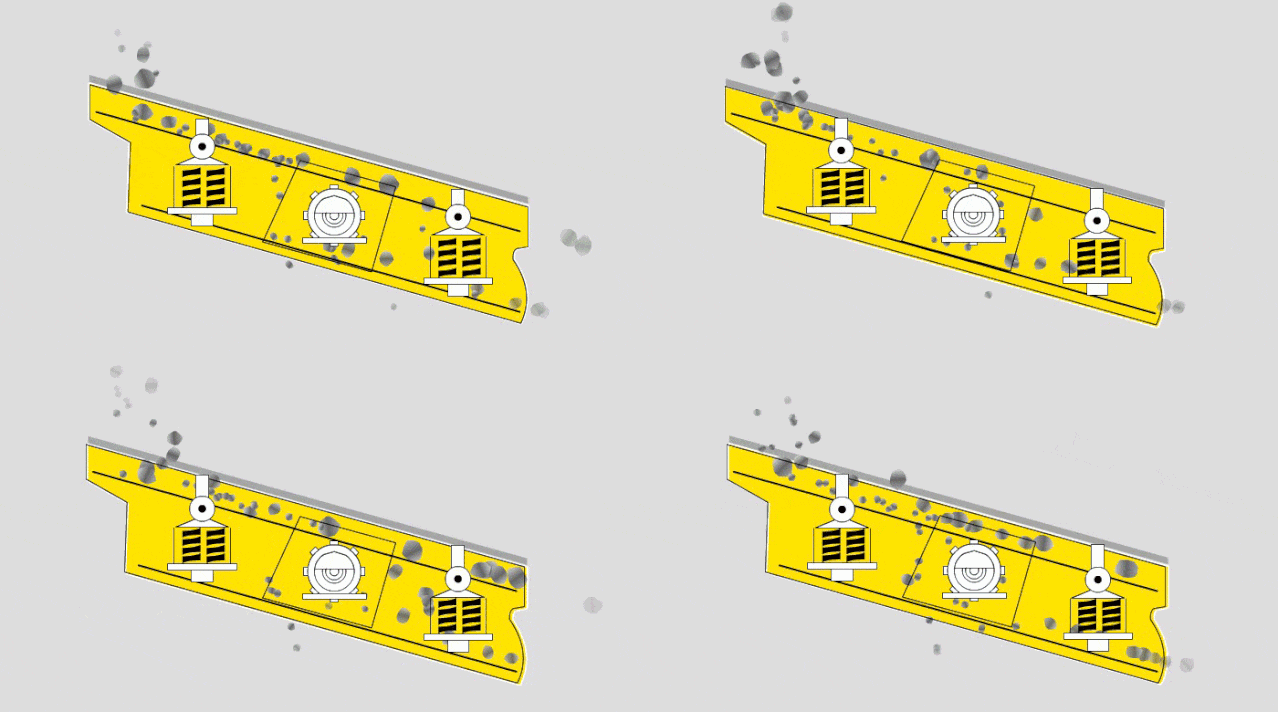
The drive and exciter generate a model-specific vibration trajectory in the screen box. Depending on the equipment design, this may be linear, circular or near-circular motion.
Feed material enters the upper deck through a feed chute and should be distributed across the usable screen width. Vibration causes the material bed to stratify. Smaller particles move toward the screen surface, while larger particles remain closer to the top of the bed.
Particles smaller than the upper-deck aperture pass to the lower deck, where they are classified again through a smaller aperture. Oversize material from each deck travels toward its corresponding discharge outlet, while lower-deck undersize is collected separately.
Screening performance depends on:
Uniform feed distribution
Material bed depth
Feed-size distribution
Percentage of near-size particles
Moisture and clay content
Screen-media open area
Vibration settings
Condition of both decks
For a broader explanation of stratification and particle passage, see the vibrating screen working principle.
Single Deck vs Double Deck Vibrating Screen
| Selection factor | Single deck | Double deck |
|---|---|---|
| Number of decks | One | Two |
| Separation cuts | One | Two |
| Maximum fractions | Two | Three |
| Equipment height | Usually lower | Usually higher |
| Internal access | Simpler | Lower-deck access is more restricted |
| Best use | Simple oversize/undersize separation | Three controlled product sizes |
| Chute arrangement | Simpler | Requires three separate discharge paths |
| Capacity | Depends on area and feed | Lower deck may become the limiting stage |
| Maintenance | One deck to inspect | Both decks and the space between them must be inspected |
A single deck screen is generally sufficient when the process requires only oversize and undersize products. A double deck vibrating screen is more suitable when three controlled size fractions are required.
A double deck design is not automatically better. If the feed contains a high percentage of fine or near-size particles, the lower deck may receive excessive loading and limit the capacity of the entire machine.
How to Select the Upper and Lower Deck Apertures
The upper-deck aperture must be larger than the lower-deck aperture. Selection should begin with the required product sizes, but nominal aperture size alone is not sufficient.
Consider:
Required product-size limits
Feed particle-size distribution
Particle shape and elongation
Near-size particle percentage
Material moisture and clay
Screen-media material
Percentage of open area
Required screening efficiency
Expected wear during operation
Example arrangements include:
| Required fractions | Upper deck | Lower deck |
|---|---|---|
| >40 mm / 20–40 mm / <20 mm | 40 mm | 20 mm |
| >20 mm / 5–20 mm / <5 mm | 20 mm | 5 mm |
| >10 mm / 3–10 mm / <3 mm | 10 mm | 3 mm |
These are arrangement examples, not universal selection specifications. Final openings should be confirmed using material data and product-quality requirements.
Linear vs Circular Double Deck Vibrating Screens
A double deck arrangement can be used with different screen motions.
A linear double deck screen uses directional vibration to move material across the decks. It can be considered for heavy-duty or high-throughput classification when its motion and deck arrangement suit the material.
XINGAONAI’s YKZ Series Linear Vibrating Screen is positioned for linear-motion screening in aggregate and mineral-processing applications.
A circular double deck screen normally uses circular or near-circular screen-box motion together with an inclined deck. It is commonly used for aggregate and mineral sizing.
The YKQ Series Circular Vibrating Screen is intended for conventional multi-deck classification duties.
Neither motion is universally superior. Selection depends on feed size, material behavior, target capacity, installation arrangement and required products.
Advantages
A correctly selected double deck vibrating screen can:
Produce up to three fractions in one machine
Complete two separation cuts in one screen box
Reduce the number of separate screening machines
Reduce transfer points and connecting conveyors
Use different screen media on the two decks
Offer flexible product-size combinations
Reduce plant footprint compared with two separate screens
These advantages depend on correct sizing and feed distribution. A second deck does not guarantee greater total throughput.
Limitations
Important limitations include:
The lower deck is harder to inspect and replace.
Fine or sticky material may blind the lower deck.
The machine normally requires more installation height.
The supporting structure must carry greater equipment and dynamic loads.
Three product streams require a more complex chute arrangement.
Damage to either deck can contaminate finished products.
Poor feed distribution on the upper deck affects both separation stages.
Common Applications
Aggregate production
A double deck screen can separate crushed stone into coarse, intermediate and fine products after secondary or tertiary crushing.
Mining and mineral processing
It can remove oversize material before downstream processing or prepare multiple ore-size fractions after crushing.
Manufactured sand
Selected configurations can separate coarse aggregate, usable sand and fine material, subject to the required cut sizes and moisture conditions.
Construction-waste recycling
The screen can classify crushed concrete, brick and mineral fractions after metal and light-contaminant removal.
Coal and industrial minerals
Double deck configurations can produce multiple product sizes when moisture, friability and dust-control requirements have been evaluated.
How to Select a Double Deck Vibrating Screen
Provide the following information before model selection:
Material name
Bulk density
Maximum feed size
Complete feed-size distribution
Required three product fractions
Target capacity
Moisture and clay content
Percentage of near-size particles
Dry or wet screening requirement
Preferred screen media
Installation space
Power supply
Project location
Capacity should be checked separately for the upper and lower decks. The lower deck often becomes the limiting stage because it receives all material passing through the upper deck.
For broader equipment comparison, see types of vibrating screens.
Inspection Points
Operators should:
Inspect both screen decks for wear or damage.
Check for material accumulation between the decks.
Confirm that all three discharge paths remain clear.
Check screen-panel fastening and tension.
Inspect springs for damage or uneven compression.
Monitor abnormal noise and vibration.
Apply lockout/tagout before working between the decks.
See the vibrating screen maintenance guide for routine maintenance and the vibrating screen troubleshooting guide for fault diagnosis.
Conclusion
A double deck vibrating screen is useful when one feed stream must be separated into three controlled size fractions. Its value comes from completing two separation cuts within one screen box, but correct performance depends on deck loading, aperture selection, material properties and feed distribution.
The correct machine should be selected using actual material and process data rather than capacity alone.