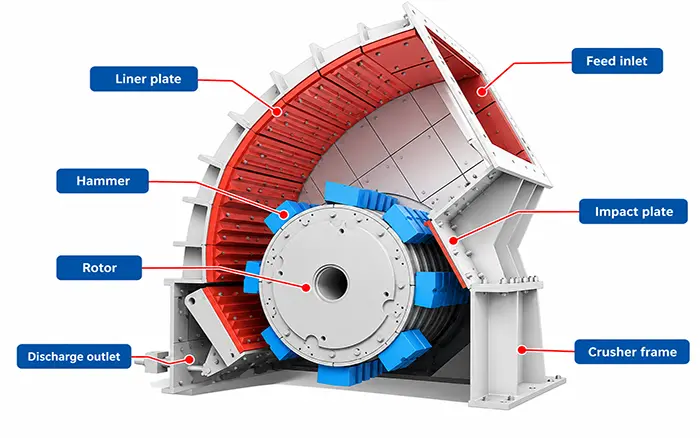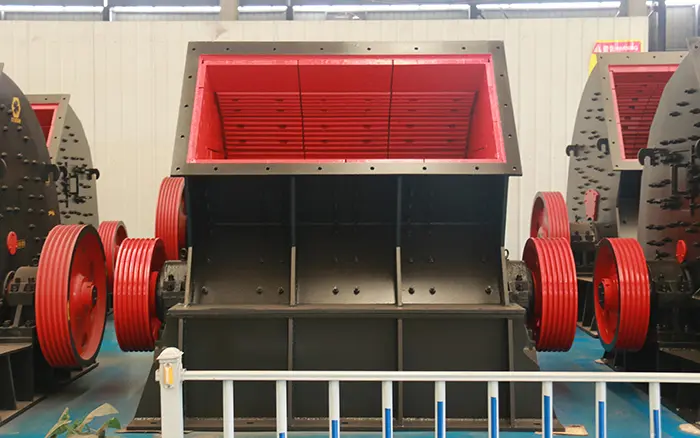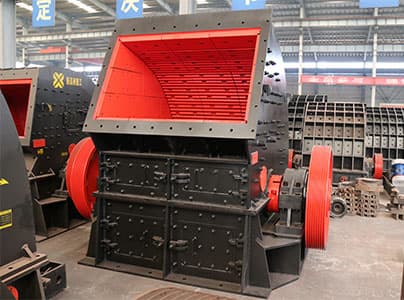
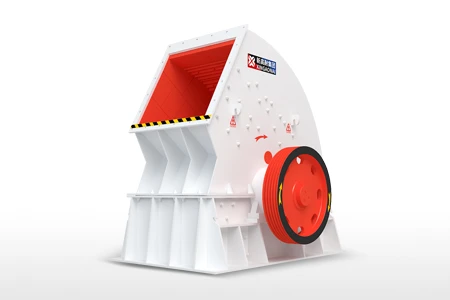
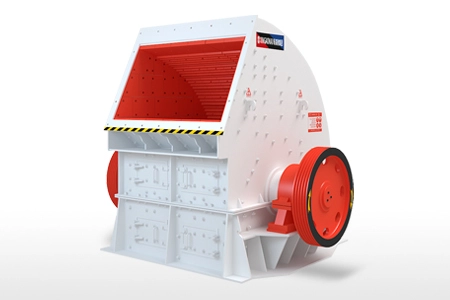
Hammer crusher wear parts operate directly inside the crushing chamber, where they are exposed to repeated impact, abrasion and material friction. Their condition affects crushing capacity, product size, vibration, energy consumption and the overall operating cost of the machine.
The principal wear parts include hammer heads, crushing chamber liners, impact surfaces, rotor protection components and, on traditional machines, grate bars. However, not every hammer crusher uses the same discharge structure. Some modern XINGAONAI machines use a grate-free design, so wear-part selection must always be based on the actual crusher model.
This guide explains the functions of the main hammer crusher wear parts, compares common material options and shows how to identify abnormal wear, plan replacements and calculate the real cost of wear parts.
For an overview of structural and mechanical components such as the shaft, rotor, bearings and drive system, see the hammer crusher parts and components guide.
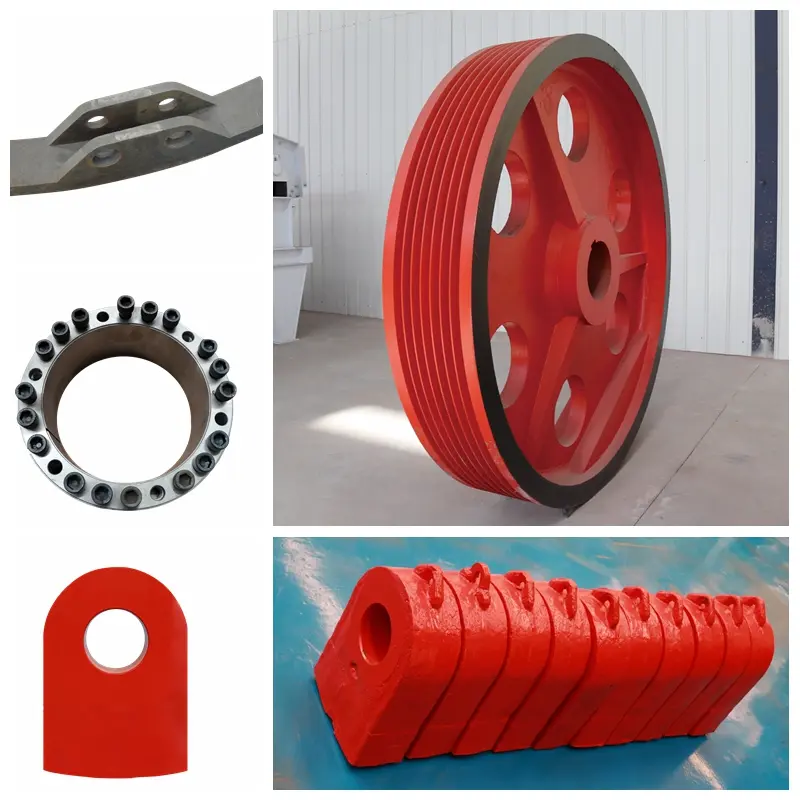
What Are Hammer Crusher Wear Parts?
Hammer crusher wear parts are replaceable components designed to absorb the impact and abrasion generated during crushing. They protect more expensive structural parts and help maintain stable crushing performance.
The main wear parts usually include:
Hammer heads or crusher hammers
Crushing chamber liners
Side liners
Impact or breaker surfaces
Rotor protection plates
Rotor disc protection rings
Hammer pins and related retaining components
Grate bars or discharge screens on applicable machines
Replaceable feed and discharge chute liners
Wear parts should not be confused with all crusher spare parts. Bearings, shafts, pulleys, couplings, seals and electrical components may require replacement during the machine’s service life, but they are not normally classified as primary wear parts.
Understanding what a hammer crusher is and how its main components work makes it easier to interpret the wear patterns found inside the crushing chamber.
Main Hammer Crusher Wear Parts
1. Hammer Heads
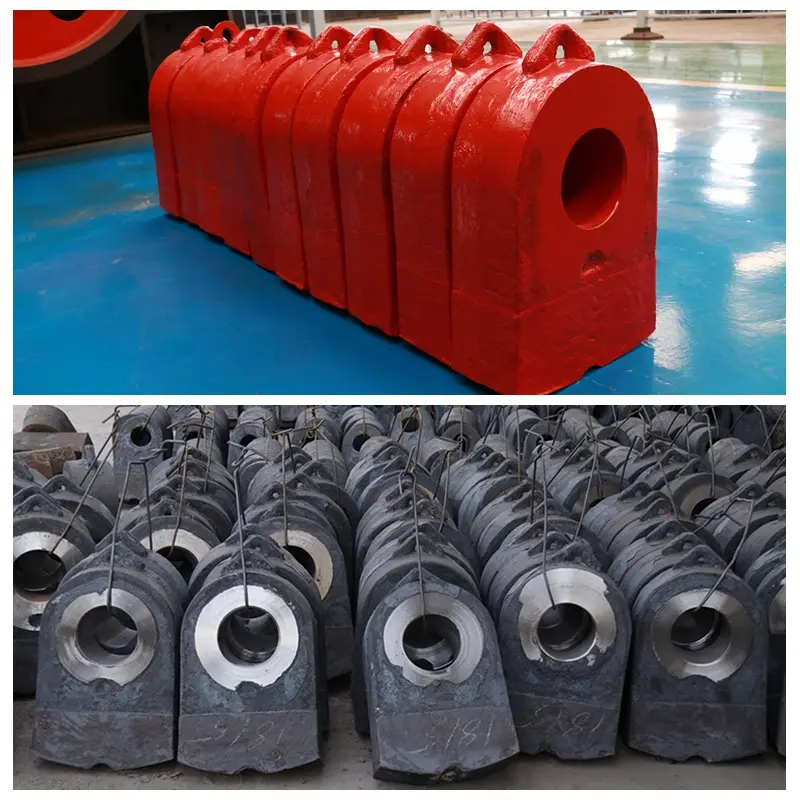
Hammer heads are the primary crushing tools mounted around the rotor. As the rotor turns, the hammers strike the feed material and transfer impact energy into it.
Because the hammer face contacts the material repeatedly, it usually experiences more rapid wear than other internal components. The rate and shape of wear depend on:
Feed material hardness
Silica and other abrasive mineral content
Maximum feed size
Feed distribution
Material moisture
Rotor operating condition
Hammer material and heat treatment
Foreign metal entering the crusher
Required reduction ratio
A suitable hammer must combine wear resistance with enough toughness to withstand impact. A material that is extremely hard but too brittle can crack or chip. A material that is tough but insufficiently wear-resistant may lose working mass too quickly.
Crusher hammers should not be called “blow bars.” Blow bars are normally associated with impact crushers, while hammer crushers use hammers or hammer heads.
2. Crushing Chamber Liners
Liners protect the crusher housing against direct impact and abrasion. Depending on the machine design, liners may be installed on the side walls, front wall, rear wall or other high-wear areas of the crushing chamber.
Common liner wear patterns include:
Uniform surface thinning
Deep grooves caused by concentrated material flow
Localized impact pits
Cracking around bolt holes
Loose or missing fasteners
Deformation caused by repeated impact
Polished areas showing continuous material contact
Liners should be inspected before the housing becomes exposed. Allowing material to wear through the liner can damage the crusher body and make a routine wear-part replacement much more expensive.
3. Impact and Breaker Surfaces
Some hammer crushers use replaceable impact surfaces, breaker plates or internal baffles to redirect material into the hammer path. These components increase material-to-metal and material-to-material collisions inside the chamber.
Their working faces may gradually become rounded, grooved or thinner. Excessive wear can change the internal crushing path and reduce the machine’s ability to control product size.
4. Rotor Protection Components
Although the rotor body is not normally treated as a routine wear part, replaceable protection components may be installed around rotor discs, exposed edges or other vulnerable areas.
These components prevent abrasive material from wearing directly into the rotor assembly. Replacing a protection plate or wear ring is generally faster and less expensive than repairing a damaged rotor.
XINGAONAI machines may use wear-resistant retaining rings or related protection structures around the rotor discs to reduce direct rotor wear.
5. Hammer Pins and Retaining Components
Hammer pins support the swinging hammers and allow them to move during operation. Pins, sleeves, retaining plates and locking components can experience:
Surface scoring
Diameter reduction
Elongated contact areas
Cracks
Bending
Excessive clearance
Damaged locking points
Worn pins may allow excessive hammer movement, change hammer position and increase vibration. Pins and retaining parts should therefore be inspected whenever hammers are removed.
6. Grate Bars and Discharge Components
Traditional hammer crushers may use grate bars or screen plates to control the maximum discharge size. Material remains in the crushing chamber until it is small enough to pass through the openings.
On these machines, worn grate bars can cause:
Larger or inconsistent product sizes
Increased oversize in the discharge
Irregular openings
Bent or broken bars
Material blockage
Reduced effective discharge area
However, grate bars are not universal hammer crusher wear parts. Modern grate-free machines use a different discharge-control structure.
For example, the XINGAONAI light hammer crusher uses a grate-free design intended to reduce clogging when processing suitable wet or high-moisture materials. The XINGAONAI heavy hammer crusher also incorporates a grate-free configuration in its current design.
Always confirm the discharge structure before ordering grate bars or planning grate maintenance.
Hammer Crusher Wear-Part Materials
No single wear-part material is ideal for every crushing application. Material selection must balance hardness, toughness, abrasion resistance, impact resistance and manufacturing quality.
High-Manganese Steel
High-manganese steel is known for its toughness and work-hardening characteristics. The working surface becomes harder when it is exposed to sufficient impact, while the inner material retains its toughness.
It is generally more suitable when:
Impact loads are relatively high
Feed contains larger lumps
Strong toughness is required
The working surface receives enough impact to harden
Its wear resistance may be less effective in low-impact applications where the surface cannot develop sufficient work hardening.
High-Chromium Cast Iron
High-chromium cast iron provides strong resistance to abrasive wear because of its hard carbide structure. It can perform well when crushing suitable brittle and abrasive materials under controlled operating conditions.
Its advantages include:
High surface hardness
Good abrasion resistance
Stable wear performance
Slower loss of working profile in suitable applications
However, high-chromium materials are generally less tolerant of severe impact and foreign metal than tougher steel grades. Material composition, component design and heat treatment must be matched carefully to the operating conditions.
Alloy Steel
Alloy steel can provide a practical balance between hardness and impact toughness. Its properties can be adjusted through alloy composition and heat treatment.
It may be selected for applications involving:
Moderate abrasion
Variable impact loads
A need for better toughness than highly wear-resistant cast materials
Repeated impact combined with occasional overload conditions
The actual performance depends heavily on casting quality, heat treatment and hardness consistency.
Composite Hammer Materials
Composite hammers combine different material properties within one component. A typical design may use:
A tough hammer shank or supporting body
A harder wear-resistant working face
Reinforced zones in areas exposed to concentrated abrasion
This approach allows the hammer to resist breakage while maintaining good wear resistance at the crushing surface.
The current XINGAONAI light hammer crusher uses a high-chromium alloy composite casting process designed to combine impact resistance in the hammer handle with wear resistance at the hammer head.
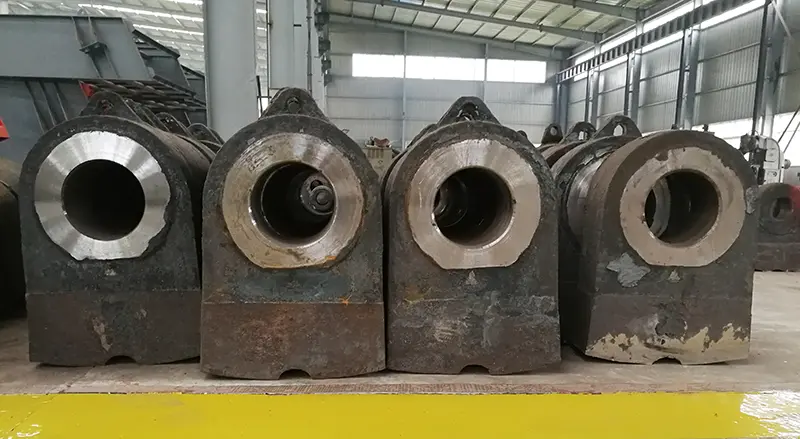
How to Select the Correct Hammer Material
Hammer material should be selected according to the actual feed and operating conditions rather than hardness alone.
| Operating condition | Material-selection priority |
|---|---|
| High impact and large feed lumps | Toughness and resistance to cracking |
| Abrasive but relatively brittle feed | Surface hardness and abrasion resistance |
| Moderate impact and abrasion | Balanced alloy steel properties |
| Concentrated wear at the hammer face | Composite or reinforced working surface |
| Unstable feed containing tramp metal | Higher toughness and effective metal removal |
| Wet or sticky feed | Suitable chamber and discharge design, not only harder wear parts |
Before selecting a wear-part material, provide the supplier with:
Feed material name
Material compressive strength
Abrasive or silica content, if available
Maximum feed size
Moisture level
Required capacity
Target discharge size
Existing hammer service history
Photographs of used wear parts
Details of previous cracks, chipping or uneven wear
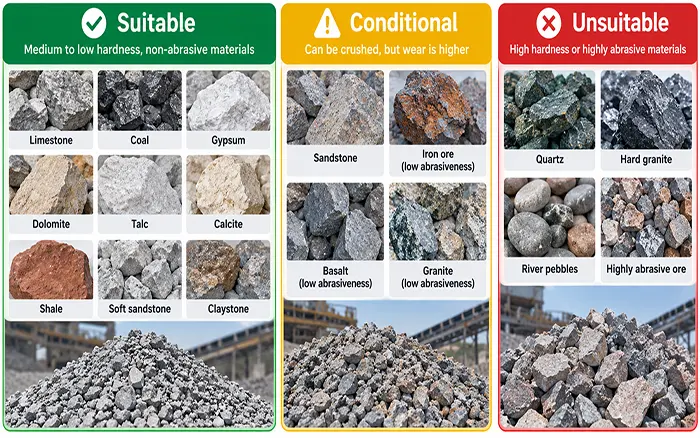
The guide to materials a heavy hammer crusher can crush can help determine whether the material is suitable for this crushing method before changing wear-part grades.
Normal Wear vs. Abnormal Wear
Wear is unavoidable, but its pattern provides valuable information about the condition of the crusher.
| Wear pattern | Likely interpretation |
|---|---|
| Gradual and similar wear across all hammers | Generally normal wear |
| Hammers on one side wear faster | Uneven feeding or poor material distribution |
| Individual hammers lose much more mass | Incorrect positioning, inconsistent material or manufacturing variation |
| Chipped hammer edges | Excessive impact, tramp metal, oversized feed or brittle hammer material |
| Cracks in the hammer body | Material, casting, heat-treatment or overload problem |
| Elongated hammer pin holes | Worn pins, excessive clearance or prolonged operation |
| Deep grooves in one liner area | Concentrated material flow |
| Loose or cracked liners | Fastener, installation or impact problem |
| Increasing discharge size | Worn crushing surfaces or discharge-control components |
| Rapid wear after installing new parts | Incorrect material selection or changed feed conditions |
Never evaluate wear from appearance alone. Combine visual inspection with measurements, vibration records, motor current, product-size data and production capacity.
What Causes Premature Wear?
Abrasive Feed Material
Materials containing hard, abrasive minerals can remove metal rapidly from hammer faces and liners. Increasing wear-part hardness may help, but the crusher type should also be reconsidered if the feed is consistently too hard or abrasive for hammer crushing.
Oversized Feed
Feed exceeding the specified limit creates excessive impact loads. It can cause hammer chipping, pin damage, liner deformation and unstable rotor loading.
Uneven Feeding
Feeding predominantly into one side of the crushing chamber causes localized hammer and liner wear. It may also create rotor imbalance and vibration.
The upstream feeder and chute should distribute material across the effective rotor width.
Foreign Metal
Steel bars, bolts, bucket teeth and other tramp metal can cause sudden hammer breakage or severe internal damage. Appropriate metal detection, magnetic separation and operating procedures should be used where contamination is possible.
Incorrect Operating Conditions
Operating outside the manufacturer’s recommended parameters can change the impact force, material trajectory and residence time inside the chamber.
Do not change rotor speed, pulley size, hammer arrangement or internal clearance without technical confirmation from the equipment manufacturer.
Material Buildup
Wet or sticky material may accumulate inside unsuitable chamber or discharge structures. The buildup changes material flow, increases localized wear and may overload the machine.
Delayed Replacement
Continuing to operate with badly worn hammers or liners can transfer damage to the hammer pins, rotor, housing and bearings. A relatively inexpensive wear part can then lead to a major repair.
How to Inspect and Record Wear
A wear-monitoring program should establish a condition baseline after new parts are installed.
Record the following information:
Hammer position on the rotor
Initial hammer weight and key dimensions
Liner thickness at fixed measuring points
Pin diameter and pin-hole condition
Rotor condition and clearances
Operating hours or processed tonnage
Feed material and maximum lump size
Product-size distribution
Motor current and power trend
Machine vibration and bearing temperature
Photographs taken from the same positions
Date and reason for each replacement
Inspection intervals should be based on actual wear rate, processed tonnage and operating severity. A fixed interval that works for limestone may not be suitable for a more abrasive or contaminated feed.
When Should Hammer Crusher Wear Parts Be Replaced?
There is no universal replacement interval for every crusher or application. Replace a wear part according to the equipment manufacturer’s limits and its actual condition.
Replacement should be planned when one or more of the following conditions occur:
Cracks are visible in a hammer, liner or retaining component
A hammer is chipped, bent or seriously deformed
Hammer weight differences can no longer be balanced safely
Pin holes or mounting points have become excessively worn
Hammer pins show severe scoring, bending or diameter loss
A liner can no longer protect the crusher housing
Fasteners cannot hold the liner securely
The required capacity or product size cannot be maintained
Vibration increases because of unequal wear
Discharge openings have worn beyond the required product-size range
A component has reached the manufacturer’s specified wear limit
Do not continue using a cracked component simply because some working material remains. Cracks and deformation create a risk of sudden failure.
How to Replace Crusher Hammers Safely
Hammer replacement must follow the machine manual and the site’s lockout/tagout procedure.
A typical replacement process includes:
Stop the crusher and isolate all energy sources.
Lock and tag the motor, feeder and connected equipment.
Confirm that the rotor cannot move unexpectedly.
Remove accumulated material from the work area.
Open the inspection or maintenance access point.
Mark the original hammer positions before removal.
Inspect hammers, pins, sleeves, rotor discs and retaining components.
Compare replacement hammer weights.
Install hammers in matched and balanced groups.
Confirm pin retention and component clearances.
Rotate the rotor manually if the machine procedure permits.
Reinstall access covers and safety guards.
Conduct a controlled no-load test.
Introduce feed gradually and monitor vibration, noise, current and bearing temperature.
Replacing only one severely worn hammer without considering rotor balance may create damaging vibration. Where the design permits, hammers should be installed in symmetrical, weight-matched sets according to the manufacturer’s arrangement.
For broader inspection and service procedures, refer to the heavy-duty hammer crusher maintenance guide.
Information Required When Ordering Wear Parts
Supplying complete information reduces the risk of receiving incompatible components.
Include:
Crusher manufacturer
Crusher model
Equipment serial number
Wear-part name
Original part or drawing number
Installation position
Required quantity
Component dimensions
Mounting-hole dimensions
Existing material grade, if known
Requested material or performance requirement
Feed material properties
Maximum feed size
Capacity and product-size requirements
Photographs of the component
Photographs of the wear pattern
Previous service life in hours or processed tonnes
A reliable hammer crusher supplier should review both the component drawing and the operating conditions instead of selecting a replacement from the part name alone.
Recommended Wear-Parts Inventory
The correct inventory depends on the crusher model, lead time and production requirements. A practical stock may include:
One or more balanced sets of crusher hammers
Hammer pins, sleeves and locking components
High-wear liner sections
Rotor protection plates or retaining rings
Applicable grate or discharge components
Required mounting bolts and fasteners
Critical wear parts should be stored in a clean, dry area and identified by crusher model, material grade and installation position.
Hammer sets should not be mixed carelessly. Parts supplied as weight-matched groups should remain grouped until installation.
How to Compare Wear-Part Cost
The lowest purchase price does not always provide the lowest operating cost. Compare wear parts according to cost per processed tonne:
Wear-part cost per tonne = Total wear-part cost ÷ Tonnes processed before replacement
A more complete comparison should also consider:
Replacement labor
Planned and unplanned downtime
Damage to related components
Product-quality changes
Energy consumption
Freight and delivery time
Inventory requirements
For example, a more expensive hammer set may be economical if it processes significantly more material, maintains the required product size and reduces shutdown frequency.
See the hammer crusher price and operating cost guide for additional cost factors beyond wear-part purchase price.
Conclusion
Hammer crusher wear parts directly influence crushing performance, maintenance frequency and operating cost. Reliable wear management requires more than selecting the hardest available material.
Operators should match hammer and liner materials to the feed, maintain even material distribution, monitor wear by position, replace damaged components before secondary failures occur and keep the rotor balanced whenever hammers are changed.
It is also important to distinguish between traditional grate-equipped crushers and modern grate-free designs. Identifying the exact crusher model and internal structure before ordering parts helps prevent compatibility problems and unnecessary downtime.
By recording service life in processed tonnes and comparing total cost per tonne, plant operators can select hammer crusher wear parts based on measurable operating value rather than purchase price alone.