Crusher tons per hour can range from a few dozen tonnes to several thousand tonnes, depending on the crusher type, model, feed material, discharge setting and operating conditions. However, the maximum capacity shown in a technical table does not automatically represent the output that an entire crushing plant will achieve on site.
A crusher may be rated at 300 tonnes per hour, while the complete plant produces less because of restricted feeding, hard or wet material, a fine closed-side setting, screen limitations, circulating load or equipment downtime. It is therefore important to distinguish between rated crusher capacity, operating throughput and saleable finished-product output.
This guide explains how crusher TPH should be interpreted, how actual output is measured and why the lowest-capacity stage normally determines the production rate of the complete crushing circuit.
What Does TPH Mean in Crusher Specifications?
TPH means tonnes per hour or tons per hour. It describes the mass of material passing through a crusher or production line during one hour.
Before comparing capacity figures, confirm which unit is being used:
Metric tonne: 1,000 kilograms
US short ton: approximately 907 kilograms
1 metric tonne: approximately 1.102 US short tons
XINGAONAI product specifications are normally expressed in metric tonnes per hour, written as t/h or tph.
The point at which the capacity is measured must also be defined. A plant may have several different TPH values:
| Capacity term | Meaning |
|---|---|
| Rated capacity | The manufacturer’s estimated capacity range under specified conditions |
| Instantaneous throughput | The production rate displayed at a particular moment |
| Operating throughput | Total material processed divided by actual crusher running time |
| Shift-average throughput | Total material processed divided by the complete scheduled shift |
| Saleable-product output | Finished material that meets the required size and quality specifications |
For example, a crusher may process material at 280 t/h while running, but maintenance stops and production changes may reduce the ten-hour shift average to 220 t/h. If part of the material becomes waste or returns through the closed circuit, saleable output will be lower again.
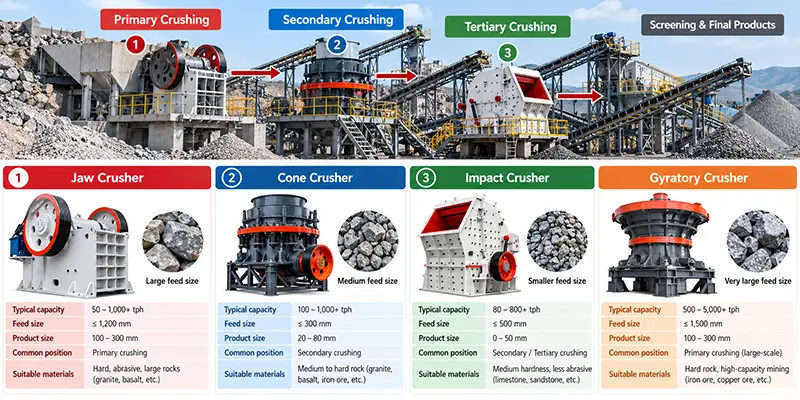
Typical Capacity Ranges for Different Crusher Types
Crusher capacity differs significantly according to the crushing method and production stage. The following figures show the published capacity ranges of selected XINGAONAI product series. They are model ranges rather than guaranteed output for every application.
| Crusher type | Published model range | Typical position |
|---|---|---|
| PEV Series Jaw Crusher | 55–1,590 t/h | Primary crushing |
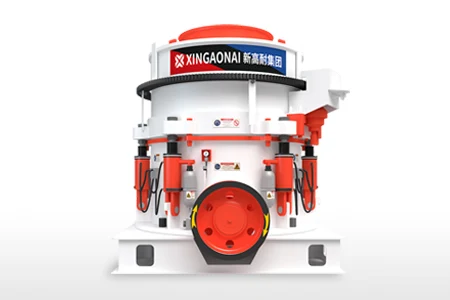
| XHP Hydraulic Cone Crusher | 90–1,200 t/h | Secondary or tertiary crushing |
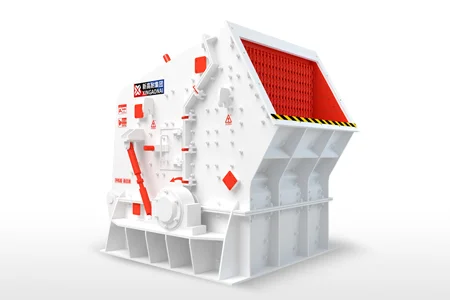
| PF Impact Crusher | 30–800 t/h | Secondary crushing |
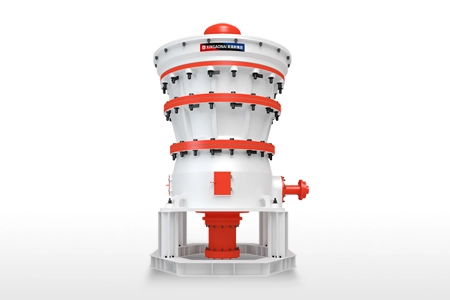
| X Series Gyratory Crusher | 310–3,200 t/h | Large primary crushing |
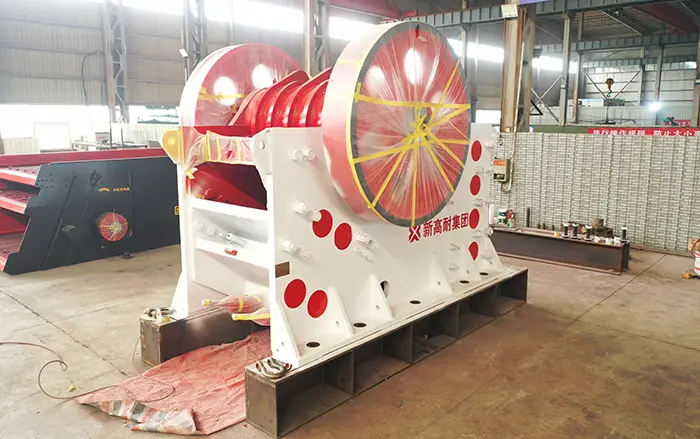
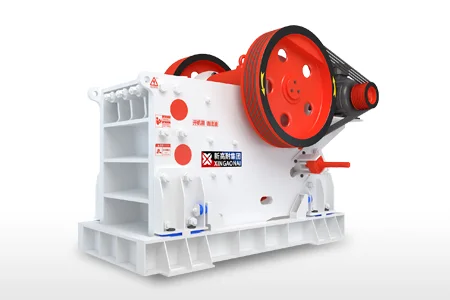
The PEV Series Jaw Crusher is designed for primary crushing of granite, basalt, river pebble, iron ore and other hard materials. Its capacity changes with the selected model, feed gradation, discharge setting and material properties.
The XHP Series Multi-Cylinder Hydraulic Cone Crusher is normally installed after the primary crusher for secondary or tertiary reduction.
These ranges should not be used to decide which crusher is “better.” A gyratory crusher and an impact crusher perform different duties, process different feed sizes and produce different types of finished material.
For detailed jaw-crusher-specific information, see this guide to the capacity of a jaw crusher.
Why Actual Crusher TPH Differs From Rated Capacity
A capacity table is normally based on defined material and operating conditions. Actual production changes when those conditions change.
Feed size and gradation
A crusher performs best when the feed size is compatible with its feed opening and crushing chamber.
Excessive oversize can cause bridging or interruptions. Too much fine material may occupy crushing chamber volume without contributing to effective size reduction. An uneven feed can also leave part of the chamber underused.
Material hardness and abrasiveness
Hard and abrasive rocks such as granite require greater crushing force and cause faster wear than soft limestone.
The same crusher model may therefore process different tonnes per hour when handling materials with different strength, fracture characteristics and abrasion levels.
Bulk density
Crusher capacity is expressed by mass, but the crushing chamber handles material by volume. A denser material can produce a different mass throughput from a lighter material occupying the same chamber volume.
True rock density and loose bulk density should not be treated as the same value.
Moisture and clay content
Moist or clay-rich feed can stick to the crushing chamber, screen media and transfer points. This may reduce effective capacity and cause blockages.
Moisture can be particularly important when the plant needs to produce fine aggregate through a closed screening circuit.
Closed-side setting
The closed-side setting, or CSS, affects both product size and throughput.
A smaller CSS normally produces finer material but may reduce crusher capacity and increase the amount of material circulating through the screen and crusher. A larger setting may increase throughput, but the product may be too coarse for the required specification.
Feed consistency
A crusher cannot maintain stable TPH if the feeder alternates between insufficient feed and sudden overload.
Consistent, well-distributed feeding helps use the crushing chamber more effectively and reduces variations in power draw and product gradation.
Crushing chamber and liner condition
Chamber profile, eccentric throw and liner selection affect how material moves through a cone crusher. Worn or incorrectly selected liners can reduce chamber utilization and make the output less consistent.
Screens, conveyors and circulating load
A crusher is only one part of the production line. Screens must separate the required products, conveyors must transport the material, and recirculating oversize must return to the crusher.
If the crusher can process 300 t/h but the downstream screen can only handle 230 t/h under actual conditions, the plant cannot continuously produce 300 t/h.
How to Measure Actual Crusher Tons per Hour
The most reliable method is to measure material with a calibrated belt scale or another verified weighing system.
Two different calculations should be recorded.
Operating throughput
Operating TPH =
Total measured tonnes ÷ actual crusher running hours
If a plant processes 2,240 metric tonnes during eight hours of actual operation:
2,240 ÷ 8 = 280 t/h
Shift-average throughput
Shift-average TPH =
Total measured tonnes ÷ scheduled shift hours
If the same plant processes 2,240 tonnes during a ten-hour shift that includes two hours of stops:
2,240 ÷ 10 = 224 t/h
Both figures are correct, but they describe different operating results. A case study should state whether its published TPH is an operating average, shift average, design target or momentary peak.
How to Estimate the Required Crusher Capacity
If the required finished-product volume is known, preliminary plant throughput can be estimated with the following planning formula:
Required raw-feed TPH =
Daily saleable-product target
÷ scheduled operating hours
÷ expected availability
÷ saleable-product yield
For example, assume a plant must produce 2,000 tonnes of saleable aggregate per day:
Scheduled operation: 10 hours per day
Expected availability: 85%
Saleable-product yield: 90%
The preliminary raw-feed requirement would be:
2,000 ÷ 10 ÷ 0.85 ÷ 0.90
= approximately 261 t/h
This is a production-planning calculation, not a universal crusher capacity formula. The final equipment model must still be confirmed using manufacturer capacity tables, material characteristics, feed gradation, required product sizes and the complete flow-sheet design.
Crusher Capacity vs Crushing Plant Capacity
The capacity of one crusher is not the same as the capacity of the entire plant.
A typical three-stage aggregate line includes:
Hopper
→ Feeder
→ Primary Crusher
→ Secondary Crusher
→ Screen
→ Tertiary Crusher
→ Final Screen
→ Product Conveyors
Every stage must pass the required material flow. The sustainable capacity of the line is normally controlled by its bottleneck rather than by the machine with the highest rated output.
For example:
| Production stage | Available capacity |
|---|---|
| Primary jaw crusher | 450 t/h |
| Secondary cone crusher | 300 t/h |
| Vibrating screen | 280 t/h |
| Main product conveyor | 320 t/h |
Although the jaw crusher can process 450 t/h, the line cannot sustainably exceed the screen’s 280 t/h capacity under the stated conditions.
The bottleneck may also change when the CSS, screen aperture or finished-product ratio changes. A configuration that produces 280 t/h of coarse aggregate may not maintain the same output when required to produce a higher percentage of fine material.
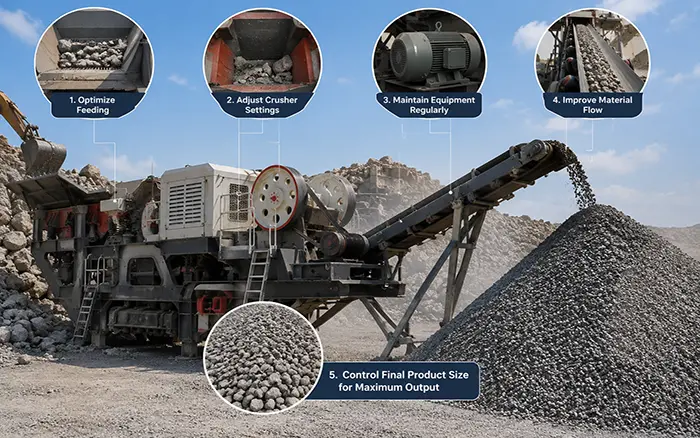
For existing plants producing less than expected, review the complete circuit before replacing the crusher. The guide on how to increase stone crusher capacity explains the main operational checks.
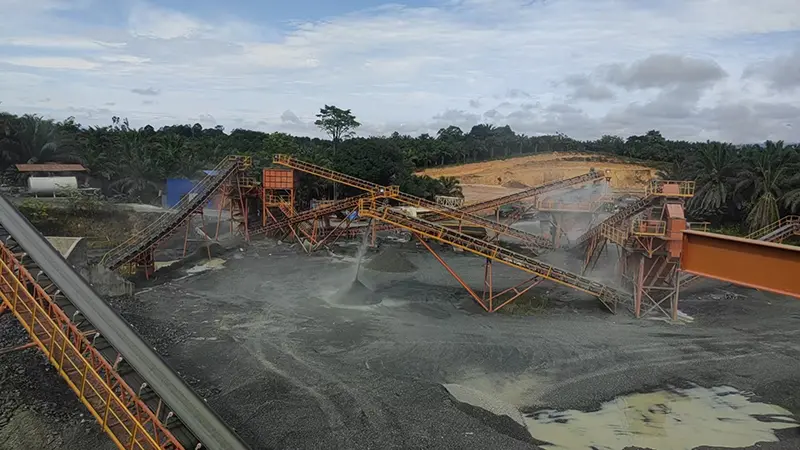
Project Example: 280 TPH Granite Crushing Plant in Malaysia
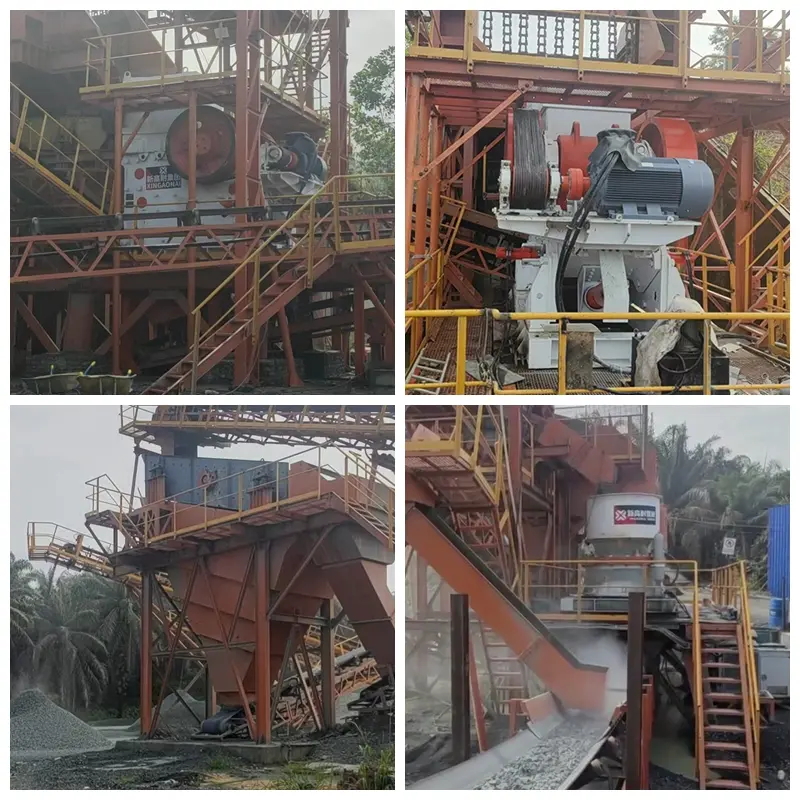
A granite aggregate production line in Malaysia was configured with a PEV950×1250 jaw crusher for primary crushing, a CS430 cone crusher for secondary crushing and a CH440 cone crusher for tertiary crushing.
Project configuration
| Item | Project information |
|---|---|
| Location | Malaysia |
| Material | Granite |
| Nominal line throughput | Approximately 280 metric t/h |
| Primary crusher | PEV950×1250 jaw crusher |
| Secondary crusher | CS430 cone crusher |
| Tertiary crusher | CH440 cone crusher |
| Process | Three-stage crushing and screening |
Primary crushing with the PEV950×1250
The PEV950×1250 jaw crusher reduces large granite feed to a size suitable for the secondary cone crusher.
Its published model capacity range is wider than the nominal 280 t/h production-line target. This gives the primary stage capacity reserve and reduces the need to operate the jaw crusher continuously at its maximum published output.
The additional capacity does not mean the complete production line will produce at the jaw crusher’s maximum rate. The jaw crusher must feed the downstream cone crusher at a controlled and consistent rate.
Secondary crushing with the CS430
The CS430 performs the secondary reduction stage. Its nominal capacity range reaches approximately 298 metric tonnes per hour, depending on the chamber, CSS, eccentric throw and feed conditions.
Because the line target is approximately 280 t/h, the secondary cone operates comparatively close to the upper part of its published nominal range. This makes chamber selection, liner condition, feed distribution and CSS particularly important.
Based on the currently available model information, the CS430 is one of the most likely capacity-controlling points in this circuit. However, this should be confirmed against the actual screen load and circulating material.
Tertiary crushing with the CH440
The CH440 completes the tertiary crushing stage and controls the final reduction before screening.
Its published nominal capacity covers the 280 t/h project target, but actual throughput depends strongly on the required finished size. A fine CSS or high recirculating load may reduce the amount of new feed that can enter the plant.
What this configuration demonstrates
This project shows why crusher selection should be based on the complete circuit:
The primary jaw crusher has reserve capacity.
The secondary cone is closer to the nominal line target.
The tertiary cone must balance reduction ratio with finished-product requirements.
Screens and conveyors must handle both new feed and circulating material.
The plant output cannot be calculated from the jaw crusher’s maximum capacity alone.
Until the 280 t/h figure is supported by belt-scale or commissioning records, it should be described as nominal or project throughput rather than a guaranteed continuous operating result.
How to Read a Crusher Capacity Table
When comparing crusher models, do not look only at the largest number in the capacity column.
Check the following information together:
Maximum feed size
Feed-opening dimensions
Closed-side setting
Crushing chamber type
Eccentric throw or operating speed
Material bulk density
Feed gradation
Motor power
Open- or closed-circuit operation
Required finished-product size
Capacity tables frequently show a wide range because one crusher can use different chambers and settings. The lower and upper figures may apply to substantially different operating conditions.
Information Needed to Confirm the Correct Crusher TPH
To select a crusher or design a production line, provide the equipment manufacturer with:
Material name
Maximum feed size
Feed-size distribution
Required tonnes per hour
Required final product sizes
Material hardness and abrasiveness
Bulk density
Moisture and clay content
Daily operating hours
Open- or closed-circuit operation
Existing feeder, screen and conveyor capacities
Project location and altitude
Available electrical supply
A crusher should not be selected from TPH alone. The correct model must also produce the required product size without excessive wear, recirculating load or power consumption.
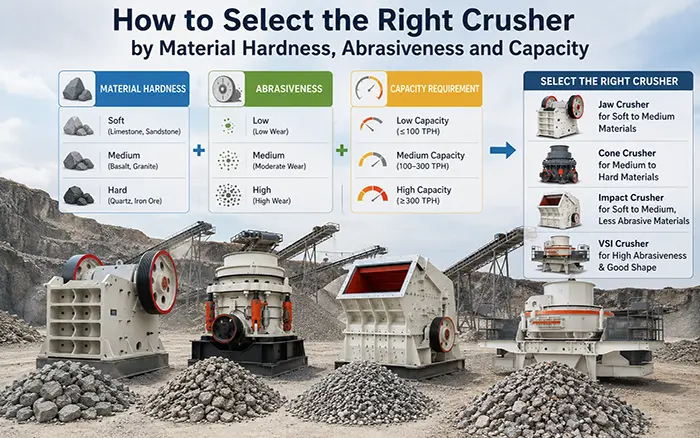
For a broader model-selection process, see how to select the right crusher according to material hardness, abrasiveness and capacity.
Conclusion
Crusher tons per hour is not a fixed value determined by machine size alone. Actual production depends on the material, feed gradation, crusher setting, chamber configuration, wear condition and the capacity of every downstream component.
The Malaysia granite project illustrates this principle. Although the PEV950×1250 jaw crusher has substantial reserve capacity, the complete line is configured around approximately 280 t/h because the secondary and tertiary crushing stages, screens, conveyors and circulating load must operate as one balanced system.
For an accurate equipment recommendation, provide the maximum feed size, material type, required capacity, finished-product sizes, moisture content and project location. These details allow the crusher and complete production line to be sized according to actual operating requirements rather than catalogue capacity alone.