Lead-zinc ore is a valuable polymetallic mineral resource, with lead and zinc often symbiotically associated with sulfide minerals (galena, sphalerite), gangue minerals (quartz, calcite), and associated metals (silver, gold). As critical raw materials for the metallurgical, battery, and chemical industries, raw lead-zinc ore requires professional beneficiation to separate lead and zinc components, remove impurities, and upgrade concentrate grade. Our custom lead-zinc ore beneficiation process—centered on flotation separation (the core technology for lead-zinc separation)—is tailored to ore properties (symbiotic relationship, particle size, impurity content) and production capacity, ensuring high recovery rates of lead and zinc concentrates while meeting industrial quality standards.
Core Beneficiation Processes of Lead-Zinc Ore
Lead-zinc ore beneficiation relies on the difference in surface properties of lead and zinc minerals to achieve separation via flotation. The full process is optimized based on ore characteristics, typically including the following key stages:
1. Crushing & Grinding: Liberation of Lead-Zinc Minerals
Raw lead-zinc ore (0-1000mm lumps) first undergoes staged crushing to reduce particle size:
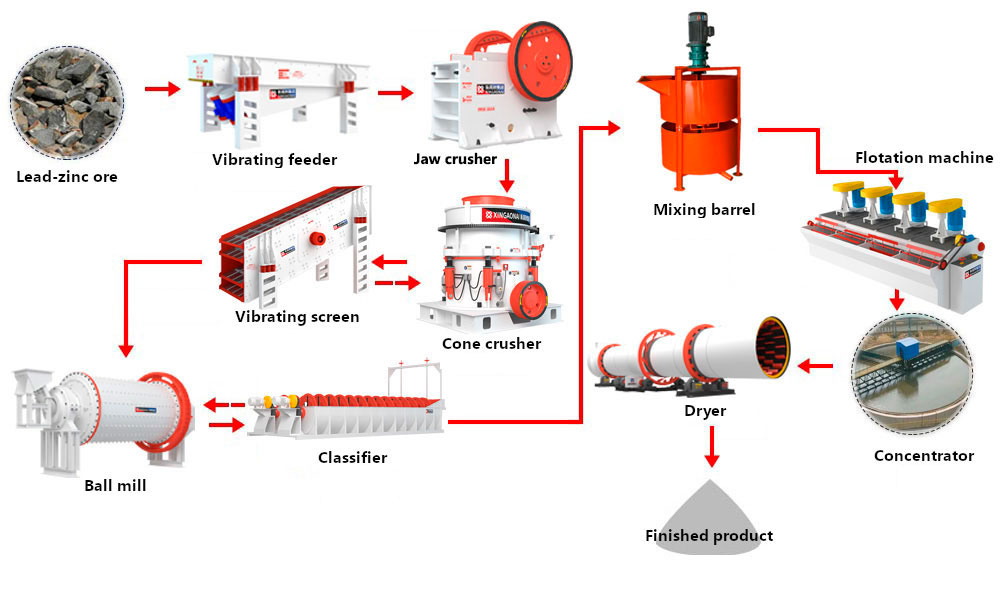
Coarse Crushing: Jaw crushers break large ore into 100-200mm particles, ensuring uniform feeding for subsequent processing.
Fine Crushing: Cone crushers further reduce ore size to 10-20mm, laying the foundation for efficient grinding.
Grinding & Classification: Ball mills grind crushed ore into slurry (particle size ≤0.074mm), fully liberating lead-zinc minerals from gangue. Spiral classifiers or hydrocyclones perform grading—qualified slurry enters flotation, while oversized particles are recycled for re-grinding.
2. Flotation Separation: Core Stage of Lead-Zinc Separation
Flotation is the key process to separate lead and zinc minerals, with "lead priority flotation + zinc flotation" as the mainstream workflow (adjustable based on ore symbiosis):
Lead Rough Flotation: Add xanthate collectors (sodium ethyl xanthate) and pine oil frothers to the slurry. Galena (lead mineral) adheres to air bubbles and floats to form lead rough concentrate, while sphalerite (zinc mineral) and gangue remain in the pulp.
Lead Fine Flotation: The lead rough concentrate undergoes 1-3 stages of cleaning flotation to remove residual impurities, obtaining high-grade lead concentrate (lead grade ≥55%).
Zinc Activation & Flotation: Add copper sulfate as an activator to the lead flotation tailings (to enhance sphalerite floatability), then add collectors and frothers to perform zinc rough flotation and fine flotation, obtaining zinc concentrate (zinc grade ≥50%).
Tailing Treatment: Tailings from zinc flotation are processed via a thickener and filter press for dehydration, with filtered water recycled to the grinding system (closed-loop water circulation) to save water and comply with environmental regulations.
3. Auxiliary Processes for Complex Lead-Zinc Ore
For complex lead-zinc ore (e.g., with high sulfur content, oxidized lead-zinc ore, or associated silver), targeted auxiliary processes are added to ensure concentrate quality and resource utilization:
Desulfurization Flotation: For high-sulfur lead-zinc ore, pre-desulfurization flotation is performed before lead flotation to remove pyrite, avoiding sulfur contamination of lead-zinc concentrates.
Oxidized Lead-Zinc Ore Treatment: Oxidized lead-zinc minerals (e.g., cerussite, smithsonite) are difficult to float directly; sulfidization roasting or chelating collector flotation is used to improve floatability.
Silver Recovery: For lead-zinc ore associated with silver, silver is usually enriched in lead concentrate during flotation; subsequent silver extraction processes are added to maximize resource value.
Key Equipment Configuration for Lead-Zinc Ore Beneficiation Line
Our lead-zinc processing solution integrates high-efficiency, wear-resistant equipment tailored to the flotation-dominated process requirements:
Crushing & Feeding Equipment: Vibrating feeder (uniform feeding), jaw crusher (coarse crushing), cone crusher (fine crushing).
Grinding & Classification Equipment: Ball mill (primary grinding), spiral classifier (slurry grading), hydrocyclone (fine grading).
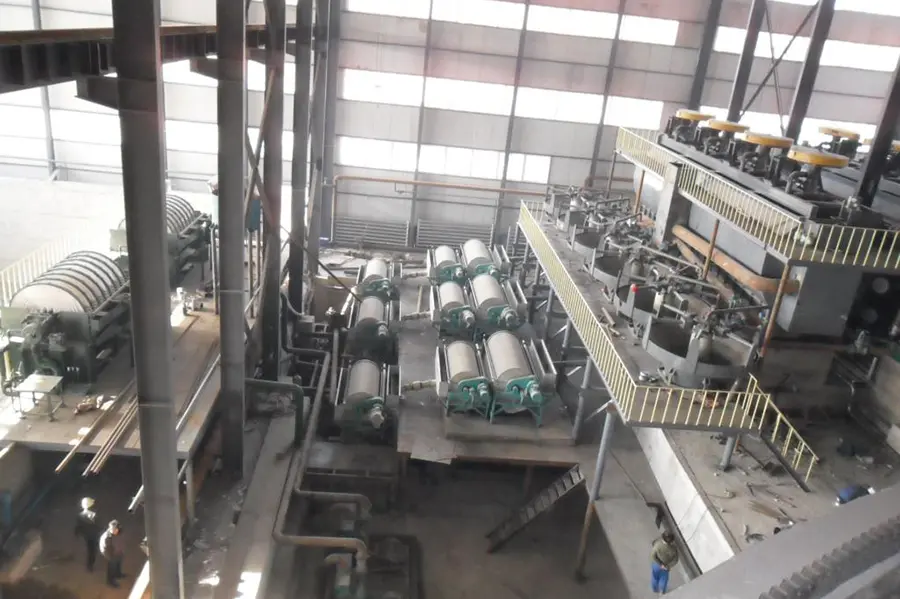
Flotation Equipment: Mechanical flotation machine (rough/fine flotation), pneumatic flotation machine (high-efficiency separation for fine-grained ore), reagent dosing system (precise control of collector/frother dosage).
Dewatering & Auxiliary Equipment: High-efficiency concentrator, filter press (dewatering of concentrates/tailings), dust removal equipment, closed-loop water circulation system, PLC control system (automated operation).
Core Advantages of Our Lead-Zinc Ore Beneficiation Process
Targeting the symbiotic characteristics of lead-zinc ore and industrial quality requirements, our solution offers distinct competitive edges:
High Separation Efficiency: Optimized flotation process and reagent system ensure lead recovery rate ≥92% and zinc recovery rate ≥90%, 5-8% higher than traditional processes.
Precise Lead-Zinc Separation: Targeted flotation workflow effectively separates lead and zinc minerals, with concentrate grades meeting metallurgical standards (lead ≥55%, zinc ≥50%).
Strong Ore Adaptability: Custom process designs for different lead-zinc ore types (sulfide lead-zinc ore, oxidized lead-zinc ore, complex polymetallic ore) and production capacities (50-1000 TPH).
Energy & Environmental Protection: Closed-loop water circulation system reduces water consumption by 65-75%; energy-efficient motors and optimized grinding parameters reduce power consumption by 10-15%; low-toxicity flotation reagents meet global environmental regulations (CE, EPA, ISO 14001).
Automated & Cost-Effective: PLC automated control system reduces labor costs and ensures stable operation; wear-resistant equipment components extend service life and reduce maintenance costs.
Lead-zinc ore is a critical strategic resource, and a professional, customized beneficiation process is the key to unlocking its industrial value. Our lead-zinc ore beneficiation solution, centered on high-efficiency flotation separation and tailored to ore characteristics, delivers high-grade lead-zinc concentrates while ensuring energy conservation, environmental protection, and cost efficiency.