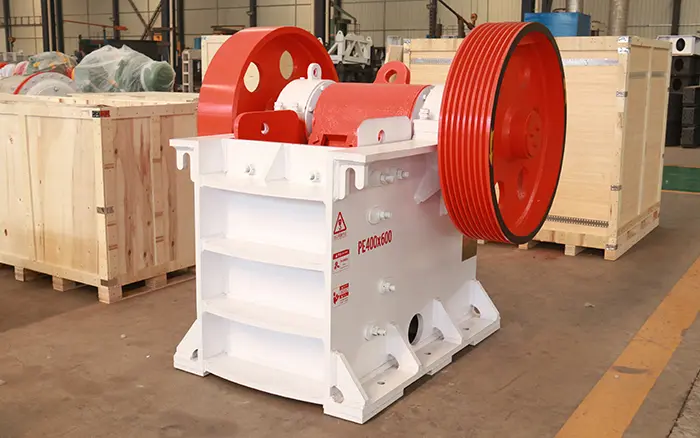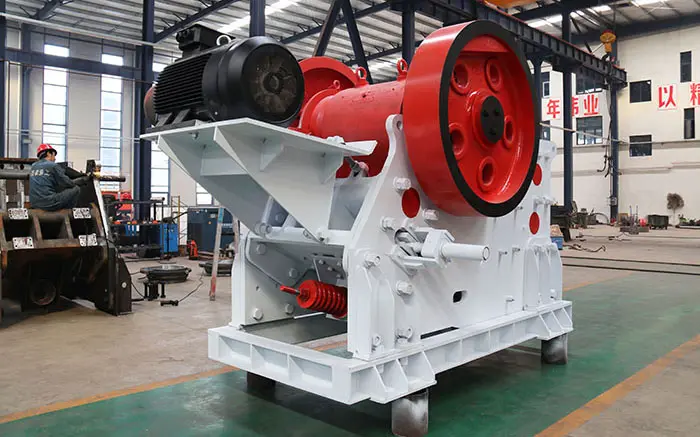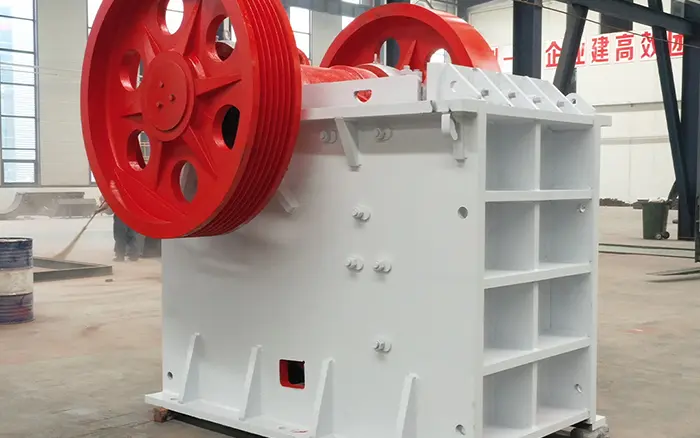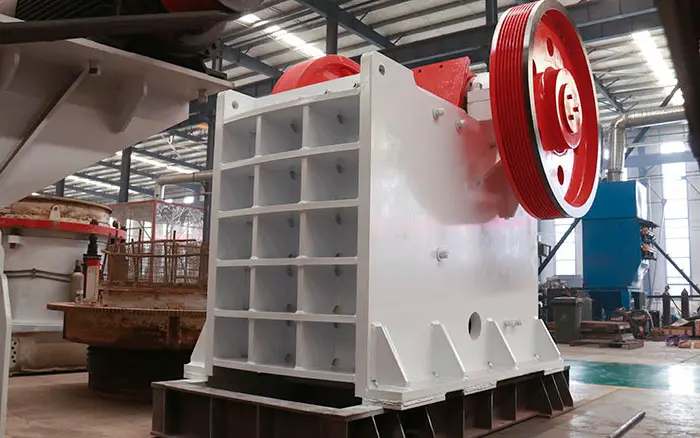
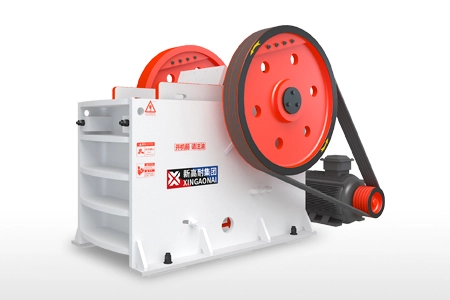
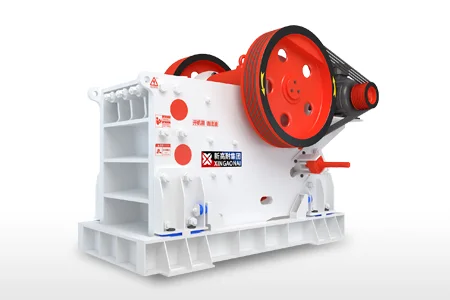
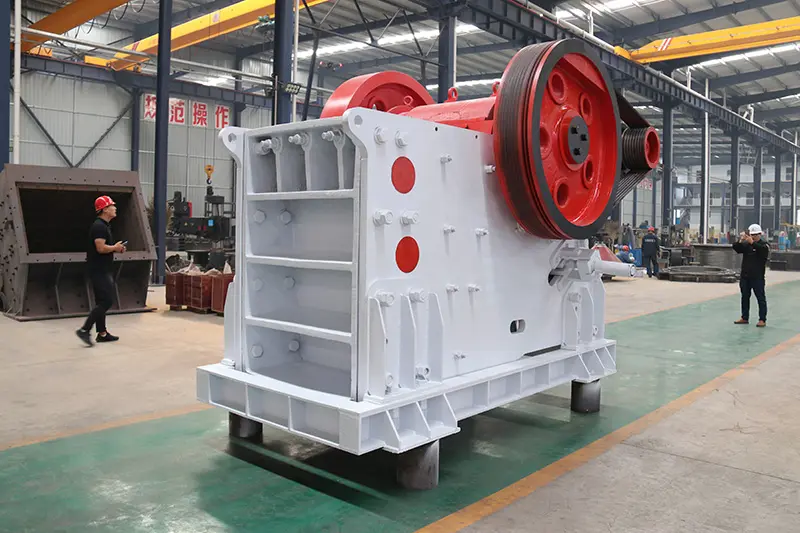
1. What Is a Jaw Crusher? Basic Definition
2. How Does a Jaw Crusher Work? Working Principle
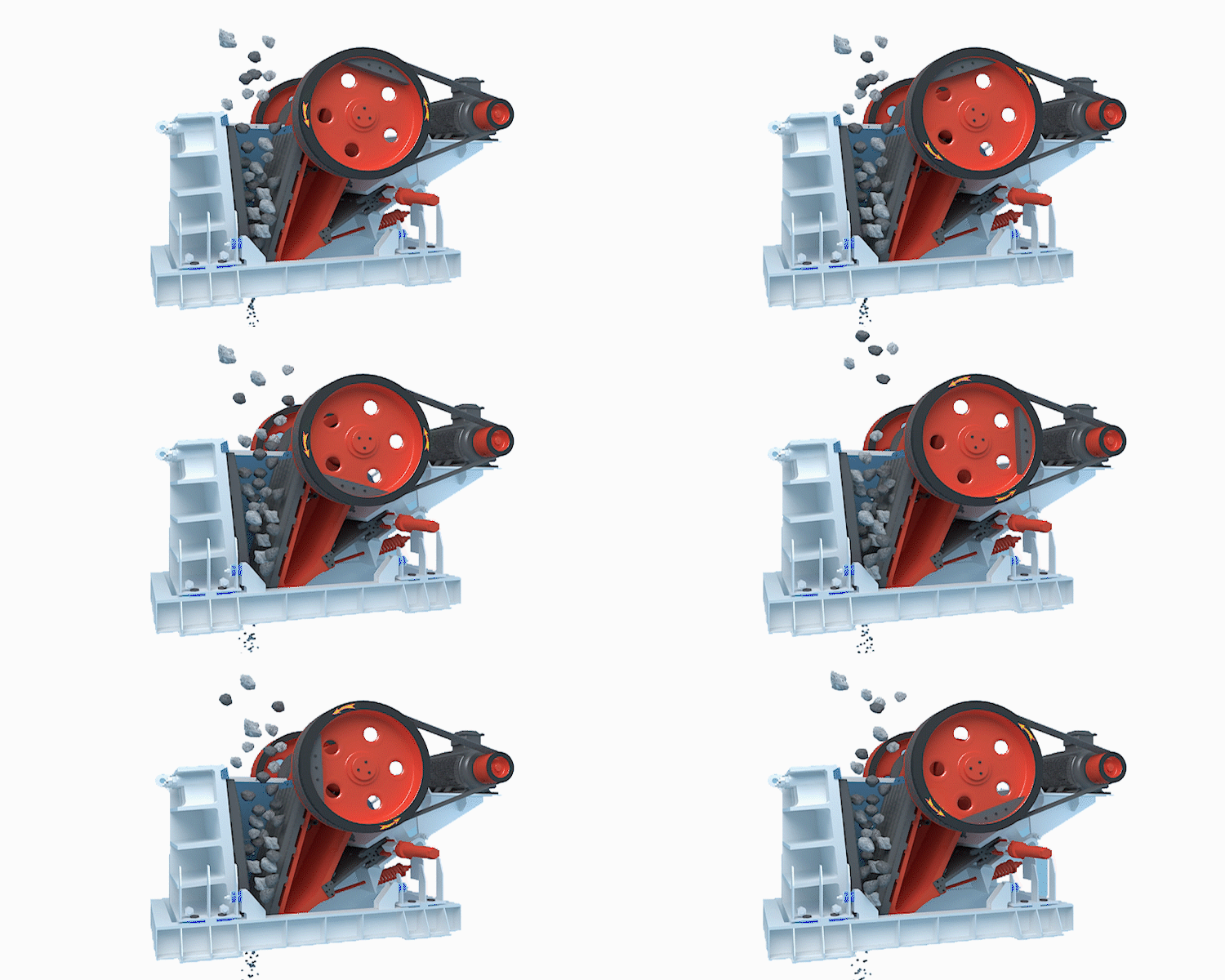
Material Feeding: Large raw materials (e.g., boulders, ore blocks) are fed into the V-shaped crushing chamber through a feeding hopper. The hopper ensures uniform and continuous feeding to avoid overloading the machine.
Crushing Process: The jaw crusher consists of two key components: a fixed jaw (stationary jaw plate) and a movable jaw (swinging jaw plate). Driven by a motor and eccentric shaft, the movable jaw makes reciprocating swing movements relative to the fixed jaw. When the movable jaw moves toward the fixed jaw, the materials in the crushing chamber are squeezed, pressed, and fractured by the compressive force.
Particle Size Control: When the movable jaw moves away from the fixed jaw, the crushed materials that meet the required particle size fall through the discharge opening at the bottom of the crushing chamber. The size of the discharge opening can be adjusted by adjusting the distance between the two jaw plates, allowing control over the fineness of the final product.
Continuous Operation: The motor drives the eccentric shaft to rotate continuously, making the movable jaw swing back and forth repeatedly. This ensures continuous feeding, crushing, and discharging, achieving efficient mass production.
3. Core Components of a Jaw Crusher
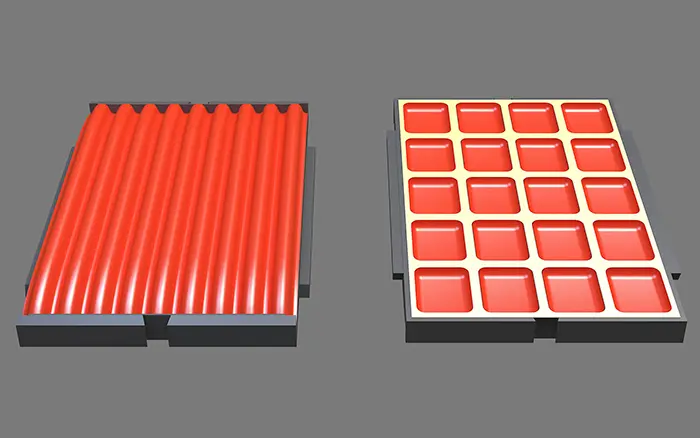
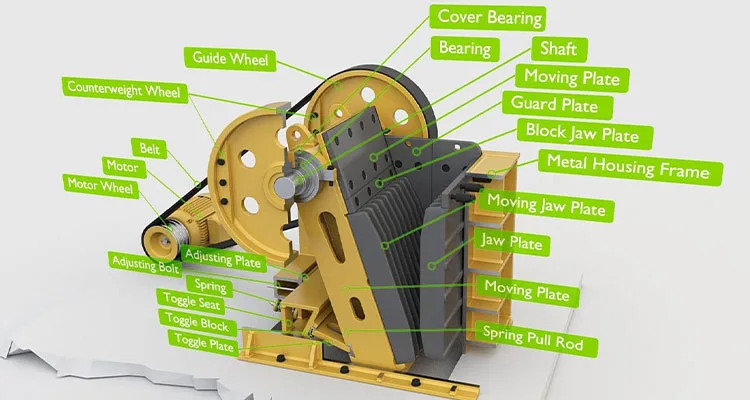
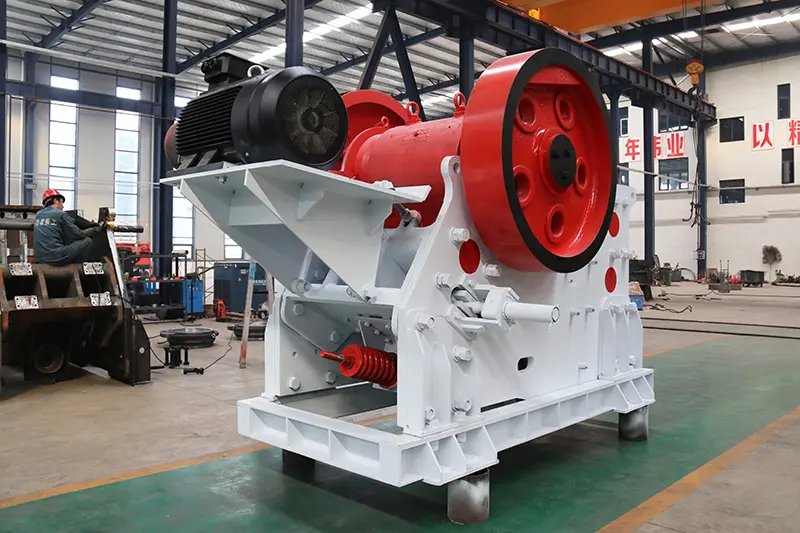
Fixed Jaw (Jaw Plate): A stationary component usually attached to the machine’s frame. It is lined with a wear-resistant jaw plate (a key wearing part) that directly contacts and crushes materials.
Movable Jaw (Jaw Plate): A swinging component that interacts with the fixed jaw to apply compressive force. It is also equipped with a replaceable wear-resistant jaw plate to withstand the high friction and impact of hard materials.
Motor & Eccentric Shaft: The power system of the jaw crusher. The motor drives the eccentric shaft to rotate, which converts rotational motion into the reciprocating swing of the movable jaw.
Feeding Hopper: Located at the top of the machine, it guides large raw materials into the crushing chamber evenly, preventing material blockages and ensuring smooth operation.
Discharge Adjustment Device: A mechanism (usually a wedge or bolt system) used to adjust the discharge opening size. By changing the gap between the fixed and movable jaws, it controls the particle size of the crushed product.
Frame: The main support structure of the jaw crusher, made of heavy-duty steel to withstand the high impact and pressure during crushing. It ensures the stability and rigidity of the entire machine.
Spring Safety System: A protective component that prevents damage to the machine when uncrushable materials (e.g., metal blocks) enter the crushing chamber. The spring compresses to open the discharge gap temporarily, allowing the foreign object to pass through.
4. Main Types of Jaw Crushers
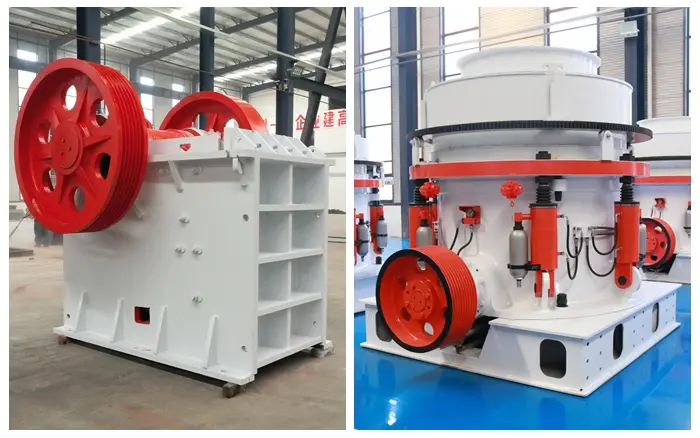
Blake Jaw Crusher (Double Toggle Jaw Crusher): This is the most traditional and widely used type. It features a double toggle plate structure that connects the movable jaw to the eccentric shaft. The Blake jaw crusher has a deep crushing chamber and a large feeding capacity, making it suitable for primary crushing of large and hard materials. It is known for its robust structure, high reliability, and low maintenance cost, making it ideal for small to medium-sized quarries and mining operations.
Dodge Jaw Crusher (Single Toggle Jaw Crusher): This type uses a single toggle plate to drive the movable jaw. The eccentric shaft is directly connected to the movable jaw, simplifying the structure and reducing the machine’s weight. The Dodge jaw crusher has a shallower crushing chamber but a faster swing speed of the movable jaw, resulting in higher crushing efficiency. It is suitable for primary crushing of medium-hard materials and is often used in large-scale aggregate plants and construction waste recycling projects.
5. Key Applications of Jaw Crushers
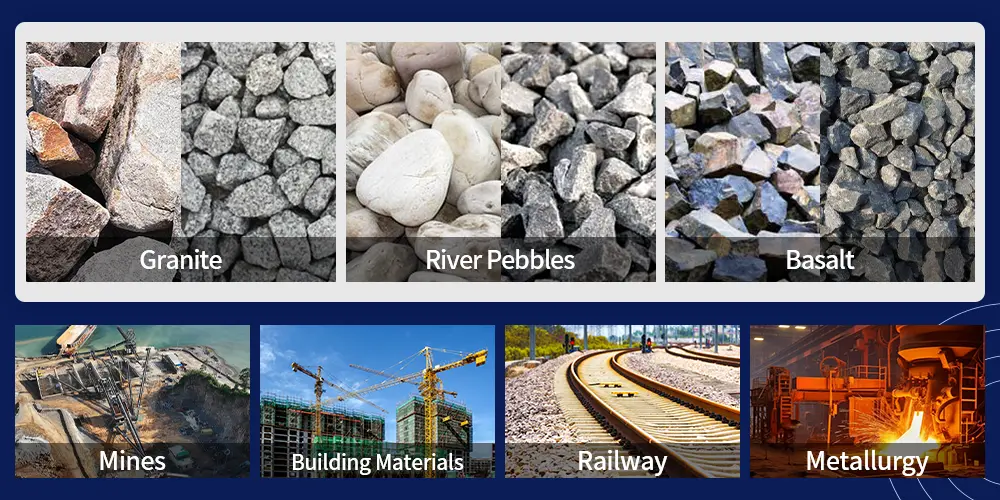
Mining Industry: Used as the primary crushing equipment for various ores (e.g., iron ore, copper ore, gold ore, limestone ore). It crushes large ore blocks into smaller particles, which are then sent to beneficiation processes (e.g., magnetic separation, flotation) to extract valuable minerals.
Quarrying Industry: Used for producing construction aggregates (e.g., gravel, crushed stone) from natural stone materials (e.g., granite, basalt). These aggregates are essential for road construction, bridge building, high-rise buildings, and concrete production.
Infrastructure Construction: Applied in construction waste recycling projects to crush concrete blocks, bricks, and other construction waste into reusable aggregates. It also plays a key role in large-scale projects such as highway construction, high-speed railway construction, and airport runway construction.
Cement & Building Materials Industry: Used for crushing limestone, clay, and other raw materials in cement production. The crushed materials are ground into powder to make cement clinker, which is the main component of cement.
Mining & Metallurgy Industry: Used in the preliminary crushing of metal ores and non-metallic ores, providing qualified materials for subsequent processing (e.g., grinding, sorting).
6. Advantages of Jaw Crushers
Strong Adaptability to Hard Materials: They can efficiently crush extra-hard, hard, and medium-hard materials (e.g., granite, basalt) that many other crushers struggle to process, making them suitable for harsh mining and quarrying environments.
Simple Structure & Easy Maintenance: With fewer moving parts and a straightforward design, jaw crushers are easy to operate, maintain, and repair. Wearing parts (e.g., jaw plates) are easy to replace, reducing downtime and maintenance costs.
Large Feeding Capacity: The V-shaped crushing chamber and large feeding opening allow jaw crushers to handle large-sized raw materials (up to 1000mm), eliminating the need for pre-crushing and improving production efficiency.
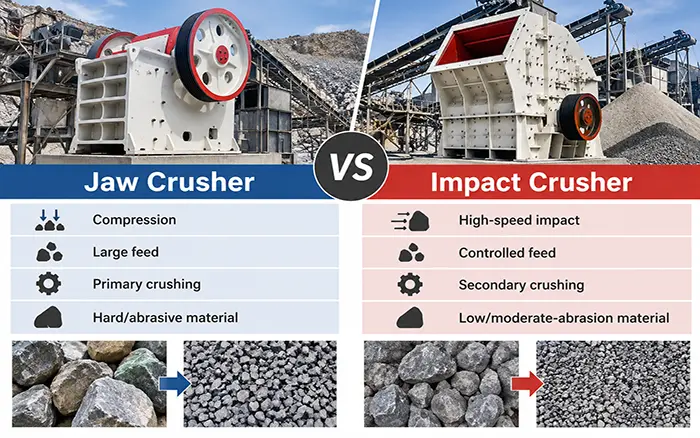
Low Initial Investment & Operational Costs: Compared with large-scale cone crushers or impact crushers, jaw crushers have a lower initial purchase price and lower energy consumption for primary crushing, making them cost-effective for small to medium-sized businesses.
Stable Operation & High Reliability: The heavy-duty frame and robust structure ensure that jaw crushers can operate continuously under heavy loads for long periods, with low failure rates and high operational stability.