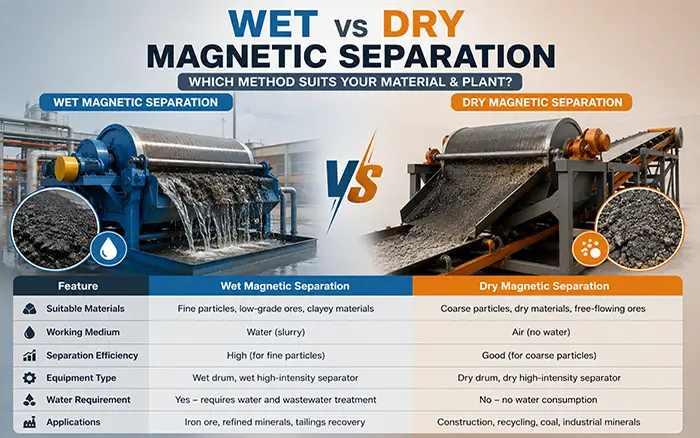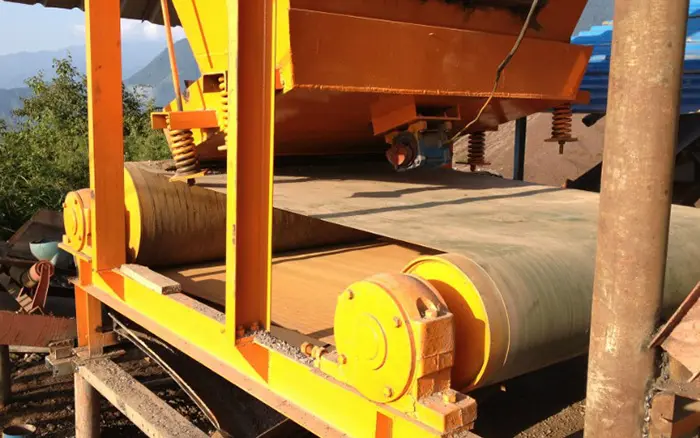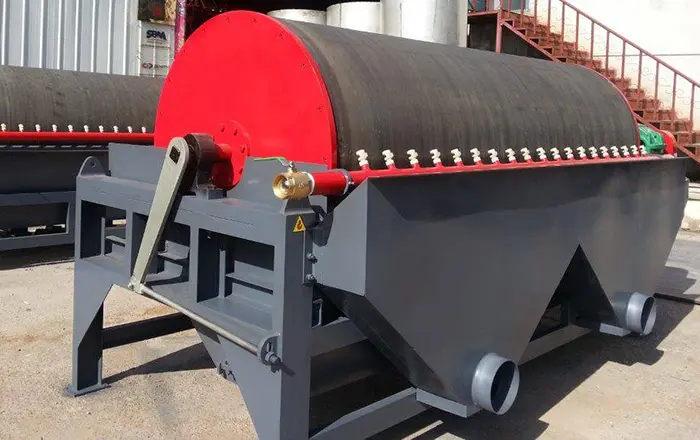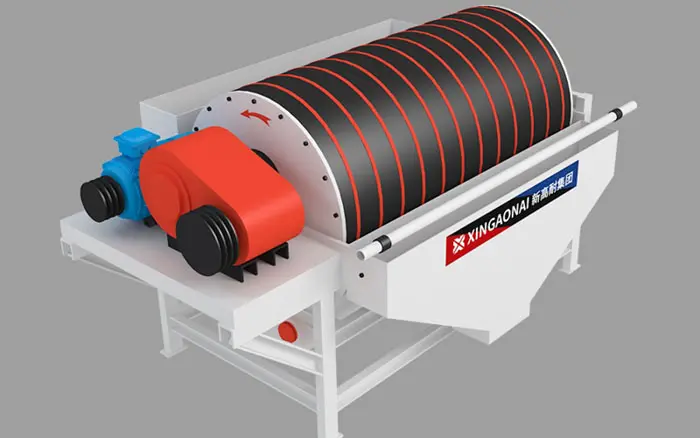
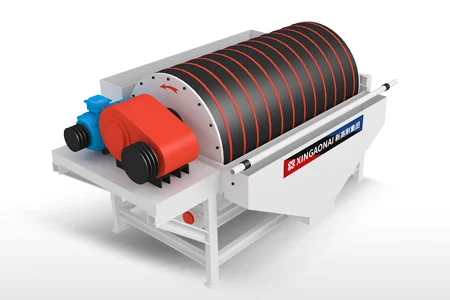
A wet drum magnetic separator separates magnetic minerals from non-magnetic material while the feed is suspended in water. It is commonly installed in mineral-processing circuits handling ground ore, fine particles or material that cannot be separated effectively in a dry state.
The machine is most commonly used to recover strongly magnetic minerals such as magnetite and ferromagnetic particles. Depending on its magnetic system and process configuration, it may be used for roughing, cleaning, scavenging or recovering magnetic media.
However, a wet drum separator is not automatically suitable for every magnetic mineral. Separation performance depends on mineral magnetic susceptibility, liberation size, particle-size distribution, slurry concentration, feed rate and the design of the magnetic system.
This guide explains how a wet drum magnetic separator works, where it should be installed and which operating conditions must be evaluated before selecting a machine.
What Is a Wet Drum Magnetic Separator?
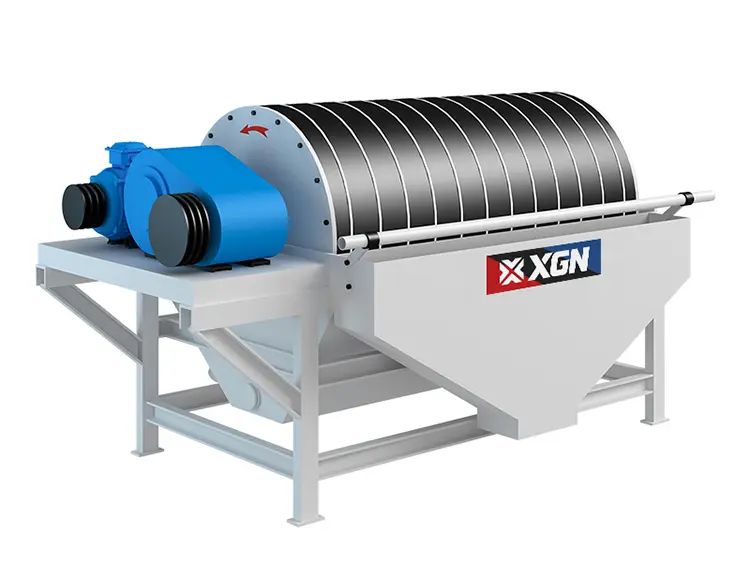
A wet drum magnetic separator is a continuous separation machine consisting of a rotating non-magnetic drum, a stationary internal magnetic system, a tank, a feed system and separate discharge points for magnetic and non-magnetic products.
The feed enters the separator as slurry. Magnetic particles are attracted toward the drum surface, while particles with insufficient magnetic response remain in the slurry and follow a different discharge path.
The rotating drum transports the captured particles away from the main separation zone. When they leave the effective magnetic field, they are discharged as a magnetic product, often with the assistance of rinse water.
For equipment specifications and available models, see the XINGAONAI Wet Drum Magnetic Separator.
How Does a Wet Drum Magnetic Separator Work?
Wet magnetic separation depends on the difference in magnetic response between particles. The process can be divided into five stages.
1. Slurry Feeding
Ground ore is mixed with water and fed into the separator tank. The feed must be distributed across the working width of the drum as evenly as possible.
Uneven feeding can overload one section of the magnetic surface while leaving another section underused. This reduces separation stability and may cause uneven wear.
2. Entry Into the Magnetic Field
As the slurry passes through the separation zone, particles are exposed to the magnetic field produced by the fixed magnet assembly inside the drum.
The force acting on each particle depends on more than the quoted surface field strength. Important factors include:
Magnetic susceptibility of the mineral.
Magnetic field intensity and gradient.
Particle size and shape.
Distance between the particle and magnetic system.
Slurry flow velocity.
Competing hydraulic and gravitational forces.
This is why two separators with a similar surface-field value may produce different results under actual plant conditions.
3. Magnetic Particle Capture
Particles with sufficient magnetic response are attracted toward the drum shell. Strongly magnetic particles, such as liberated magnetite, can normally be captured using a suitable low- or medium-intensity wet drum system.
Non-magnetic gangue and particles with insufficient magnetic response remain in the slurry.
Mineral liberation is essential. A particle containing both magnetite and gangue may still be recovered, but excessive locked gangue can lower concentrate grade.
4. Transport and Washing
The rotating drum carries captured material out of the main slurry flow. Rinse water may be applied to remove entrained gangue and improve concentrate cleanliness.
Drum speed and water flow must be balanced. Excessive speed can reduce the time available for magnetic capture, while very low speed may limit capacity or create an unnecessarily thick magnetic layer.
5. Product Discharge
Once the magnetic particles move beyond the effective magnetic zone, they are released from the drum and discharged as magnetic concentrate.
The non-magnetic slurry leaves through a separate outlet as tailings or a non-magnetic product. The exact flow pattern depends on whether the separator uses concurrent, counter-current or semi-counter-current tank design.
For a broader explanation of magnetic force and separation mechanisms, read How Does a Magnetic Separator Work?
Main Wet Drum Separator Configurations
Wet drum magnetic separators can be configured according to the direction of slurry flow relative to drum rotation.
Concurrent Tank
In a concurrent separator, slurry and the drum surface move generally in the same direction through the separation zone.
This design can provide:
Relatively simple material flow.
High processing capacity.
Suitable treatment of comparatively coarse, strongly magnetic particles.
Its suitability depends on the required recovery and concentrate grade.
Counter-Current Tank
In a counter-current configuration, slurry travels in the opposite direction to the drum surface.
This can increase the contact opportunity between particles and the magnetic field, but the flow must be carefully controlled to prevent instability or concentrate contamination.
Semi-Counter-Current Tank
A semi-counter-current arrangement combines elements of concurrent and counter-current flow.
It is widely considered for fine strongly magnetic material because it can provide a practical balance between recovery, concentrate quality and stable discharge. The correct tank design should be selected through mineral testing rather than by name alone.
Suitable Materials
Wet drum magnetic separators are primarily suited to materials that have sufficient magnetic susceptibility in slurry.
Typical applications include:
Magnetite ore.
Titanomagnetite, subject to mineral testing.
Roasted ore with adequate magnetic response.
Ferromagnetic particles in industrial process streams.
Magnetic media such as magnetite or ferrosilicon used in dense-media separation.
Removal or recovery of strongly magnetic iron-bearing particles.
The machine may also be used for removing magnetic contamination from certain non-metallic mineral slurries, provided the contaminants respond adequately to the magnetic field.
Materials That Require Careful Testing
A conventional wet drum separator should not automatically be recommended for every iron-bearing mineral.
Materials requiring laboratory or pilot testing include:
Hematite.
Limonite.
Siderite.
Manganese minerals.
Ilmenite.
Fine oxidized iron minerals.
Minerals with very weak magnetic susceptibility.
Ultrafine particles dominated by slimes.
These materials may require high-intensity or high-gradient magnetic separation, roasting, gravity separation, flotation or a combined process.
If the feed contains weakly magnetic minerals, compare the available equipment types before selecting a drum separator. See Types of Magnetic Separators.
Common Applications
Magnetite Beneficiation
Wet drum separators are widely used in magnetite-processing plants after grinding and classification.
Depending on the flowsheet, the separator may perform:
Roughing to recover most liberated magnetite.
Cleaning to improve concentrate grade.
Scavenging to recover magnetic minerals remaining in tailings.
Stage separation between grinding circuits.
A multi-stage circuit may provide a better balance between recovery and concentrate grade than attempting to complete the separation in one pass.
Dense-Media Recovery
Magnetite or ferrosilicon is often used as a dense medium in coal and mineral separation.
A wet drum separator can recover the magnetic medium from dilute process streams so it can be returned to the circuit. Stable medium recovery helps reduce operating losses and maintain the required medium density.
Iron Removal From Non-Metallic Slurries
Wet drum separators may remove strongly magnetic iron contaminants from materials such as silica sand, feldspar or certain industrial mineral slurries.
They will not necessarily remove all iron-bearing minerals. Weakly magnetic iron oxides or very fine inclusions may require higher-gradient equipment.
Steel and Industrial Residue Treatment
The equipment can recover ferromagnetic particles from some steel slags, mill scale streams and industrial residues after the material has been properly sized and prepared as slurry.
The economic value depends on iron content, liberation, abrasiveness and downstream product requirements.
Wet Separation vs Dry Separation
Wet separation is normally considered when:
The upstream process already uses wet grinding.
The feed contains fine particles.
Dust control is important.
Water improves material dispersion.
Dry particles would agglomerate or distribute unevenly.
The process requires a wet concentrate or tailings stream.
Dry magnetic separation may be more suitable when:
The material is naturally dry.
Water is unavailable or restricted.
The feed is relatively coarse.
The objective is dry pre-concentration.
Additional dewatering would increase cost.
The decision should be based on the complete process rather than magnetic separation alone. Read Wet vs Dry Magnetic Separation for a detailed comparison.
Factors Affecting Separation Performance
Mineral Magnetic Susceptibility
Magnetic susceptibility determines how strongly a mineral responds to the applied field.
Magnetite usually responds well to a conventional wet drum separator. Weakly magnetic minerals may need a stronger field, a higher gradient or a different separation technology.
Mineral names alone are insufficient. Oxidation, intergrowth and mineral composition can change magnetic response.
Mineral Liberation
Grinding must expose the magnetic mineral sufficiently for separation.
If particles are too coarse, magnetic mineral may remain locked with gangue, lowering concentrate grade. If the feed is ground excessively, ultrafine slimes may become harder to recover because hydraulic drag becomes significant relative to magnetic force.
The correct grind size should be determined through mineralogical analysis and beneficiation testing.
Feed Particle Size
A narrow and controlled particle-size distribution generally produces more stable separation than a feed containing excessive coarse particles and slimes.
The acceptable particle size depends on:
Separator design.
Magnetic field.
Mineral susceptibility.
Required concentrate grade.
Required recovery.
Slurry flow conditions.
Do not treat one nominal particle-size range as suitable for every ore.
Slurry Concentration
Slurry that is too dense can create excessive competition between particles and trap non-magnetic gangue in the magnetic product.
Slurry that is too dilute increases water handling and may reduce capacity per unit of equipment.
The correct solids concentration must be established for the material and duty. It may differ between roughing, cleaning and media-recovery applications.
Feed Rate
Overfeeding reduces the effective magnetic area available per unit of material. It can create a thick particle bed on the drum and carry gangue into the concentrate.
Underfeeding does not necessarily improve separation enough to justify the loss of capacity. The goal is a stable, evenly distributed feed within the equipment’s operating range.
Drum Speed
Higher drum speed can increase material-handling capacity but reduces residence time in the magnetic zone.
Lower speed provides more time for capture and washing but may reduce throughput. The optimum setting depends on particle size, magnetic response and the required product quality.
Rinse Water
Rinse water helps remove non-magnetic particles mechanically trapped in the magnetic product.
Too little water may reduce concentrate grade. Excessive water can disturb captured material, increase water consumption and affect downstream dewatering.
Magnetic Field and Gradient
A higher magnetic-field number does not automatically guarantee better separation.
Excessive magnetic force may capture composite particles or mechanically entrain gangue, while inadequate force can lose magnetic minerals to tailings. The magnet arrangement and field gradient must suit the feed and separation objective.
How to Select a Wet Drum Magnetic Separator
Before selecting a machine, define the process duty.
Step 1: Identify the Separation Objective
Determine whether the separator will be used for:
Roughing.
Cleaning.
Scavenging.
Pre-concentration.
Magnetic media recovery.
Removal of magnetic contamination.
Different duties may require different tank designs, magnetic systems and operating settings.
Step 2: Test the Material
Provide a representative sample for mineral analysis and separation testing.
The test should examine:
Magnetic mineral content.
Mineralogical composition.
Liberation size.
Particle-size distribution.
Magnetic susceptibility.
Required recovery.
Required concentrate grade.
Behaviour of slimes.
Testing is particularly important for oxidized, mixed or weakly magnetic ores.
Step 3: Define Feed Conditions
The supplier needs the following information:
Material or mineral type.
Dry-solids throughput.
Slurry flow rate.
Solids concentration.
Maximum and typical particle size.
Feed temperature.
Abrasiveness.
pH and corrosiveness.
Required operating hours.
Available installation space.
Capacity should be based on both dry-solids throughput and hydraulic flow.
Step 4: Select the Magnetic System and Tank
The magnetic system must provide sufficient force and coverage for the target mineral.
The tank configuration should suit particle size, separation duty and required recovery. The selected machine should also allow adequate feed distribution, concentrate discharge and maintenance access.
Step 5: Evaluate the Complete Circuit
Check how the separator connects with:
Ball or rod mill.
Hydrocyclone.
Slurry pump.
Thickener.
Filter.
Tailings system.
Additional cleaning or scavenging stages.
A correctly sized separator may still perform poorly if feed pressure, slurry concentration or upstream classification is unstable.
Common Operating Problems
| Problem | Possible causes | Corrective actions |
|---|---|---|
| Low magnetic recovery | Insufficient liberation, excessive feed rate, unsuitable field, high drum speed | Check grind size, reduce or stabilize feed, verify magnetic system and adjust speed |
| Low concentrate grade | Locked gangue, excessive slurry concentration, insufficient rinse water, overly strong capture | Improve liberation, adjust concentration and washing, review magnetic configuration |
| Unstable performance | Fluctuating feed rate or density, uneven distribution | Stabilize pumping and classification; inspect the feed distributor |
| Magnetic material in tailings | Overloading, worn components, unsuitable operating settings | Reduce loading, inspect the separator and perform material testing |
| Excessive concentrate dilution | Too much rinse water or poor discharge control | Adjust water flow and inspect the concentrate outlet |
| Abnormal noise or vibration | Loose fasteners, bearing damage, misalignment or trapped debris | Stop the machine and inspect the drive, bearings and drum |
| Drum surface wear | Abrasive feed, damaged lining or trapped objects | Inspect and replace protective lining; remove foreign material |
Changes should be made one parameter at a time and results should be verified through concentrate and tailings sampling.
Routine Maintenance
A wet drum separator normally has fewer moving parts than many other beneficiation machines, but it still requires regular inspection.
Recommended checks include:
Inspecting the drum shell and wear-resistant covering.
Checking bearings, reducer and drive components.
Verifying drum alignment and rotation.
Removing accumulated magnetic debris.
Inspecting slurry and rinse-water pipes.
Checking feed distribution.
Monitoring abnormal noise, vibration and temperature.
Sampling concentrate and tailings regularly.
Checking the magnetic system when performance changes unexpectedly.
Maintenance intervals should be based on the operating environment, abrasiveness and manufacturer’s instructions.
Conclusion
A wet drum magnetic separator is an effective continuous machine for recovering strongly magnetic minerals from slurry. Its most common applications include magnetite beneficiation, magnetic-media recovery and removal of ferromagnetic contamination from suitable wet process streams.
Reliable separation depends on more than magnetic-field strength. Mineral susceptibility, liberation, particle size, slurry concentration, feed distribution, drum speed and circuit stability all affect the result.
Before selecting equipment, test a representative material sample and define whether the machine will perform roughing, cleaning, scavenging or media recovery. This makes it possible to select the correct magnetic system, tank configuration and operating range without relying on unsupported recovery claims.