

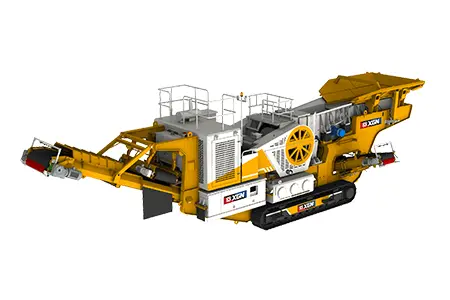
A mobile jaw crusher is a portable crushing unit that brings the crushing process directly to the material source. Unlike stationary jaw crushers that are fixed on concrete foundations, mobile jaw crushers are mounted on tracks or wheels. They can move between job sites and start crushing within hours. This article explains the working principle of a mobile jaw crusher, its main technical specifications, and the best applications for this versatile equipment.
What Is a Mobile Jaw Crusher?
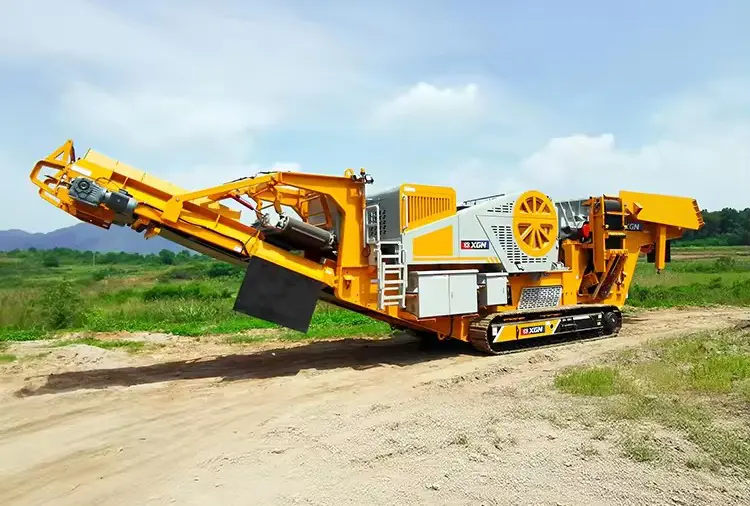
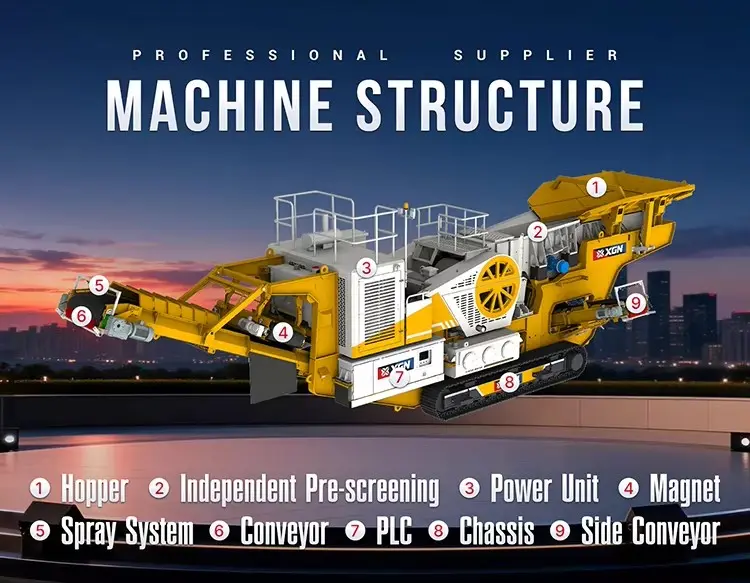
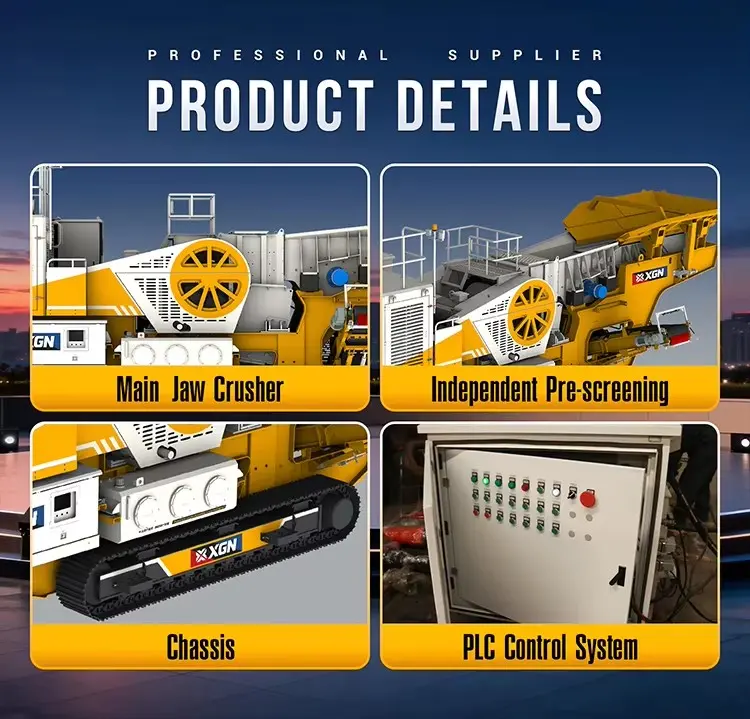
A mobile jaw crusher is a compact, self-contained crushing plant. It integrates a vibrating feeder, a jaw crusher, a discharge conveyor, and a tracked or wheeled chassis into one unit. Some models also include a pre-screen and a return conveyor for closed-circuit operation. The machine is powered by a diesel engine or an electric motor. It can crush a wide range of materials, from hard rocks like granite to recycled concrete and asphalt.
Working Principle of a Mobile Jaw Crusher
The working principle of a mobile jaw crusher is the same as that of a stationary jaw crusher. The material is fed into the crushing chamber, which is formed by a fixed jaw plate and a moving jaw plate. The moving jaw plate moves back and forth against the fixed jaw plate, crushing the material by compression.
Here is the step-by-step process.
1. Feeding
An excavator or wheel loader dumps the material into the vibrating feeder hopper. The feeder meters the material and removes fine particles through a grizzly bar section (if equipped). This prevents the crusher from being clogged by fines.
2. Crushing
The material falls into the jaw crusher chamber. The moving jaw plate, driven by an eccentric shaft, moves towards the fixed jaw plate. The crushing force compresses the rock until it fractures. The opening at the bottom of the chamber is adjustable, which controls the maximum output particle size. The moving jaw then retracts, allowing the crushed material to fall down by gravity.
3. Discharge
The crushed material falls onto a discharge conveyor belt. The conveyor carries the material away from the crusher and forms a stockpile or feeds it into a secondary crusher or screen.
4. Mobility
The tracked chassis allows the entire unit to be driven remotely. The tracks provide high traction on soft or uneven ground. Once on site, the operator lowers the stabilizer legs, connects the power, and starts production. No concrete foundation or crane is needed for setup.
Key Technical Specifications of Mobile Jaw Crushers
When choosing a mobile jaw crusher, you need to look at several specifications. Below are the most important ones.
Feed Opening (Inlet Size)
The feed opening determines the maximum rock size that can enter the crusher. Common sizes range from 500 mm x 300 mm (for small units) to 1,200 mm x 800 mm (for large units). As a rule, the crusher can accept rocks up to 80% of the feed opening width.
Capacity (Tons per Hour)
Capacity varies widely based on material hardness, feed size, and crusher settings. Small mobile jaw crushers process 30–100 tons per hour (TPH). Medium models handle 100–300 TPH. Large tracked units can reach 500–800 TPH.
Hydraulic Adjustable CSS (Closed Side Setting)
The CSS is the gap between the jaw plates at the bottom. It controls the product size. Most mobile jaw crushers have a hydraulic CSS adjustment, allowing the operator to change settings from a control panel without manual shimming. Typical CSS ranges are 40–150 mm for coarse crushing and 20–80 mm for fine crushing.
Engine Power
Mobile jaw crushers are usually powered by a diesel engine (150–600 HP) or a diesel-electric hybrid. The engine drives the crusher and the hydraulic system for the tracks and conveyor. Some models can run on external electricity to reduce fuel costs.
Weight and Transport Dimensions
Weight ranges from 15 tons (small) to 100 tons (large). For transport, the machine must fit on a low-bed trailer. Maximum transport width is typically under 3 meters, length under 15 meters. Many units fold the hopper and conveyor for transport.
Track Speed
The machine can move at a slow speed (0.5–1 km/h) on site for repositioning. It is not designed for long-distance travel on roads.
Best Applications for Mobile Jaw Crushers
Mobile jaw crushers are used in many industries where mobility is a key advantage. Here are the best applications.
1. Quarrying and Mining
In a quarry, the working face moves over time. A stationary crusher requires long haul roads for trucks. A mobile jaw crusher can follow the face, reducing hauling distance and fuel costs. It is also used for primary crushing of ore in small to medium-scale mining operations.
2. Construction and Demolition Recycling
Recycling concrete, asphalt, and bricks is a perfect match for mobile jaw crushers. The material is often located in urban areas where space is limited. A mobile crusher can be moved into a demolition site, crush the waste on-site, and produce reusable aggregate. This saves the cost of trucking waste to a central plant and then buying new aggregate.
3. Road and Highway Construction
When building a highway, the rock source may be several kilometers away from the paving site. A mobile jaw crusher can be placed near the rock source, crushing stone directly into base course material. The flexibility to move along the project corridor is invaluable.
4. Infrastructure Projects (Dams, Tunnels, Ports)
These projects have limited duration (2–5 years). Building a stationary crushing plant is not cost-effective. A mobile jaw crusher can be rented or purchased for the project duration and then sold or moved to the next site.
5. Contract Crushing
Many contractors own a fleet of mobile crushers and rent them to quarry owners or construction companies. The ability to transport a crusher on a low-bed trailer and set it up in a few hours is essential.
Mobile Jaw Crusher vs. Stationary Jaw Crusher: When to Choose Mobile
| Feature | Mobile Jaw Crusher | Stationary Jaw Crusher |
|---|---|---|
| Mobility | High (move between sites) | None (fixed) |
| Setup time | Hours to days | Weeks to months |
| Foundation | None or minimal | Concrete required |
| Cost per ton | Higher | Lower |
| Best for | Short-term, multi-site projects | Long-term, fixed-location production |
Choose a mobile jaw crusher when your project duration is less than 3–5 years, when the material source moves, or when you need to process material at multiple sites.
Maintenance Tips for Mobile Jaw Crushers
To keep a mobile jaw crusher running reliably, follow these tips.
Inspect jaw plates daily for wear. Replace them when the wear exceeds 50% of the original thickness.
Check the hydraulic system for leaks. The hydraulic CSS adjustment and track drive depend on clean oil.
Grease the bearings and toggle plate seat regularly.
Keep the feeder and conveyor belts aligned. Misalignment causes spillage and belt damage.
Run the engine and hydraulic system at the recommended operating temperature. Cold starts should be done gently.
Conclusion
The mobile jaw crusher is a powerful tool for on-site crushing. Its working principle is simple but effective: material is compressed between two jaws and reduced to a smaller size. Key specifications like feed opening, CSS, capacity, and engine power determine which machine fits your job. Best applications include quarrying, recycling, road construction, and contract crushing. By understanding these factors, you can select the right mobile jaw crusher for your project and maximize your return on investment.