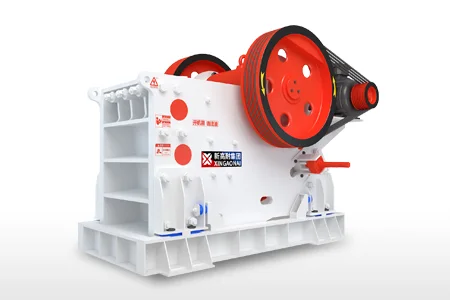
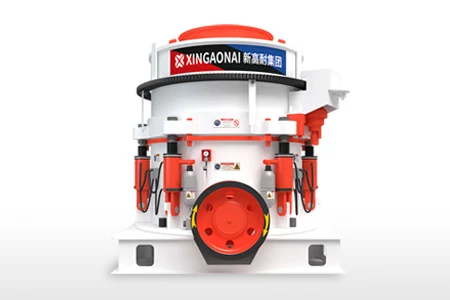
A jaw crusher is commonly used to reduce large run-of-mine or quarry feed in the primary stage. A cone crusher is commonly used after primary crushing to reduce prepared material further.
Both use compression, and both can process suitable hard, abrasive rock. Their most useful distinction is the duty they perform within the crushing circuit.
For many projects, the question is whether one stage can meet the requirement or whether jaw and cone crushing should be combined.
This guide compares their operating roles, feed requirements, product control and practical selection boundaries.
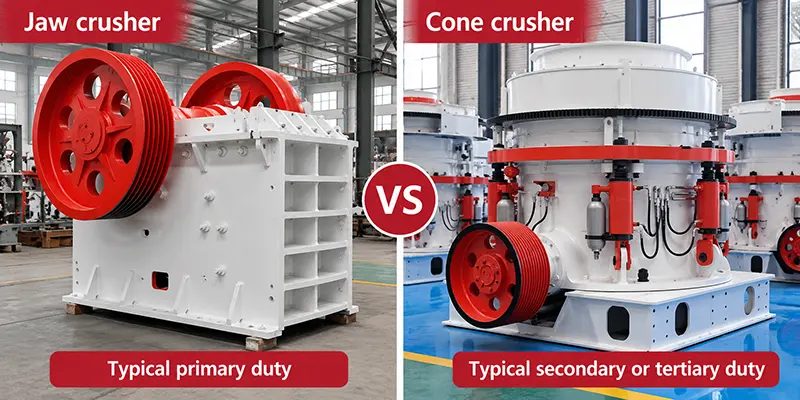
Cone Crusher vs Jaw Crusher: Quick Comparison
| Comparison | Jaw crusher | Cone crusher |
|---|---|---|
| Typical role | Primary crushing; some designs serve other duties | Secondary, tertiary or further reduction, depending on configuration |
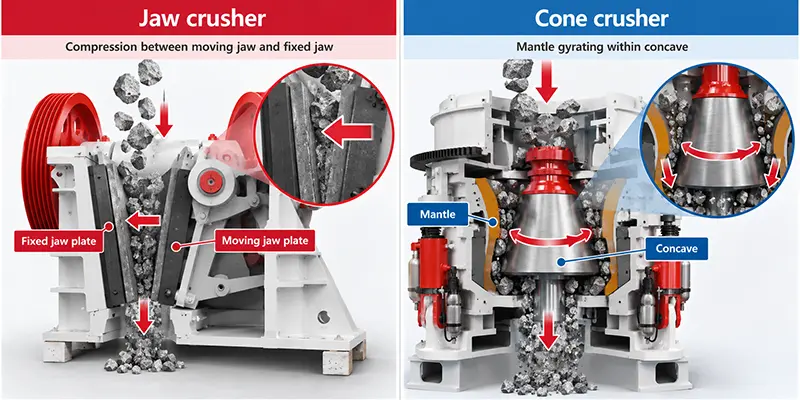
| Crushing surfaces | Fixed and moving jaw plates | Mantle and concave |
| Material movement | Compression as the moving jaw approaches the fixed jaw | Compression as the head gyrates within the crushing chamber |
| Typical feed condition | Larger, coarser material within the selected feed opening | Prepared feed within the selected chamber’s limits |
| Main selection question | Can it accept the feed and produce suitable material for the next stage? | Can it further reduce that feed at the required capacity and setting? |
| Product control | Influenced by discharge setting, jaw profile and feed condition | Influenced by chamber profile, setting, feed condition and circuit |
| Hard, abrasive material | Commonly evaluated for primary duty | Commonly evaluated for secondary and tertiary duty |
| Feeding requirement | Controlled delivery without bridging or excessive loading | Stable, appropriately distributed feed suited to the chamber |
| Screening relationship | May discharge to a stockpile, screen or secondary crusher | Frequently used with screening where controlled product sizes are required |
| Capacity and cost | Depend on model and operating duty | Depend on model and operating duty |
This table describes typical roles rather than universal limits. Machine size alone does not determine whether a jaw or cone crusher is appropriate.
1. They Perform Different Jobs in the Crushing Circuit
The primary stage accepts the material delivered from the mine, quarry or stockpile. Its task is to reduce that material into manageable feed for the next operation.
A jaw crusher is often evaluated here because of its feed opening and coarse-crushing arrangement.
A cone crusher generally receives material already reduced to a suitable size. Its chamber and setting are selected for the next reduction stage.
For example:
Run-of-mine rock → Jaw crusher → Prepared feed → Cone crusher → Screen
The jaw crusher prepares the material. The cone crusher performs further reduction. Screening separates material that meets the required size from material that needs another pass.
The circuit may be simpler or more complex, depending on the required product and material behavior.
2. Both Use Compression, but Their Chamber Movements Differ
Jaw Crusher
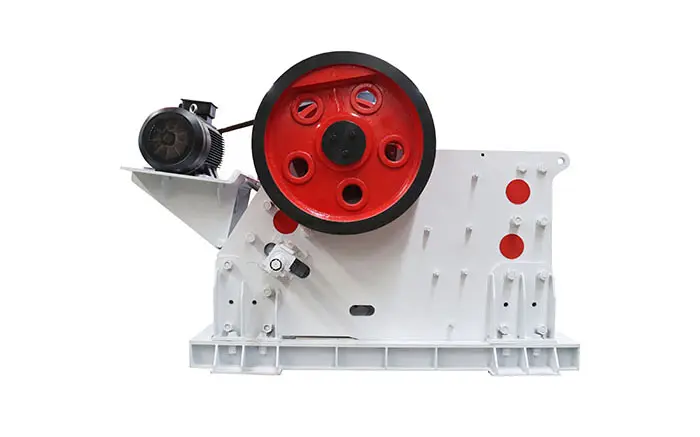
A moving jaw compresses material against a fixed jaw. As the chamber opens and closes, particles are broken and move toward the discharge.
The feed opening, jaw profile and discharge setting influence how the machine handles material.
For component and operating details, see what is a jaw crusher.
Cone Crusher
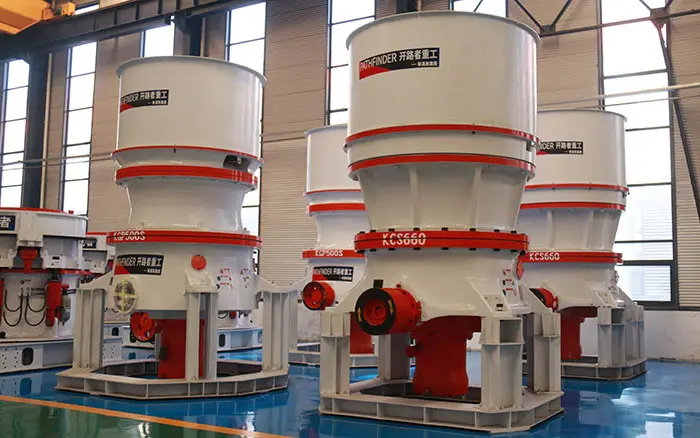
The head gyrates within the surrounding concave. Material is compressed as the space between the crushing surfaces changes around the chamber.
Depending on the chamber and feeding conditions, crushing includes interaction between particles as well as contact with the liners.
The head should not be described simply as a rotor spinning around a fixed central axis.
For the detailed mechanism, refer to how a cone crusher works.
3. Feed Size Determines Whether Substitution Is Practical
A cone crusher cannot automatically replace a jaw crusher handling large raw feed.
The proposed replacement must accept:
The largest expected lumps;
The complete feed-size distribution;
The material shape;
Normal feed variations;
The required flow rate.
An average feed size can conceal occasional oversized rocks that cause bridging or interruptions.
The reverse substitution also needs review. A jaw crusher accepting the feed does not prove it can produce the finer product required from an existing cone-crushing stage.
Check the complete feed and discharge conditions before treating the machines as alternatives.
4. Both Can Process Hard Rock
Hardness alone does not separate jaw-crusher applications from cone-crusher applications.
Both are commonly considered in hard-rock circuits processing materials such as granite, basalt, quartzite and suitable metal ores.
The stage, feed size, abrasiveness, fracture behavior and required output determine the arrangement.
Avoid the assumption that a cone crusher is unsuitable simply because the rock is very hard. It may be appropriate after primary crushing when its chamber, power and operating conditions match the duty.
Wet, clay-rich or cohesive feed creates another set of challenges. Neither machine should be assumed suitable without reviewing material handling, pre-screening and potential blockage.
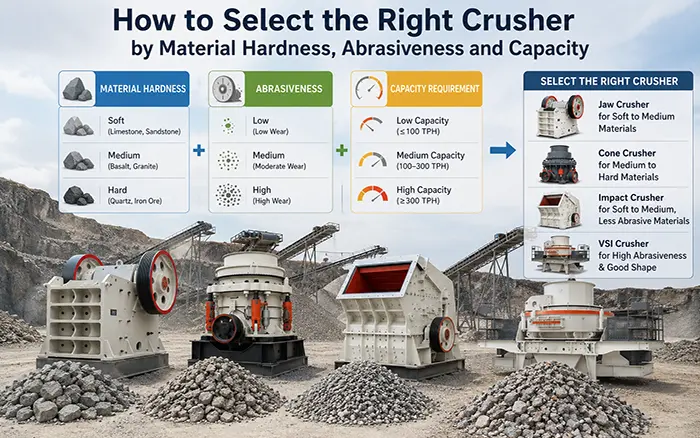
For the broader material assessment, see how to select a crusher.
5. Product Size Is a Distribution, Not One Fixed Number
Both jaw and cone crushers discharge a range of particle sizes.
The closed-side setting influences the product, but it does not mean every discharged particle is smaller than that setting.
Product gradation depends on:
Feed-size distribution;
Material properties;
Crushing-chamber profile;
Discharge setting;
Liner condition;
Feeding consistency;
Screening and recirculation.
A cone stage can provide additional reduction and influence product shape under suitable conditions. It does not guarantee a specific aggregate grading or shape requirement by itself.
Where final size limits are important, evaluate the crusher together with the screen and return circuit.
6. Compare the Required Reduction Across Stages
Trying to achieve all size reduction in one machine may restrict capacity or produce an unsuitable product.
A jaw-only circuit can be appropriate when its discharge meets the next process’s requirements. If further reduction is necessary, a cone stage may allow the duty to be divided more effectively.
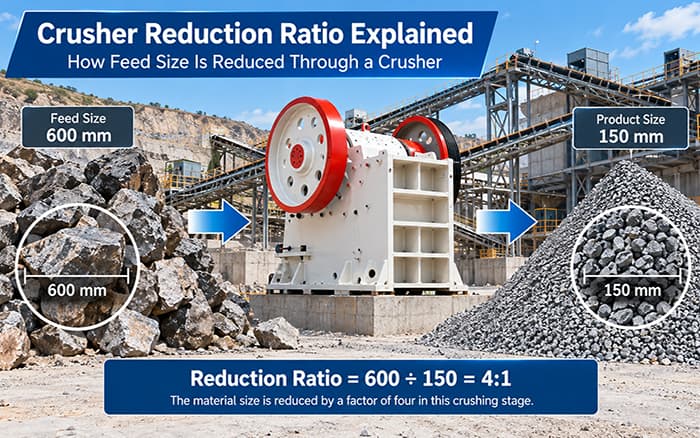
Use a consistent particle-size basis when comparing reduction ratios. Do not mix maximum lump dimensions with representative distribution sizes.
Calculation methods and stage allocation are explained in the crusher reduction ratio guide.
The objective is a workable circuit, rather than the highest possible reduction ratio from either machine.
7. Capacity Must Be Compared at the Actual Duty
A jaw crusher is not inherently limited to small production lines. Cone crushers are also available for different production requirements.
Comparing maximum catalogue capacities can be misleading because those figures may represent different:
Materials;
Feed distributions;
Settings;
Chamber configurations;
Operating conditions.
For a jaw–cone circuit, confirm that the jaw discharge can be accepted by the cone stage and that both stages support the required plant output.
Include circulating material in a closed secondary circuit.
For an illustrative example:
Fresh feed to the secondary circuit: 100 t/h
Screen oversize returning to the cone crusher: 30 t/h
Total material reaching the cone crusher: 130 t/h
The secondary crusher and associated conveyors must be checked against the total load. Actual recirculation must be calculated for the proposed circuit.
8. Feeding Requirements Affect Performance
Both machines benefit from controlled material delivery, but their chamber requirements differ.
Feeding a Jaw Crusher
The receiving arrangement should provide controlled delivery, suitable feed size and a clear path into the chamber.
Surges, oversized pieces and poor chute alignment can interrupt production.
Feeding a Cone Crusher
The feed arrangement should provide the distribution and chamber loading required by the selected design.
Where choke feeding is specified, the plant must be capable of maintaining it within the approved operating limits.
Unstable or one-sided feeding can affect loading, liner wear and product consistency.
A primary crusher’s rated output alone does not establish a suitable feed condition for the cone crusher. Stockpiling, surge capacity and controlled feeding may be needed between stages.
9. Compare Costs at the Circuit Level
It is not meaningful to declare one crusher universally cheaper or more energy-efficient when the machines perform different reduction duties.
Compare alternatives that achieve the same required production result.
Include:
Equipment supply;
Feeding and screening;
Conveyors and transfer points;
Foundations and supporting structures;
Electrical installation;
Wear parts;
Lubrication and servicing;
Lifting and maintenance access;
Energy per tonne of acceptable output;
Downtime;
Return load.
A lower purchase price can lose its advantage if the circuit requires repeated handling or restricts downstream production.
For hard, abrasive feed requiring substantial reduction, a suitable primary and secondary combination may be more practical than forcing one machine to perform the entire task.
When Is a Jaw Crusher Alone Sufficient?
A jaw-only arrangement may be suitable when:
Feed fits the selected opening;
Required reduction is achievable;
Its discharge suits the receiving process;
Product shape is acceptable for the application;
Additional screening or crushing is unnecessary;
The operating capacity meets the project requirement.
Examples may include coarse material preparation or a primary stage supplying a downstream process that accepts its output.
Confirm the product distribution rather than assuming a jaw crusher always needs a secondary machine.
When Can a Cone Crusher Be Used Without a Jaw Crusher?
A jaw crusher may be unnecessary when material already arrives within the cone crusher’s feed limits.
Possible situations include:
A prepared stockpile;
Material from another primary crusher;
Pre-crushed feed transferred from another plant;
A project where another primary-crushing technology is selected.
The key requirement is suitable feed preparation. A cone crusher does not require a jaw crusher specifically, but it does require feed appropriate to its chamber and operating duty.
When Should Jaw and Cone Crushers Work Together?
A combined arrangement is worth evaluating when:
Raw feed is too large for the cone crusher;
Hard or abrasive material requires more than one reduction stage;
Jaw discharge is too coarse for the required product;
Screening and recirculation are needed;
The plant requires controlled feed preparation before grinding or further processing.
A typical arrangement is:
Hopper → Controlled feeding → Jaw crusher → Surge storage or transfer → Cone crusher → Screen
The PEV Series Jaw Crusher and XHP Series Multi-Cylinder Hydraulic Cone Crusher are equipment series to evaluate for their respective stages.
Selecting one model from each series does not establish a matched plant. Feed compatibility, settings, output and auxiliary equipment must be reviewed together.
Information Needed to Compare a Jaw and Cone Configuration
Prepare:
Material and mineral composition;
Hardness, strength and abrasiveness information where available;
Maximum feed size and feed distribution;
Moisture and clay conditions;
Required fresh-feed rate;
Required product sizes;
Downstream process requirements;
Operating hours;
Existing equipment and settings;
Site layout and available power;
Proposed screening and return arrangement.
Ask the supplier to identify the operating assumptions behind its recommendation.
A useful proposal explains why each machine is required and how the stages connect.
Select the Combination Around the Required Output
A cone crusher vs jaw crusher comparison is most useful when it begins with the crushing stage.
Confirm what material enters, what product must leave and how much reduction is required. Then determine whether a jaw stage, a cone stage or a combined circuit meets that duty.
Provide XINGAONAI with the feed information, required capacity, product sizes and existing layout to request a preliminary equipment-matching proposal.