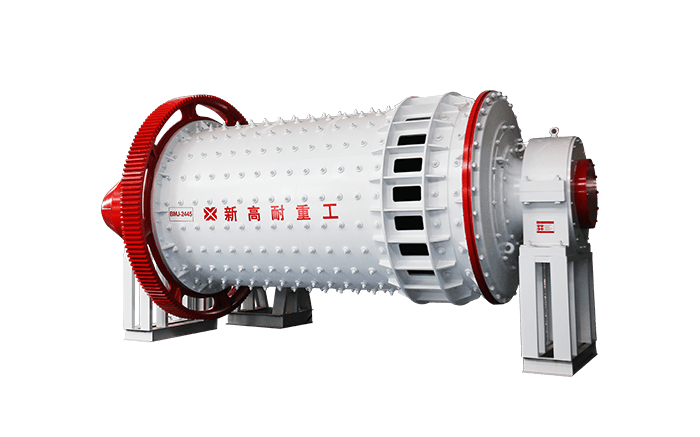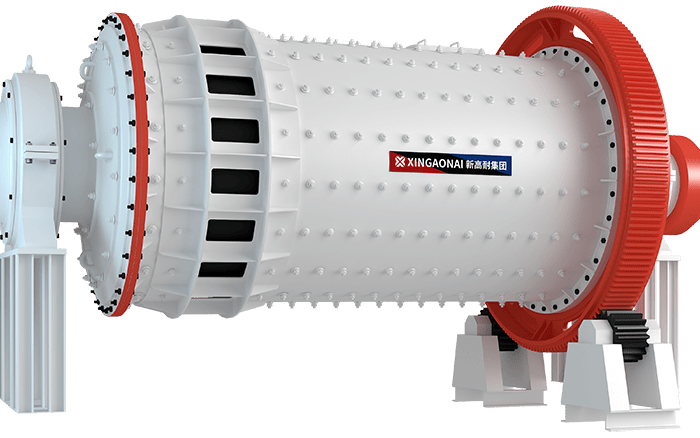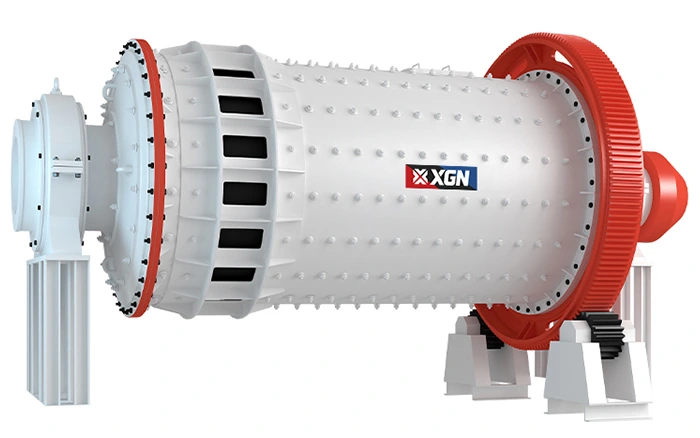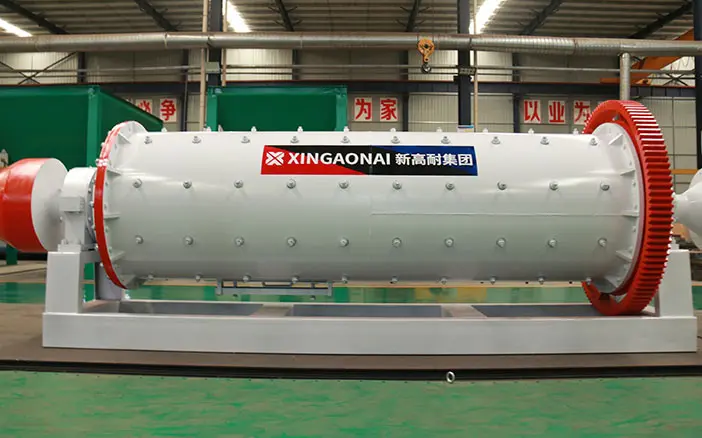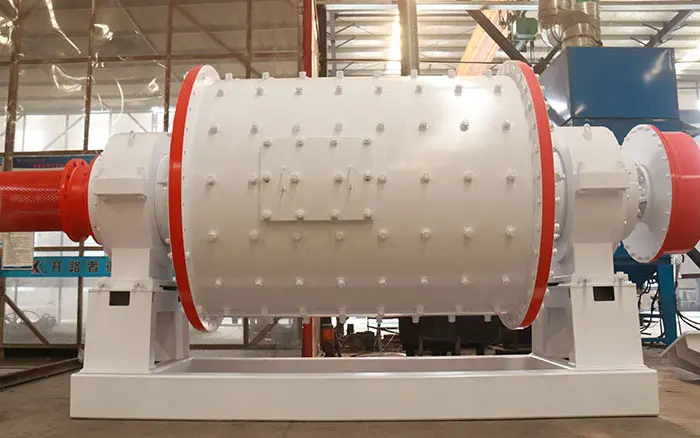
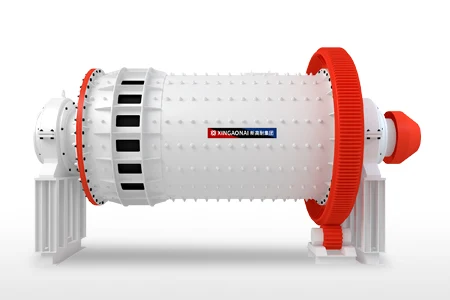
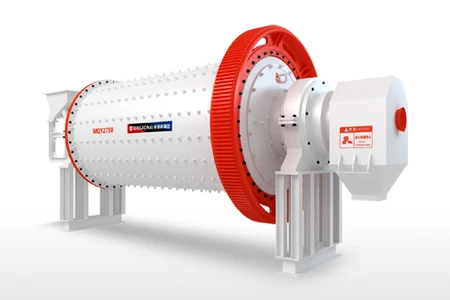
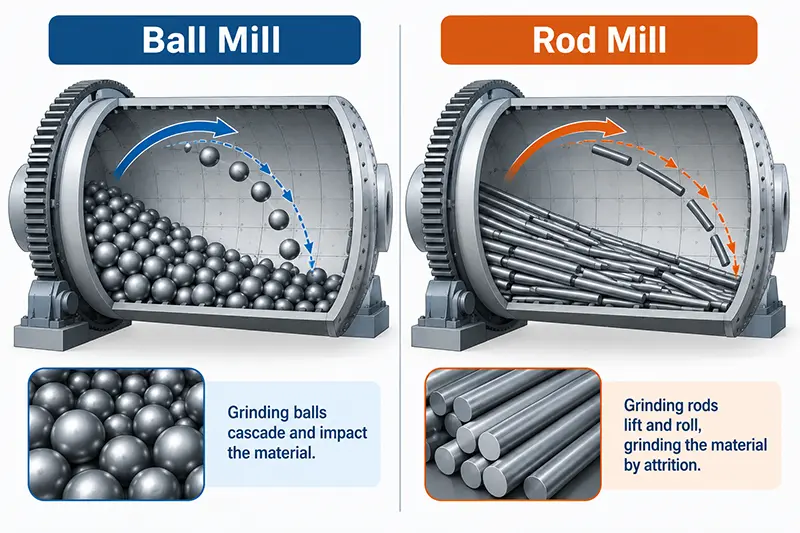
The main difference between a ball mill and a rod mill is the grinding media. A ball mill uses steel or ceramic balls, while a rod mill uses long steel rods.
This difference changes how the material is broken, the size distribution of the ground product and the applications for which each machine is normally selected.
In general:
Choose a rod mill for controlled coarse or intermediate grinding, manufactured sand or a first grinding stage where excessive fines should be limited.
Choose a ball mill when the process requires finer grinding, greater mineral liberation or a product suitable for downstream flotation, leaching, magnetic separation or powder production.
This is a general selection rule rather than an absolute one. The final decision must consider feed size, target product size, material grindability, circuit design and operating cost.
Review the XINGAONAI Ball Mill and Sand Making Rod Mill for the available model ranges.
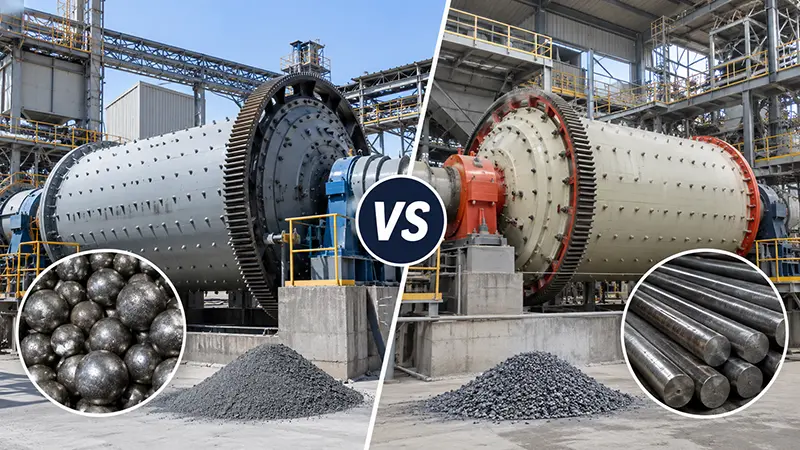
Quick Comparison: Ball Mill vs Rod Mill
| Comparison | Ball mill | Rod mill |
|---|---|---|
| Grinding media | Steel or ceramic balls | Long steel rods |
| Main contact pattern | Multiple point contacts | More line contact |
| Typical grinding duty | Intermediate to fine grinding | Coarse to intermediate grinding |
| Feed handling | Usually receives finer prepared feed | Can generally accept relatively coarser prepared feed |
| Product characteristic | Usually finer product | Relatively coarse and more selectively ground product |
| Fine generation | More suitable when fines are required | Can limit overgrinding in suitable duties |
| Common circuit position | Final or secondary grinding stage | First grinding stage or sand-making stage |
| Typical applications | Mineral liberation, cement, industrial powder | Manufactured sand, coarse ore grinding, feed preparation |
| Media behaviour | Balls move in multiple directions | Rods remain generally parallel to the cylinder axis |
| Main operating concern | Ball and liner wear, classification efficiency | Rod wear, alignment and rod tangling |
| Wet/dry operation | Both available | Both available |
| Selection priority | Required fineness and mineral liberation | Controlled grading and reduced excessive fines |
1. Difference in Grinding Media
Ball mill grinding media
A ball mill uses steel balls, ceramic balls or other spherical media. Balls of different diameters may be combined to provide a balance between impact and contact area.
Larger balls help break coarser particles, while smaller balls provide more contact points for fine grinding.
Because balls move and collide in multiple directions, a ball mill creates many impact and abrasion zones. This makes it suitable for producing relatively fine material.
Rod mill grinding media
A rod mill uses long cylindrical steel rods. The rods are installed approximately parallel to the cylinder axis and roll or cascade as the mill rotates.
The elongated rods create more line contact with the material. Larger particles are more likely to be trapped between the rods, while smaller particles can move through the spaces between them.
This selective action can reduce unnecessary overgrinding in suitable coarse-grinding applications.
The rods must have the correct length, diameter and loading. Bent, broken or excessively worn rods can cross each other and cause unstable operation.
2. Difference in Working Principle
Both machines use a horizontal rotating cylinder. The difference lies mainly in how their grinding media move and contact the material.
How a ball mill works
As the cylinder rotates, the balls and feed are lifted along the rising side of the shell. Gravity then causes the balls to cascade, roll or fall.
Material is reduced through:
Impact from falling balls
Compression between balls
Abrasion between balls, material and liners
Attrition caused by sliding movement
The large number of point contacts supports progressive fine grinding.
Read How Does a Ball Mill Work? for a more detailed explanation.
How a rod mill works
Cylinder rotation lifts the rods and material. The rods then roll and cascade downward while remaining generally aligned with the cylinder axis.
Material is reduced through:
Impact from falling rods
Compression between adjacent rods
Compression between rods and liners
Abrasion during rolling and sliding
The line-contact pattern tends to act more directly on larger particles.
See the complete rod mill working principle.
Rotation speed comparison
It is inaccurate to say that every ball mill operates at 45–60 RPM and every rod mill at 30–45 RPM.
The actual rotational speed depends on:
Cylinder diameter
Grinding-media dimensions
Liner profile
Media loading
Material characteristics
Required grinding action
Percentage of critical speed
Larger-diameter mills normally operate at lower RPM than smaller-diameter mills. Therefore, speed should be specified for the individual model rather than used as a universal difference between the two machines.
3. Feed Size Differences
A rod mill can generally accept relatively coarser prepared feed than a ball mill performing fine grinding. However, neither machine should normally receive run-of-mine rock directly.
The acceptable feed size depends on:
Material hardness
Feed-size distribution
Rod or ball diameter
Mill dimensions
Target product size
Available motor power
Open- or closed-circuit operation
XINGAONAI currently publishes:
| Equipment | Published maximum feed size |
|---|---|
| Sand Making Rod Mill | ≤30 mm |
| Ball Mill | ≤20 mm |
These values apply to the listed product ranges and should not be treated as universal limits for all rod mills and ball mills.
Oversized feed can reduce capacity, increase power fluctuations and accelerate media and liner wear.
4. Product Size and Particle Distribution
Ball mill product
Ball mills are generally selected when a finer product is required.
Depending on the mill configuration and classification circuit, they may be used for:
Mineral liberation before flotation
Grinding before leaching
Grinding before magnetic separation
Cement and clinker grinding
Industrial mineral powder preparation
Ceramic or chemical material grinding
The final particle-size distribution depends heavily on the classifier. A ball mill alone does not guarantee that every particle will meet the target size.
Rod mill product
Rod mills are generally associated with a coarser and more selectively ground product.
They may be selected when the process requires:
Controlled coarse grinding
Reduced excessive fine generation
Manufactured sand
Preparation of feed for a ball mill
Preparation of ore before separation
A relatively narrow coarse product distribution
XINGAONAI’s sand making rod mill lists a nominal discharge size below 5 mm, but actual grading depends on the raw material, rod configuration, operating conditions and downstream screening.
Which mill produces a more uniform product?
A rod mill can produce a relatively narrow coarse product distribution because larger particles receive more direct contact from the rods.
A ball mill can achieve a controlled fine product when it operates with an effective classifier. Therefore, it is too broad to say that a rod mill always produces a “more uniform” product. Uniformity must be evaluated at the required product size and across the complete circuit.
5. Structural Differences
| Structural item | Ball mill | Rod mill |
|---|---|---|
| Grinding chamber | Horizontal cylindrical shell | Horizontal cylindrical shell |
| Media | Balls of selected diameters | Rods slightly shorter than the effective cylinder length |
| Cylinder proportion | Varies with grinding duty | Often relatively long to allow stable rod movement |
| Liner function | Protects shell and controls ball lifting | Protects shell and supports controlled rod movement |
| Media movement | Multi-directional | Mainly parallel to cylinder axis |
| Common discharge designs | Overflow or grate discharge | Overflow, end peripheral or center peripheral discharge |
| Main media risk | Incorrect ball-size distribution | Bent rods, crossed rods or rod tangling |
Cylinder length-to-diameter ratio varies among manufacturers and applications. Fixed universal ratios should not be used as the only basis for distinguishing the machines.
6. Discharge and Classification Differences
Ball mill discharge
Ball mills commonly use overflow or grate discharge.
Overflow discharge is often selected for finer wet grinding.
Grate discharge can allow faster material removal and may be used for relatively coarser grinding or higher throughput.
Ball mills frequently operate in closed circuit with a hydrocyclone or spiral classifier. Fine material proceeds to the next process, while coarse particles return to the mill.
Rod mill discharge
Rod mills may use overflow, end peripheral or center peripheral discharge.
Overflow discharge is commonly associated with wet grinding.
End peripheral discharge can provide shorter retention time.
Center peripheral discharge may be considered for coarse grinding or sand-making duties.
The discharge configuration influences capacity and retention time, but external screening or classification is still necessary when strict product-size control is required.
7. Application Differences
Common ball mill applications
Ball mills are widely used for:
Gold, copper and iron ore grinding
Lead-zinc and other flotation circuits
Fine grinding before leaching
Cement clinker grinding
Limestone and industrial mineral powder
Ceramics and chemical materials
Slag and other suitable industrial materials
A ball mill is generally preferred when mineral liberation or product fineness is the primary objective.
Read What Is a Ball Mill? for its components, types and uses.
Common rod mill applications
Rod mills may be used for:
Manufactured sand production
Coarse ore grinding
First-stage grinding before a ball mill
Preparation of material for mineral separation
Applications where excessive fines should be controlled
Selected aggregate and industrial-mineral processes
Suitability depends on the specific material. A rod mill should not automatically be selected for all sticky, wet, soft or abrasive materials.
Read What Is a Rod Mill? for its main types and uses.
8. Energy Consumption Differences
Neither machine is always more energy-efficient.
Energy consumption depends on:
Feed size
Target product size
Material grindability
Mill dimensions
Media size and loading
Feed rate
Wet or dry operation
Open- or closed-circuit configuration
Classification efficiency
Mechanical condition
A rod mill may use energy effectively when the objective is controlled coarse grinding because it avoids unnecessarily reducing all particles to a fine size.
A ball mill may be more suitable when fine grinding is required because its ball charge provides more contact points and grinding zones.
Comparing the two machines at different product sizes is misleading. Energy comparison should use the same material, throughput and final particle-size requirement.
9. Wear and Maintenance Differences
Ball mill wear
Important wear-related items include:
Grinding balls
Shell liners
Discharge grates
Trunnion liners
Bearings
Pinion and girth gear
Ball consumption and liner wear depend strongly on material abrasiveness, ball quality and operating conditions.
Rod mill wear
Important wear-related items include:
Grinding rods
Shell liners
Discharge components
Bearings
Pinion and girth gear
Rod diameter gradually decreases during operation. Rods must be replenished, and bent or broken rods should be removed.
A rod mill does not always have lower wear than a ball mill. Wear must be compared for the same material and grinding duty.
For further information, see the rod mill liner maintenance guide.
10. Capacity Differences
Capacity should not be compared using cylinder volume alone.
A mill’s practical capacity depends on:
Feed characteristics
+ Feed size
+ Target product size
+ Grinding energy requirement
+ Mill dimensions
+ Installed power
+ Media loading
+ Discharge system
+ Classification circuit
A ball mill producing a fine mineral product performs more size-reduction work than a rod mill producing coarse sand. Lower tonnage does not necessarily mean lower efficiency.
Similarly, a rod mill with a higher published capacity is not automatically more productive for a fine-grinding task it was not designed to perform.
The current XINGAONAI product ranges are:
| Product | Feed size | Published capacity | Primary positioning |
|---|---|---|---|
| Sand Making Rod Mill | ≤30 mm | 80–500 t/h | Sand making and controlled coarse grinding |
| Ball Mill | ≤20 mm | 10–248 t/h | Fine grinding and mineral liberation |
These are different product families serving different process goals. Final selection requires material and target-product data.
11. Wet vs Dry Grinding
Both ball mills and rod mills can be configured for wet or dry operation.
Wet grinding
Wet grinding is common in mineral processing because it:
Reduces airborne dust
Supports slurry transport
Integrates with hydrocyclones and classifiers
Connects easily with flotation or wet separation
It also requires water management, slurry pumps and dewatering where applicable.
Dry grinding
Dry grinding may be selected when:
The finished product must remain dry
Process water is limited
Water would affect the product
The downstream process handles dry powder
Dry circuits require dust collection, ventilation and careful moisture control.
The choice between wet and dry operation is separate from the choice between a ball mill and a rod mill.
12. When Should You Choose a Rod Mill?
Consider a rod mill when:
The required product is relatively coarse
Excessive fine generation must be controlled
The process produces manufactured sand
The mill will prepare feed for a downstream ball mill
A relatively selective first grinding stage is needed
Feed can be maintained within the specified size
Rod handling and replenishment can be managed safely
A rod mill is not usually the first choice when the process requires a very fine finished product.
13. When Should You Choose a Ball Mill?
Consider a ball mill when:
Fine grinding is required
Mineral liberation determines process recovery
The mill will operate with a hydrocyclone or classifier
The product feeds flotation, leaching or another separation process
Cement, clinker or industrial minerals must be ground
A wide range of wet or dry configurations is required
Ball-size distribution can be managed according to the grinding duty
The required fineness and grindability should be used for equipment sizing rather than selecting a model from throughput alone.
14. Can a Rod Mill and Ball Mill Work Together?
Yes. Some grinding circuits use a rod mill before a ball mill.
A simplified two-stage circuit is:
Crushing
   ↓
Rod mill: coarse grinding
   ↓
Ball mill: fine grinding
   ↓
Classification
   ↓
Mineral separation
The rod mill reduces the coarse feed and can help control excessive fines in the first stage. The ball mill then completes the finer grinding required for mineral liberation.
However, two-stage grinding increases equipment, foundation, control and maintenance requirements. It should only be used when test work and process calculations show a benefit.
Ball Mill vs Rod Mill Selection Table
| Project requirement | More likely choice | Reason |
|---|---|---|
| Manufactured sand below a controlled top size | Rod mill | Controlled coarse grinding |
| Fine ore grinding before flotation | Ball mill | Greater fine-grinding capability |
| First stage before a ball mill | Rod mill | Prepares a relatively controlled feed |
| Cement clinker grinding | Ball mill | Suitable for fine powder production |
| Strict control of excessive fines | Rod mill | Selective action on larger particles |
| Mineral liberation at fine sizes | Ball mill | More grinding contact points |
| Coarse wet grinding | Depends | Material and discharge design must be evaluated |
| Dry industrial powder | Usually ball mill | Better suited to many fine dry-grinding duties |
| Sand-sized product with external screening | Rod mill | Suitable for coarse product and closed screening |
| Uncertain application | Test first | Grindability and product requirements determine selection |
Information Needed Before Selecting a Mill
Provide the manufacturer with:
Material name and composition
Hardness and abrasiveness
Maximum feed size
Feed-size distribution
Required throughput
Target product size
Required mineral liberation, if applicable
Feed moisture
Wet or dry process
Open- or closed-circuit requirement
Downstream classifier or screen
Project location and power supply
A responsible supplier should not recommend a final model based on capacity alone.
Conclusion
The central difference between a ball mill and a rod mill is the grinding media and the resulting contact pattern.
Rod mills use long steel rods and are usually selected for controlled coarse grinding, manufactured sand and first-stage grinding where excessive fines should be limited. Ball mills use spherical grinding media and are generally selected for finer grinding and mineral liberation.
Neither machine is automatically better, more efficient or less expensive. The correct choice depends on the material, feed size, target fineness, required capacity and complete process circuit.
For preliminary selection, compare the XINGAONAI Ball Mill and Sand Making Rod Mill, then provide actual project conditions for model confirmation.