1. Core Principles of Daily Maintenance for Cone Crushers
The daily maintenance of cone crushers must follow the principles of "prevention first, combination of prevention and treatment, standardized operation, and regular inspection". Focus on the four core parts: lubrication system, crushing chamber, wearing parts, and electrical system. Implement "daily inspection, weekly inspection, and monthly maintenance" to timely detect potential hidden dangers, avoid small problems from escalating into major faults, and reduce maintenance costs and spare parts consumption.
2. 12-Step Standard Process for Daily Maintenance of Cone Crushers
The following 12-step process is the core maintenance content of cone crushers before startup, during operation, and after shutdown. It must be strictly operated in accordance with standards by professional maintenance personnel, with records kept to ensure each step is implemented in place.
Step 1: Pre-Startup Inspection – Lubrication System (Core Link)
The first step before startup is to inspect the lubrication system, which is the "lifeline" for the normal operation of the cone crusher. ① Check the oil level of the lubricating oil tank to ensure the oil level is between the scale lines (not lower than the minimum scale to avoid component wear due to lack of oil); ② Check the quality of the lubricating oil, observe the color of the oil (normal is transparent or light yellow; if it turns black, turbid, or contains impurities, it must be replaced immediately); ③ Check if the lubrication pipeline is unobstructed, with no leakage or blockage, to ensure that the lubricating oil can be normally delivered to key parts such as the main shaft and eccentric sleeve; ④ Start the lubrication pump, run it for 3-5 minutes, check if the pump operates stably without abnormal noise, and confirm that the lubricating oil pressure is within the normal range (0.2-0.4MPa).
Step 2: Pre-Startup Inspection – Electrical System
Check if the lines of the electrical control cabinet are intact, with no looseness, aging, or damage; check if the emergency stop button and start button are sensitive and effective; check if the wiring of electrical components such as motors and solenoid valves is firm and the grounding protection is in place; confirm that the voltage and current of the electrical system are stable to avoid equipment failure to start or abnormal operation due to electrical faults.
Step 3: Pre-Startup Inspection – Crushing Chamber and Feed Inlet
Clean the residual materials inside the crushing chamber (to avoid material jamming after startup, which may damage the liner and main shaft); check if the feed inlet is blocked or deformed to ensure the feed channel is unobstructed; observe if the liner of the crushing chamber is loose or falling off. If the liner gap is too large or the fixing bolts are loose, it must be tightened or replaced in time to prevent excessive liner wear or falling off and injury to personnel.
Step 4: Pre-Startup Inspection – Fasteners and Connectors
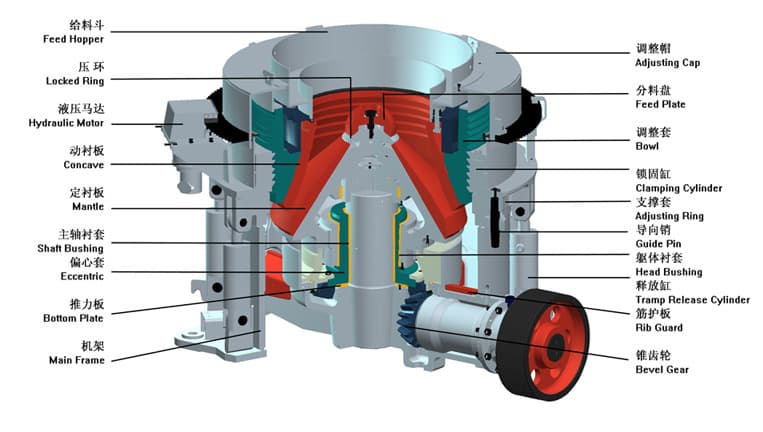
Comprehensively inspect the fasteners of each part of the equipment, focusing on the bolts and nuts of key parts such as the main shaft, eccentric sleeve, frame, moving cone, and fixed cone, to ensure there is no looseness or loss; check if the connectors (such as pins and bushings) are intact, with no wear or deformation. If problems are found, replace them in time to avoid component falling faults during operation.
Step 5: Pre-Startup Test Run – No-Load Inspection
After completing the above inspections, start the cone crusher for no-load test run, with the running time controlled at 5-10 minutes. Observe if the equipment operates stably without abnormal noise or vibration; check the temperature of the motor and bearings (normal temperature does not exceed 75℃); confirm that the moving cone and fixed cone rotate normally without jamming or deflection. If abnormalities occur, stop the machine immediately to troubleshoot, and it is strictly prohibited to start the machine with faults.
Step 6: In-Operation Monitoring – Load Operation Inspection
After the no-load operation is normal, load operation can be carried out. Full monitoring is required during operation: ① Observe if the feeding is uniform to avoid overload (the feeding amount must match the equipment capacity, and it is strictly prohibited for large materials and metal foreign objects to enter the crushing chamber); ② Monitor the equipment vibration and abnormal noise. If severe vibration or abnormal noise occurs, stop the machine immediately for inspection; ③ Regularly check the temperature of the lubrication system. If the lubricating oil temperature exceeds 80℃, stop the machine to cool down and check for oil circuit blockage, lack of oil and other problems; ④ Observe if the discharge particle size is uniform. If the particle size is abnormal, adjust the discharge port size in time.
Step 7: In-Operation Monitoring – Wearing Parts Status
Focus on observing the status of wearing parts during operation, including crushing chamber liner, moving cone liner, fixed cone liner, dust ring, etc. If the liner is severely worn (wear amount exceeds the specified value) or the dust ring is aging and damaged, make records and replace it in time after shutdown; at the same time, check if there is material leakage at the discharge port. If there is material leakage, adjust or replace the seal in time.
Step 8: Post-Shutdown Cleaning – Equipment Surface and Crushing Chamber
After shutdown, first cut off the power supply and turn off the lubrication system. After the equipment completely stops running, perform cleaning work: ① Clean the dust and residual materials on the equipment surface to avoid dust accumulation and corrosion of the equipment surface; ② Thoroughly clean the residual materials inside the crushing chamber, especially the materials stuck between the liners, to prevent jamming during the next startup; ③ Clean the material accumulation at the feed inlet and discharge port to ensure the channel is unobstructed.
Step 9: Post-Shutdown Inspection – Wearing Parts and Component Wear
After cleaning, check the wear of wearing parts again, focusing on parts such as liners, hammers, and eccentric sleeves, record the wear degree, and formulate a spare parts replacement plan; check if the main shaft and bearings are worn or have abnormal noise. If the bearing clearance is too large or the main shaft is deformed, it must be repaired in time; check if the hydraulic system (
hydraulic cone crusher) has leakage and if the hydraulic oil level is normal.
Step 10: Post-Shutdown Maintenance – Lubrication System Maintenance
Maintain the lubrication system after shutdown: ① If the service time of the lubricating oil reaches the specified cycle (generally 200-300 hours) or the oil quality deteriorates, replace the lubricating oil in time. When replacing, clean the oil tank and oil filter to avoid residual impurities; ② Check the lubricating oil filter, clean the impurities on the filter element, and replace the filter element in time if it is blocked; ③ Supplement the lubricating oil to the specified oil level to ensure normal lubrication during the next startup.
Step 11: Post-Shutdown Maintenance – Electrical System Inspection
Check each part of the electrical system, clean the dust in the electrical control cabinet, and fasten loose lines; check if the motor cooling fan is intact to ensure normal heat dissipation; check if the sensors and instruments are accurate. If the instruments fail or the sensors malfunction, repair or replace them in time.
Step 12: Recording and Archiving – Maintenance Records
After completing all maintenance work, record the maintenance situation in detail, including inspection items, found problems, treatment measures, replaced spare parts, lubricating oil replacement time, etc., and establish a maintenance file. Regularly sort out the files, analyze the equipment operation rules, optimize the maintenance plan, and improve maintenance efficiency.
3. Notes on Daily Maintenance of Cone Crushers
Maintenance personnel must receive professional training, be familiar with the equipment structure and operating specifications, wear protective equipment (safety helmet, gloves, protective shoes), and it is strictly prohibited to operate in violation of regulations;
It is strictly prohibited to perform maintenance, cleaning, or adjustment work while the equipment is running. If maintenance is needed, the power supply must be cut off and a "No Closing" sign must be hung to ensure safety;
The lubricating oil must be of the type recommended by the equipment manufacturer. It is strictly prohibited to mix different types and brands of lubricating oil to avoid damaging the lubrication system;
Wearing parts must be original genuine products. When replacing, strictly follow the installation specifications to ensure proper installation and avoid component wear due to improper installation;
Regularly conduct skill training for maintenance personnel to timely master new knowledge and methods of equipment maintenance and improve maintenance level;
If the equipment has a major failure (such as main shaft breakage, large-area liner falling off), it is strictly prohibited to repair it by yourself. Contact professional technicians or the manufacturer for handling.
4. Core Significance of Maintenance
The daily maintenance of
cone crushers can not only effectively reduce the incidence of equipment failures and reduce downtime losses but also extend the equipment service life, reduce spare parts consumption and maintenance costs, and ensure the continuous and stable operation of the mine crushing production line. For mining enterprises, standardized implementation of the 12-step maintenance process can maximize the production capacity of cone crushers, improve production efficiency, ensure safe production, and create higher economic benefits for the enterprise.