Gold is a valuable metal that has been sought after for thousands of years. But finding gold in nature is not always easy. Gold ore often looks very different from the shiny metal you see in jewelry. In fact, most gold in the ground is mixed with other minerals like quartz, iron pyrite (fool’s gold), or chalcopyrite. So how can you tell if a rock contains real gold? This article explains how to identify gold ore in the field using three main clues: color, weight, and a few simple tests. These methods do not require special equipment and work well for beginner prospectors.
Why Is It Hard to Identify Gold Ore?
Many people mistake shiny yellow minerals for gold. The most common fake is pyrite, also called fool’s gold. Pyrite is an iron sulfide mineral that looks like gold but is much lighter and more brittle. Another common confusion is mica, which flakes easily and has a silvery-yellow shine. To correctly identify gold ore, you need to look beyond the surface color and use other physical properties.
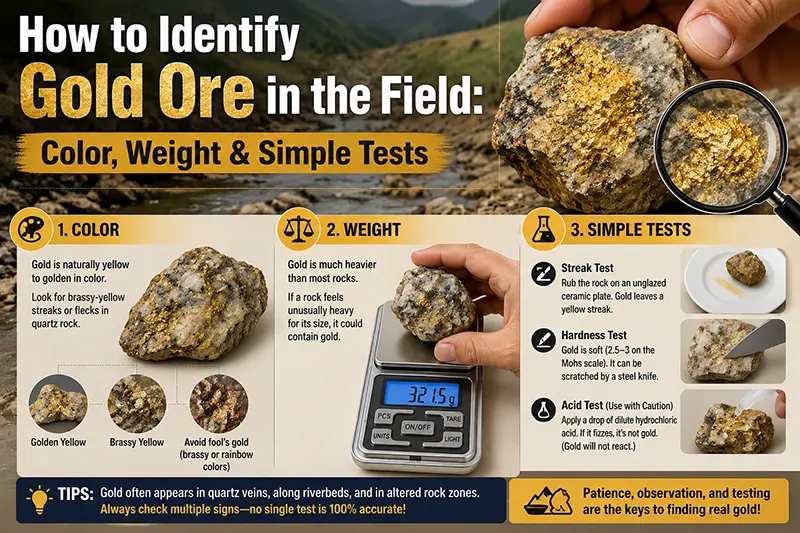
Step 1: Look at the Color
Gold has a very distinct yellow color. It does not tarnish or change color over time. When you find a rock that might contain gold, look for bright yellow metallic specks or veins. However, gold can also appear as:
Golden yellow (pure gold)
Pale yellow (when mixed with silver)
Brassy yellow (sometimes confused with pyrite)
But color alone is not enough. Pyrite also looks brassy yellow. So you need to combine color with other clues.
Step 2: Check the Weight (Specific Gravity)
Gold is very heavy. It has a specific gravity of about 19.3, which is much higher than most other minerals. Pyrite has a specific gravity of only about 5.0. That means a piece of gold feels almost four times heavier than a piece of pyrite of the same size.
When you pick up a rock that you suspect contains gold, compare its weight to a normal rock of the same size. If it feels unusually heavy for its size, that is a good sign. This is one of the most reliable ways to identify gold ore in the field without any tools.
Step 3: Perform the Streak Test
The streak test is very simple. You rub the mineral against a piece of unglazed white porcelain (like the back of a ceramic tile). Real gold leaves a yellow to golden-yellow streak. Pyrite leaves a greenish-black or dark gray streak. This test works because gold is very soft (Mohs hardness 2.5–3) and will rub off as a bright yellow powder.
If you do not have a streak plate, you can use the bottom of a coffee mug or a piece of unglazed tile.
Step 4: Test Malleability (Hammer or Knife Test)
Gold is very malleable, meaning you can flatten it with a hammer or cut it with a knife without breaking it. Pyrite is brittle; it will shatter or crumble when struck. So take a small hammer or the blade of your knife and try to press or tap the suspected gold particle.
Real gold: Flattens or bends. Does not break.
Pyrite or other fake gold: Breaks into small pieces or powder.
Be careful not to damage your sample if you want to keep it intact. A gentle tap is enough.
Step 5: Look at the Shape and Texture
Gold in nature often appears as small flakes, nuggets, or wiry shapes. It is rarely found as perfect cubes or sharp crystals. Pyrite, on the other hand, often forms cubic or octahedral crystals with smooth faces. If you see a mineral with square or sharp-angled crystal shapes, it is almost certainly not gold.
Gold also tends to be found in quartz veins or as free particles in stream sediments (placer gold). In hard rock, look for thin, yellow veins running through white quartz.
Step 6: Use a Magnet
Gold is not magnetic. Pyrite is weakly magnetic in some cases, but the best way to check is to use a strong magnet. Hold the magnet near your sample. If the particles are attracted to the magnet, it is not gold. However, some gold ores contain magnetite (a black magnetic mineral) that can stick to the magnet along with gold. So this test is not perfect, but it helps eliminate obvious pyrite.
Step 7: Acid Test (For Advanced Users)
Nitric acid can test gold. Real gold does not react with nitric acid. Pyrite and other base metals will dissolve or change color when touched with a drop of acid. This test is destructive, so only use it on a small piece of your sample. You can buy gold testing kits online or at prospecting stores. For field identification, the earlier tests are usually enough.
Where to Look for Gold Ore
Knowing how to identify gold ore in the field is useless if you are looking in the wrong places. Gold is typically found in:
Quartz veins in metamorphic or igneous rocks.
Stream beds and riverbanks where heavy gold particles settle (placer deposits).
Old mine dumps – waste rock may still contain small gold particles.
Contact zones between different rock types, where hot fluids deposited gold.
Common Mistakes When Identifying Gold Ore
Trusting only color: Many yellow minerals fool beginners.
Ignoring weight: If it is not heavy, it is not gold.
Not testing malleability: This is the fastest way to tell gold from pyrite.
Forgetting about black sand: Magnetite and hematite can be heavy and dark, sometimes containing tiny gold particles inside.
Summary
To identify gold ore in the field, use these steps:
Look for bright yellow color but do not rely only on it.
Feel the weight – gold is very heavy.
Do the streak test – gold leaves a yellow streak, pyrite leaves dark gray.
Test malleability – gold flattens, pyrite breaks.
Check shape – gold is not cubic; pyrite often is.
Use a magnet – gold is not magnetic.
With practice, you will quickly tell real gold from fool’s gold. Always take a small sample to a lab or use an acid test for confirmation. Happy prospecting!