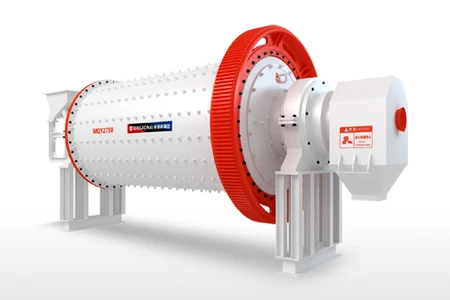
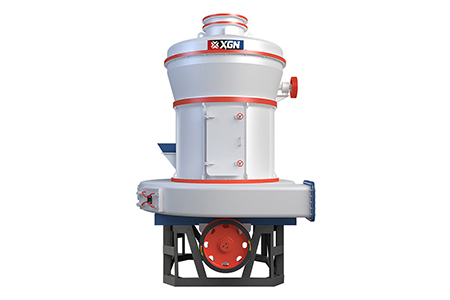
A Raymond mill uses grinding rollers and a grinding ring, usually working with air classification. A ball mill uses grinding media inside a rotating shell. Both reduce particle size, but the appropriate choice depends on the product and the process surrounding the mill.
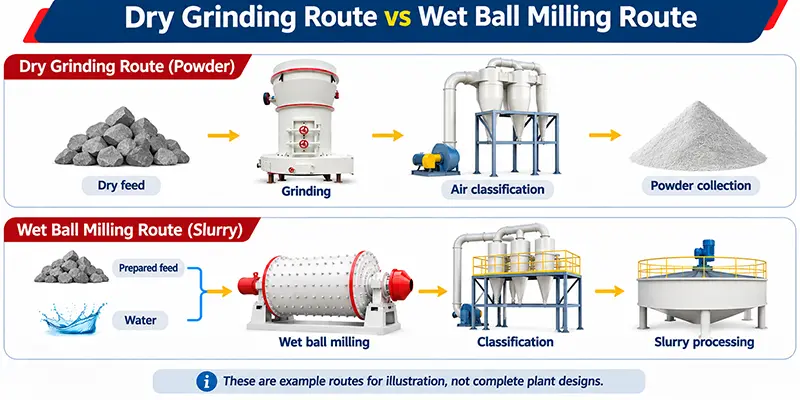
For suitable dry mineral powders, a Raymond-type system may provide a practical combination of grinding, classification and powder collection. Where the downstream process requires slurry, an appropriately configured wet ball-milling circuit may be more relevant. Ball mills can also be configured for dry grinding.
Start by defining what must leave the system: a dry powder, a slurry, or another specified grinding product. Then compare equipment against the same material, production target and quality requirements.
Raymond Mill vs Ball Mill: Quick Comparison
| Comparison factor | Raymond-type roller mill | Ball mill |
|---|---|---|
| Grinding mechanism | Material is ground between rollers and a grinding ring | Grinding media act on material inside a rotating shell |
| Common process direction | Dry mineral powder production | Wet mineral grinding or suitably configured dry grinding |
| Product transport | Commonly uses airflow to carry ground material | Depends on wet or dry operation and discharge design |
| Classification | Commonly integrated into an air-classification circuit | May use wet classification or a dry classifier, depending on the process |
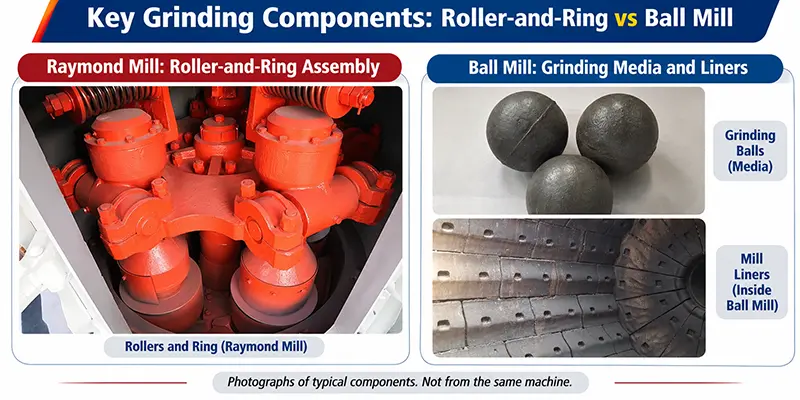
| Important wear components | Rollers, ring and other material-contact parts | Grinding media, liners and other material-contact parts |
| Moisture considerations | Feed must suit the selected dry system; drying capability must be confirmed | Wet and dry designs have different requirements |
| Selection basis | Material properties, powder specification and complete system performance | Material properties, grinding duty, product specification and circuit performance |
These descriptions refer to the configurations being compared, not every machine sold under either name. Qlar describes the Raymond® Roller Mill as an air-swept vertical pendulum mill with integral classification.Qlar roller mill definition
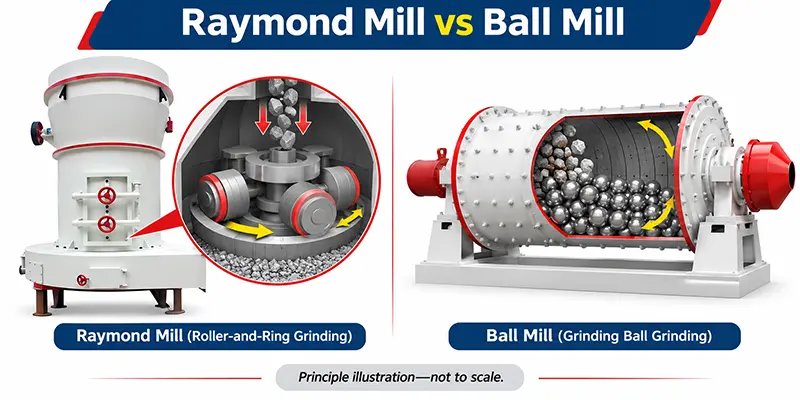
Roller-and-Ring Grinding vs Grinding Balls
Raymond-Type Grinding
In a typical roller-and-ring arrangement, material enters the grinding zone between the rollers and ring. Their relative movement applies grinding forces to reduce particle size.
Airflow carries ground material toward a classifier. Accepted particles continue to collection, while rejected coarse material returns for further grinding.
The result depends on the grinding components, classifier, airflow and feed condition working together. Increasing the main mill size alone will not correct a restricted collection system or unsuitable classification.
Ball Milling
A ball mill rotates a shell containing grinding media and material. Movement of the charge produces impact and abrasion that reduce particle size.
Performance depends on the feed, media, liners, speed, discharge arrangement and connected classification system.
A ball mill is not limited to one grinding mode. Wet and dry arrangements exist, but their discharge, material handling and auxiliary requirements differ. Selecting a suitable design is essential; changing an existing installation from wet to dry operation is not simply a matter of stopping the water supply.Metso mineral-processing handbook
Dry Powder or Slurry: Define the Required Product
This is often the most useful starting point.
When the Required Product Is Dry Powder
Consider how the material will be ground, classified, collected and stored without introducing unwanted moisture.
A suitable Raymond system may be evaluated for mineral powders such as limestone, calcite or barite. However, the material name alone does not establish suitability. Moisture, abrasiveness, impurities and the required particle-size distribution still matter.
A dry ball-milling system may also be considered where its configuration suits the material and product. It requires appropriate classification, ventilation, dust collection and product handling.
When the Required Product Is Slurry
If the next process uses slurry, wet grinding may fit the flowsheet more directly.
The assessment should include solids concentration, slurry behavior, pumping and classification. A wet ball-milling circuit can be evaluated for this duty, with the final arrangement determined by the mineral and downstream requirements.
If a dry product is ultimately required, include any necessary dewatering and drying when comparing the complete process.
Fineness Control: Compare the Same Product Target
Neither mill name guarantees a particular powder quality.
Define the required product using the relevant test method and acceptance limits. These may include sieve residue, percentage passing, or a particle-size distribution expressed through values such as D50, D97 or P80.
A mesh designation, a D97 value and a P80 value should not be treated as equivalent specifications.
| Product requirement | What to confirm |
|---|---|
| Sieve specification | Opening, permitted residue or passing percentage, and test method |
| Particle-size distribution | Required values and whether the basis is mass, volume or another measure |
| Coarse-particle limit | Maximum acceptable amount above a specified size |
| Fine-particle limit | Whether excessive fines are restricted |
| Product consistency | Acceptable variation between representative samples |
For a dry system, classifier performance and airflow influence which particles reach collection. In a wet circuit, the classification arrangement and slurry conditions influence the material sent downstream.
Compare the output meeting the specification, not only the feed entering the mill.
Moisture, Wear and Product Contamination
Moisture
Moisture can affect storage, feeding and operation in a dry powder system. Sticky feed may require preparation before grinding.
Do not assume that every Raymond installation includes a drying system. Confirm whether drying is provided, how it is integrated and which feed conditions it can handle.
Wet ball milling introduces different operating considerations. It does not make every wet or clay-rich material easy to process; slurry behavior and the downstream circuit still require assessment.
Wear
Raymond-type mills require inspection of rollers, the grinding ring and other exposed components. Ball mills require management of grinding media, liners and associated parts.
Wear depends on abrasiveness, feed condition, loading and operating practice. Neither arrangement has a universal service-life advantage.
Contamination
Both systems can introduce wear material into the product.
Where iron or other contamination is restricted, evaluate the actual contact materials, expected wear and measured product quality. Alternative media or lining materials may be considered for some duties, but their compatibility and performance must be confirmed.
Comparing Energy Use and Installation Requirements
A main-motor rating is not a complete energy comparison.
For a useful assessment, use the same feed, required output and product quality. Define whether the figures include crushing, drying, classification, fans, pumps and collection.
| Comparison item | Fair basis |
|---|---|
| Energy | Total defined-system energy per tonne of acceptable product |
| Production | Output meeting the specified quality |
| Wear cost | Media and component consumption under stated conditions |
| Installation | Footprint, building height, foundations and auxiliary equipment |
| Maintenance | Access, replacement work, downtime and parts availability |
For wet processing, distinguish tonnes of dry solids from tonnes of slurry. If the final target is dry powder, include the relevant water-removal stages.
A vertical arrangement may use space differently from a horizontal drum, but the complete installation also needs room for ducts, collectors, storage and maintenance.
Application Examples
Limestone Powder
Where suitable limestone must become a dry powder, assess the required distribution, moisture and quality limits. A Raymond system may be considered, while a dry ball-milling arrangement remains another possible option where supported by testing.
Barite Powder
Distinguish finished dry powder from grinding within a beneficiation process. Density, impurities and other quality requirements cannot be resolved by fineness alone.
For the material-specific considerations, see barite grinding mill selection.
Ore Grinding Before Separation
Where downstream separation requires a defined slurry product and sufficient mineral liberation, evaluate the complete grinding and classification circuit.
Detailed dimensions and power belong in a separate ball mill sizing exercise. For the role of a ball mill after an earlier coarse-grinding stage, see the SAG mill vs ball mill comparison.
Common Selection Mistakes
Choosing from the material name without defining its condition and product requirements.
Assuming every Raymond mill includes drying.
Assuming every ball mill can switch between wet and dry operation.
Comparing capacity figures measured at different fineness levels.
Comparing only main-motor power.
Treating a finer product as automatically better.
Ignoring classification, contamination or maintenance access.
Choose Around the Required Product
Define the product state and quality first, then evaluate the feed and complete grinding system.
Explore the XINGAONAI Raymond Mill for suitable dry-powder duties and the Ball Mill for applicable wet or dry grinding configurations.