A barite grinding mill should be selected according to the required powder quality and production rate. The mill type alone does not determine whether the finished material will meet its intended application.
Feed size, moisture, associated minerals and target particle-size distribution all affect the grinding duty. The classifier and powder collection system must also match the mill so that the complete circuit can produce acceptable powder consistently.
For this reason, barite grinding equipment should be evaluated as a system: feed preparation, grinding, classification and finished-product collection.
Key Factors in Barite Grinding Mill Selection
Barite is commonly ground for use as a weighting agent in drilling fluids and as a filler or extender in industrial products. These applications can require different powder characteristics, so there is no single grinding specification suitable for every project.USGS Barite Statistics and Information
The following factors provide a practical starting point for equipment selection.
| Selection factor | What to evaluate | Effect on the grinding system |
|---|---|---|
| Feed size | Maximum particle size and size distribution | Determines feed preparation and grinding duty |
| Moisture and clay | Actual moisture, stickiness and seasonal variation | Affects storage, feeding and dry processing |
| Associated minerals | Quartz and other impurities present in the feed | Influences grinding behavior, wear and product quality |
| Product fineness | Required particle-size distribution and test method | Determines grinding and classification requirements |
| Finished-product output | Required production rate at the specified quality | Helps establish the necessary system capacity |
| Quality requirements | Density, purity, whiteness or contamination limits | May require additional processing or testing |
These factors should be considered together. A capacity measured with dry feed at one fineness should not be assumed to apply to wetter material or a finer product.
When Is a Raymond Mill Suitable for Barite?
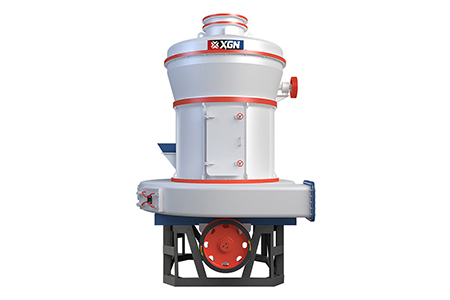
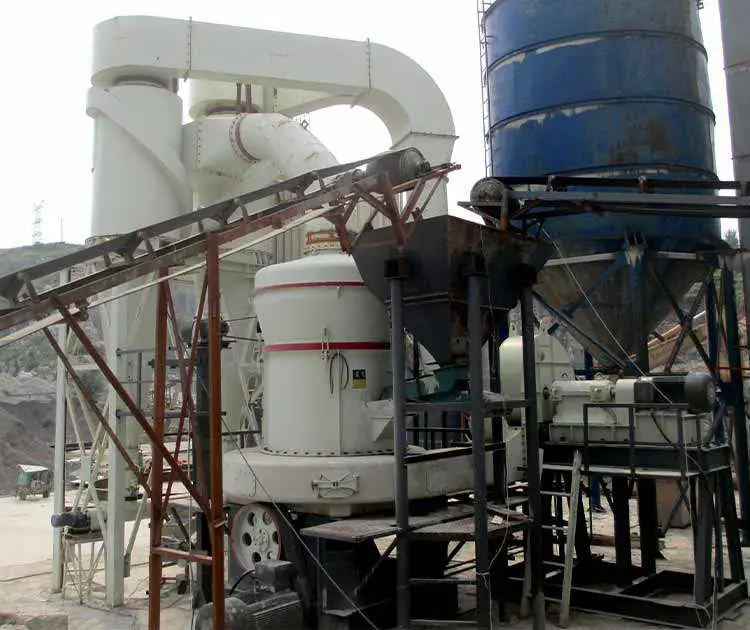
A Raymond mill can be considered for barite dry-powder applications when the feed condition, required fineness and production target are within the capabilities of the selected model and its supporting system.
In a typical Raymond-type grinding circuit, the grinding assembly reduces particle size and the classifier separates sufficiently fine material from particles that require further grinding. The coarse fraction returns to the grinding zone, while the accepted powder travels to the collection system.
The mill and classifier therefore perform different but connected functions:
Grinding reduces the size of the feed particles.
Classification controls which particles leave the circuit as product.
Collection separates the finished powder from the conveying air.
A larger main mill does not automatically solve a classification or collection limitation. The complete circuit must be assessed against the required finished-powder output.
The XINGAONAI Raymond Mill provides a starting point for reviewing available equipment configurations. Model selection should then be checked against the actual barite feed and product specification.
When Should Another Grinding System Be Considered?
Raymond mill technology should not be selected solely because it is commonly used for mineral powders.
Another grinding or classification arrangement may require evaluation when:
The product needs a finer particle-size distribution than the proposed configuration can reliably achieve;
The permitted coarse-particle content is particularly low;
The required output exceeds the capability of the selected system;
Product contamination limits require different materials or process controls;
The material belongs in a wet beneficiation circuit rather than a dry finished-powder line.
The last distinction is especially important.
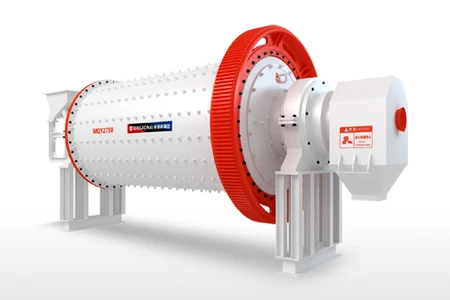
Producing a saleable dry barite powder and grinding ore to liberate barite from associated minerals are different process duties. A Ball Mill, for example, may be evaluated within an appropriate mineral-processing circuit. Its suitability depends on the feed, liberation requirement, grinding mode and classification arrangement.
If unwanted minerals prevent the feed from meeting the required quality, the barite beneficiation process must also be considered. Grinding reduces particle size; impurity removal requires a suitable separation process.
How Fine Does Barite Powder Need to Be?
The required fineness depends on the final application and the purchaser’s specification. A broad description such as “fine barite powder” is not enough to define grinding performance.
Even a request expressed in mesh requires clarification:
Which sieve system and opening apply?
What percentage must pass or remain on the sieve?
Are there limits on very fine particles?
Which preparation and test methods must be used?
Some specifications describe the distribution using D50 or D97. These values identify points on a measured particle-size distribution, but the measurement basis and method must be stated.
A mesh designation and a D97 value should not be treated as interchangeable. They describe different ways of reporting particle size, and results may depend on the measurement procedure.
| Product requirement | What it establishes |
|---|---|
| Sieve-passing percentage | The proportion of material passing a specified opening |
| Sieve residue | The proportion retained on a specified sieve |
| D50 | The particle size below which 50% of the reported distribution falls |
| D97 | The particle size below which 97% of the reported distribution falls |
| Fine-particle limit | Control of the proportion below a specified small size |
For D-values, confirm whether the distribution is reported by volume, mass or another basis.
For drilling-fluid applications, particle size is only part of the product assessment. The applicable specification may also contain requirements for density and other properties. Achieving one stated fineness does not demonstrate that the powder meets every requirement for drilling-grade barite.USGS Barite Yearbook
What Affects Barite Grinding Capacity?
The useful production figure is the output of finished powder meeting the specified quality. Feed entering the mill and material circulating internally are not the same as saleable output.
Feed Size and Consistency
The grinding system must receive material within its permitted feed range.
A feed containing a larger proportion of coarse particles requires a different grinding duty from a finer feed, even if both have the same stated maximum size. Irregular feeding can also cause fluctuations in mill load and product quality.
Feed preparation and controlled feeding help the circuit operate under more consistent conditions.
Moisture and Clay Content
Moisture and clay can affect material flow, grinding and classification. Sticky material may accumulate in storage or feeding equipment and interfere with stable operation.
The feed condition used for selection should reflect normal production, including seasonal changes. A dry sample taken during favorable weather may not represent the material handled throughout the year.
Drying or other preparation may be necessary for some feeds, but it should be determined from the actual material and process requirements.
Associated Minerals
Barite feed may contain quartz and other minerals that behave differently during grinding.
Their presence can influence energy demand, wear and finished-product quality. Two feeds with similar barite content do not necessarily have the same grindability or equipment requirements.
Material characterization is therefore useful when performance is uncertain or the deposit varies.
Target Product Fineness
A finer product changes the grinding and classification duty. More material may need to remain in the circuit before it meets the required specification.
A production figure obtained at a coarser fineness should not be used as the expected output for a finer product without confirmation.
Classifier Performance
The classifier must control the required product distribution while handling the circuit load.
Poor classification can allow excessive coarse particles into the finished powder or return material unnecessarily for further grinding. Either condition can reduce the useful output of the system.
Airflow and Powder Collection
In an air-swept dry grinding circuit, airflow, duct resistance and collection performance interact with the mill and classifier.
Increasing feed without checking these conditions may increase internal loading rather than finished-product output. Performance should be evaluated across the complete system.
Typical Barite Grinding Plant Process
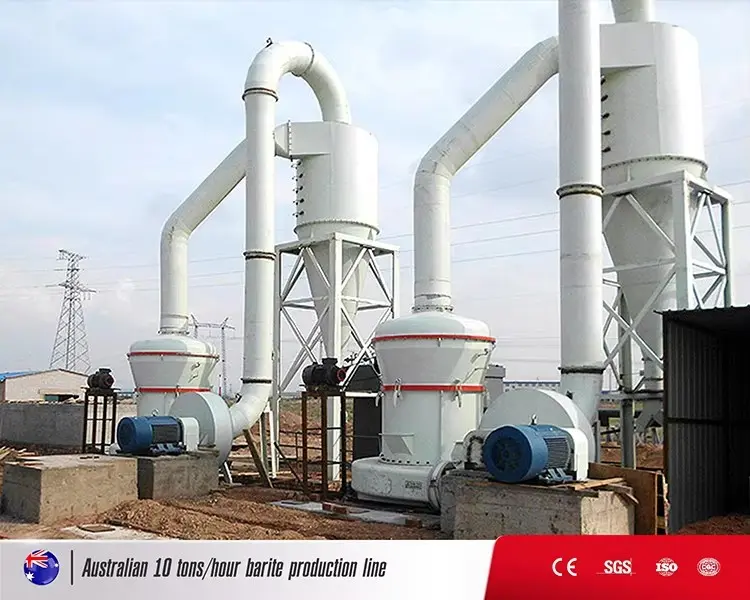
A dry barite powder line may include the following stages:
Feed preparation → controlled feeding → grinding → classification → powder collection → storage or packing
Coarse material rejected by the classifier returns for further grinding.
| Process stage | Main purpose |
|---|---|
| Crushing, where required | Brings oversized feed within the mill’s permitted range |
| Drying, where required | Adjusts feed moisture for the selected dry process |
| Storage and controlled feeding | Provides a more consistent supply to the mill |
| Grinding | Reduces particle size |
| Classification | Separates acceptable powder from material needing further grinding |
| Collection | Recovers powder from the conveying air |
| Storage and packing | Handles the finished product for use or delivery |
This is a process outline, not a fixed equipment list. The arrangement depends on the feed, grinding technology, powder specification and site conditions.
Dust control should be considered at relevant transfer points as well as within the main collection circuit.
Grinding and Beneficiation Serve Different Purposes
A grinding mill cannot compensate for every limitation in the raw material.
If the feed contains unwanted minerals, reducing all particles to a smaller size does not automatically increase barite purity or density. In some processing routes, grinding helps liberate barite so that a later separation stage can remove impurities.
The sequence depends on how the minerals occur in the ore. Some material may be upgraded before final powder grinding, while other ores require grinding within the beneficiation circuit.
The practical question is therefore:
Does the feed already meet the required mineral quality, or does it first need a separation process?
Answering this before selecting the finished-powder mill helps avoid designing a grinding line around unsuitable feed.
How to Evaluate Barite Grinding Performance
Performance should be assessed using representative material and a clearly defined product specification.
The main checks include:
| Performance measure | What to verify |
|---|---|
| Particle-size distribution | Whether the powder meets the required sieve or distribution limits |
| Finished-product output | Production rate of powder meeting those limits |
| Energy consumption | Power use at the stated output and fineness, with the system boundary defined |
| Product moisture | Whether the powder meets the handling or application requirement |
| Product quality | Relevant density, purity, whiteness or contamination results |
| Operating stability | Consistency of feeding, grinding, classification and collection |
Comparisons should use equivalent conditions. A higher output at a coarser product size does not demonstrate better performance for a finer specification.
If the feed varies substantially, evaluate whether the available sample represents that variation. Record the feed condition, equipment configuration and operating settings alongside the measured results.
Selecting Equipment for the Required Barite Powder
Select a barite grinding mill according to the actual feed condition, required powder specification and finished-product output. Evaluate grinding, classification and collection together, and use representative results to confirm performance.
Explore the XINGAONAI Raymond Mill for equipment details and a configuration suited to your material.