A manganese ore processing plant should be designed around the minerals present, their liberation size, the occurrence of impurities and the required product specification. Washing, gravity separation, magnetic separation and flotation are possible options—not mandatory stages in every plant.
Some ores can be upgraded after washing and size classification. Others require further grinding or a combination of separation methods. Installing more equipment does not automatically improve manganese recovery or produce a saleable concentrate.
This guide explains the main selection decisions and includes a preliminary 4,000 t/day planning example based on a customer enquiry. The example illustrates equipment duties and mass-balance calculations; it does not represent verified operating performance.
1. Start with Ore Characteristics and Product Requirements
Feed Mn grade alone cannot determine the flowsheet. Two ores with the same manganese content may respond differently because the manganese occurs in different minerals or is associated differently with gangue.
Before selecting the process, establish:
The manganese-bearing minerals and principal gangue minerals.
Particle-size distribution and liberation characteristics.
Clay, slime and moisture conditions.
The occurrence of iron, phosphorus and other relevant impurities.
Required concentrate grade, particle size, moisture and impurity limits.
A higher Mn grade does not automatically mean that every product requirement is satisfied. Impurities may remain in the concentrate, particularly where they are closely associated with manganese minerals.
This article covers ore preparation, beneficiation and dewatering. Smelting, electrolytic manganese and battery-material production require separate downstream process evaluation.
2. Match the Process Direction to the Ore
| Ore characteristic | Processing direction to investigate | Main point to verify |
|---|---|---|
| Coarsely liberated material with a useful density contrast | Size classification followed by gravity separation | Separation of liberated particles and remaining intergrowths |
| Clay-rich or weathered material | Washing, classification or desliming before separation | Manganese distribution in the removed fines |
| Useful differences in magnetic response | Magnetic separation with a suitable configuration | Mineral response, liberation and impurity distribution |
| Fine intergrowths or complex mineral associations | Grinding followed by magnetic separation, flotation or a combined route | Liberation, slime generation and process economics |
These are investigation directions, not ready-to-build flowsheets. Representative testwork should establish which stages are useful and how the streams should be connected.
3. Crushing, Washing and Screening
Crushing Where Size Reduction Is Needed
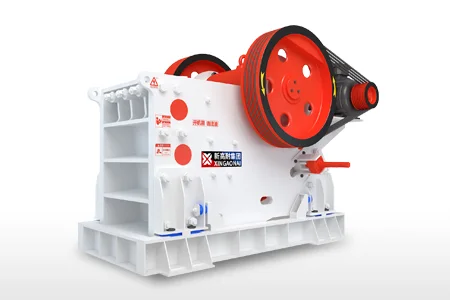
Crushing prepares oversized material for downstream handling and separation. Where primary crushing is required, a PEV jaw crusher can be evaluated against feed size, ore characteristics and the required downstream size range.
Already-sized stockpiled fines may have a different preparation requirement. A crusher should not be added simply because it appears in a standard plant diagram.
Crusher throughput is also not the same as concentrate output or the capacity of the complete beneficiation plant.
Washing and Desliming
Washing can release adhering clay and improve subsequent classification. However, the material removed with the wash water may contain manganese.
Sample and assess the fine stream before treating it as waste. Washing intensity, water requirements and the need for scrubbing depend on the actual material.
Screening and Classification
Controlling the feed-size range helps match each stream to its separation equipment. Coarse and fine fractions may need different treatment rather than being sent together through one separator.
4. Gravity and Magnetic Separation
Gravity Separation
Gravity separation uses differences in particle behavior associated with density, size and shape. Jigs and shaking tables may be investigated for suitable size fractions.
Performance depends on liberation and feed preparation. High-density composite particles may report differently from fully liberated manganese minerals, and very fine material can require a separate treatment strategy.
Magnetic Separation
First define the duty: recovering manganese-bearing minerals and removing magnetic impurities are different tasks.
Separator type, field conditions, matrix configuration where applicable, particle size and slurry conditions must match the mineral response. A conventional low-intensity wet drum separator is not interchangeable with a high-intensity or high-gradient separator.
The guide to types of magnetic separators explains the equipment distinctions. The appropriate manganese application still requires material-specific evaluation.
5. When Are Grinding and Flotation Necessary?
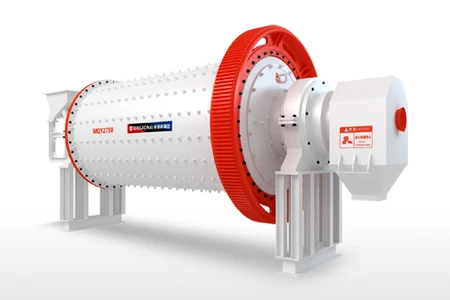
Grinding is justified when additional liberation is required. A ball mill may be considered for that duty, but it should not be included automatically in every manganese plant.
Excessive grinding can create fines that complicate separation and dewatering. The target size should come from liberation and beneficiation testing, not a universal mesh specification.
Flotation may be investigated for certain fine or complex ores when mineral surface properties provide a useful separation opportunity. Reagent selection, water quality, slime content and operating conditions need testing.
Neither grinding nor flotation guarantees that iron or phosphorus will be removed to the required level.
6. Concentrate Dewatering and Process Water
Wet processing produces streams with different solids concentrations and particle-size distributions. Concentrate and tailings may therefore need different thickening and filtration arrangements.
Dewatering equipment should be evaluated using slurry flow, solids loading, settling or filtration behavior and the required discharge condition.
A slurry density calculation can help relate concentration to material flow. It does not replace settling and filtration tests. Similarly, filter press sizing requires more than the plant’s nominal daily feed quantity.
Recovered water should also be assessed for its effect on washing, separation and any reagent-dependent stages.
7. Preliminary 4,000 TPD Planning Example
Customer Requirement
A customer enquiry reviewed by XINGAONAI described stockpiled manganese fines reported at approximately 1–10 mm, with an indicated Mn grade of 12–18%. The customer wanted to evaluate methods for producing a concentrate containing at least 30% Mn.
These were customer-reported characteristics, not independently verified assays presented here.
Equipment Duties Considered
The preliminary equipment schedule contained the following groups:
| Duty | Equipment listed |
|---|---|
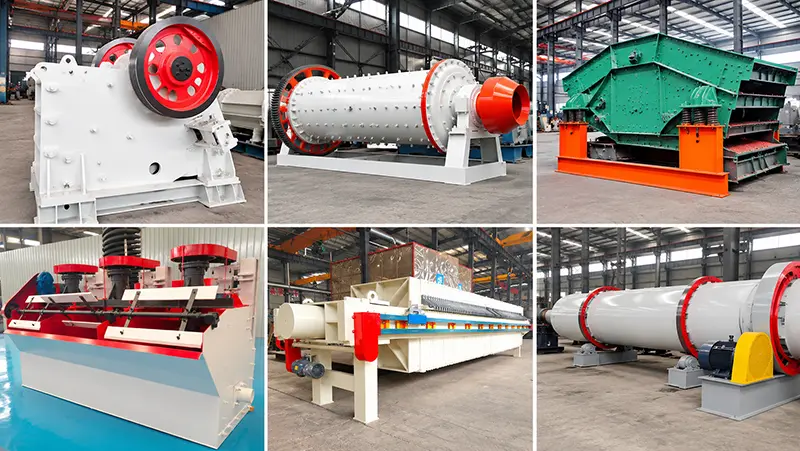
| Feeding and washing | Disc feeders, a rotary drum washer and a trough-type ore washer |
| Screening and dewatering | A dewatering screen and an additional separation screen |
| Gravity separation | Twelve AM30 jigging machines |
| Magnetic separation | One vertical-ring high-gradient magnetic separator, listed at 1.0 T |
| Magnetic concentrate dewatering | A thickener and an external drum filter |
| Tailings and water handling | A tailings thickener, three filter presses, feed pumps and circulating-water pumps |
The schedule identifies equipment duties but does not establish every stream connection. It does not confirm whether gravity and magnetic separation operate in series, on separate size fractions or on an intermediate product.
No crusher or ball mill is listed in the supplied schedule. Their general functions discussed earlier should not be interpreted as equipment included in this proposal.
The listed magnetic-field value is a proposal parameter, not proof that the proposed separation will achieve the target.
Preliminary Mass Balance
The estimate adopted a feed grade of 15% Mn, a concentrate grade of 30% Mn and a tailings grade of 9% Mn.
| Item | Basis or calculated result |
|---|---|
| Feed quantity | 4,000 t/day |
| Feed Mn grade used | 15% |
| Target concentrate Mn grade used | 30% |
| Assumed tailings Mn grade | 9% |
| Calculated concentrate mass yield | 28.57% |
| Calculated Mn recovery | 57.14% |
| Calculated concentrate quantity | Approximately 1,143 t/day |
| Calculated tailings quantity | Approximately 2,857 t/day |
Concentrate mass yield
= (Feed grade - Tailings grade)
  / (Concentrate grade - Tailings grade)

= (15 - 9) / (30 - 9)
≈ 0.285714 = 28.57%
Mn recovery
= Concentrate mass yield × Concentrate grade / Feed grade

= 0.285714 × 30 / 15
≈ 0.571429 = 57.14%
The workbook divides daily quantities by 24 hours. This gives approximately 166.67 t/h of feed and 47.62 t/h of concentrate for the calculation; it does not confirm actual operating availability or equipment capacity.
All stream quantities and assays must use a consistent basis. The dry or wet tonnage basis remains to be confirmed before detailed design.
These results are estimates, not testwork or operating results. The assumed concentrate and tailings grades must be demonstrated before the calculated recovery can be treated as achievable.
The example also shows why grade and recovery must be considered together: under these assumptions, approximately 42.86% of the feed manganese remains in the tailings.
8. Common Plant-Selection Mistakes
Choosing a fixed equipment package from feed Mn grade alone.
Treating washing, grinding, gravity separation, magnetic separation and flotation as compulsory consecutive stages.
Discarding slimes without checking manganese losses.
Substituting low-intensity magnetic equipment for a different magnetic-separation duty.
Treating concentrate grade as a complete product-quality specification.
Confusing feed capacity, concentrate mass yield and manganese recovery.
Presenting a calculated balance as evidence of proven plant performance.
A practical flowsheet should explain the purpose of each stage, the material sent to it and the result that testing must confirm.