Slurry density is the total mass of a solid–liquid mixture divided by its total volume. It is commonly expressed in kg/m³ or t/m³.
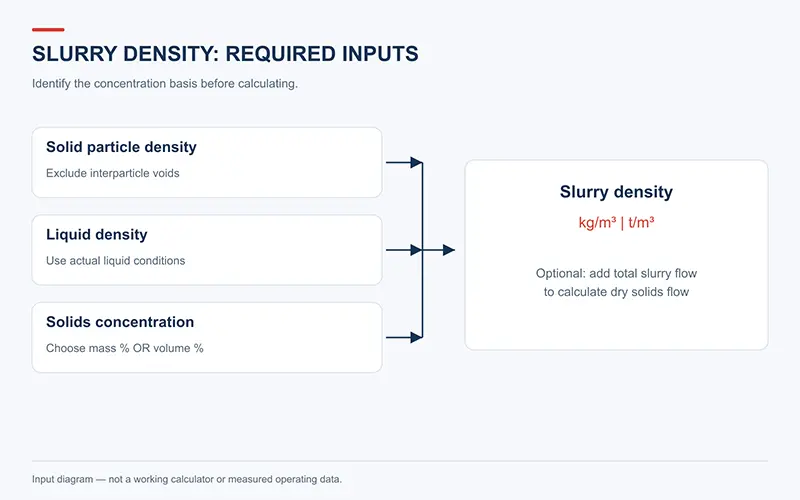
To calculate it, you need the solid particle density, liquid density and solids concentration. The concentration basis must be identified: 40% solids by mass is not the same as 40% solids by volume.
Whether you use a slurry density calculator or calculate manually, the same distinction applies. Entering the wrong concentration basis can produce a plausible result that describes a different mixture.
This guide explains the formulas, a worked example, a sampling check and how to use the results in mineral processing.
1. What Information Do You Need?
| Input | Meaning | Suggested unit |
|---|---|---|
| Solid particle density | Mass per unit volume of the solid phase, excluding voids between particles | kg/m³ |
| Liquid density | Density of the carrier liquid under the relevant conditions | kg/m³ |
| Solids concentration | Solids as a percentage of total slurry mass or total slurry volume | % by mass or volume |
| Slurry flow rate, optional | Total mixture volume passing per hour | m³/h |
Use consistent density units throughout the calculation.
Do not substitute stockpile bulk density for solid particle density. Bulk density includes spaces between particles and does not represent the solid-phase volume required by these equations.
For water-based examples, 1,000 kg/m³ is a convenient assumed liquid density. Actual process water, brine or reagent solution may have a different density.
When preparing operating data for a high-efficiency agitation tank, report density together with concentration, particle size and viscosity. Slurry density alone does not determine the required mixer configuration.
2. Solids by Mass vs Solids by Volume
Solids concentration by mass describes how much of the total slurry mass consists of dry solids:
Solids mass fraction = Dry solids mass / Total slurry mass
Solids concentration by volume describes how much of the total slurry volume is occupied by solids:
Solids volume fraction = Solid phase volume / Total slurry volume
For example:
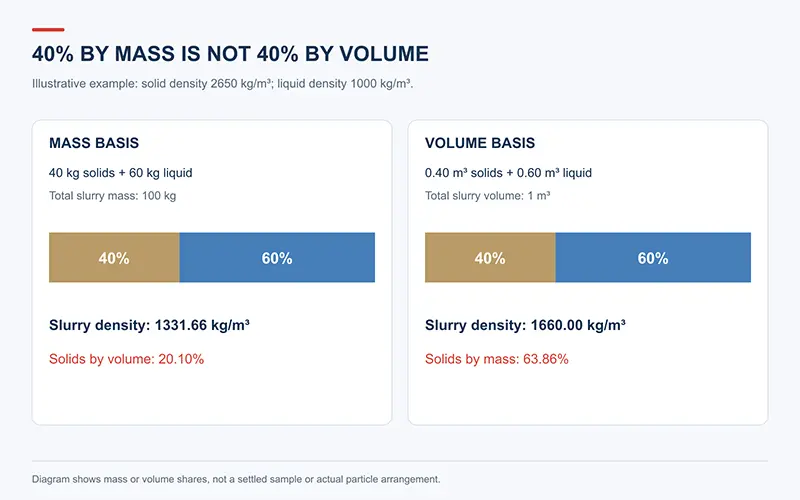
40% solids by mass means 40 kg of dry solids in 100 kg of slurry.
40% solids by volume means 0.40 m³ of solid phase in 1 m³ of slurry.
These describe different mixtures when the solid and liquid densities differ.
The concentration is a fraction of the total mixture, not a solids-to-water ratio. A specification such as “40 kg of solids per 100 kg of water” must be converted before it is used as a mass percentage.
3. Slurry Density Formulas
Use the following symbols:
rho_m = Slurry density
rho_s = Solid particle density
rho_l = Liquid density

Cw = Solids mass fraction
Cv = Solids volume fraction
Convert percentages to fractions before using these formulas:
40% = 0.40
From Solids Concentration by Mass
rho_m = 1 / [Cw / rho_s + (1 - Cw) / rho_l]
This adds the solid and liquid volumes associated with a unit mass of slurry, then takes the reciprocal.
Do not use a simple arithmetic average of phase densities weighted by mass fraction.
From Solids Concentration by Volume
rho_m = Cv × rho_s + (1 - Cv) × rho_l
Here, each phase contributes mass according to its share of the total volume.
Convert Between Concentration Bases
Once slurry density is known:
Cv = Cw × rho_m / rho_s

Cw = Cv × rho_s / rho_m
Multiply the resulting fraction by 100 to display a percentage.
These relationships assume a two-phase solid–liquid mixture with additive phase volumes and no entrained gas. Corresponding water-based slurry specific-gravity relationships are explained in the Xylem Slurry Handbook.
4. Worked Example: Density and Dry Solids Flow
Assume:
Solid particle density = 2650 kg/m³
Liquid density = 1000 kg/m³
Solids concentration by mass = 40%
Total slurry flow rate = 100 m³/h
These are demonstration inputs, not a measured plant operating point.
Step 1: Calculate Slurry Density
rho_m = 1 / [0.40 / 2650 + 0.60 / 1000]

rho_m ≈ 1331.66 kg/m³
The equivalent density is approximately 1.332 t/m³.
Step 2: Calculate Solids Concentration by Volume
Cv = 0.40 × 1331.66 / 2650

Cv ≈ 0.2010

Solids concentration by volume ≈ 20.10%
Step 3: Calculate Dry Solids Flow
With Q in m³/h and density in kg/m³:
Dry solids flow (t/h) = Q × rho_m × Cw / 1000

Dry solids flow = 100 × 1331.66 × 0.40 / 1000

Dry solids flow ≈ 53.27 t/h
The total slurry mass flow is approximately 133.17 t/h, consisting of 53.27 t/h of dry solids and 79.90 t/h of liquid.
The calculated dry solids flow is a material-flow estimate, not an equipment capacity guarantee.
It can be carried forward into filter press sizing, but chamber volume, filtration behavior, cake properties and cycle time still require separate evaluation.
Why the Concentration Basis Matters
Using the same solid and liquid densities:
| Known concentration | Slurry density | Equivalent concentration |
|---|---|---|
| 40% solids by mass | 1331.66 kg/m³ | 20.10% solids by volume |
| 40% solids by volume | 1660.00 kg/m³ | 63.86% solids by mass |
A concentration value without its basis is therefore incomplete.
5. Units and Specific Gravity
Useful density conversions are:
1000 kg/m³ = 1 t/m³ = 1 kg/L = 1 g/cm³
Specific gravity, or SG, is a density ratio and has no unit:
Slurry SG = Slurry density / Reference water density
If the chosen reference density is 1,000 kg/m³:
Slurry SG = 1331.66 / 1000 ≈ 1.332
The numerical similarity between SG and density in t/m³ under this reference does not make them the same quantity. State the reference used when reporting SG.
6. How to Check Slurry Density with a Sample
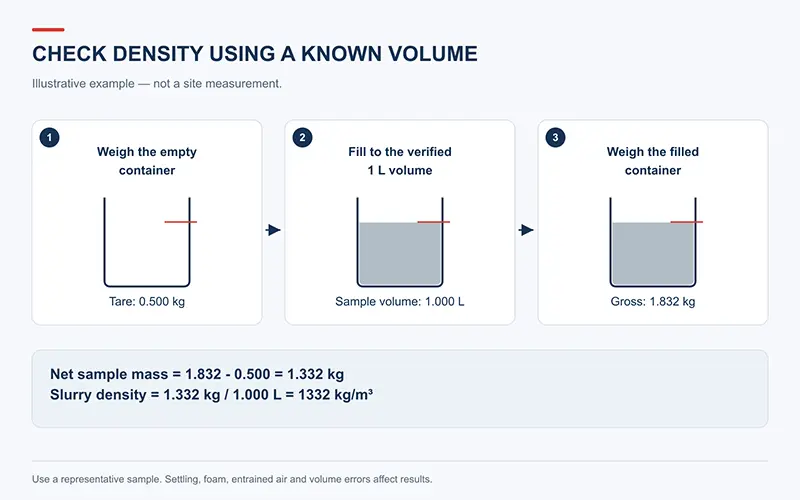
A known-volume weighing method provides a practical comparison with the calculated result:
Slurry density = Net slurry sample mass / Slurry sample volume

Net slurry sample mass = Filled container mass - Empty container mass
For example, if a 1 L sample has a net mass of 1.332 kg:
Slurry density = 1.332 kg / 1 L

Slurry density = 1.332 kg/L = 1332 kg/m³
This is another illustrative calculation, not a reported test result.
For a useful check:
Use a container with a verified effective volume.
Record the empty container mass.
Obtain a representative sample using an approved procedure.
Minimize segregation, settling and loss of solids during handling.
Fill to the defined volume and record the filled mass.
Compare the result with calculations using representative phase densities and concentration data.
Foam, entrained air, nonrepresentative sampling and inaccurate volume can affect the result. Follow site procedures when sampling process streams.
7. Using the Results in Mineral Processing
Agitation and Conditioning
Density and concentration help describe the mixing duty. Particle size, viscosity, settling behavior, working volume and process requirements are also needed.
A denser slurry does not automatically require one particular impeller or motor size.
Filtration and Dewatering
Combining slurry flow, density and mass concentration gives an estimate of the dry solids entering a dewatering stage.
This does not establish filtration rate, cake moisture or cycle time. Those depend on material properties, equipment configuration and relevant test results.
Hydrocyclone Operation
Density changes can alter operating conditions even if the pressure reading remains similar. Assess concentration and particle-size data alongside hydrocyclone feed pressure.
The density calculation does not predict separation efficiency or the required operating-pressure setting.
8. Assumptions and Common Input Errors
This calculation treats the slurry as solids plus a liquid phase. It does not calculate viscosity, settling velocity, pipeline pressure loss or equipment performance.
Avoid these common errors:
Entering 40 instead of 0.40 in a formula requiring fractions.
Mixing kg/m³ with t/m³.
Using bulk density instead of particle density.
Confusing solids-to-water ratio with solids percentage.
Treating slurry density as the same property as solids concentration.
Using a liquid density that does not represent the actual solution.
Applying the model to aerated slurry without considering the gas phase.
Reporting hypothetical results as plant measurements.
For mixed mineral solids, use a representative solid-phase density. A single generic mineral value may not represent the feed.