A filter press should be sized for the amount of dry solids it must remove, the volume of cake produced in each batch, and the time available to complete each cycle. Slurry flow alone does not tell you how large the press should be. Two slurries with the same flow rate can require different presses if their solids content, particle size, filtration behavior or target cake moisture differ.
This guide shows how to make a preliminary sizing calculation. The result is a starting point for discussing equipment dimensions and testing—not a guaranteed model selection.
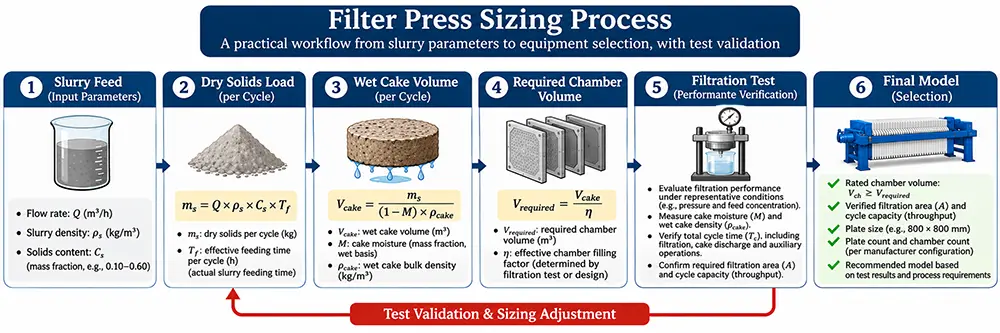
1. Collect the Process Data
Before calculating, record the following information:
| Input | Why it matters |
|---|---|
| Slurry feed rate, m³/h | Defines how much slurry reaches the press |
| Slurry density, t/m³ | Converts slurry volume into slurry mass |
| Dry solids content, % by mass | Determines the mass of solids to be retained |
| Operating hours per day | Determines the daily solids load |
| Target cake dry solids, % by mass | Converts dry solids into wet cake mass |
| Wet cake bulk density, t/m³ | Converts cake mass into the volume the press must hold |
| Complete cycle time | Determines how many batches can be processed |
| Particle size, temperature and slurry behavior | Affect filtration rate, cloth selection and cake release |
Use mass-based dry solids content in the calculation below. A laboratory result reported as a volume percentage cannot be inserted into the formula as if it were a mass percentage.
A complete cycle includes filling, filtration, any specified washing or air-blowing stage, opening, cake discharge, cleaning where required, and closing. Counting only the pumping time overstates the number of cycles available.
2. Calculate the Dry Solids Load
First convert slurry flow into dry solids per hour:
Dry solids (t/h)
= Slurry flow (m³/h) × Slurry density (t/m³)
  × Dry solids mass fraction
Then calculate the daily load:
Dry solids (t/day)
= Dry solids (t/h) × Operating hours per day
For example, 20% dry solids by mass is entered as 0.20.
This step answers the central capacity question: how many tonnes of dry material must the press retain during the available operating period?
3. Determine the Number of Cycles
Estimate the number of complete cycles that fit within the operating window:
Cycles per day
= Available operating hours per day ÷ Complete cycle time (h)
Then divide the daily dry solids load by that number:
Dry solids per cycle (t)
= Dry solids per day (t) ÷ Cycles per day
If the result is not a whole number, check the real production schedule. For example, 4.5 calculated cycles do not automatically mean the plant can discharge five complete batches in one shift. Allow for start-up, interruptions and planned cleaning where they fall outside the stated cycle time.
4. Convert Dry Solids into Cake Volume
The press must hold wet cake, not just dry solids. Convert the dry solids load per cycle into wet cake mass:
Wet cake mass per cycle (t)
= Dry solids per cycle (t) ÷ Cake dry-solids mass fraction
Then calculate cake volume:
Wet cake volume per cycle (m³)
= Wet cake mass per cycle (t) ÷ Wet cake bulk density (t/m³)
If cake moisture is given on a wet-mass basis, subtract it from 100% to obtain the cake dry-solids fraction. For example, 30% moisture on a wet-mass basis corresponds to 70% dry solids, entered as 0.70.
Cake density and achievable moisture should be measured or established through representative filtration tests. They are not fixed values for every mineral or slurry.
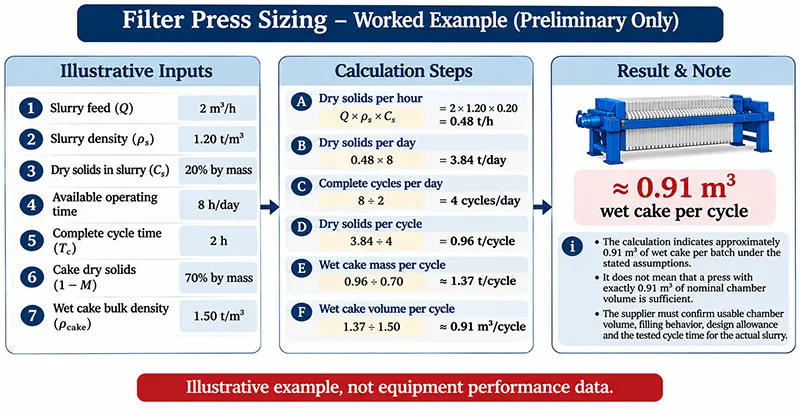
5. Worked Example: Preliminary Sizing Only
Assume the following illustrative inputs, which are not results from an XINGAONAI installation:
| Parameter | Assumed value |
|---|---|
| Slurry feed | 2 m³/h |
| Slurry density | 1.20 t/m³ |
| Dry solids in slurry | 20% by mass |
| Available operating time | 8 h/day |
| Complete cycle time | 2 h |
| Cake dry solids | 70% by mass |
| Wet cake bulk density | 1.50 t/m³ |
Step A — Dry solids per hour
2 × 1.20 × 0.20 = 0.48 t/h
Step B — Dry solids per day
0.48 × 8 = 3.84 t/day
Step C — Complete cycles per day
8 ÷ 2 = 4 cycles/day
Step D — Dry solids per cycle
3.84 ÷ 4 = 0.96 t/cycle
Step E — Wet cake mass per cycle
0.96 ÷ 0.70 ≈ 1.37 t/cycle
Step F — Wet cake volume per cycle
1.37 ÷ 1.50 ≈ 0.91 m³/cycle
The calculation indicates approximately 0.91 m³ of wet cake per batch under the stated assumptions. It does not mean that a press with exactly 0.91 m³ of nominal chamber volume is sufficient. The supplier must confirm usable chamber volume, filling behavior, design allowance and the tested cycle time for the actual slurry.
6. Check Chamber Volume, Filtration Area and Press Design
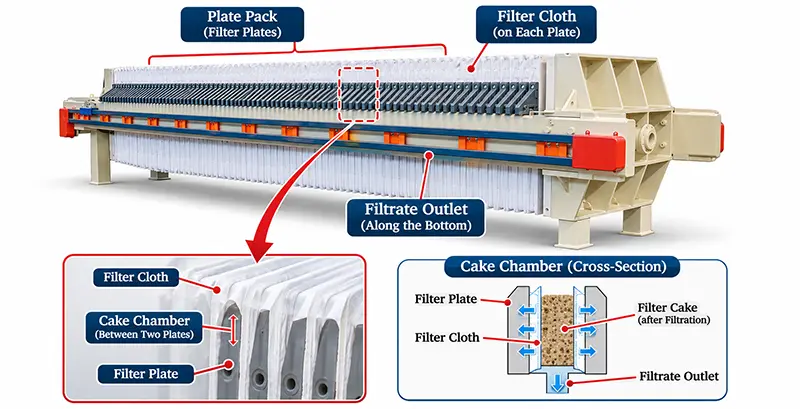
Chamber volume indicates how much cake the plate pack can accommodate in one batch. Filtration area describes the effective cloth area available for liquid to pass through. Both matter, but they answer different questions.
A larger filtration area does not by itself prove a particular hourly throughput. Filtration rate changes with the slurry, cake thickness, cloth condition and operating pressure. Likewise, sufficient chamber volume will not solve a cycle that is too slow to meet the daily production target. Equipment makers therefore use material data and cycle testing when selecting a press; McLanahan’s filter press guidance lists chamber volume, material properties and cycle-related factors among the sizing inputs.
Also confirm the plate construction. A true plate-and-frame press uses separate plates and frames; recessed-chamber and membrane presses form their chambers differently. Their chamber dimensions and operating sequences should be checked against the offered configuration. For a basic explanation of the plate-and-frame arrangement, see how a plate-and-frame filter press works.
When reviewing a quotation, request the proposed model’s usable chamber volume, effective filtration area, plate arrangement, feed-pressure limits and expected full-cycle time under your tested conditions. The area figure in a product table is not a verified production rate.
7. Test the Slurry Before Final Model Selection
A representative filtration test should establish:
Time needed to fill and filter one batch.
Cake moisture at the proposed end point.
Wet cake density and cake-release behavior.
Filtrate clarity.
Suitable filter-cloth material and permeability.
Whether washing or air blowing is needed.
If the slurry changes significantly between shifts or ore sources, test a representative range rather than only the easiest sample. The filter press cloth selection guide explains why cloth material and fit also need to match the process.
The feed pump creates filtration pressure on the slurry side. The hydraulic closing system holds the plate pack closed. These are different duties; do not treat hydraulic closing pressure as the filtration pressure used in a test.
8. Information to Send with an Enquiry
To obtain a model recommendation from XINGAONAI, send the slurry flow rate, operating hours, solids concentration and whether it is measured by mass, slurry density, material and particle-size information, desired cake moisture, filtrate requirement, available test results, and site power and operating conditions. If you already run a press, add its plate dimensions, plate count, chamber volume and actual cycle records.
Review the plate-and-frame filter press product page as a starting point, then ask for the chamber and test data needed to match a model to your slurry. If you are still comparing dewatering methods, see dewatering screen vs filter press vs thickener.