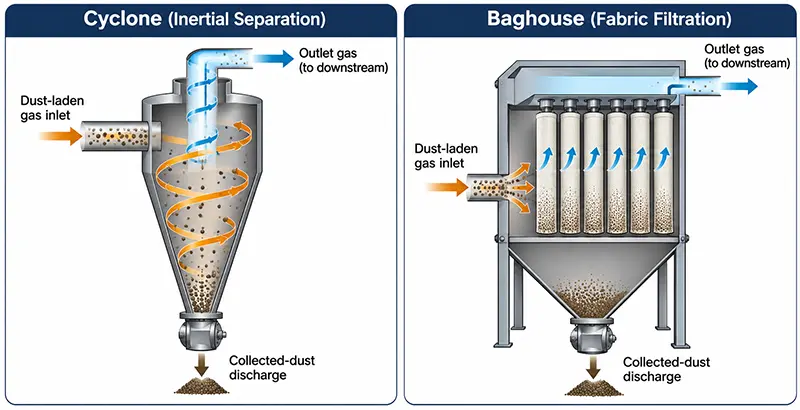
A cyclone separates particles from a gas stream through inertial effects in a rotating flow. A baghouse passes dust-laden gas through fabric filters to capture particles.
Conventional cyclones are commonly considered for coarse-particle recovery or pre-separation. Baghouses are generally better suited to collecting fine particulate. Some applications benefit from using both, but an additional separation stage also introduces pressure loss, discharge equipment and maintenance.
The choice is therefore not simply “which collector is better?” It is whether a cyclone, a baghouse or a combined arrangement meets the actual dust-handling and outlet requirements.
This comparison covers industrial dust collection in crushing, screening, conveying and mineral grinding. Here, “cyclone” means a gas–solid separator, not a hydrocyclone processing slurry.
1. Cyclone vs Baghouse: Key Differences
| Factor | Cyclone | Baghouse |
|---|---|---|
| Separation mechanism | Inertial separation in a rotating gas flow | Filtration through fabric media and the deposited dust layer |
| Common role | Coarse-particle recovery or pre-separation | Fine-particle collection and final filtration |
| Main performance factors | Particle characteristics, collector geometry and gas conditions | Filter media, filtration loading, cleaning, sealing and gas conditions |
| Filter consumables | No filter bags | Filter bags require inspection and replacement |
| Maintenance concerns | Erosion, plugging, air leakage and dust discharge | Bag condition, cleaning equipment, leakage and dust discharge |
| Pressure loss | Depends on design and operating conditions | Changes with filtration, dust accumulation and cleaning |
| Standalone suitability | Requires evaluation against the remaining particulate and outlet requirements | Requires a configuration compatible with the dust and gas conditions |
| Combined use | May reduce the coarse load reaching a downstream filter | Receives the dust that remains after pre-separation |
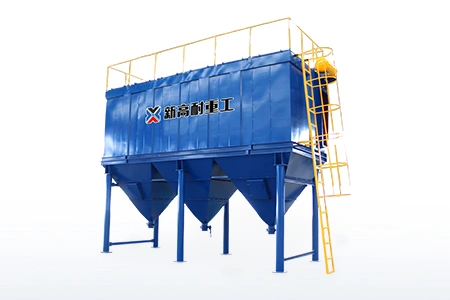
For applications requiring fabric filtration, XINGAONAI’s pulse jet bag filter can be evaluated against the actual airflow, dust characteristics and gas conditions. Whether a cyclone pre-separator is justified should be assessed separately.
2. How Particle Characteristics Change the Choice
Particle size is important, but size alone does not determine cyclone performance. Particle density, shape, gas flow and collector geometry also influence separation.
A conventional cyclone may recover a substantial coarse fraction while allowing finer particles to remain in the outlet gas. The EPA identifies particle size and cyclone design among the factors affecting collection efficiency. EPA cyclone fact sheet
This creates an important distinction: high removal by total dust mass does not prove equally high collection across every particle-size range.
For a feed dominated by coarse material, the collected mass can look impressive even when fine particles remain. Comparing equipment only by one overall efficiency percentage can therefore be misleading.
Baghouse suitability also depends on the material. Moisture, sticky deposits, abrasion, gas temperature and chemical conditions affect filter selection and operation. A baghouse should not be treated as a universal solution regardless of inlet conditions.
3. When Can a Cyclone Be Used Alone?
A cyclone may be considered as the only collection stage when its expected separation performance meets the process and outlet requirements.
That assessment should establish:
The actual particle-size distribution and particle characteristics.
Normal and variable gas flow.
Inlet dust loading.
The required product-recovery or dust-control result.
The particulate expected to remain in the outlet gas.
Reliable discharge of collected material.
Visual observation of “mostly coarse dust” is not enough to confirm suitability. Neither is the absence of visible dust at one operating point.
A standalone cyclone should be selected from applicable performance information, with verification appropriate to the project.
4. When Is a Baghouse the Better Fit?
A baghouse is generally the more relevant option when fine-particle collection is central to the duty.
Examples include fine mineral powder escaping from transfer points, dry screening enclosures or grinding-system exhaust. The actual collector still needs to be matched to the airflow and material conditions.
Key considerations include:
Suitable filter media.
Filtration area and loading.
Cleaning method and utilities.
Inlet flow distribution.
Hopper and discharge design.
Inspection and maintenance access.
The air-to-cloth ratio is one part of this evaluation. It does not replace checks on gas conditions, material behavior or the complete extraction system.
Not every baghouse needs a cyclone upstream. A properly evaluated standalone baghouse may be appropriate when the inlet load and particle characteristics are compatible with its design.
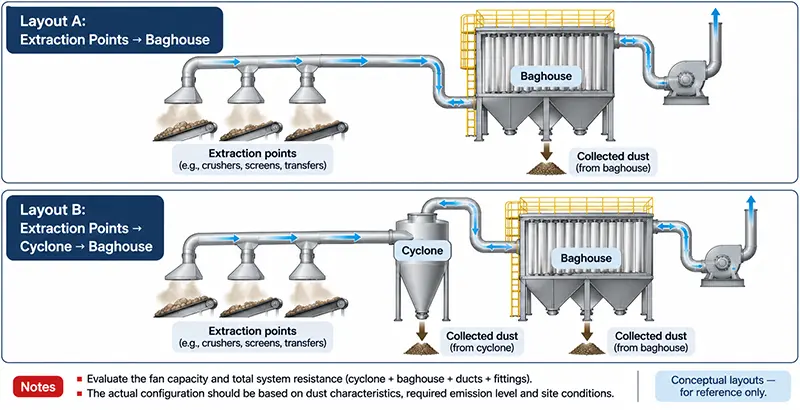
5. When Should You Use a Cyclone Before a Baghouse?
Pre-separation is worth evaluating when removing a coarse fraction provides a clear process or maintenance benefit.
Potential reasons include:
A substantial coarse-particle load.
Abrasive particles reaching the filter inlet.
A need to recover a coarse material stream separately.
A downstream filter duty that benefits from reduced incoming solids.
The arrangement must also account for additional ductwork, space, pressure loss and dust discharge.
Collected material has to leave the cyclone without causing excessive air leakage or blockage. The downstream filter must still be designed for the remaining dust and any operating variation.
A cyclone is not a substitute for evaluating combustible dust, hot particles or ignition sources. Do not assume that a general cyclone provides a verified spark-control or explosion-protection function.
6. Pressure Loss, Maintenance and Total Cost
Pressure Loss and Fan Operation
Adding a cyclone does not automatically reduce energy consumption.
NIOSH notes that the cyclone’s added resistance can outweigh a reduction in downstream baghouse resistance associated with lower dust loading. NIOSH industrial minerals dust-control handbook
Evaluate the complete system at the required airflow. An existing fan may not maintain the same extraction flow after equipment is added.
For baghouse operation, interpret differential pressure alongside airflow, cleaning condition and other operating information. A lower reading alone does not establish that dust control has improved.
Maintenance
A cyclone has no filter bags, but it is not maintenance-free. Inspect wear surfaces, inlets, outlets, discharge devices and seals.
A baghouse requires attention to filter condition, cleaning equipment, leakage and hopper discharge. If pre-separation is proposed to protect bags, assess the actual abrasive fraction and inlet arrangement rather than assuming a fixed increase in bag life.
Total Cost
Compare more than equipment purchase prices. Include:
Foundations, supports and installation.
Ductwork and fan requirements.
Electricity and, for pulse-jet systems, compressed air.
Filter consumables and wear components.
Inspection access and maintenance labor.
Collected-material handling.
Space requirements and production interruptions.
A combined system should have an identifiable benefit that justifies its additional equipment and operating requirements.
7. Selection Checklist for Mineral Processing
| Question | Why it matters |
|---|---|
| What is the particle-size distribution? | Establishes the coarse and fine fractions requiring evaluation |
| What are particle density and abrasiveness? | Influences separation behavior and wear |
| What airflow is required? | Connects the collector to extraction and fan operation |
| What are the gas temperature and moisture conditions? | Affects material compatibility and condensation risk |
| What is the inlet dust loading? | Defines the incoming collection and discharge duty |
| What outlet result is required? | Provides the performance target |
| How will collected material be discharged? | Helps avoid blockage and unwanted leakage |
| Is the existing fan suitable for the proposed arrangement? | Checks whether the required airflow can be maintained |
Wet, sticky, reactive or combustible dust requires additional assessment. Neither collector type should be selected solely from a general comparison table.
This checklist supports preliminary evaluation; it does not establish a final equipment configuration or guaranteed performance.